
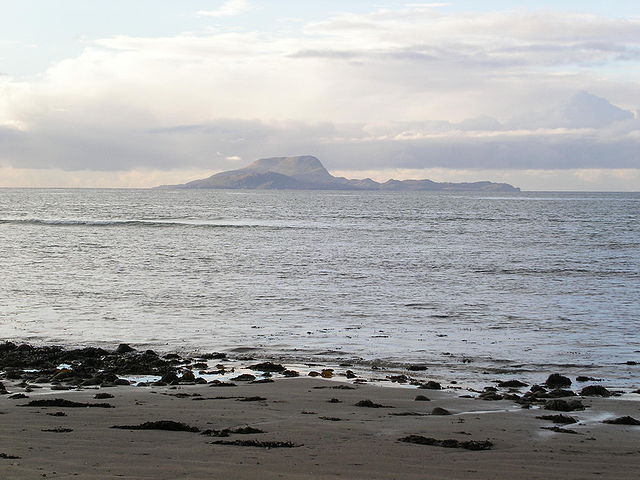
Associated with Grace O’Malley
Wikipedia.org
IRMA TIMES, DECEMBER 14TH 1928 P 6
THE O’MALLEYS CLAIM THEY GO BACK TO 365 A.D.
Apart from the Royal Family which is the oldest in Great Britain and Ireland?
This provocative question has produced volumes of correspondence from ancient families claiming the honor. Latest and most impressive of all is a claim from a member of the O’Malley family which has been settled in Galway for centuries.
In his letter he stated that there is in existence a documented pedigree showing that his family, of which Sir Nevile Wilkinson, the Ulster King of Arms, is a member through the female line, can be traced back to an ancestor who flourished in A.D. 365 or nearly half a century before the Romans left Britain.
Month: October 2013
Valiant Fishermen from County Clare – 1907
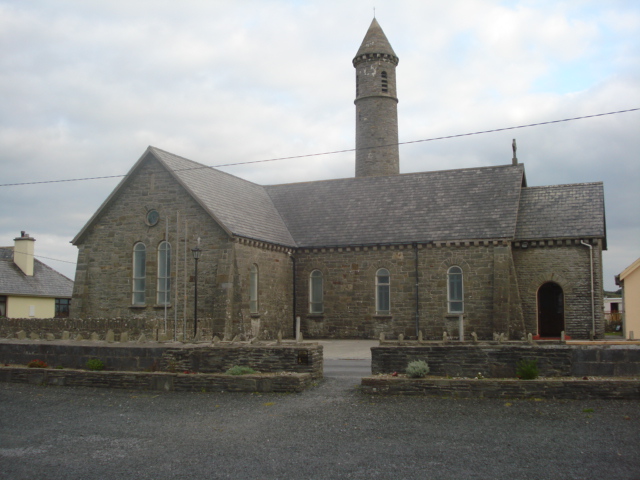
Built with funds donated by French people after the rescue of the crew of the Leon XIII. The church porch contains a replica of the Leon XIII in a glass bottle, and the ship’s bell stands in front of the altar.
Photo: Eddylandzaat Wikipedia.org
THE STARK COUNTY DEMOCRAT, 4TH OF OCTOBER, 1907, WEEKLY EDITION P5
IRISH FISHERMEN WORK VALIANTLY TO SAVE CREW OF FRENCH VESSEL WRECKED BY GALE
London, October 3rd
Throughout yesterday and today the fishermen on the coast of County Clare, Ireland, aided by coast guards and volunteer helpers, worked with the greatest courage and devotion to rescue the crew of the French ship Leon XIII, which went ashore in a gale on Spanish Point.
By nightfall they succeeded in saving thirteen, but nine men are still clinging to the rigging. There is hope, however, that they will be rescued at low tide tonightl
Clog na neal – 1918
Wikipedia.org
COLEMAN BULLETIN, 20TH DECEMBER, 1918 P3
RELIC OF FAMOUS BELL (abridged)
An ancient relic is being offered for sale in London. This is the famous “Clog an air” (sic. – bell of gold) a renowned relic which for centuries has been venerated by the people of the West of Ireland. From time immemorial the bell has been in the possession of a County Clare family, the O’Cahanos (sic.).
According to tradition, it descended from heaven, ringing loudly to St. Senan, the patron of the Seven Churches of Scattery, a holy island near the mouth of the river Shannon, opposite Kilrush, in the earliest years of Christianity in Ireland. Hence it was originally known as “Clog na neal,” or bell of the clouds. But the antiquaries are agreed that it is the work of human hands, not angelic, and from its decorations, they date it from the 11th century.
The bell is known to have been used for a period of time in the religious services at Scattery (now a place of ecclesiastical remains of great antiquity) before it was given into the care of the O’Cahanes, the ancient protectors of the island. It attained to an extraordinary degree of fame and sanctity throughout Clare and Galway. No oath was held to be so sacred as one sworn on the Golden Bell. It was believed that anyone who told a lie, after being sworn on the bell, would have his mouth twisted on one side; and down to about the middle of the 19th century it was used successfully for the discovery of information when all other means failed. The relic is in the form of a shrine which probably once contained a bell and clapper. It is made of bronze and silver, and is decorated with the figures of two-winged dragons and quaint serpent interlacings.
The crew of Columbus – 1912
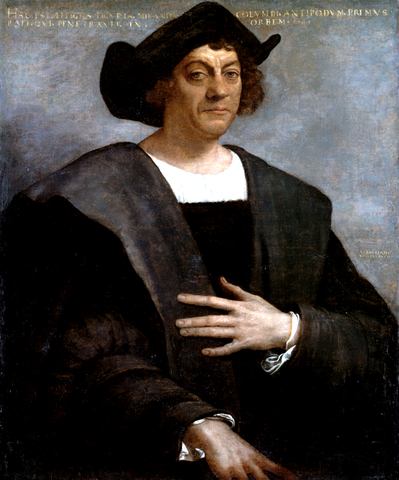
Sebastiano del Piombo (1485-1547)
Metropolitan Museum of Art
wikipedia.org
BLAIRMORE ENTERPRISE 9TH MAY, 1912
THE CREW OF COLUMBUS – (abridged)
The list of the officers and sailors in the first voyage of Columbus was almost cosmopolitan in its character Among them there was a man of Jewish heritage, Luis de Torres; an Irishman from Galway Ireland, William Harris; an Englishman, Arthur Laws; Italians, Portuguese, Spaniards and several other nationalities, though, of course, the Spaniards were largely in the majority.
It is maintained by some authorities, with considerable plausibility too, that there was a Scotchman in the list and that after Columbus himself he was the first man to tread the soil of the new world – Exchange
Anxious to vote? – 1933
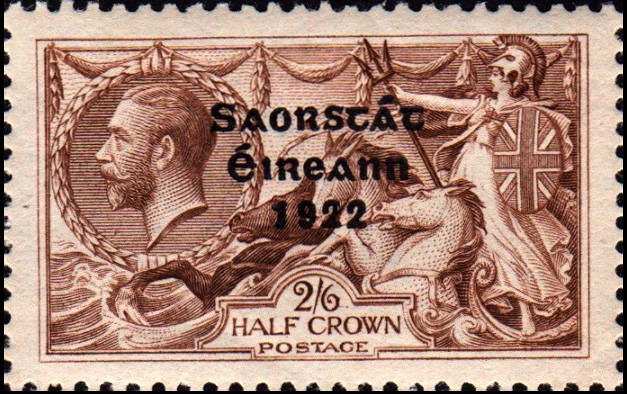
Irish Minister for Posts and Telegraphs
BLAIRMORE ENTERPRISE 2ND FEBRUARY, 1933 P 7
ANXIOUS TO VOTE
Man in Ireland cycles 100 miles to cast his ballot.
Dublin, Ireland – Two centenarians were among the first to case their vote in Donegal as the Irish Free State went to the polls. In Kenmare a husband, a wife, aged 101 and 99 years respectively, voted their preferences.
A Galway man cycled 100 miles to cast his ballot, while an enthusiast in Killarney walked 40 miles to do his bit for his party.
Cry of the Banshee – 1887
 https://widgetworld3.wordpress.com/podcasts/
JAMESTOWN WEEKLY ALERT, APRIL 21, 1887, P1
THE CRY OF THE BANSHEE
There is now living in Bristol ad Mrs Linahan, an old Irish woman, who has not seen her own country for forty years. She is old, poor, bed ridden and suffering, but patient and cheerful beyond belief.
Her strongest feeling is love for Ireland, and she likes talking to me because I am Irish. Many a time, sitting in her little close room, above the noisy street, she has told me about banshees and phookas and fairies, especially the first. She declares solemnly she once heard the cry, or caoin of a banshee.
“It was when I was a little young child,” she told me,
“And knew nothing at all of banshees or of death. One day mother sent me to see after my grandmother, the length of three miles from our house. All the road was deep in snow, and I went on my lone – and didn’t know the grandmother was dead, and my aunt gone to the village for help. So I got to the house, and I see her lying so still and quiet I thought she was sleepin’. When I called her and she wouldn’t stir or speak, I thought I’d put snow on her face to wake her. I just stepped outside to get a handful, and came in, leaving the door open, and then I heard a far away cry, so faint and yet so fearsome that I shook like a leaf in the wind. It got nearer and nearer, and then I heard a sound like clapping or wringing of hands, as they do in kneeling at a funeral. Twice it came and then I slid down to the ground and crept under the bed where my grandmother lay, and there I heard it for the third time crying, “Ochone, Ochone,” at the very door. Then it suddenly stopped; I couldn’t tell where it went, and I dared not lift up my head till the woman came in the house.
One of them took me up and said: “It was the banshee the child heard, for the woman that lies there was one of the real old Irish families – she was an O’Grady
And far away…1910
https://widgetworld3.wordpress.com/podcasts/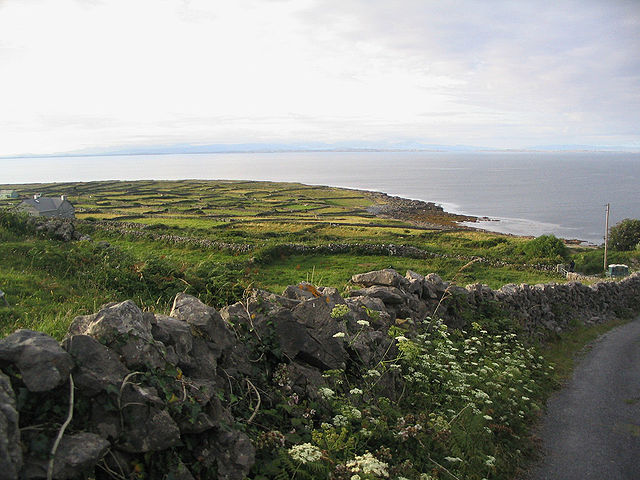
Photo: Creative Commons
THE WEST AUSTRALIAN 25TH JUNE, 1910
EXCERPT FROM ‘THE LAND OF THE WESTERN GLEAM’ BY E. LONGWORTH DAMES (VI – Galway of the Tribes)
…And far away, far out across Galway Bay, there is a faint vision of the mysterious Aran Islands, some of the fairy isles of the west, the last retreat, it is said, of a very ancient people called the Fir Bolgs, a primeval tribe which was in Ireland before even the Gods came there. This is what lies dimly and half seen on a gray horizon against gray skies colouring at evening, and Galway, dreaming away its life in a soft Western langour, with a pale glory of the past about it, like last daylight lingering, looks out upon these for evermore. Ptolemy is said to have spoken of Galway as then existing under the name of Nagnata. And when twilight settles down in a silence that is full of old voices, one may well fell that the place and the country round it, are of far off beginnings and ageless.
Burren memories – 1890
Wikipedia.org
THE ADELAIDE ADVERTISER 18TH MARCH, 1890
ST. PATRICK’S DAY – CELTIC DEMONSTRATION
Excerpt from Mr Patrick MacMahon Glynn M.P (President Irish National Federation) address;
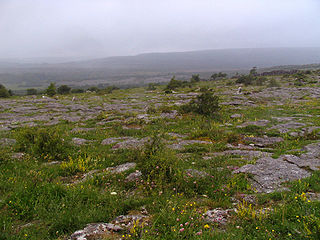
…”Some of you may have, like myself, been born in the West. There by a road which winds along the side of the Burren Mountains is a spring of clear cold water such as the water which fills our day dreams but not our throats, when the mercury is dancing a South Australian hornpipe between 100 degrees and 110 degrees in the shade. It is called Patrick’s Well. Why, I am not sure. I may have been baptised there and don’t remember. Some say that my great namesake once or twice opened his flask by that spring. If he did it is proof that he had a taste for more than spring water, for the sight commands a splendid view of Galway Bay. It was there that I first felt the romance of the sea, as I watched with the wondering eyes of childhood the turf boats glide down between Aughinish and the mainland on the swift ebb of the tide. This is one of the characteristic reaches of a western bay. Outside on the shimmer of the horizon are the wild islands of Arran against whose bold cliffs beat for ever the breaking swell of the Atlantic. It is there that you can feel the glory of Shakespeare’s rebuke of the surges that “Wash both heaven and hell.”
 The Burren and Beyond