Alabama Enquirer And Morgan County News Date: January 26 1888 p2
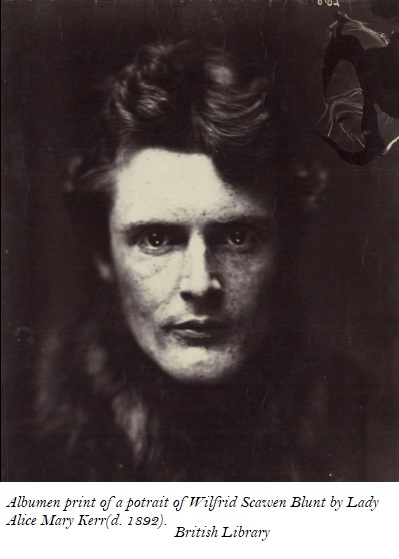
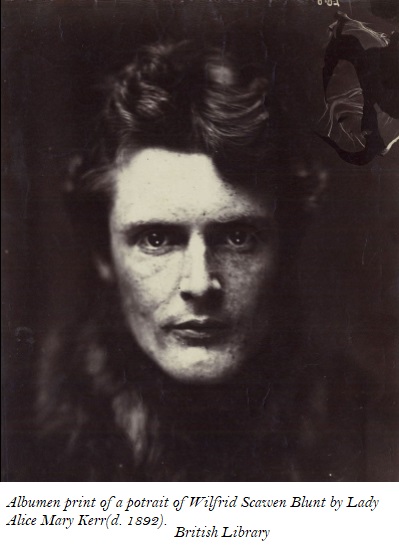
Wilfred Blunt has been moved to a warmer cell in the Galway prison, and his overcoat has been returned to him. A band tried to serenade him, but was prevented by the police. Mr. Blunt says that while staying at a country hotel in the south of England last September, he met Mr. Balfour, who made the statement that he intended to imprison six of the physically weakest of the Parnellites, adding: “I shall be sorry for Mr. Dillion, as he has some good about him. He will have six months, and as he had bad health he will die in prison.” In response to an inquiry, Mr. Balfour said: “The history is a ridiculous lie. I do not believe that Mr. Blunt ever made the assertion attributed to him.”
Sir,
A report appeared in the Independent of the 29th April from the Cork Evicted Tenants’ Association, inquiring if there was any evicted tenants who did not get grants for the last twelve months.
I wish to inform you that I was evicted in 1887. Immediately after the eviction I took forcible possession in presence of the sheriff and the evicting party. The property being in Chancery, I was arrested on an attachment order and sent to Galway Jail for twelve months, my wife and children keeping possession during my confinement. After my release I joined my wife and children, where were laid up with typhoid fever. I was rearrested and sent back to jail for another twelve months. My wife was also arrested.
After my liberation the Kinvarra Branch of the National League made an application to the Central Branch in Dublin, and I received two grants in succession. Some time afterwards the Kinvarra Branch broke up, and since 1889 I was left to provide for a helpless family, and never since then got a penny from any quarter. At the late general election I was asked to vote for the McCarthyite. I refused to do so, and voted for the Parnellite. Some time after I got forms down from the Evicted Tenants’ Commission. I took them to the parish priest and he told me to take them to the Parnellites, that he would not do anything for me being one. I am now in a helpless condition, and am appealing to your association to do something for me. If not I will be left at the mercy of the waves.
Sunset, Galway Bay wallpapers.varjati.com https://widgetworld3.wordpress.com/podcasts/
PETTICOAT PAPERS. OTAGO WITNESS, 23RD APRIL, 1891 P35
THE IRISH GIRL.
(abridged)
Irish women are the most passionate partisans in the world. Get an Irish girl into the corner of any drawing room, and tickle her with a remark about Balfour. or Parnell, or rents or evictions, or any of the burning questions which rend the “distressful country asunder”, and she will go for you with all the headstrong volubility of her race, and if she doesn’t convince you with her logic, she will do it with her eyes.
Have you never heard an Irish girl sing “The wearing o’ the green” with that passionate abandon which no English girl can approach, until you were ready to curse – Tory though you be – the scoundrels who were “hanging men and women for the wearing o’ the green”? For she has that keen sensibility, that quick sympathy which is so distinctive of the French woman. In fact, she is by nature and temperament a French girl, with a somewhat deeper reserve of passion and a freer system of education and social life than her Gallic Sisters.
That is why the Irish woman succeeds so well in Paris. When she finds herself in a congenial soil she takes root and flourishes with the luxuriance of an indigenous plant. She has all a French woman’s aptitude for intrigue, with more than a French woman’s fire and vigour. Politics, personal politics form her native element, and nowhere are politics so personal as in Paris. And so, when, in obedience to the French maxim, you have looked for the woman, you need not be surprised if she speaks with an Irish accent.
The Irish girl in England often creates an impression of fastness. It is quite a false impression, but springs naturally from her character. She is, as I have said, keenerwitted than home-grown girls “alive all o’er to smart and agonise at every pore.” This is mirrored in her talk, which is fervid and fluent hot from the heart which she bares to you in her speech. She presents herself to you au naturel. She is natural, unconventional, straightforward.
But the Irish girl must be studied at home on her native soil before she can be fully appreciated, and not in Dublin, or Cork, much less in Belfast or Ulster. Generally all big cities approximate to London, as all roads once led to Rome.
I should select Galway as the district where the purest and most unadulterated Irish maidenhood is to be discovered. Often and often, as one drives across the rainswept hills, one comes suddenly upon a cabin and as the clatter of wheels draws near, a figure steps out of the cabin which makes you feel instinctively for your sketch-book, ‘so wonderful are its suggestions of grace and beauty. Only suggestions, alas! For the dress is ragged, and the whole aspect unkempt. But there is a dignity in the carriage, a shimmer in the raven hair, and a purity of complexion.
The features of the girl are reproduced in a score of Galway country houses, only in a prettier frame. The eyes deep grey for choice with all sorts of half lights lurking in the corners, ready to blaze up in passion or melt in pity; eyes that rivet your own till you catch yourself blushing at your own temerity – were there ever such eyes?
All other features are blurred and indistinct if the real Irish eyes are there and as the Cheshire cat lives by its smile alone, so the Irish girl, in spite of a snub nose and a wide mouth, has only to look and conquer. And the voice! I You have no idea of the magic of the human voice if you have never heard an Irish girl tell Irish stories in an Irish house.
Oliver Wendell Holmes says somewhere that he has only heard two perfect speaking voices. One belonged to a German chambermaid, the other I forget to whom. But neither to an Irish girl.
He had never been in Ireland.
At home we often hear soft melodious voices—” voices low with fashion, not -with feeling” – but never in the world have I heard anything like the linked sweetness of an Irish girl’s voice. If it were but a page of Bradshaw that she were reading, the effect would be the same; as the long-drawn notes of a Stradivarias in the simplest melody bring tears from the heart. I cannot explain it, but everyone feels it. There is a note in the human voice which finds its complement in our inmost being. And the Irishwoman has put her finger on that note.
Every Irishman has a touch of Bohemianism in his nature. Thackeray said that we lose our way to Bohemia when we turn the corner of 40. The genuine Irishman never forgets his way there. The Irish girl has it, too, Only a soupcon— like garlic in French cookery; but it gives a flavour to her character. It comes out sometimes in a reckless disregard of expense and consequent financial disaster, sometimes in a wild rush to go nursing in Egypt or missioning in China. I have seen a Galway girl sit up all night while her brothers played billiards, and ride 30 miles after the hounds the next day without turning a hair. And I have seen the same girl sit by a sick bed for a week without taking off her clothes. It is this touch of Bohemianism which sometimes throws the Englishman off his balance. This reckless audacity, this outspoken frankness, which springs from warmth of heart he mistakes for something warmer. And then he notices that the tender grey of the Irish eye can harden into a steely blue, and finds the Irish girl bulwarked by the impregnable rock of maidenhood. She is without fear. Because she is without reproach.



 The Burren and Beyond