In the Ballyvaughan and New Quay District the Subscribers state that several of the chief Proprietors, who are mainly non residents, contribute nothing to the Dispensary. In proof of this statement eighteen such individuals were mentioned, whose joint annual rental is £12,000 a year. As the District is poor, those whose subscriptions support the charity consider it a hardship that, as occupiers, they should be doubly taxed while many owners do not contribute by subscriptions nor by assessment. The Medical Officer resides at Kinvara; his duties appear to be very diligently performed.
XX By the Hon P McM. Glynn K.C. Minister for Home and Territories (abridged)
Gort, August 12, 1916. I arrived here on August 10. Names, not much else, have changed. Some old people, some middle-aged, knew me; their faces are not those of the past. Newquay, twelve Irish miles from here, is changed. The four or five white cottages facing the beach of shingle and sand, looking across the opening of ihe Straits towards Aughinish, are in ruine. It was difficult to identify the location of the seaside cottage in which, during some summer months, we lived.
Driving round by the flaggy shore to Ballyvaughan and then across a gap in the Burren Mountains towards Kinvara, from which is a fine view of the inner-part of Galway Bay. The promontory of Aughinish and the swift current of the sea between it and the mainland is open; along dusty, limestone roads; the crumbling walls of deserted houses are seen in many places by the way. Most people of. the past seem to have gone to heaven or the United States.
Politics, as they go, are still matters of conversational interest here. The Sinn Fein movement is mentioned by some with sympathy for motive and contempt for methods and organization. The rising came as a surprise, if not a shock, to some persons, but there were, or are, scattered sympathisers or objectors to the more, drastic of the methods of repression among the middle as well as the working classes. For among those who paid the inevitable penalty of revolt in time of war were some leaders of ripe scholarship and. in other respects, stainless lives; ‘Poets of the Insurrection’ as they were called, whose mistakes of judgment, policy, and method are lightly regarded by those of emotional temperament to whom disinterestedness primarily appeals.
Discontent now turns on the recent check to Home Rule as expressed an the Government of Ireland Act, 1914. There is a feeling that the political system – Union Government – is still the source of any economic maladjustments, and that the country will at once flower under the working of autonomy.
At Loughrea, behind the house of my brother James, are the ruins of an old abbey, one of the finest of the monastic days, and the Abbey walk. Across the road is the Carmelite church and monastery, and beyond sloping country, with a good growth of meadow grass and trees. Loughrea is situated on a lake, on the far bank of which the historic or traditional Fian ma Cumhill had some of his escapades. It has an excellent cathedral church, built by the lake; finished in every point of architectural design.
The Freeman’s Journal 3rd May, 1865 p 278Corcomrue Abbey, The Burren Wikimedia.org
The two remaining unsold lots of the Burren estate in the county Clare were purchased by private sale on Friday by Wm Lane Joynt, Esq, agent to Lord Anally for £11,000. Thus the noble lord has become the owner of all the Burren estates.
The noble lord is also the owner of the Duke of Buckingham’s estate at Ballyvaughan, Mr Burton Bindan’s at Currenrue, on which are the famous oyster beds, Mr John B. Scott’s at New Quay, Sir Hugh Dillon Massy’s Broadford estate and Mr John Westropp’s at Kilkeryne. These represent, as a whole, one of the largest territorial possessions in the hands of any peer or commoner in Clare.
There is still a friend left here and there says United Ireland, to the evicted and harassed tenants of Ireland. While the majority of their brethren look on indifferently at eviction and consequent suffering, a few faithful friends, priests and payment, are doing what they can to stem the tide of landlord oppression. Among these must be reckoned Father Newell, the parish priest of New Quay, County Clare, on the southern shore of Galway Bay. He recently drew attention to some harsh evictions carried out by Lynch, of Renmore galway in his parish, and he has consequently received some private assistance for the poor people. Father Newell returns to the subject in a public letter published recently. He says;
I regret to have to add that more ‘processes’ were served a day or two ago on the same island. In the early days of the Land League, Major Lynch was one of the first to put down his name for $100 (pounds) for the funds of the;Property Defence Association’, got up by the late A McMurrogh Kavanagh.
I wish he would show a like generosity to the poor tenants in these trying times.’ The moral of this and similar pitiful stories is that the people require again a protective organisation, widespread and powerful, to prevent the landlord fro indulging in his pet pastime of harassing legal process and subsequent eviction.
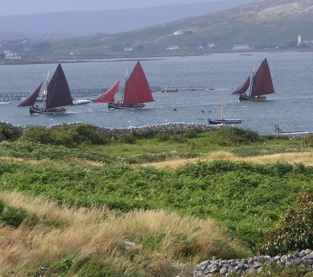
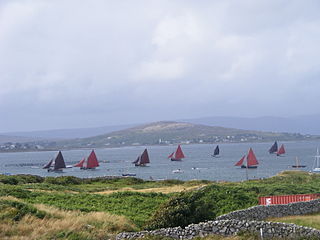
Galway Hookers Wikipedia.orghttps://widgetworld3.wordpress.com/podcasts/ COLONIAL TIMES 5TH NOVEMBER, 1844
EXTRAORDINARY OUTRAGE IN THE BAY OF GALWAY
On Tuesday, the 25th ult, while Mr J. H. Hynes, of New Quay, and the Rev Mr Fullam, Protestant clergyman, were out traul fishing, with a crew of three men, in the Bay of Galway, a fleet consisting of 80 to 100 boats from the Galway Claddagh, bore down on them, and nine or ten of the boats having surrounded the fishing boat, 50 0r 60 of the Claddagh fishermen suddenly boarded her, and, after cutting away the traul, rushed on Mr Hynes and his party with the most awful imprecations and savage yells, armed with open knives, poles etc., knocked them down, beat them most unmercifully, leaving them apparently lifeless on the deck.
Then then cut down the sails, which along with the anchor, cables, ropes, poles and oars, they threw overboard. Finally they tore up the deck, and with the stones that formed the ballast, made many fruitless attempts to scuttle the boat, after which they departed, leaving her a complete wreck to drift along the sea.
Fortunately she was rescued from her perilous situation by a New Quay boat, and towed into harbour. An investigation was held on Monday, at Correnrue, concerning this most daring outrage, before Messers Bell and Kernan, stipendiary magistrates, and G. Macnamara, Esq., J.P. Harbour – Hill. Although the lives of two of the crew and that of Mr Hynes were considered in imminent danger for four or five days, they are now supposed to be convalescent.
Clare Journal
On Tuesday the 25th ult. while Mr. J. H. Hynes of New Quay, and the Rev Mr Fullam, Protestant clergyman, were out traul (sic.) fishing, with a crew of three men, in the Bay of Galway, a fleet consisting of 80 to 100 boats from the Galway Claddagh, bore down on them, and nine or ten of the boats having surrounded the fishing boat, 50 or 60 of the Claddagh fishermen suddenly boarded her, and after cutting away the traul, rushed on Mr Hynes and his party with the most awful imprecations and savage yells, armed with open knives, poles etc., knocked them down, beat them most unmercifully, leaving them apparently lifeless on the deck; they then cut down the sails, which along with the anchor, cables, ropes, poles and oars, they threw overboard. Finally they tore up the deck, and with the stones that formed the ballast, made many fruitless attempts to scuttle the boat, after which they departed, leaving her a complete wreck to drift along the sea; fortunately, she was rescued from her perilous situation by a New Quay boat, and towed into harbour.
An investigation was held on Monday at Correnrue (sic.), concerning this most daring outrage, before Messrs Bell and Kernan, stipendiary magistrates, and G. Macnamara, Esq J.P Harbour Hill. Although the lives of two of the crew and that of Mr Hynes were considered in imminent danger for four or five days, they are now supposed to be convalescent – Clare Journal.
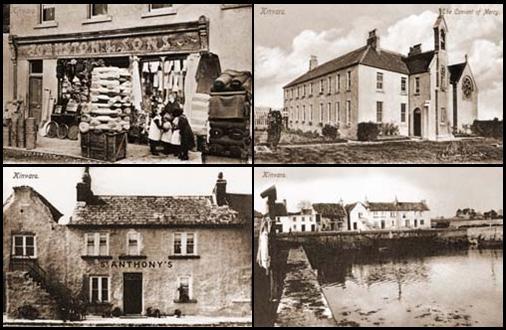
https://widgetworld3.wordpress.com/podcasts/ Johnstons, Saint Joseph’s, Saint Anthony’s Hotel and Kinvara Harbour.During 1842-43 Thomas L. Cooke wrote articles for the Galway Vindicator about Kinvara, Co. Galway… KINVARRA
“Within a long recess there lies a Bay,
An island shades it from the rolling sea, And forms a port secure for boats to ride.”
Dryd. Virg.
Such is the geographical position of the harbour of Kinvarra, situate on the south east extremity of the bay of Galway. The entrance to Kinvarra bay is a moderately narrow one, lying between Durus head land on the west, and a point of Drumacoe parish on the east. Opposite to the mouth of this narrow channel is Eddy Island, which forms a natural breakwater protecting the little Delta of a bay within, from the rough seas that are occasionally reverberated from off the southern face of Kilcolgan point.
The village of Kinvarra is built on a gentle acclivity at the bottom of the bay, bearing the same name.
– The appellation seems to be derived from the Irish Ceann, the end or limit, and Mara, of the sea. –
This village is about five miles distant from New Quay, and is situate in the barony of Kiltarton, and county of Galway. Fairs are held here the 18th of May, and 17th of October annually. Kinvarra also is the name of the parish in which the village is situate, being a Vicarage in the Diocese of Kilmaduach.
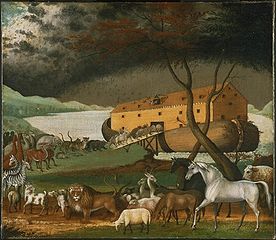
This little town is the property of Mr. Gregory, of Coole, and has been much improved of late years. Many good houses have been erected – an excellent quay, wall and pier, have been built, and some good shops have been opened. Amongst the latter is an Apothecary’s establishment, kept by Dr. Hines where the infirm are supplied, on moderate terms, with medicine, and all meet with that attention and humanity, which is ever grateful to the invalid. There are several streets here, and the population is much employed in traffic. The market, is principally, remarkable for the sale of corn, bought up to be exported from hence. Adjoining the quay are temporary stocks, on which a superior class of sea boats are built.” Noah’s Ark, (1846), Edward Hicks (1780 –1849 Philadelphia Museum of Art The boats will gather in Kinvara for Cruinniu na mBad very soon – and the Ark will open its doors.

 The Burren and Beyond