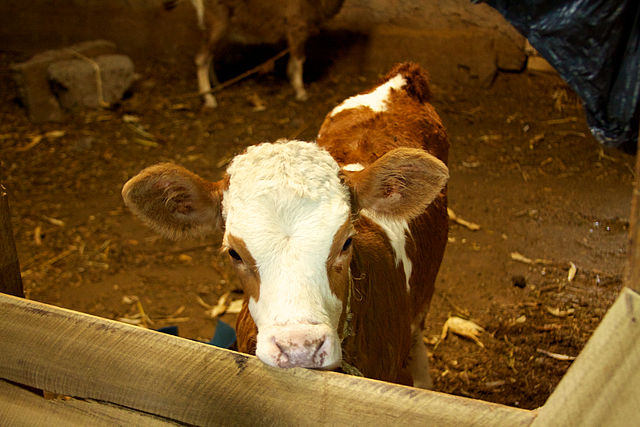
The famous untamed Ballyclery bullock, five years old, again defied capture on Saturday last when a posse of twenty-six men drawn from Ardrahan and Loughrea failed to hold the beast.
Bought by Mr Murphy of Loughrea, the Loughrea Carnival Committee was desirous of putting the bullock on display at the carnival. Armed with ropes and stout sticks, the posse succeeded in driving the bullock into a rope snare where he was hung with half hundred weights. The animal refused to budge, however, until angered when he scattered his tormentors with a few judicious charges and then disdainfully flung the weights from off him.
The hunters set another snare and succeeded in driving him into it. This time he tore furiously through the bushes until he succeeded in divesting himself of the trailing ropes and stayed free.
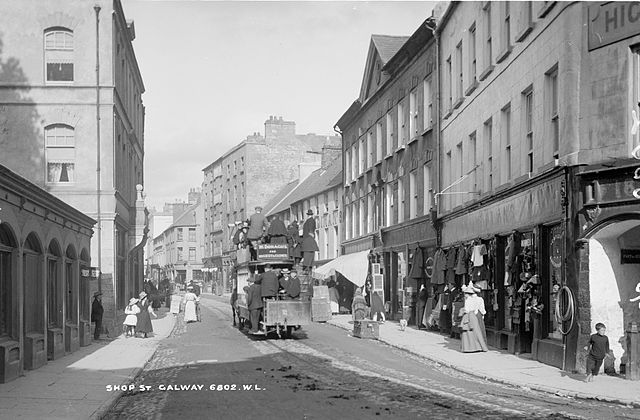
Horse drawn Tram, Shop Street, Galway. National Library of Ireland on The Commons Wikimedia Commons
(excerpt of letter from Mr T. Bermingham to “To the Guardians of the unions of Loughres, Gort, Ballinasloe and Tuam, especially – and to the inhabitants of the County Galway in General.”)
I have lately examined the southern coast of the Bay of Galway, and from the trade at present existing at Kinvarra and the New Quay, I have no hesitation in recommending the building there of two good piers, to protect the boats engaged in the fishery and seaweed trade, and as asylums for vessels of moderate burden, to encourage still further their spirited trade in corn, with a view of being a proper point of communication with the town of Galway by means of a steam tug – a plan which has been long agitated by the inhabitants of Galway. Tram roads for horse power are perhaps more adapted to the present trade of this county than more expensive railways for locomotive power.
With the experience that I have had in constructing a short line of railroad on cut bog, the property of Lord Clonbrock in this county, I can almost confidently state that a double line of rails of dimensions adapted to the present trade, can be constructed for three thousand pounds per statute mile – upon which one horse can draw a load weighing ten tons upon the level. Of course it would be necessary to have relays of horses to assist at some of the elevations – which upon the route that I propose to take, would be but few.
More on Kinvara in the news archives at theburrenandbeyond.com
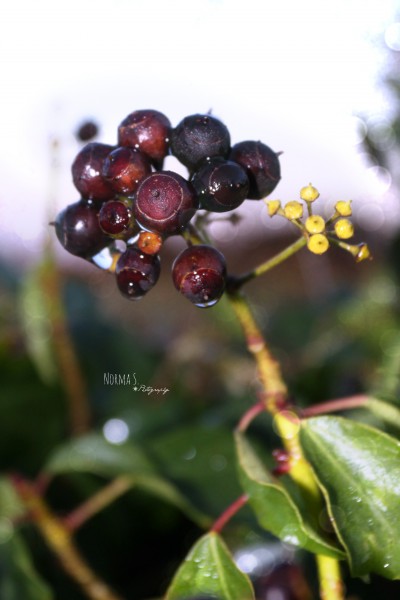
New Zealand Tabled 22nd April 1887 p19Photo: Norma Scheibe
On January 15 placards were posted in Loughrea and neighbourhood calling upon the tenants on the estates of Lord Clonbrock and other landlords to meet at four o’clock on the following day at the Cross roads, Holyhill. A strong force of police was consequently despatched to the place, but no meeting was held, and after remaining until a late hour the police discovered that the notices were intended to hoax them. The actual meeting was held at a place three miles distant and the tenants paid to the trustees considerable sums under the rules of the plan of campaign.
New Zealand Tablet Vol XXVII Issue 9, 2nd March 1899 p9
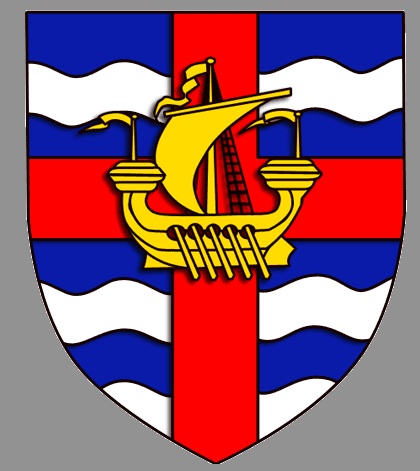
Loughrea Crest Wikimedia Commons
In Loughrea shields have been erected bearing the names of each street in Irish. Father Nolan ODC, who is an Irish scholar, is responsible for the idea, and the painting and lettering of the shields was done by Father Thomas ODC, assisted by the nuns of the Carmelite Convent.
7th August, 1909
A gentleman, a resident of Loughrea living in England, thus writes about the changes time has wrought there: – “There was a Pawn Office – a Mont de Piete – established in my day in a house once occupied by Mr Smyth, in Main Street. Behind was a three storey range of wool stores once used by him. The manager of the Pawn Office was Mr John Cowen, but the enterprise came to grief, and Dr Lynch went to live there, but later on it was converted into a police barrack. In those days I speak of, the population was about 8,000. It is not half now. I knew Monahan’s Hotel, built where the new Cathedral now is. It was called ‘The Head Inn’ and is mentioned in Lever’s Novels where many a pleasant evening was held. Loughrea was then the centre of the county society, and its hunt ball the great social event. One of the Monahans was Anthony, but the other, James, became a chief Justice. By the way, Charles Lever was Consul in Trieste, where he died and was succeeded by a great Irishman, Sir Richard Burton, whose grandfather was the Rev Edward Burton, Rector of Tuam. His grave is in Mortlake Cemetery
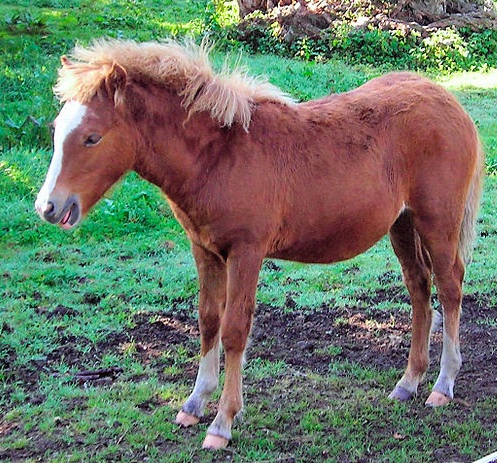
St. Paul daily Globe, 18 December 1886 p4Kerry Bog Pony Photo: Jim Linwood Wikimedia Commons
Dublin Dec 17
Mr Dillon and Mr O’Brien arrived here today. Both are much disturbed and hurt physically. In addition to the troubles which the gentlemen had yesterday at Loughrea when they were arrested for acting as tenants’ trustees, they met with an accident on the road home. The horse drawing the car on which they were riding from Loughrea to Athenry bolted on the way and both were thrown violently to the ground. The gentlemen were badly shaken up and considerably bruised by their fall.
During the progress of the meeting at Loughrea yesterday, at which Messers Dillon, O’Brien, Harris and Sheehy were arrested, Mr Sheehy received a summons to appear and show cause to keep the peace because of a speech he made recently at Kylebeg and which, it was claimed, was calculated to arouse disorder.
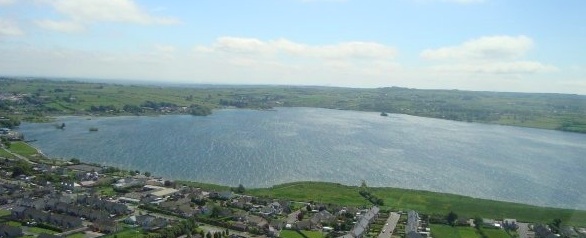
The Daily News 9th November, 1937 p6Loughrea lake Photo: Anthony Wikimedia Commons
An infernal machine today partly wrecked the rent-office in Loughrea, County Galway, where the Earl of Harewood’s agent is due tomorrow to collect quarterly rents from the Harewood tenants.
Arrests are expected.
Negotiations are progressing between the Earl of Harewood and tenants for the sale of the town of Loughrea. Court proceedings for the recovery of outstanding rents have been postponed pending an agreement
A correspondent of the Freeman has sent the following account of a remarkable discovery in a bog near Loughrea:
Last week the body of a full-grown female was dug up by a young man while cutting turf in Carnagarry bog, about two miles from this town. The body is supposed to be buried over 200 years, as the turf was quite close all round it and cut like soap, having no appearance of being recently disturbed. Some years ago there was a bank cut off this place about six feet deep. This recent cutting of a second bank uncovered the body two feet below the surface. The body must have been buried about eight feet deep. .
An inquest was held, and the jury found a verdict of murder by some person or persons unknown. The body had the appearance of a well-tanned leather bag of a dark brown colour. With the exception of the top of the nose being shrunk, and the under jaw a little to one side, the features were perfect. The top of the nose could be easily lifted back to its place, it being just like the finger of a glove. The throat was evidently cut, as the cut was quite visible. The feet and hands appear, to be quite small; the calf of the leg large as it formed a great empty bag, the two sides of which were clapped or drawn together. The police say that her height was about 5ft 7in. Her teeth were regular and sound. Her hair seemed as fresh and glossy as if only buried yesterday; in the knot of hair at the back of her head was found a beautiful carved wooden comb, with a cord and tassle attached.
The oldest inhabitant here never remembers having seen anything like it. Some say the cord and tassle are silk, while others say it is flax. As silk is an animal matter it would rot away, but the flax would stand. The comb is in the possession of Mr. Reeves, sub-inspector of police.
There was also found round her neck another cord with a purse attached, which seems to have thrown light upon the matter.
Lord Ashton says, I hear, that there is an old story in his family that shortly after the battle of Aughrim two servant maids were sent by one of his ancestors from Woodlawn to Loughrea with a purse of money to pay an account. They never returned. One was a red-haired woman, the other black.
About three years ago, while cutting turf in the same bog and bank, but not so deep, only about six feet before mentioned, the skull of a red-haired woman was dug up. Rumour also has it that the body has been dug up again and sent to either Dublin or Galway.
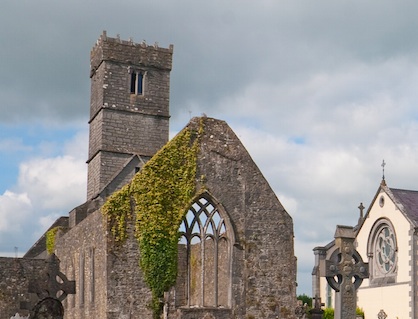
South Australian Register 13th May, 1843 p2Loughrea Old and New Priory Photo: Andreas F. Borchert Wikimedia Commons
At the petty sessions of Loughrea, Ireland, the master of the Union Workhouse preferred a charge against one of the inmates, named Catherine Mahony, “for having continued to speak when cautioned to be silent.”
The magistrate dismissed the complaint and strongly censured this new mode of burking (hurting?) the paupers.
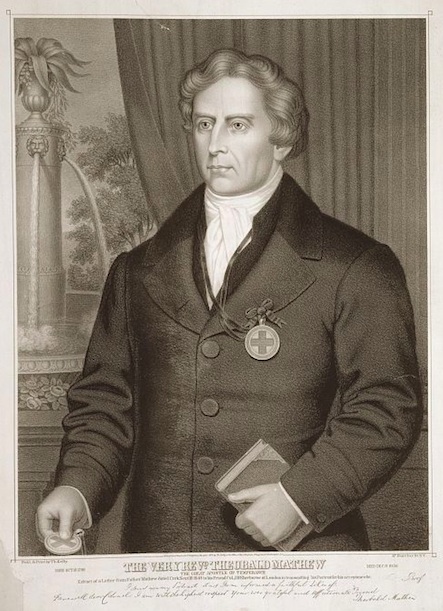
Australasian Chronicle 17th November, 1840“Theobald Mathew” by Thomas Kelly (fl. 1871-1874) United States Library of Congress’s Prints and Photographs Wikimedia Commons
The Very Rev. Fr. Mathew, being on a visit at Kilcornan, the hospirable mansion of N. Redington, Esq., M P., administered the total abstinence pledge on the 21st and 22nd ult., to upwards of eight hundred postulants.
Many from the neighbouring parishes of Oranmore, Ballinacourty, Ballinderreen, &c., who lost the opportunity of approaching him while in Galway and Loughrea, took advantage of his propitious visit to Kilcornan. The people of this locality have been extremely fortunate.

 The Burren and Beyond