On Friday evening, at a place called Duras Demesne, near Kinvara, the patrol of police from Kinvara had a severe encounter with some civilians. They succeeded in arresting two men who were brought before Mr. Persse, J.P. and remanded without bail for three days, when there will be an inquiry into the matter.
The National Forces operating from Galway under Commandant-General Austin Brennan have now begun to clear the country of Irregulars in real earnest, writes our Galway correspondent. As a result of an operation just under the valley of Tullira Castle, on the Kinvara road at Coolfin, sixteen prisoners were captured on Monday afternoon and on Tuesday a total of 22 prisoners was brought to Galway and lodged in the local gaol.
Early on Monday afternoon eight motor vehicles containing over thirty riflemen and their officers left Galway for Gort. They were equipped with cross-cut saws and engineering tools, and quickly cleared the roads on their way. They passed through Ardrahan village without incident, and along the road to the west of Tullira Castle, under the shadow of the Skehanagh heights, which have been made famous by the dramas of Lady Gregory and other Irish play-wrights.
To the west of this road lies the Great Southern Railway line to Gort and Ennis, and at the inlet of the sea further west the village of Kinvara. As the lorries passed along they noticed men on the march through the fields about a mile distant. They were evidently coming from Kinvara and making for Tullira Castle. The lorries passed along the road towards a bend in the hope of getting a better view, but here they found that their range of vision was altogether obstructed by trees and undergrowth. The vehicles were thereupon put in charge of a small party, whilst the little company of riflemen was distributed amongst the three officers and a few efficient sergeants, who had seen considerable service in the recent war. A few of the cars moved slowly back along the road that they had come, whenceupon the men dismounted, and one officer proceeded along a boreen towards the north-west, accompanied by half a score of men in extended formation. The first shot was fired when a scout was seen rushing across the fields apparently to warn his comrades in the rearguard. He was called upon to halt, and shots were then discharged at him at a range of over 400 yards. Thereafter shooting became general at long distance range.
The Irregulars replied, firing about 100 shots in all. Lieut. McCarthy, who was in charge of the centre, crossed a wall with a sergeant whilst bullets whizzed past. As the sergeant fell on his knees to take aim in the fields a bullet grazed his knuckles.
The National troops operated in a “V”, seeking what cover they could find, and sniping at the Irregulars as the occasion offered. The latter had splendid positions and excellent cover and they retreated as they fired. The main body was at least 1,000 yards from their adversaries and it was at this range that most of the shooting took place. When the scout had got clear, there was considerable commotion in the rearguard of the Irregulars, whistles were blown loudly and shrilly and a general retreat took place.
Connacht Tribune 12th December 1931 p 5 (abridged)
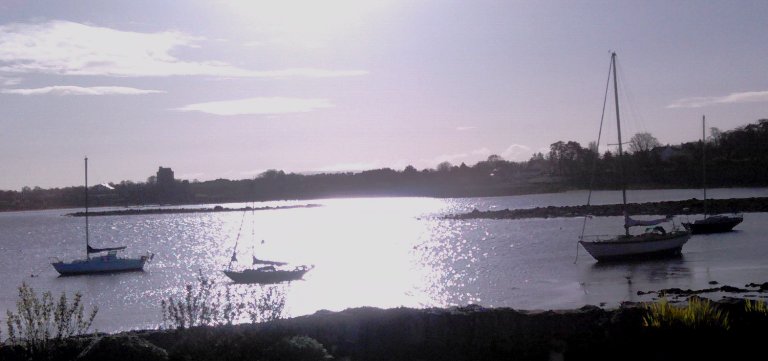
Photo: EO’D
The Danes left their mark in Aidhne with the following incursions;
In 816 A.D. Corcomroe was raided. Glen Columkille and Oughtmama suffered and the northmen went through Aidhne to Oranmore and Loughcorrib. After the plundering of inis Cealtra the marauding vikings used the island as a base from which they plundered the church of Beagh. In 843 the warrior Turgesius, operating from Loughrea sought to establish his authority in Connacht.
The following year the Danes landed at Kinvara and proceeded in their woeful way by Kilmacduagh to Clare.
Numerous reports of mines having been seen in Galway Bay and along the west coast have been made during the last week by fisherman, including one proceeding from Connemara to Kinvara with a boat load of turf on Wednesday. It is worth recalling that, during the last war, only two mines drifted into Galway Bay. Both exploded with fatal results, but the stringent precautions now being taken should avert any repetition of such tragedies.
Captain Hamilton, competent Port Authority at Galway told our representative on Friday that a drifting mine had been reported to him about half a mile south-west of the Margaretta Buoy on Thursday night. He immediately reported the matter to the authorities at Renmore Barracks. “I know,” he said, “that there is a mines expert in this area at present and he went to Furbough yesterday where he dismantled a mine that had come ashore. I understand that the expert has gone to Clifden this morning where he is dismantling two more mines that came ashore there.”
Asked if he thought there was a danger of any of those mines coming ashore at Salthill, Captain Hamilton asked “Why not? Of course,” he said. “There are look-out posts all along the west coast who are keeping a constant watch and they report immediately any sign of mines.” Asked if he could give any explanation for the presence of the mines, Captain Hamilton said that in his opinion they broke away from a minefield in the English Channel and the easterly wind which has been blowing from some time, drove them out into the Atlantic and now they are drifting back in again.
The following is clipped from a west of Ireland newspaper. It is the protest of an Irish priest against what, on the facts related, seems to be a mean, petty prying system practised upon the people of Kinvara for the purpose of extracting evidence for use against the rebels. Such irritating measures exercised for the production of incriminating information are bound to foment strife and discord, and are well described as stupid. Father J. W. O’Meehan writes;
As a priest I feel bound to warn our people against the danger of revealing anything whatsoever, either under blandishment or threat, to armed men concerning the most sacred subject of Confession. Unfortunately it has fallen to my lot to inform the people of the fact that in this catholic parish of Kinvara, questions of a most improper character were recently put to a parishioner – a decent but simple country boy – by one of two armed men concerning the boy’s Confession. Lest in present circumstances I should be regarded as a prejudiced person, I think it better to set down in writing, coolly and deliberately, the bold facts of this sad occurrence.
On Monday evening, May 29th, two armed “gentlemen” (?) approached this young man, and having put him several questions, which, as a Catholic priest, do not concern me now, one of these armed “gentlemen” then proceeded to ask him about the Confession which he made at the Convent Church on Easter Saturday evening. I shall allow yourselves, Catholics of Kinvara, to form your own judgment on the propriety of an Irish Catholic armed “gentleman” asking an Irish Catholic youth the four following questions;
First question: Who told you to go to Confessions on that particular evening?
Second question: Where did you meet Father ________ when he told you to go to Confession?
Third question: What reasons did the priest give you for asking you to make your Confession, or why did he ask you to go on that particular Saturday evening rather than any other evening?
Fourth question: How long was it since your last Confession?
I have ample evidence to show that these four questions have been asked on the evening of May 29th. The boy who was so questioned and two other persons who were present on the occasion and prepared to swear to the truth of the statement. May it be my privilege now to ask four questions?
First: Had this armed “gentleman” authority from his superiors to pry into this most intimate and sacred subject of a man’s Confession?
Second: Does the Defence of the Realm Act empower armed “gentlemen” in Ireland to invade the sealed realm of the Confession?
Third: Can this armed “gentleman” be too ignorant or too stupid not to realise that questions of this nature would outrage the most tender feelings of Irish Catholics?
Fourth: who really are the “gentlemen” who are now exasperating the people and helping in this most peaceful district to manufacture crime?
Catholics of Kinvara, even if there are vile tongues amongst you, which blab when they should not, let those of you at any rate who still remain faithful to birth and fatherland guard even with your lives, the sanctity of Confession against all the agents of stupidity in this land.
(Signed) J.W. O’Meehan
Albury Banner and Wodonga Express 16th September, 1921 p.35 (abridged)
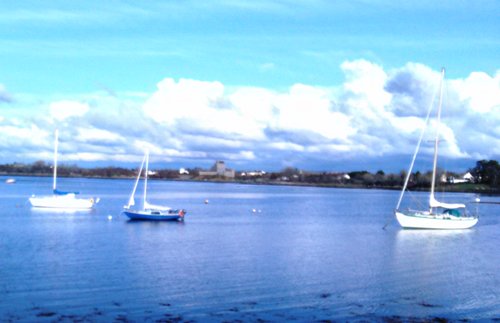
Photo: EO’D
Crown forces, finding the road to Ballyvaughan obstructed by walls built across the road, commandeered shopkeepers, artisans and labourers at Kinvara to remove the stones. At the Ballyvaughan side men were forced to remove similar obstacles at Muckinish and Bellharbour.
“We, the priests of the Diocese of Kilmacduagh, have heard with amazement of an outrage perpetrated against the Convent of Mercy and community, Kinvara on Sunday, June 4, by the police, who said they came to search the convent for rebels. We enter our solemn protest against their search of the convent, and we say that the search, and the manner in which that search was made, was a gross outrage on religion and an uncalled for indignity and insult to the Sisters.
Catholics well know that religious Sisters never harbour strangers or externs in their convent, and that the sisters’ cells are privileged, no strangers being allowed to enter them. This immunity was violated by the police and the manner in which the cells were searched was equally offensive to manliness and common decency.”
A large and enthusiastic meeting of the people of Kinvara was held on Sunday last under the presidency of Rev. Thomas Burke P.P, for the purpose of forming a branch of the Town Tenants League. The following were amongst those present;
Messrs Arthur O’Dea
Thomas O’Halloran
Patrick J Flatley
Bartley Bermingham
William R Flatley
Thomas Green (hotel)
Fred. J. Johnston
Michael Corless
Augustus Johnston
Thomas Leetch
James Davenport
John McMahon
Patrick Winkle
Edward Holland
John Fahy
Patrick Whelan
ThomasMoran
Michael Howard
Thos P. Corless
Correspondence was submitted from J Coghlan Briscoe Esq. T.C. Secretary Town Tenants Exec., Dublin after which a working committee and officers were elected as follows;
President; Rev. Thomas Burke P.P.
Chairman;Thomas P Corless D.C.
Hon Treas; Thomas O’Halloran
Hon Sec; Arthur O’Dea
Committee;
Augustus Johnston
Michael Corless
Michael Connolly
Patrick Flatley
Thomas Green
William R Flatley
Fred J Johnston
Edward Holland
Bartley Bermingham
Representative on Central Executive – Thos P. Corless D.C.
Representative on County Committee Thomas Green and Thomas P. Corless
A sum of £3 was forwarded to the Town Tenants Executive as affiliation fee. The next meeting of the branch will be held on Sunday November 14th and the first Sunday in each month afterwards. Rev Father Burke P.P has written to Messrs Kirwan, Tuam, agents on the Sharpe estate demanding a reduction of 50 per cent on all rents now due. The tenants are determined to pay no rent until their just demand is conceded. The Kinvara town tenants are the most rack-rented in the west and have not been allowed any abatement in their rent since the present owners purchased the property, notwithstanding the way the trade of the town has fallen and the wretched condition of the houses.
Kinvara Branch of Cumann na mBan had eight members, including:
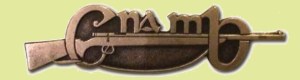
Cumann na mBan clasp
Miss Kate Fogarty
Mary Hynes, Dungora, Kinvara
Miss Aggie Staunton, Clooas, (sic.) Kinvara
Miss Mary Fogarty, Kinvara
Miss P. Regan, Kinvara
Margaret Johnston, Kinvara
The Soldiers of Cumann na mBan
by Brian O’Higgins
All honour to Óglaigh na hÉireann
All praise to the men of our race,
Who, in days of betrayal and slavery,
Saved Eire from shame and disgrace.
But do not forget in your praising,
Of them and the deeds they have done,
Their loyal and true-hearted comrades,
The Soldiers of Cumann na mBan!
Chorus
They stand for the honour of Ireland,
As their sisters in days that are gone,
And they’ll march with their brothers to freedom,
The Soldiers of Cumann na mBan.
No great-hearted daughter of Ireland,
Who died for her sake long ago,
Who stood in the gap of her danger,
Defying the Sassenach foe,
Was ever more gallant or worthy,
Of glory in high sounding rann,
Than the comrades of Óglaigh na hÉireann
The Soldiers of cumman na mBan!
Chorus
O, high beat the hearts of our Mother,
The day she had longed for is nigh,
When the sunlight of joy and of freedom,
Shall glow in the eastern sky;
And none shall be honoured more proudly,
That morning by chieftain and clan,
Than the daughters who served in her danger,
The Soldiers of Cumann na mBan!
Chorus
Brian O’Higgins (1882-1963) penned the lyrics of
The Soldiers of Cumann na mBan in the week immediately prior the 1916 Rising
This song has been arranged and recorded by Joseph Forde.

 The Burren and Beyond