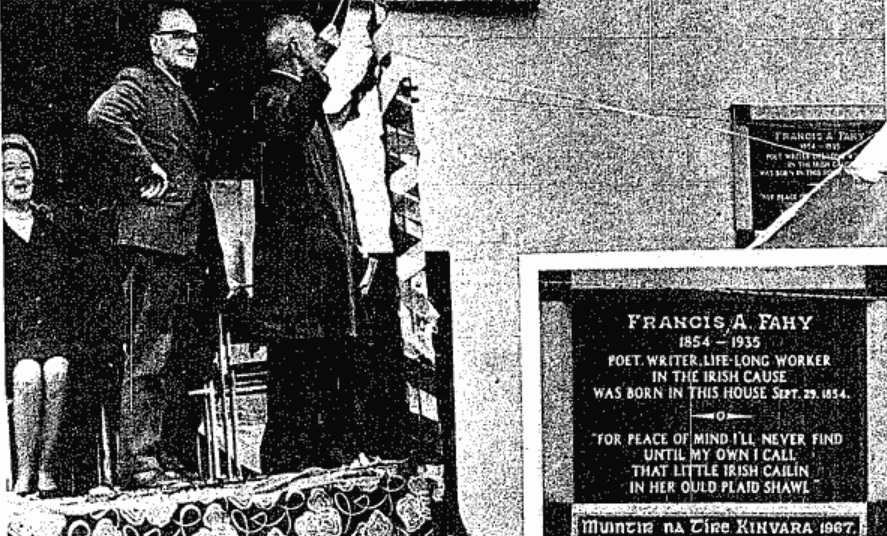
The unveiling of the memorial to Francis A. Fahy at Kinvara on Sunday last led to a large turnout. A son of the Kinvara-born poet, Mr. Dermot A. Fahy, from Cambridge, travelled from England to be present. With him were cousins of the poet, Mr. James Quinn and Miss Bofey-Quinn (Corofin), Mr. and Mrs. Marlborough(Corofin) and Mr. George Marlborough (Corofin). The local branch of Muintir na Tire organised the erection of the memorial and the County Executive of Muintir na Tire were represented by Mr. Peter Moylan, Loughrea, Mr. Joe Lally, Manager, Ireland-West was also present. The late poet’s son, Dermot, unveiled the memorial and addressed the attendance. Mr. Thomas Donlon, N.T., Dr. Francis Greene, Mr. Patrick Diskin, M.A., and Very Rev. B. Mulkerrin P.P., also spoke. Fifteen year old Geraldine Quinn from Crushoa, Kinvara, presented Mr. Fahy with her own oil painting of the scene of the “Old Plaid Shawl.” Mr. Richard J. Johnston, recited his own verse composition, “To Francis A. Fahy, Poet and Patriot: a Tribute.”
Tom May, Churches of Galway, Kilmacduagh and Kilfenora, Galway 2000
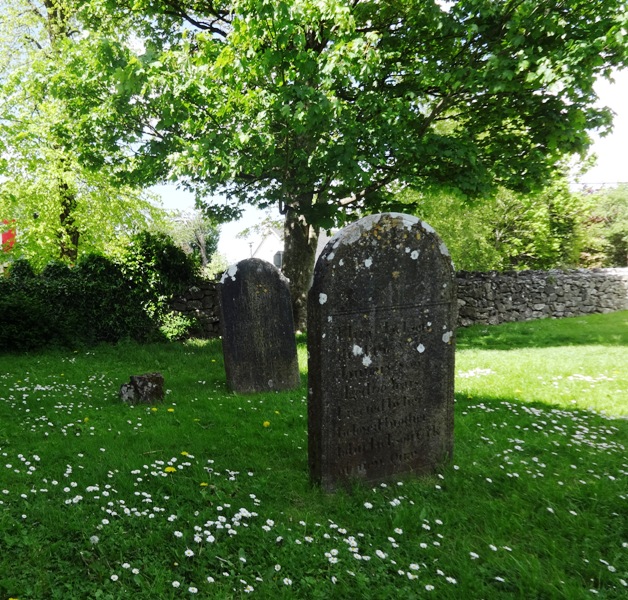
Church of England Graveyard, The Glebe, Kinvara Photo: EO’D
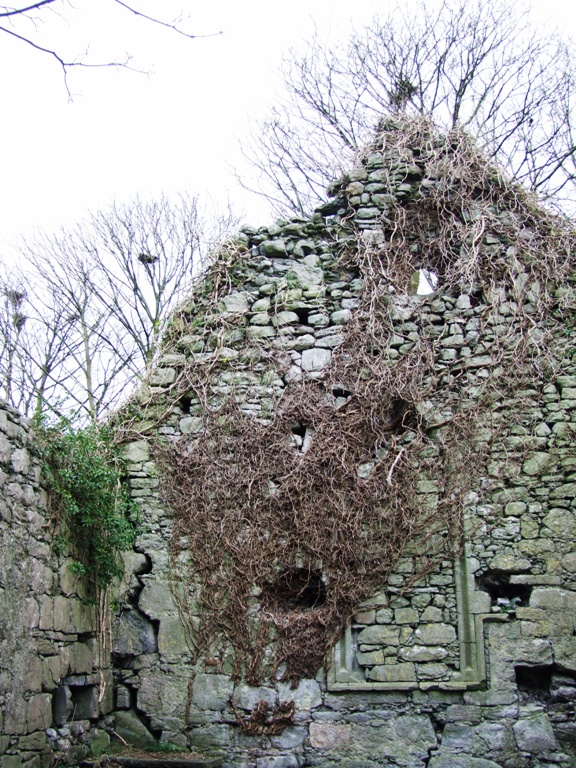
In 1939 Bishop Browne purchased a Church of Ireland building in Kinvara for 25 pounds and transferred
it to Noughaval, roofing the new structure with timbers from Galway gaol!
South Galway, which has already succeeded in having most of its parishes entirely or almost entirely electrified, is now moving steadily towards the completion of the scheme.
Kinvara Guild, Muintir na Tire, has already completed the preliminary spade work necessary for the launching of the scheme. The area hoped to be electrified comprises the entire parish of Kinvara, plus the northern part of Ardrahan parish not included in the primal electrification done in the district. In order to arouse interest the Parish Council of the Guild secured the services of Messrs. Treston and Carlin of the E.S.B. who showed films in Kinvara illustrating the many advantages of electricity. Mr. D. Treston, a member of the well-known Gort family, gave an excellent commentary on the films and explained the scheme of rural electrification. The members are conducting a house to house canvass prior to the official house to house visits of the officials of the E.S.B
The Privy Council met yesterday in the Council Chamber at 3.30.
Present:
Excellency the Lord Lieutenant, the Lord Chancellor, the Recorder, Right Hon. J.Napier, Mr. Justice O’Hagan, the Chief Secretary, Mr. Justice George, and the Lord Bishop of Meath. The Attorney-General and Solicitor-General attended.
In re the Churchyard of Kinvara, County Galway;
This matter came before the council on an application by the Poor Law Guardians of the Gort Union, for an order to close the ancient churchyard of Kinvara, on the ground of its being in a state dangerous to the public health of the district.
Mr. Blackburne and Mr.Mullins appeared on behalf of the parishioners of Kinvara, who memorialled (sic.) the Privy Council against the closing of the churchyard. The memorial against the closing was signed by Dr. McEvilly, the Roman Catholic Bishop of the diocese; by the Parish Priest; Mr. Lynch, a magistrate and upwards of 200 families living in the district, all testifying that it was not necessary to close the churchyard, that it was not overcrowded and that up to the present some portions of it had not been used for the purpose of interment. There was no danger of its becoming overcrowded, as the population of the district had very much diminished. The people of the district, counsel stated, were most anxious that the right of interment in this ancient burial ground should be preserved to them, for there were few families in the district who had not relative interred in it. If it were closed they would be under the necessity of having a new burial ground opened, for which it would be difficult to get a suitable site. It was admitted that some ten or twelve of the graves were scantily covered with earth, but that was a matter which a few workmen could remedy in a short time.
The Parish Priest of Kinvara was then examined by Mr. Blackburne, and his evidence was with a view of showing that the graveyard was not injurious to public health. He admitted portion of the earth in the eastern end had given way, but the bones exposed were the bones of persons interred at a remote period, from which no injurious miasma could possible arise. There was but little mortality in the district and it was not likely the graveyard would become overcrowded. The claim of the parishioners to the churchyard was on the ground of their ancestors being interred there.
The Recorder said it was very natural the parishioners should entertain a strong feeling on the subject. He inquired if upwards of 700 persons did not still claim the right of sepulture there. The Parish Priest, in reply, stated it was not likely more than 200 would claim the right. The Recorder said that there was no doubt as long as the churchyard was left open all would have the liberty.
After some discussion the Council determined not to grant the request of the Gort guardians, so the cemetery will remain open as usual.
A great demonstration was held at Kinvara on Sunday in furtherance of the object of the United Irish League. At an early hour the picturesque little town was thronged by a great concourse of people, and as each contingent arrived from surrounding parishes, ringing cheers greeted them. Clarenbridge and Rooveagh had a splendid turnout, headed by their fife and drum band, followed by an immense procession of horsemen dressed in green sashes and wearing their membership cards on their hats.
The following communications, have been forwarded to us by the committee for publication. They present the most gratifying prospect yet afforded with respect to the probable consequences and progress of the potato disease. In strictness we should say that one letter presents those gratifying features – that of Mr. Gregory of Coole, father of the representative for Dublin. That gentleman’s station and character are guarantees for the perfect truth of this consoling announcement; Coole Park, 27th December, 1845 My Lord, I have to apologise for not replying immediately to your communication, dated the 10th inst. I was, however, unwilling to answer your queries from my own individual judgment, without endeavouring to obtain the best information I could procure from those most able in this neighbourhood to give it. Among such I have carefully considered the evidence I have received from tenant farmers, and now that the panic has ceased, I am more likely to ascertain the truth than when I had last the honor of addressing your lordship. 1st Query – I am happy to be enabled to state that a most favorable change in the potato crop has taken place since my last letter, inasmuch as the disease is not on the increase. 2nd – I wish particularly to make this addition to my former letter – that in the return of the police constable of the Kinvara district, every potato was enumerated as bad in the percentage I had the honor to enclose, which had the last appearance of taint upon it, the greatest portion of these were perfectly available for human food, but from the rapid progress of the disease at that time, I considered it my duty to send you the actual number of the potatoes affected, without note or comment, as we entertained but little hope of the disease being so mercifully averted. 3rd – Presuming the potatoes now in pit to remain as sound as I hear they are at present, I have no reason to dread a deficiency of the potato food in the immediate neighbourhood. 4th – for fear of inaccuracy I must decline replying to this question but as an index to the state of opinion, I have to inform you that the price of potatoes in Gort market on Saturday was 2 1/2d per stone, and that the contract entered into yesterday by the Poor Law Guardians of the Gort Union was for a supply of sound potatoes at 4d per stone, for the next three months. I have the honor to be, my Lord, your obedient servant, Robert Gregory
Michael Bohanan, a native of Gelha (Geeha?), Kinvara, County Galway, who came to this country 21 years ago; he served some time in the late American War; when last heard from he was in St. Louis, Mo, Information concerning him will be received by his brother Stephen Bohanan, Geneva, Ontario County, N.Y.
24th April, 1874
Michael Kelly, a native of the parish of Kinvara, County Galway; father’s name Patrick Kelly and mother’s name Eilen Cavanagh, who sailed from Londonderry seven years ago last March; he worked in the State of New York; he left there and went to Chester county, Pa., and worked there until January 1981 when he went to Philadelphia and enlisted in the navy. Information of him will be received by his brothers, James and Peter Cavanagh, Address James Cavanagh, Millstone Point, Waterbury, Connecticut
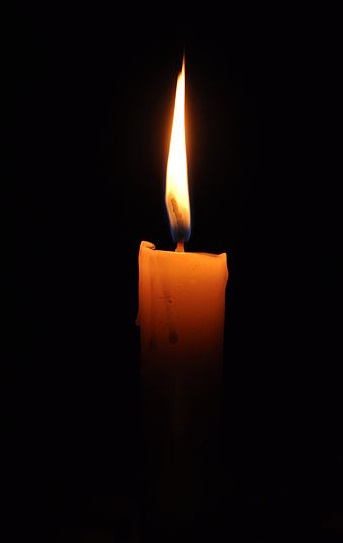
During Christmas, placing a light in the window of one’s home is
a tradition in parts of the west of Ireland, including Kinvara. In the old days the cottage door was also left unlocked throughout the night and a member of the family watched in prayer. The tradition arose from the story of the flight of the Holy Family into Egypt, following which, Joseph, Mary and Jesus wandered without shelter for fourteen days and nights.
Candles are placed in the windows to mark the event and offer safe refuge.
To the Editor of the Freeman
Kinvara, December 11th
Dear Sir,
I regret very much that the distress in the west, on which you so seasonably commented in your leader in Wednesday’s Freeman, is not confined to Clifden nor to Connemara, but is to be met with as severely elsewhere.
We have in Kinvara, with its population of over 350 families, want at present bordering on starvation, while the people in the rural districts all round are not much, if anything, better off, and unless our paternal Government open up public works in some form, actual starvation, with its usual sad and sickening train, will be the result before the 1st February.
Our rulers may shut their eyes to and pretend to ignore the present crisis, but there can be no question as to the existence of deep and general destitution among the labouring classes. This distress seems to be more keenly felt by a certain class of small farmers than it is by those who have nothing to fall back on but their daily pay, for the latter are more or less familiar with want, though not to anything like the present extend; while the former were before now comparatively comfortable, but this year an accumulation of misfortunes, for which they were unprepared, came upon them, and crushed them to the very earth. Rot among the sheep, consequent on the severe autumn and winter of last year; losses in the sale of stock, the partial destruction of their crops this year by blight, storms, and a wet summer and autumn – these were the casualties that crowded in rapid succession on the small farmers, and reduced them to a state worse, if possible, than that of the purely labouring class.
How miserable the condition of many among the small landholders is at present no person knows better than the priest who goes among them with all the freedom of a father, and is made their confidant in their weal and woe. It requires no prophet to tell how those poor people are to eke out an existence during the next six months, for starvation and pestilence will victimise many of them unless something is done to give employment to the many hands among them who are able and willing to work.
If, as we are assured, the solas pupuli be the suprema lex, surely the Government of the country is bound to save the people, and when this can be done without any loss to itself, as in the present emergency by opening up reproductive works. The obligation becomes so grave and solemn that no Government can overlook or disregard it without laying itself open to the charge of being anxious to get rid of its subjects “with a vengeance.”
In Kinvara a great deal might be done in the way of giving employment to the labouring classes. We have a beautiful bay, but no trade, except in turf; a good harbour, which we require badly, would do much to encourage and promote trade with Galway; opening a communication between Kinvara and Gort, a distance of seven miles, by means of a railroad, which could be laid down at present, would not only serve the poor by giving them employment, but would also materially benefit both towns. Then again, though it might sound paradoxical to assert it in the depth of winter, still it is perfectly correct to say that we are at the present time suffering from a dearth of fresh water, as the only one spring which supplied the whole town, and neighbourhood, has ceased (not an unusual occurrence) to yield its usual refreshing beverage, and in consequence we are compelled to put up with a substitute of a very muddy description, while never-failing wells of the most crystal like water are to be found on the burren hills about three miles off. But as far as we are practically concerned at present they may as well be thirty miles; for, like the lakes that “shone in mockery nigh” they are untouched and untasted by us. However, it would be very easy and by no means expensive to convey the water from those hills by pipes to Kinvara, and as employment is required for the poor, the present would be a very favourable opportunity for doing a very useful, if not a necessary work.
I am, dear Mr. Editor, faithfully yours,
J. Molony P.P.
The town of Kinvara was brilliantly illuminated in honor of the first visit of the Most Rev. Dr. O’Dea to his episcopal parish since his translation to Galway. His Lordship attended for the purpose of opening the mission conducted by the Capuchin Fathers in connection with the founding of the St. Patrick’s Temperance League of the West, as well as for the purpose of administering the Sacrament of Confirmation to hundreds of children throughout the parish.



 The Burren and Beyond