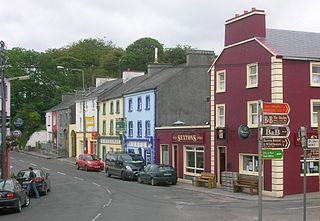
Townsville, North Queensland c 1870 Richard Daintree (1832-1878) John Oxley Library, State Library of Queensland. Wikimedia CommonsThe World’s News 21st April, 1917 p21
Will you tell me? (abridged)
Adjenda says:
“I see a correspondent (‘Kinvara’, Brisbane) asks, I presume for the meaning f the word Kinvara.
When I was a young man I was among the blacks of North Queensland and New South Wales; also for many years had them working for me. I can speak the language of both, but I never heard the word Kinvara, nor do I know the meaning of it. I think he refers to ‘Timbarra,’ which means ‘track him’. There is very little difference in the pronunciation of the words if uttered quickly.
<strong>The Richmond River Herald and Northern Districts Advertiser 13th July, 1920 p4
LABORER SHOT.
On Sunday- morning, at. 2 o’clock, the house of John Killeen, a laborer, living near Kinvara, was fired into. One bullet lodged in Killeen’s chest, and tho other fell beside him in tho bed. Dr. Connolly immediately was on the scene and had him removed to the County Infirmary, whore the bullet was extracted. Killeen is a laborer employed by Mr Fergus O’Dea, Kinvara, who held some land at Seamount from Mrs Nally, Kinvara, for the division of whose property a strong agitation has sprung up among the surrounding tenants. Mr. O’Dea surrendered part of his land, and Killeen and others took up an acre or so each. On Monday Killeen walled in his portion.
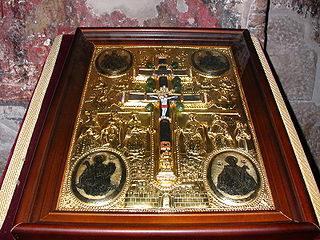
Relic of the True Cross, Decani Monastery, Kosovo Wikimedia Commons
Freeman’s Journal 21st October 1876 p 17
A daring robbery was attempted on the 10th of August, at Kinvara, near Ennistymon (sic.). The administrator of the parish, Father Molony, was attending a diocesan retreat of the clergy, and in his absence a burglar entered the oratory and abstracted a beautiful gold cross and silver pedestal, the latter containing a gold box set with precious stones enclosing a piece of the true cross. It was a treasured relic in the parish, being the gift of a French Catholic nobleman, Baron de Bastrot, whose ancestry, in the stormy days of the French Revolution, had acquired property in the locality. It is pleasant to say that the burglar was detected in his midnight depredations by some of the female inmates, who raised shrieks sufficient to awake the dead and appal the living. So terrible was their effect on the burglar that in his hurried exit through the window he dropped the booty in the dark, and did not consider it prudent, with Pandemonium at his heels, to stay and pick it up.
Kinvara Branch of the National League held a meeting April 28th
Rev. John Moloney presided. Among those present are Dr. W.J. Nally, Messrs Holland, Burke, Spellman, Cavanagh, Tallman, Shaughnessy, Farrell and Corless. £5 was forwarded to the Central Branch. The following resolution was passed:
“That we hereby beg to tender to Thomas and Patrick Cavanagh our sincere sympathy on the harsh and cruel treatment they have received at the hands of their landlord, Major Lynch, and his agent, Kendall of Connemara, in being evicted.”
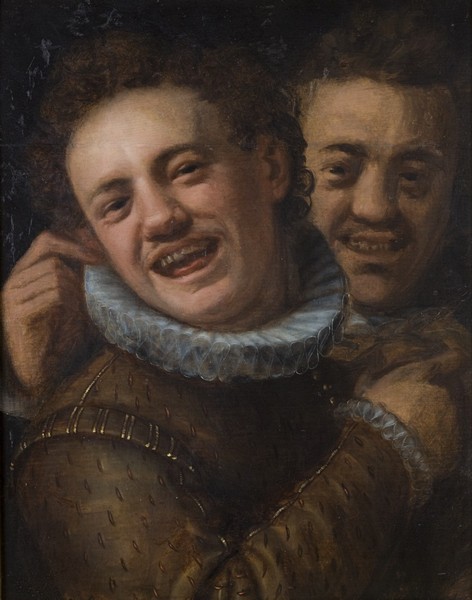
Two laughing men – double Self-Portrait c.1574 Hans von Aachen (1552-1615) Olomouc Museum of Art Wikimedia CommonsNew Zealand Tablet
Vol 27 Issue 21 – 27th May, 1909
GALWAY— A Myth (abridged)
Mr. William Moore, M.P., is a gentleman who takes a genuine delight in endeavouring to make the inhabitants of Great Britain believe that the wickedness of the people of Ireland, the country where he represents a constituency, is past imagining. No matter how pleasant or how peaceable the Irish Catholic may look, he is always, in Mr. Moore’s opinion, brewing mischief. Mr. Moore’s parliamentary life, therefore, consists of a daily array of questions as to what measures the Government have taken or intend to take in order to prevent this or that crime, or to punish this or that criminal. On Thursday, March 11, he enquired in tragic accents what the Government meant to do with Mr. James Hogan,- J.P., of Kinvara.
Mr. Hogan, he stated, was a plague in the community. He was a boycotter and oppressor, and had been inflicting suffering on innocent people. The law-breaker had been brought before the magistrates for his misdeeds, but being of his religious and political belief, they acquitted him. The Resident Magistrate had unavailingly protested against the scandal, and the County Inspector had urged the institution of further proceedings. The Attorney-General for Ireland had, however, refused to act on the suggestion, and the audacious Mr. Hogan, of Kinvara, was still at liberty.
Mr. Redmond Barry, amidst the laughter of the House, informed the-hon. member that Mr. James Hogan, J.P., was a myth that no such person exists at Kinvara, a Galway village, by the way, made famous through- one of Mr. Frank Fahy’s songs. The moral is very plain— that anti-Irish members are perfectly reckless as to the grounds upon which they prefer charges against Irish Catholics and Nationalists.
Dublin Penny JournalTUBBER MAC-DUACH (KINVARRA, COUNTY GALWAY).
From The Dublin Penny Journal, Volume 1, Number 25, December 15, 1832.
The place called Tubber-macduach, or Tobar Mhic-Duach, “the well of Duach’s son,” is situated about a quarter of a mile from Kinvarra, in the County of Galway, on the Loughrea side. Here is a small spring of water, neatly walled in, and shaded by a few hawthorns, in blighted contrast with the verdure of which there appears in the background the remains of a blasted and withered ash, whose aspect indicates that it has long stood companion to the holy fountain. The upper wall, apparently of recent erection, is in form a square of about seven feet to the side, having a small stile for the more easy admission of pilgrims. Beneath the square wall is another of a circular form, fencing in the whole, as represented in the annexed cut.
On the left hand side as you enter by the stile, you find in the interior of the upper wall a small niche, intended for holding a cup, and also serving as a receptacle for the offerings of devotees. Unfortunately for the guardians of the place, however, such tributes now consist of nothing more than a few worthless rags, brass pins, and the like. Mr. Sheehan, who when I visited this spot, resided hard by, caused a handsome stone cross to be erected in front of the well, between it and the high road, and the exertions of the parish priest, (Rev. Mr. Quinn,) were not wanting on the pious occasion.
This well seems to have been formerly the resort of St. Colman, who flourished about the beginning of the seventh century. He was a member of the illustrious house of Hua-Fiacra-Aidne, in Connaught, and was a near relative to Guare,[1] King of that Province, who began his reign about the year 604, and held the sceptre thirty-eight years. The saint was, from his father’s name, Duach, surnamed Mac-Duach, by which appellation he is more generally known than by that of Colman.
The earliest accounts of Colman’s life say that he lived as a hermit in the forests of Burrin, County Clare, attended only by one young clerk, his disciple. Their food was water-cresses and wild herbs–their drink the pure spring–and deer-skins served them for clothes. Having constructed a habitation and oratory encircled with trees, they remained in Burrin forest seven years, without conversing with any other person.
Colman’s reputation becoming very great, he was taken notice of by his relative, Guare, who was a prince[2] of great piety and liberality. He offered Colman as much land as he choosed for the establishment of a religious community, but the Saint, it is said, refused to accept of more than a small spot, on which he afterwards erected a monastery, and where he became bishop. This place was not far from his former habitation, and has, from his name, been called Kilmacduach. The foundation of that church took place in the early part of the reign of Guare, and probably before the year 620. After a life well spent, St. Colman died on the 3rd of February, but the precise year of his demise is unknown. His memory is held in high veneration in the diocese of Kilmacduagh.
From what has been already mentioned, the reader will perceive that the hermitage of Colman, alias Mac-Duach, must have been somewhere in the neighbourhood of the fountain just described, which springs in the barony of Kiltartan, part of the ancient Hy-Fiachra-Aidhne. This well is also near the barony of Burrin,[3] in the forests of which St. Colman is said to have secluded himself. It must likewise be remembered, that he and his attendant are reported to have lived upon water and water herbs, both which Tubbermacduach was capable of furnishing them with. I shall only remark farther, that the parish of Kinvarra, or Kinmarra, in which the spring rises, is a prebend in the diocese[4] of Kilmacduach, which See was, as I have already mentioned, founded by St. Colman.
Most probably this well, (like many others of the same description,) was used by the Saint, whose name it bears, for the purpose of baptizing converts to Christianity. Thus Archbishop Usher (Primord. p. 862-3.) says that St. Patrick baptized his converts in Dublin, including Alphin, the king’s son, in a well near Patrick’s Church, which in after ages became an object of devotion for the faithful, and so continued until it was enclosed within the foundation of a house, in the 17th century.[5]
NOTES:-
[1] Guare’s father was Colman, son of Cobhtach, who was cousin-german of Duach, the father of Saint Colman.– Vide Colg. A.A.S.S. p. 248.
[2] 2. Lanigan’s Eccl. Hist, Tr. 342.
[3] Burren barony was formerly denominated Hy-Lochlean, and was part of Corcumruaidhe district. The ancient proprietors of it were the O’Loghlins, of the race of Ir, by Fergus-Riogh and Maude, Queen of Connaught.–See Seward Top. Hib. title Burren, and Macgeogh. Hist. d’Irl. fo. 215.
[4] Harris’s Ware’s Bishops at Kilmacduach.
[5] See 1. Mac Geoghagan Hist. d’Irl. 258. to the like effect.
Galway County Council Archives ‘…to acquire, preserve and make accessible the documentary memory of county Galway’ U:\Archives – Collection Management\Descriptive Lists\Poor Law Unions\G01-12 Gort PLU2, 2009-11.doc ix
By January 1848 temporary fever hospitals were established in Kinvarra and Killeenavau (G01/12/7, p28). In April 1848 the Board accepted the tender of Martin Linnane ‘for the erection of Fever sheds near Kinvarra for one hundred patients at one pound two shillings per foot lineal measurement…’ (G01/12/7, p122). The Board at this time also accepted the tender of Michael Nilan for the erection of fever sheds adjoining the Workhouse, costs divided as follows, Office sheds at £1.1.6 per foot, fever sheds including bedsteads at £1.3.6 per foot, finding and setting boilers at £1.6 pre gallon, and clothes stores £0.12.6 per foot (G01/12/7, p124).
TOMAS MAC EOIN (for Tomás O Conaill): To ask the Minister for Defence what steps have been taken to settle the account due to Mr. Thomas Greene, of the Commercial Hotel, Kinvara, Co. Galway, for the hire of motor cars by the military authority during the period October, 1921, to March, 1922; whether he is aware that, in accordance with the instructions inserted in the local Press, Mr. Greene submitted his account to the Quartermaster, 1st Western Division, at Ennis, and received a reply from that officer, dated 18th March, 1922, to the effect that same was passed on to the Transport officer; whether Mr. Greene has since made several applications for payment without avail; and if he will take steps to see that this long-standing account is immediately settled.
General MULCAHY: I have no information on the matter, but enquiries are being made.
Ua Corra was a Connaught squire, not one of the jolly, fox hunting, rakish, ‘gentleman’ of more modern times, but a professor of the black art, who did not hesitate to hold direct communication with the devil, and to drag his wife into a partnership in necromancy. Like the three witches in Macbeth, they had their vessels, and spells, and charms, and pit of Acheron.
And now about the caldron sing,
Like elves and fairies in a ring,
Enchanting all that you put in.
These worthy parents had three sons in due time, who also surrendered themselves to the evil spirit. It was not confined to words. The three brothers at the head of a band of desperadoes, burned the churches and monasteries, and murdered their inmates. While their hands were still red with the blood of their victims, God, in a vision gave them a glimpse of the unspeakable torments of hell, which aroused them to a deep sense of their guilt, and to an earnest wish to repent. They entered the Magh Bile, where after expiating their crimes by a long course of penance, they resolved to make restitution, as far possible, for the ruin they had wrought. Accordingly they set to work to restore the churches they had demolished.
While engaged on the church of St.Cainin at Ceaun Mara, now Kinvara— a little town pleasantly situated on the Bay of Galway – they witnessed a sunset of unusual magnificence. The bright orb, as it descended into the Atlantic, turned it into a stripe of gleaming gold. The gorgeous sight inspired the idea of an Elysium, and the enthusiastic brothers determined to go out under that distant horizon, float over those golden waters and be near the sun as it sank into the wave.
Having fitted up a bark they set sail from Kinvara and roamed over the mighty waters for many years. In their wanderings they came upon islands teeming with nature’s richest and rarest gifts.
Coole Park, Gort Photo: AMcCarron Wikimedia CommonsHansard Commons Deb 28 June 1909 vol 7 c195W
Mr. DUFFY asked the Chief Secretary whether he is aware of the fact that the sergeant of the Royal Irish Constabulary stationed at Kinvara, county Galway, sends a telegram to the police authorities at Gort on each occasion that Mr. Michael O’Donohoe, J.P., county councillor, Kinvara, visits Gort in discharge of his public duties; will he state the cause or justification for such action, having regard to the fact that Mr. O’Donohoe discharges his duties conscientiously to all concerned?
§Mr. BIRRELL
I do not know whether the facts are as alleged, and I see no reason to inquire as to the manner in which the Constabulary authorities exercise their discretion in a case of the kind.




 The Burren and Beyond