Ireland is smaller than it was, only to an inappreciable extent, it is true, and apart from any action of the waves or weather which may have a tendency to affect its size by natural means. The truth is that some Ireland has been shipped to America in barrels.
Turf from Connaught and Clare, soil from Limerick and Mayo, heather from Croagh Patrick, shamrocks from Donegal, peats from the bogs of Ulster, turf from every county in Ireland, have been sent to Chicago to be used in building a miniature Ireland in the Coliseum. The soil will carpet the floor of the big building during an Irish fair which is to be held in that city. There were thirty-two casks of the soil, and it will be arranged in the shape of the counties from which it waa dug. There were eight great crates of peat, which will supply fuel for the miniature shops, stores, and houses that will be erected in each county.
New Zealand Tablet Vol XX Issue 22, 18th March 1892 p27
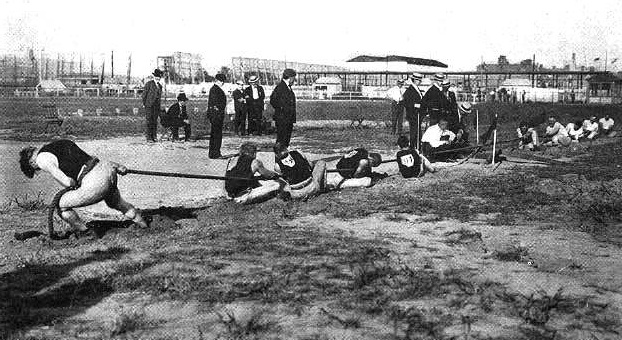
1904 tug of war Wikimedia Commons
THE IRISH WIN IN ADELAIDE.
(Sydney Freeman’s Journal.)
The Irish team, under Captain M. Ryan, have in the International Tug-of-War at Adelaide, South Australia, followed the example of their countrymen in Melbourne. In Melbourne Captain Flannagan carried the boys through without defeat, and secured the first prize of £100. In Adelaide the stout-hearted Irish also came through the tournament with an unbroken record against 17 competing teams, and carried off the bag of 100 sovereigns.
(Details on In the News at theburrenandbeyond.com)
The Catholic Press 13th June, 1907 p6
Father Fitzgerald OFM (abridged)
At the very period of the year when travellers from other lands are trooping to the beauty spots, of Ireland, her own sons and daughters are bidding farewell for ever to her shores. The column of the morning papers devoted to fashionable intelligence relates daily that various honorables with their ladies and retinue have arrived from abroad at Kingstown, but the emigrant ship may bear away her freight of the young and strong unnoticed and unchronicled save by widows wails and the ruined fireside. The emigration season sets in now in Ireland as regularly and as surely as the fishing or the shooting seasons.
To accommodate the thousands, or rather the scores of thousands, who depart yearly, excursion trains are run to the seaports, and large steamers compete with each other in speed and cheapness of transit to America. Indeed, it is a sad thing to meet one of those American excursion trains, still worse to occupy a place in the train even for a short journey, for scenes of great affliction occur at every station.
A bird of ill-omen appeared in Galway Bay on the 27th of the present month of April. This was an emigrant steamer the first of the season. Another will call in ten days more and take up her own portion and those who were left behind through over-crowding on Friday morning. About a fortnight ago a large poster, printed in red lettering, appeared on the dead-walls and gate-piers of Galway, announcing the fact that the Salmatian of the Allan Line would call at Galway on the above date. Details followed concerning the superior accommodation, and the lowness of the fare across. The news was carried through the hills of Connemara and out to the Isles of Aran and along the coast to Inishbaffin, and in answer to the call, like to the beacon-fires of old, many a youth and maiden was up and doing. Many a one humped the last Irish of seaweed up the barren hillside or spent the last dark night watching the phosphorescent gleam on the dark waters that tells of the herring shoal, or walked six miles, if not more, to the town and back to sell a quart or two of milk.
In almost every townland in the surrounding country there are celebrated several American wakes. Your readers may not know that this is the title given to the domestic celebration that is held in every home, however humble it may be. On the eve of the departure of one of its inmates to America, A quarter-cask of porter is provided, or some good poteen, and the neighbours get word, and music is supplied by a piper or an expert on a melodeon or a flute, or a concertina, or all in turn. The boys, and the girls take the floor, and the rinca fada, the curcaher, or the Curuckther are faithfully performed, until day breaks. Then, weeping takes the place of laughter, and the whole house turns out to accompany the parting one to the station, except the old grandfather or grandmother, who rocks the cradle with their foot and minds the house.
Lancaster, April 15, 1766. (abridged)
WAS committed to my Custody, on suspicion of being a runaway servant, a Girl, who calls herself Isabel Beard.
She was born in Ireland, and came in the Snow Pitt above two Years ago. She is about 4 Feet 8 Inches high, had on a blue Stuff Gown, striped Linsey Petticoat and Bed Gown, old Shoes and Stockings. She says she belongs to a certain William Grimes, a Jobber, and late of York County, where she says she left him.
Her Master therefore is hereby desired to come, pay her Charges, and take her away, otherwise she will be sold for her Fees, by MATTHIAS BOOGH, Goaler.
———————————————–
October 12, 1769 The Pennsylvania Gazette
New Castle County, October 3, 1769.
WAS committed to the goal of this county, upon suspicion of being runaway servants;
JOHN MONEY, born in Ireland, about 5 feet 6 inches high, black hair, pale complexion, by trade a weaver. When committed he had on a light coloured homespun cloth coat, linsey waistcoat, and coarse tow trousers.
ELIZABETH MOORE, a native Irish woman, about 30 years of age, fair complexion, brown hair. When committed, she had on a stampt cotton gown of a purple colour, a linsey petticoat, shoes, and stockings.
Their masters (if any they have) are desired to come, pay their cost, and take them away, in 6 weeks from this date, or they will be sold for the same by THOMAS PUSEY, Goaler.
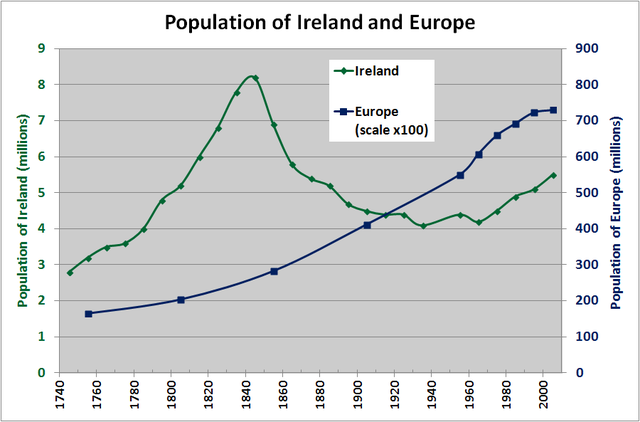
Population of Ireland and Europe 1750 to 2005CC BY-SA 3.0 Ben Moore – Own work Wikimedia Commons
ENFORCEMENT OF THE POOR RATES
The Limerick Chronicle of yesterday contains the following extract of a letter from Kinvarra.
“On Tuesday morning, at eight o’clock a large military force, about 300 strong, of cavalry and infantry, including 4th Light Dragoons, 69th and 89th detachments, under Colonel Sir Michael Creagh, with 56 of the constabulary under Mr Macmahon, S.I., accompanied by two stipendiary magistrates, Messrs Davys and Kelly, marched from here to the district of Kinvarra and Doorus, where the collection of poor rates was successfully resisted on a former occasion.
On arrival at Doorus this force was joined by 100 rank and file of the 68th under Major Smith and officers from Galway. Having crossed the bay in man-of-war boats, the entire party then traversed the county in different directions for eight or nine hours, presenting a formidable array, and meeting with no resistance or obstruction while the poor rate collector and his men were busily engaged collecting the rates, and received a large sum, although the doors in almost every village and hamlet were closed: however all who could pay, paid their rates, and the people themselves had removed the barricades some days before.
About thirty of the principals concerned in the former riots have been arrested by the police and lodged in Gort Bridewell.
On Monday last the military and constabulary were again out collecting poor rates, under Sir Michael Creagh, accompanied by two resident magistrates, and after traversing a considerable extent of barren country and visiting many a desolate village, the troops returned to Gort, having experienced no resistance.”
Dublin, Wednesday evening.
NOTE:
The Poor Rate was a form of taxation arising from the Irish Poor Law enacted by the British Government in 1837.
The Sydney Morning Herald 25th October, 1849 page 3
GO TO IRELAND.
(From the Times, June 15. – abridged)
A SEASON comes in every year when English- men are converted into a nation of tourists.
The high-pressure Parliamentary, professional, and commercial occupation is taken off, and the enjoyment of the holiday-making is in proportion to the irksomeness of the previous confinement. We are a good deal laughed at by foreigners for our roving propensities—they are never at the pains to consider the true explanation of the fact. It is because we work so hard that, when we find an opportunity, we travel so fast and so far. We are but changing our occupation after all, and making a business of our amusement.
An English traveller does his work as conscientiously as the most trustworthy bagman. He purchases one of Mr. Murray’s handbooks for a particular district, and verifies the indications it contains. He checks off the mountains, ruins, and galleries, and is very careful in communicating to Mr. Murray any information he may practically glean as to the qualities of inns and the peculiarity of diet. ” Tourism” is, in fact, a duty of annual recurrence, and must be discharged.
Ballybranigan EJO’D
This year, unfortunately, the continent is sealed to pleasure-seekers. To which of the old remembered spots shall a tourist convey himself and his family? To be sure, if he has a taste for Dutch pictures there is the Hague, and the flat plains of the peaceful lHollanders. Between this and Turkey a traveller must make his election if he desire to travel in continental parts. In Paris a man’a dressing-case and the bonnet-boxes of his helpmate might at any moment be converted into the topmost ornaments of a tasty barricade. If a summer party should try the Rhine, this is but another word for offering themselves as targets to the Trans Rhenane marksmen. A corpulent merchant or a dust conveyancer who should adventure his person at Baden would, as a matter of course, in twenty-four hours find his head decorated with a gaily-plumed hat, and himself marching under the greenwood tree to various Republican airs of an exciting character. Prussia won’t do. Saxony with its beautiful capital is still worse. Who would willingly try the Danube and Austria ? The Italian peninsula is out of the question. From desecrated Venice to that city which has been so rashly styled Eternal, and thence to Naples, all is trouble, disorder, or actual warfare. For this year the Continent is hermetically sealed to all but the most adventurous and irresponsible tourists.
We are so far happy in the British isles, that it is rather an advantage to those amongst us who love beautiful scenery for its own sake to be turned back upon our own country. The impulse to “take a run upon the continent” when we have a month to spare is too strong to contend against. Now, whether we will or no, we must fall back upon our own resources. There are the Scotch Highlands and the English lakes; there are North and South Wales-Snowden and the Vale of Festiniog ; Chepstow and the Wye ; there is Devonshire with the Dart and the Exe ; there are the southern counties with all their beautiful home scenery. All these points are more or less visited by all wanderers.
IRELAND
There is one portion of the British isles, however, which, as far as beauty and variety of scenery are concerned, yields to no other, but yet remains comparatively unknown. How few are the persons who, except for business purposes, have visited the southern and western districts of Ireland? One occasionally meets a stray sportsman who has gone salmon-fishing in the Shannon, or spent a season in Connemara, but these are rare exceptions to the rule.
Ireland, by mere tourists, not being natives of the country, is rather less frequented than the Spanish Peninsula, and yet it would be easy to point out in it districts which, once seen, would hang in the recollection for ever as spectacles of natural beauty. There is the Bay of Dublin; nearly the whole of the county of Wicklow; the counties of Waterford and Cork; Kerry with the Killarney Lakes; the South Riding of Tipperary with the Golden Vale; portions of Limerick; Clare with the Mohir Cliffs and its fine coast scenery; Galway with its magnificent bay; Connemera with the Killeries, and districts of Mayo,
If a tourist should visit the spots we have just indicated he would return with the conviction, that beautiful as continental scenery may be, there are points in Ireland which may stand competition with the show districts of any other country.
In the advertising columns of The Times of this day will be found an advertisement to which we wish to give every support in our power. An agreement has been come to between the London and North-Western Railway Company, the Chester and Holyhead Railway Company, and the Great Southern and Western Railway Company, by which tourists can be transported from London to Killarney and back for £6 in the first, and £4 in the second class.
They will have an opportunity given them of visiting the Cove of Cork and the beautiful scenery of the south of Ireland. Other advantages are offered, particulars of which will be found in the advertisement. There is no way in which a fortnight could be more profitably or ” enjoyably” spent than in such a trip; but, independently of this, we wish to recommend the scheme to public attention for other considerations.
In view of the triumphal progress of the Irish delegates in America, it may be interesting to give some figures showing what Irish-America really means:-
The city of New York contains more Irish than Dublin, Cork and Belfast combined.
The city of Brooklyn contains more Irish than Galway and Waterford put together.
There are more Irish in Boston than in Dublin, and more in Philadelphia than there are in Belfast – but it is in the Irish names in America that the greatest proof is evinced of the devotion of the Irish exile to the old land.
There is an Ireland in Alabama, another in West Virginia, another in Indiana and another in Minnesota.
The are three Hibernias situated in Florida, New Jersey, and New York.
There are five Erins scattered throughout the States of Georgia, New York, Tennessee, Texas, and Wisconsin.
There is an Irishburg in Virginia, an ‘Irish Ridge’ in Ohio, an ‘Irish Ripple in Pennsylvania, an ‘Erina’ in Nebraska, ‘Erin Shades’ in “Virginia, and ‘Erin Spring’s’ in Indian Territory.
The names of Irish provinces are illustrated by Munster in Illinois, and Munster and Ulster in Pennsylvania.
In New York there is an Ulster Park, an Ulsterville, and an Ulster County.
There are 17 Dublins in the States, 18 Waterfords, 9 Tyrones, 7 Limericks, 5 Clares, 4 Mayos, 4 Sligos, 3 Corks, 3 Wexfords, 6 Antrims, 9 Derrys (four of which are called Londonderry), a Roscommon. a King’s County, a Queen’s County, a Galway, a Wicklow, a Longford, Kilkenny, Kildare, Donegal, Carlow, Monaghan and Armagh.
There are 12 places called Avoca, and 6 places called Avondale in honor of Parnell. There are also several places called after Parnell himself. There is a Garryowen in lowa, a Tullamore in Illinois, a Rathdrum in Idaho, an Achill in Roscommon County, Michigan; a Ballina in California, a Doneraile in Kentucky, a Strabane in Dakota, an Ardee in New York and in Tennessee, a Kinsale in Virginia, a Kincora in New Jersey, a Tara in lowa, a Navan in lowa, and another in Michigan, a Queenstown in Maryland and Pennsylvania while there are twelve towns called Westport, four called Newry, thirty called Newport. There’s a Valencia in Kansas and Pennsylvania, four places called Ennis, a Kilmichael, a Kilmanagh, Lismore, Lisburn, and eleven Bangors.
There are ten places called Belfast, a Boyne in Michigan, a Bandon in Minnesota and in Oregon, a Clontarf in Minnesota, a Dungannon in Ohio and twenty-five, Milfords.
Almost every State in the Union has counties called after the famous Irish-Americans of revolutionary fame. There are two counties eight towns, and seven places called after Jack Barry, ‘the father of the American Navy’ who was a County Wexford man. It would be almost impossible to enumerate the towns and places named after ‘Old Ironsides,’ Parnell’s grandfather. The ‘Starktowns are also very numerous, some in honor of General Stark and some in honor of his wife, ‘Irish Molly Stark,’ as she was always lovingly described, who took her husband’s place when he was killed at his gun, and remained in command of the gun till the end of the war. She was created captain for bravery in action, but never lost the title to ‘Irish Molly.’
In honor of O’Brien, of Machias Bay fame, there ia an O’Brien County in lowa, and an O’Brien in Glynn County, Ga. In honor of Patrick Henry we have 10 counties and 18 towns. There are towns and counties ad libitum called M’Donough, Sullivan, M’Cracken, Calhoan, O’Brien, Emmet, Meagher, Dougherty, Murphy, etc. Phil Sheridan has no fewer than 3 counties and 17 towns named in his honor while there are several Colorans, Burkes Shields, Kearney, Clebarn, Mulligan, Moran, Lynch, Kelly Mai one, etc.
The Shannon Pot – traditional source of the River Shannon Photo: Gerard Lovett Wikimedia CommonsTHE SALT LAKE TRIBUNE 27TH MARCH 1910 P5
Ireland has had her share of floods and can sympathize with France. Along the Shannon in some places the water invaded the country for miles at each side, compelling people living near to hasten from their homes. In one or two places the inhabitants of entire villages sought shelter elsewhere. Some of these people suffered great loss as their entire farm produce was swept off on the swollen river. So great was the flood that the powerful cargo boats could scarcely make headway.
The district near Athlone suffered much and a considerable number of men were thrown out of work. The greatest sufferers are the inhabitants of the islands in Lough Ree, where the water rose to an alarming height. They were completely cut off from the mainland for days and unable to obtain supplies of food or fuel.
Tobacco Flower, leaf and buds. Photo: William Rafti Wikimedia CommonsTHE INTERMOUNTAIN CATHOLIC, 10TH AUGUST, 1907 P1
TOBACCO IN IRELAND
Tobacco culture was introduced in Ireland by Sir Walter Raleigh during the reign of Elizabeth. County Cork can boast of being the first part of the country in which the plant was cultivated. The plant thrived and grew abundantly in the prolific soil of this country for some centuries.
During the reign of Charles II a law was passed prohibiting the culture of tobacco in Ireland. However, in the reign of George III the act was repealed. The people had forgotten all about its culture until some inhabitants of Wexford returned. This state of things continued till 1829. In this year 1,000 acres were under cultivation in Ireland. The industry is now flourishing in County Meath.
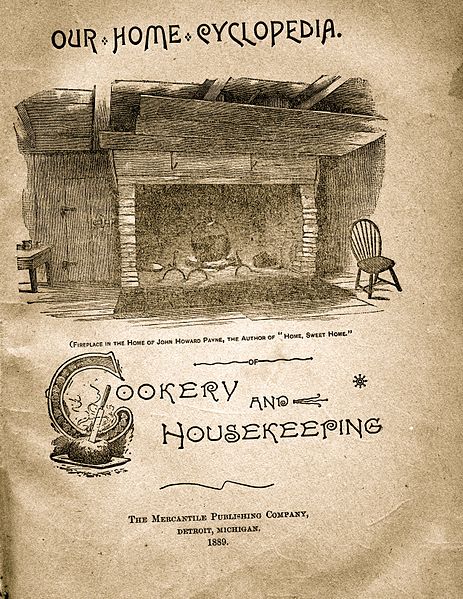
Title page of “Our Home Cyclopedia,” of “grocery and housekeeping – 1889 Mercantile Publishing Company Wikimedia CommonsTHE TIMES (LONDON)
28TH MARCH, 1788 (abridged)
Mr. Conolly of Ireland has brought forward a motion for abolishing the tax upon HEARTHS, and the Irish Ministry will not oppose it. In Ireland, hearth-money is at this day more oppressive than ever it was in England.
This tax has ever been hateful, and as the subject is again revived- we will give its history. In Doomesday-Book, compiled by order of William I. there existed a tax called fumages or fuage, which common people termed smoke farthings. This tax was paid by custom to the King, and was rated upon every chimney in a house.
Edward, the Black Prince, after his successes in France, in imitation of the English custom, imposed a tax, one florin upon every hearth in his French dominions. This tax is mentioned in the twenty-third volume and four hundred and sixty-third page of the Modern Universal History, and in Spelman’s Glossory under the word Fuage.
In the fourteenth year of the reign of Charles II, a statute was passed in Parliament that all houses liable to church and poor, should pay two shillings for every hearth. This payment was granted as an hereditary revenue to the king for ever. Subsequent statutes allowed a surveyor, appointed by the crown, a constable and two other inhabitants of the parish, to view the inside of every house in the parish.
Hearth-money was eventually abolished by a statute, passed in the first year of King William and Queen Mary. The statute declared-that hearth money is “not only a great oppression to the poorer sort, but a badge of slavery upon the whole people, exposing every man’s house to be entered into, and searched at pleasure, by persons unknown to him. To erect a lasting monument of their Majesty’s goodness in every house in the kingdom, the duty of hearth-money was taken away and abolished.”
Ireland awaits and the Minister will acquire well earned popularity by not opposing its annihilation.
NOTE: The hearth tax was abolished in England in 1689 – It was abolished in Ireland during the 19th Century.


 The Burren and Beyond