Posted in Posts and podcasts

The Ould Bad Scrawl – 1901

Evening Herald 7th October, 1901, page 4
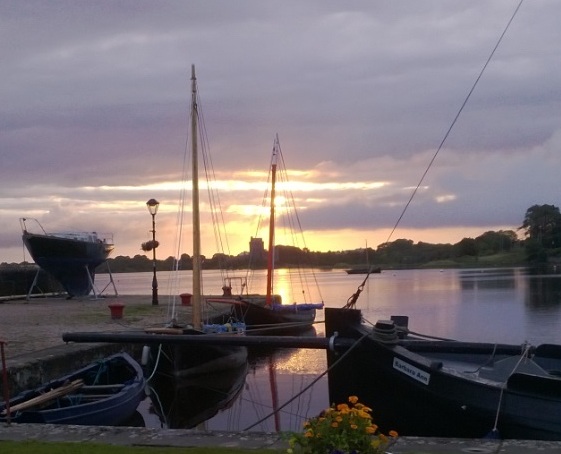
Morning Light, Kinvara
Photo: EO’D

From “Cloona” (Ballinrobe)
How is our good friend Bartley Hynes, of Kinvara and has he altered the Gaelic inscription on his donkey cart? The Irish class at the Depot has not been started yet, but they are investigating whether the crosses on donkeys’ backs are “legible.” My laureate had dedicated his ballad, “The Ould Bad Scrawl” to the Kinvara “copper,” but so far has not apologised to the authors of the “Ould Plaid Shawl.”

This is how he tears the cloth:-

Not far from ould Kinvara, on a merry August day,
When winds were singing cheerily there came across my way
As if from out the sky above an earthquake chanced to stray
An ass, a cart, a man named Hynes, likewise a load of hay.
He tripped along right joyously, his hat upon three hairs,
And seemed as if this cruel world from him had kept all cares.
His bright eyes glistened ‘neath his brows – he looked so trim and smart,
As he pointed to the name of “Hynes” in Irish on his cart.

I courteously saluted him, “God save you sir,” said I.
“God save you kindly, sir,” said he, and winked the other eye.
“I’ll thank you for your name,” says I, “as well as your address,
I’m a constable of police, and I fear you’re in a mess.
By 12 and 14 Vic.,, you see, and section ninety-two,
Your name must be upon your cart, so I must summon you.”
“Bedad,” says he, “’tis like ‘Lynch’ law, me liable to fines!
For writing in my native tongue the name of Bartley Hynes!”

Some people sigh for riches, some people live for fame,
And some upon their vehicles in Irish put their name.
My aims are not ambitious, though my wishes, don’t you see,
Are to get a quick promotion in the gallant R.I.C.
I’ll summon them through Galway, and I’ll summon them through Clare;
I’ll have no Irish on their carts, but English everywhere,
Else peace of mind I’ll never find, this motto’s next my heart
“When a name is writ in Gaelic, put the owner in the cart.”
Posted in Posts and podcasts

Bridget – 1900

New York Tribune 15th June, 1900 p9

c EO'D
c EO’D

Bridget Coughrey from Clifden County Galway landed here yesterday with only a shilling in her pocket and for a time she had the immigration officials puzzled.

She was so comely and so earnest in her endeavours to explain that there was universal sympathy for her. But she could not speak a word of English and Gaelic was not understood in the Barge Office. Finally one of the officials sent for Peter Groden. Peter relapsed into Gaelic the minute he saw Bridget. They talked it over and she told him she was the eldest of five children. Her family was struggling for a living at home in County Galway and she had come over here to earn money to send home to pay the rent of the farm, which amounts to $80 a year. Bridget said that she was on her way to see Patrick Coughrey her uncle who lives in Pittsburg. He would advance the money necessary for her transportation if he was informed of her predicament. Peter told the officials what she had said and they sent word to her uncle at once.

Posted in Posts and podcasts

Bridget – 1900

https://widgetworld3.wordpress.com/podcasts/

THE INTERMOUNTAIN CATHOLIC, 30TH JUNE, 1900. P3

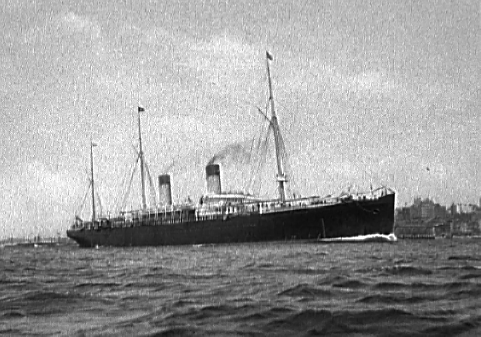
 White Star liner S.S. Teutonic 1900  Photo:John S. Johnsten wikipedia.org
White Star liner S.S. Teutonic 1900
Photo:John S. Johnsten
wikipedia.org

LONESOME IRISH LASS
Had Only the Gaelic Language and a Shilling to Begin New World With.
A lonesome blue-eyed little Irish girl from County Galway landed the other day at the barge office in New York from the White Star line steamship Teutonic. She would not have been so lonesome if she had not been the only person in the ships company who had
no English. There was not a soul among all the Irish immigrants who could talk the Gaelic with her and she made herself understood by signs and smiles.  She had so many of the latter
that she made friends of all the Irish aboard who all regretted for her sake that they were not of the stock that have regained a knowledge of the language of their fathers.
All the baggage the child had was a big valise and all the money she displayed to the inspectors was a bright I shilling piece. The interpreters tried to make out what was her object in coming to America. None of them succeeded. Then somebody recalled that
Peter Groden the barge office plainclothes cop was an expert in Gaelic. He was sent for and came in a hurry. There is nothing delights Peter more than talking Gaelic.
The girl opened her eyes when Peter began crooning to her in her only tongue. Then her smile broke out like a sunburst and she clasped her hands about Peters neck, greeting him as a cousin. Peter is not her cousin but she considered that anybody who could talk her language in America must be at least a cousin.
Peter was much impressed with the girl. She told him between smiles that she was Bridget Coughrey and that she was the eldest of five children. Her parents rent a farm at Clifden, County Galway for which they pay $80 a year. She had learned from letters in Gaelic written by her uncle, Patrick Coughrey of Plttsburg, that there was a chance in America for an energetic girl to make a good living and she had persuaded her father and mother to let her come to her uncle.
They said they would and the uncle sent her a ticket entitling her to passage from Queenstown to New York aboard the Teutonic. She told Peter  that times were hard at Clifden and she expected to make enough by working in Pittsburg to pay a good part of the yearly rental of the Galway farm.
Peter took her over to the Mission of Our Lady of the Rosary at 7 State street and Father Henry took care of her She said that the buildings in the lower part of the town were much bigger and finer than any at Clifden or Cork.

Her uncle has been asked to send her fare to Pittsburg. He probably will but if he does not Bridget will be sent
to Pittsburg at the expense of the mission.