Posted in Posts and podcasts

The Long Black Hand

The Schools’ Collection, Volume 0036, Page 0210
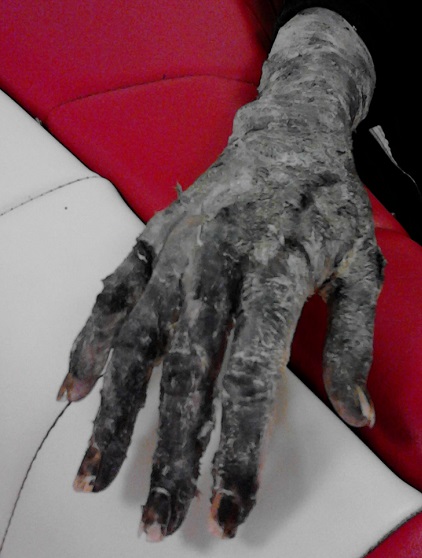
The long black hand

National Folklore Collection, UCD.
From Ardrahan, Co. Galway
Teacher: Tomas S. O Meadhra
Collector: Cahal Kelly from Michael Kelly, Ardrahan.
There was a certain old witch in Kinvara and she lived under a big tree with five branches out of it. Every night at ten o’clock she used to come out on the road and every one that would pass she would kill them. There was one brave man in Ballindereen named Blake and this night there was a great banquet in Clough. The people of the place told Mr. Blake that there was a ghost in the place and he would not believe it. He sent a soldier named Hynes to see if this was true. They gave him three sheaves of oats by which he would know if the ghost was there. The man with the sheaves of oats ran on around the grave three times and the third time she hit him with the lid of a churn. The man went from the place about three miles and the long black hand gripped to the horses mane. He drew his sword and cut the hand up near the shoulder. A voice said ‘Hit again. You have enough and keep it.’ He went home and told them but they would not believe him. He told them to go out and see the long black hand on the horse’s mane and they did and found the horse dead.
Posted in Posts and podcasts

Local place names – Killina N.S.

From Margaret Cavanagh (c.1937)wall
When the women of our village “Clúin-a-see” would be leaving a cake out to cool on the window-sill they would first take a bite of it. The fairies would take it only for that.
There is a field near my house it is called poll-a-Feóla. It is called that name because in olden times robbers used to steal sheep from farmers and kill them and hide them there. There is a great big heap of stones in the middle of the hole.
There is another hole near our house and it is called pollac-na-mbó. It is called that because since it was made there are cattle going into it for water. One time people were trying to make a road down to it. Every night the stones used to be put back to the place they cleared. One night they stayed there after six and they saw a stick pointing towards them. Nobody tried to “ready” it since because they think it is haunted.
There is another hole near my house. It is called poll-beacháchán it is so-called because a man was following a fox on horse-back and they fell into the water and got drowned. There is another field called poll na Choonach. There are badgers living in it.
There is another field and my father said there was war in it once. There is another hole called poll-eidhin. It was choked by ivy long ago. The people filled it up with stones for fear the cattle would fall into it.
There are some people great for putting “the bad eye” on things. They would say “Isn’t that a fine child” and would not say “God bless him”. There was a woman and a boy coming home from town at ten in the night and every step she took there used to be a candle-stick before her on the road and she put them in her basket and kept one in her hand and when she reached home she had only the one that she had in her hand and people say that it is in Gort yet.
There is a “lios” near my house and it is down in history. The name is liosin-a-mheala.

Posted in Posts and podcasts

Irish Fairy Tales – 1893

Freemans Journal 1st November, 1893 (abridged)

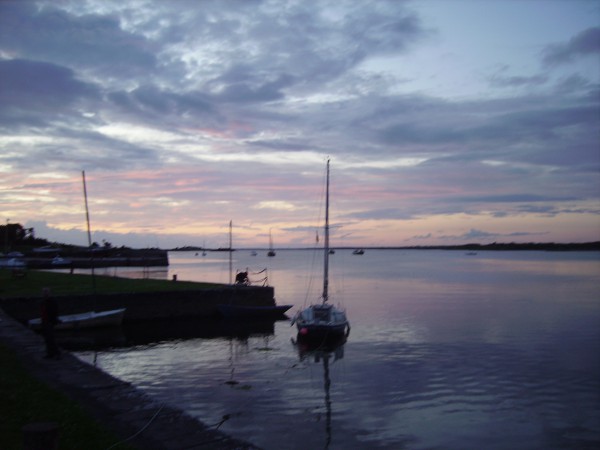
Kinvara Twilight Photo: BO'D
Kinvara Twilight
Photo: BO’D

Mr W. B. Yeats delivered an interesting lecture on “Irish Fairy Tales” at 15 D’Olier Street last evening, under the auspices of the Young Ireland League. Mr Henry Dixon presided.
Mr Yeats, who was received with applause,  said that night was sacred to the fairies in general and to the phouca in particular. The phouca sometimes appeared as a horse, sometimes as a donkey, sometimes as an eagle and, indeed, took innumerable four-footed and two footed shapes.

The night of Samhain in old Pagan days was the commencement of winter, over which presided the phouca, whom the people considered the spirit of decay. They believed it was dangerous to go abroad on that night because the fairies might carry them off into their kingdom.  That night also the dead were believed to come out of their graves and ride upon the white sea waves, and there were stories of fishermen, who, having escaped the waves and come ashore, found the dead grasping them from behind.

Mr Yeats related a number of interesting fairy tales and said that folklore afforded the most beautiful material for literature and they could not do better than encourage people to use it for such. Every country in the world had these beliefs and universal belief like that meant some universal need for it. If there was not deep down in the human soul some need to think about imaginary beings more beautiful and more powerful than the men and women they met in ordinary life, these things would not have arisen.   Forelore gave a beautiful and most ample expression for their vast emotions –  emotions which were always struggling to express themselves but were beaten down by the sordid interest of real life.  Poets were folklorists who had listened to the voice of the people.  They had taken the stories of the old men and women and had made them the delight of the most profound minds of all nations.