Mrs Skerrett, of Pembroke road, Dublin and Finavarra House, Kinvarra, Co. Clare, has let the latter place for the summer months to Mr. J. Harris Stone, B.L. of Oxford and Cambridge Mansions, London. The change to the solitude of the Burren district will be pleasing to the tired London man, and the air is deliciously fresh. There is a fine music room at Finavarra, and a series of theatrical performances was given there a couple of years ago by Mrs Skerrett and her sister, Mrs Sampson – both widows and full of quite unique talent in a musical and histrionic way.
Irish Examiner 17th July, 1914 p.5 (abridged)
By the Volunteers of North Tipperary it is persistently rumoured that on Sunday week a cargo of arms, supposed to be from the Tipperary Men’s Association in America, was landed at Finavarra Point, West Galway. In the days following, the arms, it is alleged, were brought by night by easy stages, by the various Volunteer corps in West Galway, through Gort, Woodford and Williamstown, reaching the latter village on Saturday night last. Here the arms were received by a number of volunteers from the Tipperary side of Lough Derg, and in the course of the night were transferred by boat to Terryglass. Next day (Sunday) while the Volunteers of North Tipperary were mobilised at Nenagh, and while the police of the district were on special duty in that town, the arms, it is alleged, were hidden in a bog. The strictest secrecy was observed while the arms were in transit and it was only when they were well under cover that the information leaked out.
In view of the above rumour it is interesting to note that the commander of the Nenagh corps last even when dismissing his men publicly informed them opposite the Literary Institute that they would be in possession of rifles next week.
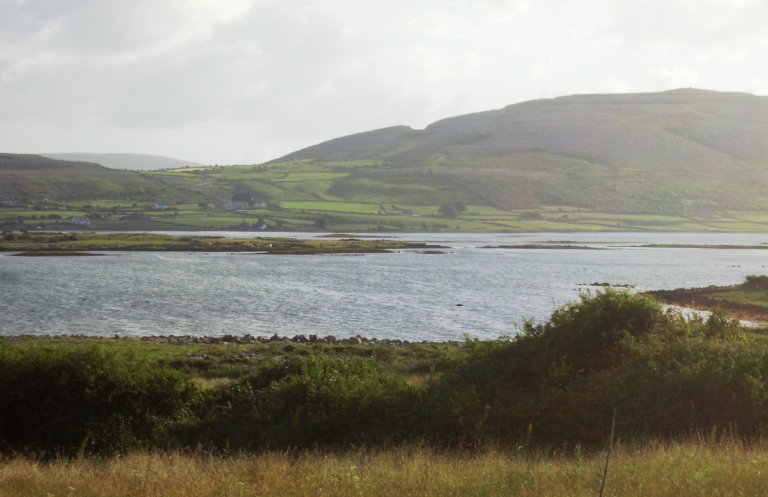
New Quay is encircled on the south side by the rugged range of the Burren Mountains showing the ancient ruins of Corcumroe Abbey, Aughmama Abbey, Mucknish castle, and other castellated ruins along Bellharbour Bay, with the villages of Curranroe, Kinvara, Bellharbour, Ballyvaughan and Finavara, in the immediate vicinity. The air at this district and its surrounds, filled with the ozone and saline of the salt sea of the Atlantic Ocean infuses new life and vigour into one accustomed to living in inland places where the air is entirely devoid of those health giving properties and less embracing.
There are two bathing centres in New Quay supplied with bathing boxes, and a splendid range of sanded strand, one at New Quay and the other at Old Quay, a short distance away towards the Flaggy Shore. The circle of sea surrounding New Quay extends from Curranroe, at the boundary of Clare and Galway, by Munna and Carton, along one of the northern peaks of the Burrin Mountains and continuing on by Old Quay, the Flaggy Shore, Finavarra, Martello Tower and Scanlan’s Island. At this point the entrance is to Bellharbour Bay by a narrow strait dividing Finavarra from Mucknish castle and Ballyvaughan and continuing inland by the southern slopes of Finavarra demesne, and Corcumroe Abbey to Bellharbour Quay and circling outward in the opposite direction by Muckinish Castle, Oughmama Abbey and Ballyvaughan, under the shade of the Burren Mountains.
In fine weather the open sea from the mountain heights and verdant plains of this district, presents one crystal sheet of sparkling surface, with ships, steamers, trawlers, and every style of sailing boat strewn here and there along the surface of the water, from the coast to the circle of the horizon, touching the Atlantic Ocean in the West where the top rigging of the largest barque afloat is seen as a speck above the curvature of the sea, until the full sails and hull of the vessel are exposed to view as it approaches nearer along the surface of the sea.
In stormy weather this open expanse of sea presents an entirely different appearance form what it is in fine weather. To residents of the district the disturbed and placid surfaces of the sea are as familiar as the rising and setting of the sun, but to the visitor or tourist unaccustomed to the fury of the tempest, a short sojourn at New Quay brings the extreme changes caused by the elements into view.
There are intermediate phases in the elements and surface of the sea which only add to the enjoyment of a sail in open boats, but woe betide the boats or even larger vessels, tossed about like shells on the surface of the mountain waves, rolling in silvery breakers from the Atlantic ocean against the cliffs and rock-bound coast.
Donnchadh Mór Ó Dálaigh (who died in 1244) lived in Finavarra in County Clare. A monument in his memory was erected at Pouldoody Bay opposite the site thought to be the poetry school of the Ó Dálaigh’s. According to O’Donovan the Annals of the Four Masters states that he was the head of the O’Dalys of Finavarra. The Ó Dálaigh’s of Finavara were hereditary poets to the Ó Lochlainn’s of the Burren.
MOST IMPORTANT LITERARY MEN IN IRELAND. (abridged)
From about the 13th century to the close of the 16th the hitherto despised family bard became the most important literary man in Ireland. Bards were not simply makers of verse or singers of elegies. They were much more than this. They were personages of considerable political power who made it their business to inflame the ardour or soothe the passions of their chiefs. By their songs, reciting the deeds of the ancestors of their lords, they stirred them up to wars; by persuasion, they averted displeasure from some personage or clan in whom they felt an interest. It was they who advised, warned, threatened or encouraged; their praise was as much sought after as their blame was dreaded. Moreover, they wandered about the country, welcomed and feasted wherever they went, and the acquaintance that they formed with tribal affairs and with the trend of events was of service to their own chiefs and available for the guidance of the tribe at large. They were trained from birth for their office, and, as Dr. O’Donovan says;
they discharged the functions and wielded the influence of the modern newspaper and periodical press.
They formed a guild apart, and for substantial rewards they gave information and encouragement useful to their patrons, sang their praises and deplored their deaths.
The influence wielded by the bards is best shown by the anxiety of the English Government to suppress an order which they felt to be dangerous to their power in Ireland, or, failing this; to buy their services for their own use. A great number of laws were passed with the object of limiting their power, and occasionally regular raids were made upon them, as, for example, when in 1415 Lord Justice Talbot
harried a large contingent of Ireland’s poets, as O’Daly of Meath, Hugh Oge Magrath, Duffach son of the learned Eochy and Maurice O’Daly.
In the ensuing summer he raided O’Daly of Corcomrua (County Clare).
The bards did not always succeed in pleasing their own patrons. For instance, about 1213, the poet Murdoch O’Daly of Lisadill had a quarrel with a steward of O’Donnells, a vulgar loon who fell to wrangling with him about a cess to be paid to the chief. ‘
The man of verse,’ says the Four Masters, ‘lost his temper with him, and having taken into his hand an extraordinary sharp axe, dealt him a stroke whereby he left him dead – lifeless.’
The bard flew to Clanrickard (County Galway), and the Northern Chief, more to avenge the insult to himself than to punish the breach, followed. He marched in chase of the offending bard, ravaged Clare and laid siege to Limerick, whence the culprit was passed on from house to house till he reached Dublin. Thither again O’Donnell pursued him, and the bard was finally banished to Scotland, from which circumstance he is known as ‘Scottish Murray’ (Muireadhach Albanach), underwhich name he wrote several good poems, found both in Scottish, and Irish collections.
He seems to have travelled. One of his works mentions a visit made by him to the Mediterranean, and he frequently expresses the joy it would be to him to find himself off the Scottish coast or to breathe the breath of Ireland. He seems to have slipped back to Ireland and to his old home more than once. Finally he gained O’Donnell’s pardon and a grant of land by the production of three poems in his honor. ‘Scottish Murray’s’ own comment on his deeds and their punishment is pithy and quaint. In one of his poems he says: Trifling is our difference with the man (O’Donnell) that a bumpkin was abusing me and that I killed a serf— O God, doth this constitute a misdemeanor?
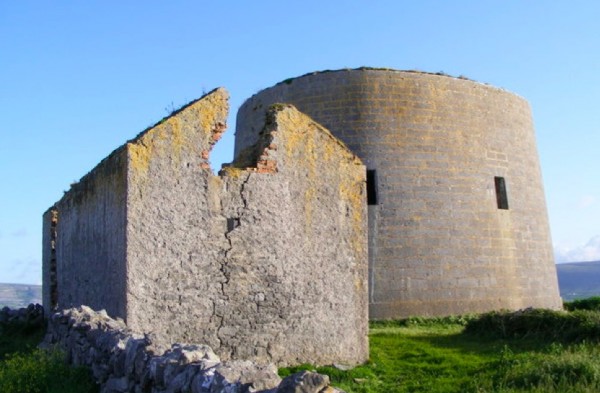
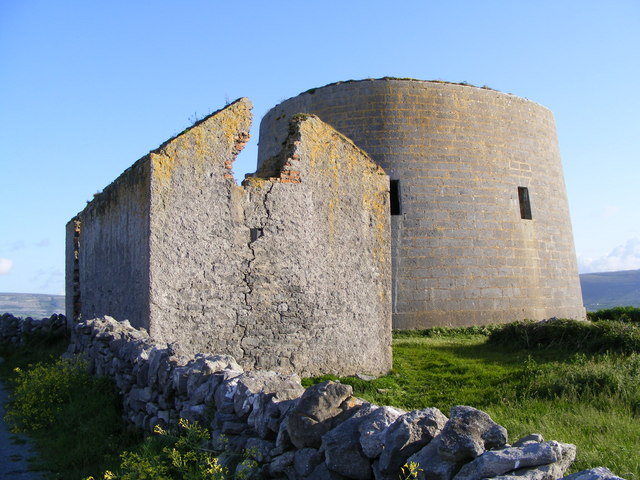
Finavarra Martello Tower at Finavarra Point, County Clare, Ireland A McCarron Wikimedia CommonsQUEENSLAND TIMES 28TH NOVEMBER, 1863 abridged
Owing to the great revolution which has taken place in war material, both for naval and military purposes, it has been decided to reconstruct (sic.) a great many of the martello towers around the Irish coast, it having been found from experiments with the Armstrong guns against similarly constructed towers in some parts of England, that they are entirely useless as works of defence.
At a late inspection of all the fortifications in Ireland, it was found that in some parts of the coast some of these towers were manned, armed, and kept in a state of repair at great expense to the public. As much from their position as from their useless construction, they were quite incapable of rendering the slightest service, either offensive or defensive. Consequently the whole of the towers in Galway Bay, also the tower and battery at Drogheda, have been dismantled, and the guns, stores, and artillerymen withdrawn. The buildings have been taken posession of by the the Barrack Department. We believe it is in contemplation also to withdraw the guns and stores from the towers in Dublin Bay, north and south.

 The Burren and Beyond