Posted in Posts and podcasts

Female Fashions for January – 1825

The Connaught Journal – 10th January, 1825

Head Dress

Bonnet of royal purple terry velvet or velour epingle; the brim broad and flat ,with a corded satin edge; the crown high, and rounded at the top, and partially covered with a (?) of velvet, bound in satin nearly half an inch in breadth, and ornamented with a small twisted silk cord of the same colour; the trimmings in front are large, and finished with a small twisted silk cord of the same colour; the trimmings in front are large, and finished in the same manner; the centre one is long and narrow, and finished in the same manner and placed perpendicularly, concealing the termination of those on each side; bows of pearl-edge satin ribbon are disposed about the crown; long stripes of the same inside the brim.

Black velvet dress hat, bound with gold lace from a small bow in front, the brim forms double and small white marabouts [*] are introduced between – it is closed behind in a similar manner; broad gold band around the crown, and at the top four curved ornaments, bound also with gold lace; marabouts in front and on the right side.

Tartarian turban, formed of a richly shaded stripe silk kerchief.

Cap of pink and white crepe lisse, with double borders, and broad strings of the same; the crown is high; the back part of white crepe lisse, full, and arranged by five flat pink satin bands, placed perpendicularly, and inserted in the pink satin band at the bottom of the caul; the front is formed by bouffants of alternate pink and white and crepe lisse, interspersed with pink satin ornaments of a papillonascous shape, with a profusion of winter cherries or alkekengi, and rosebuds above.

    Evening Dress
    Pinin colour velvet dress; the corsage plain, across the burst, and drawn to shape with a little fullness at the waist; high in front, and falling rather low on the shoulders, and finished with gold embroidered lace round the top; the sleeves are short, with epaulettes formed of heart-shaped leaves, trimmed with blond; attached are long full sleeves of white gauze, regulated in front by ribbon velvet passing from under the area to the lower part of the sleeve, which is confined by three velvet bands round the arm, each fastened by a bow and gold clasp; blonde ruffle at the wrist. At the bottom of the skirt is a broad band of satin of the same colour, with small silk cord laid across, forming squares; gold embroidered ceinture, fastened in front with an antique gem.- African turban of lilac barege, richly embroidered in gold, with a band of gold round the head, and supporting the feids over the right ear. The hair parted from the forehead, and three or four large curls on each side. Necklace of medallions in enamel, united by triple chains of gold ear-rings to correspond. English Thibel square shawl with embroidered corners. Short white kid gloves.- White satin shoes.

    • [marabout n : large African black-and-white carrion-eating stork; downy under-wing feathers are used to trim garments]
    Posted in Posts and podcasts

    Galway Girls – fashion – 1823

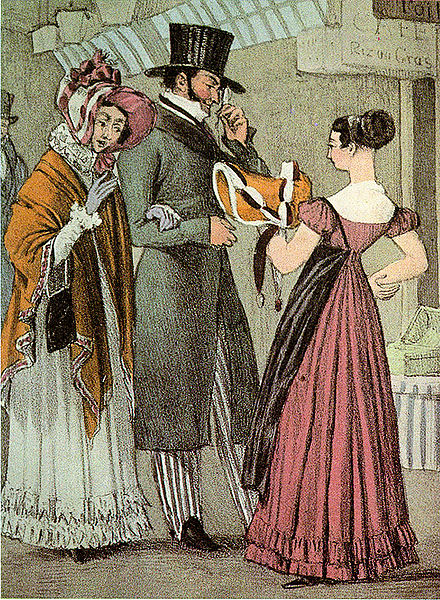
    Millinery Shop Paris, 1822 John James Chalon (1778-1854) Wikipedia
    Millinery Shop Paris, 1822
    John James Chalon (1778-1854)
    Wikipedia
    Connaught Journal

    Thursday, April 10, 1823
    FEMALE FASHIONS FOR APRIL
    Morning Visiting Dress
    Pelisse robe of mignionette, leaf green, of Gros de Naples, trimmed down
    each side in front, and round the border with puffings of same, confined by
    straps of satin; the bust ornamented by satin Brandenburgs, each terminated
    by a silk tassel. Frill a la Henriette, of Urling’s lace. Small equestrian
    hat of fine beaver or satin, of a lavender gray, placed very backward and
    crowned with a plume of curled feathers of the same colour.–Sautoir of pale
    silk. Green satin half boots, and Limerick gloves.

    Connaught Journal 3rd March – Fashionable Millinery
    Miss E ROBINSON
    Begs to announce to her Friends and the Public her having received, from the
    first Houses in Dublin, a select and fashionable assortment of Millinery;
    Laces, of a superior quality; and a variety of Satins and Lutestrings, of
    different shades for Bonnets, for which she has received the Newest
    Patterns.
    The above Articles having been purchased for Ready Money, they will be
    disposed of on the most moderate terms, at her Shop, next door to the
    American Society-room, Shop-street.
    Bonnets made in the most fashionable manner, and on the shortest notice.

    Posted in Posts and podcasts

    For the ladies – arsenic, lead and bismuth – 1878

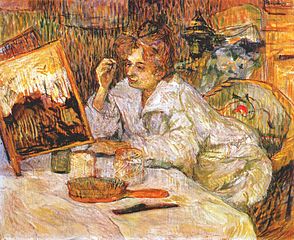
    1889 Henri de Toulouse-Lautrec painting of a woman applying facial cosmetics
    1889 Henri de Toulouse-Lautrec painting of a woman applying facial cosmetics

    widgetworld3.wordpress.com

    The Colac Herald (vic:  1st November, 1878)

    Supplement

    FOR THE LADIES – COSMETICS ETC

    In an article on “making up” the Pictorial world says: 

    “With the utmost recklessness our fashionable fair luxuriate in cosmetics, washes, and powders, and many other triumphs of the perfumer.

    Yet so long as their end is gained by fancying they have improved their complexion, added an eight of an inch to their eyebrows, or imparted a sunset gilt to their hair, they but little trouble themselves with such commonplace subjects are the hygiene of analytical chemistry.  A lily whiteness is given to the skin – what matter whether it be done by arsenic or bismuth? A bloom is given with the proper peach-blush tint.  What matters if the carmine be adulterated with red-lead?  An ordinary passable good head of hair is made to rival the locks of Diana. What matters it whether it be done by a golden wash or something else equally delightful and dangerous?

    Albrecht Dürer's drawing contrasts a well turned out bourgeoise from Nuremberg (left) with her counterpart from Venice. wikipedia.org
    Albrecht Dürer’s drawing contrasts a well turned out bourgeoise from Nuremberg (left) with her counterpart from Venice. wikipedia.org

    And this rage for entering in the race for beauty is by no means confined to the well-to-do women of the upper and middle classes.  The main of all work, charwoman, and the humblest of the humble, have their cheap favourite shops, where they can purchase the most attractive, beautifying trash at the lowest prices. By recent inquiry it has been discovered that the popular cheap aids – even expensive aids – to beauty are far more dangerous than even exaggeration-loving rumour has reported.  Some unfortunate children, who were honoured by being treated to the charms of their mothers’ powder puffs, have actually died through the effects of the poisonous compound – chalk and arsenic.  It is a known fact that the majority of hair dyes have a most injurious influence on the health of those who constantly indulge in using them.  Neither need one go further than the nearest skin doctor to be tole of the horrors of bismuth, cheap rouge and face washes.  The Nemesis of disease, ill-health, and worse still, of ugliness, without doubt lies in wait for those who will not trust to Nature as the best beautified, and for ever rush to the chemist and hair-dresser: but a word to the foolish is always a word wasted, and no amount of preaching, magazine moralising, or even coroner;s inquest reports, will stop the fanatics who throw themselves down before the Juggernaut of fashion and vanity.