Statue of Daniel O’Connell St. Patrick’s Cathedral grounds, Melbourne Photo; Donaldytong Creative Commons
The first monster meeting since the prorogation of Parliament, came off at Loughrea, in the county of Galway, about ninety miles from Dublin, on Sunday. Mr. O’Connell went with his friends from Dublin in a carriage and four to Ballinasloe. He departed from thence about twelve o’clock on Sunday morning and arrived at Loughrea at three o’clock. At various points along the road groups of people were assembled who hailed Mr. O’Connell with that enthusiasm which is the characteristic of the Irish people. Multitudes, accompanied by bands and banners, went out from Loughrea to meet and escort Mr. O’Connell to the meeting. The procession was swelled by many bands of music and companies of men and women who came from various distances.
Several hundreds of horsemen, many with their wives mounted behind them, joined in the procession. The rain fell heavily during the whole day and somewhat dampened the ardour of the zealous repealers. Mr. Bodkin, M.P., took the chair. Mr. O’Connell’s speech was brief and distinguished by no novelty. Speeches were afterwards made by Dr. M. Hales, Dr. Ffrench, and Mr. J. Ffrench.
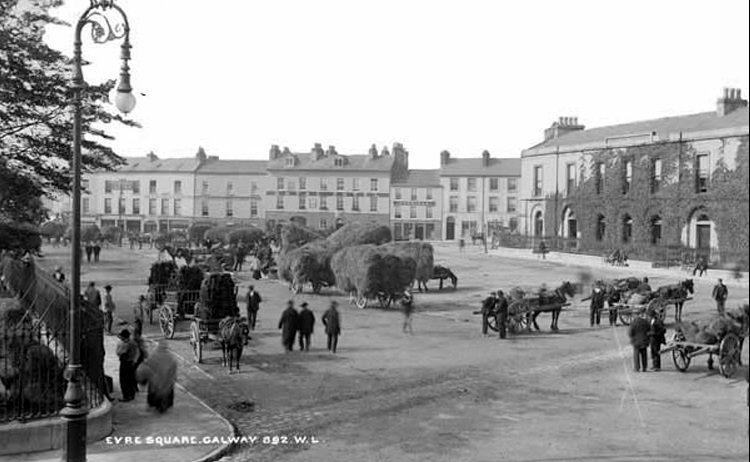
Eyre Square, Galway c.1897 National Library of Ireland Wikimedia Commons.
The great public banquet to Mr. O’Connell took place this evening at the magnificent and extensive pavilion, erected for the purpose in Eyre Square, and served as a fitting conclusion to the grand and imposing scene of yesterday. The preparations were all on the most extensive scale, and no trouble or cost was spared to render the banquet worthy of the great importance of the occasion. The pavilion was large enough to contain upwards of 1,000 persons, and was fitted up with great taste and effect. Over the two principal entrances the word “Repeal” appeared in gas lights, and behind the head table several beautiful devices were also formed in the same brilliant material. The tickets collected by the stewards at the dinner amounted to 560 in number, and when the occupants of the principal table and the stewards were enumerated, the entire of the gentlemen present somewhat exceeded 600 in number.
Daniel O’Connell in Galway (abridged)
From an early hour the streets were densely thronged by the country people, who continued to pour into the town in countless thousands, exhibiting in their persons all the wild and picturesque costumes of the west. The women’s short dark-red flannel petticoats were surmounted by the deep blue or brilliant scarlet cloaks. The majority of the younger portion were barefooted, and had their heads uncovered, their hair hanging loosely over their shoulders. Nearby were the dark frieze coats and corduroy breeches of the men from the interior of the country and the light sky blue dress of the Connemara men, who had prepared themselves to come in thousands in boats. Owing to the lightness of the wind, only a comparatively small portion were able to enter the harbour in sufficient time for the meeting.
The dark blue of the Claddagh fishermen, the Aran Islanders in their hairy shoes of untanned calf-skin, and the Iar Connaughtmen, mounted on their untrained and unshod mountain ponies – all mingled together in the old streets, talking Irish in loud accents as they went along.
When twelve o’clock, the hour at which the procession was to set forth, approached, the throng in the neighbourhood of the Square and Market-place became extremely dense, while the excitement was increased by the arrival of the tradesmen, all ornamented with sashes and bands and carrying long white rods surmounted with ribbons, to take their places in the procession, and by the merry strains of the temperance bands, that were each carried in boats placed in carts, and profusely ornamented with flags and green boughs.
At length the loud shouts of that peculiar and most interesting body of men – the Claddagh fishermen – was heard as they approached to take their ascribed place at the head of the procession. They mustered nearly a thousand strong, and a large portion of them wore large white flannel jackets, ornamented with ribbons and pieces of various coloured silk, while their hats were quite concealed with ribbons, flower-knots, and ostrich feathers.
The tailors were allowed to take their position second in the procession, and the remainder of the trades, twenty-four in number, were placed by lot, as arranged at a preliminary meeting held on the preceding day, in the following order;
Millers, Wheelwrights, Hatters, Tobacconists, Bakers, Stonecutters, Ropemakers, Broguemakers, Printers (having a printing press mounted on a richly decorated chariot), Butchers, Plasterers, Shoemakers, Coachmakers, Shipcarpenters, Coopers, Chandlers, Cabinetmakers, Nailers, Sawers, Housecarpenters, Stonemasons, Painters, Smiths, and Slaters.
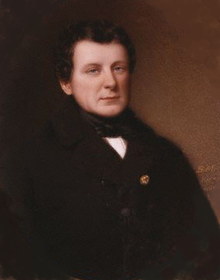
Daniel O’Connell George Hayter National Portrait Gallery Wikimedia Commons
The return to the writ for the Election of a Knight to serve in Parliament for the County of Clare was received at the Crown office, London, on Thursday. The following is a copy of the return and the Indenture accompanying it;
By virtue of this writ, to me directed, I did within two days after the receipt of the same, (that is to say), on the 19th of June, 1828, cause proclamation to be duly made for holding an election, to be held at the County Court house of the County of Clare, at Ennis, on the 30th of June, 1828, of a Knight to serve in Parliament for said county.
Sir Edward O’Brien and Sir Augustine Fitzgerald, Bart., two of the said electors of Knights, did then nominate and propose the Right Hon William Vesey Fitzgerald, being a Protestant, as the most fit and discreet person to be elected. James Patrick O’Gorman Mahon and Thomas Steele, Esqrs, two other said electors, did nominate and propose Daniel O’Connell Esq., as the most fit and discreet person to be elected a Knight. Daniel O’Connell did, at said Court, publicly declare and profess that he was a Roman Catholic, and that he intended always to continue a Roman Catholic.
The poll commenced on the 1st day of July, 1828 and continued until the 5th day of July, when same finally closed.
During the said poll electors did publicly protest against the election of said Daniel O’Connell insomuch as he was, and declared that he intended to continue, as Roman Catholic.
At the final close of said poll 982 electors voted for William Fitzgerald Vesey Fitzgerald, as a fit and proper person o be elected and 2,057 voted for said Daniel O’Connell as a fit a proper person to be elected a Knight to serve for said county.
O’Connell, MP for Clare 1828 – 1930 Painting by Bernard Mulrenin 1836
The Warning
Hear you not that wild wind moaning,
Shrieking o’er our withered land?
Hear you not our mountains groaning
To tell us sorrow is at hand?
See you not our people dying.
Young and old are swept away ;
The proud and strong around are lying,
Ere life ebbs out they turn to clay!
Hear you not that Ocean storm?
Convulsed Atlantic shows her sorrow:
See you not that shipwreck’d form?
All, all portends of grief to-morrow.
List, oh list, the Banshee crying
Around the walls of Derrynane;
Away from us our Chieftain’s dying,
The Mileslan dirge her midnight wail.
Alas! alas! the morn looks sad,
The sun lies hid behind yon cloud,
In deepest dye of mourning clad,
Close wrapped as in a grave-like shroud.
Hush, oh hush, all hearts are breakiig
Weep, oh weep, his spirit’s fled.
Hark! a mighty voice is speaking
“Slaves, your friend O’Connell’s dead.”
Poland grieved o’er Kosciusko’s pall;
Columbia wept her Washington;
Each nation’s mourned her hero’s fall,
Proud England still has Wellington;
But ours – oh ours – the wide worlds’ friend,
In every clime the tyrants’ dread;
What slaves shall now know sorrow’s end,
Their champion all, O’Connell’s dead.
Yes; his fall through every clime will ring,
The myriads shout his hallowed praise;
And those will weep his funeral song,
Who heeded not his glorious rays;
Aye, they will seek a borrowed fame,
As earth is brightened by the sun;
And those will claim O’Connell’s name!
Whose every deed his bosom wrung.



 The Burren and Beyond