In order to prevent disorderly persons from crossing the River Shannon from Limerick County into the County of Clare there are boats stationed on the river with peace officers on boat, who are directed to search all boats crossing the river, and to apprehend suspected persons in order that they may be examined by the Magistrates, and such persons as wish to come across the river on lawful purposes are directed to have a pass from some Magistrate to save them trouble or interruption.
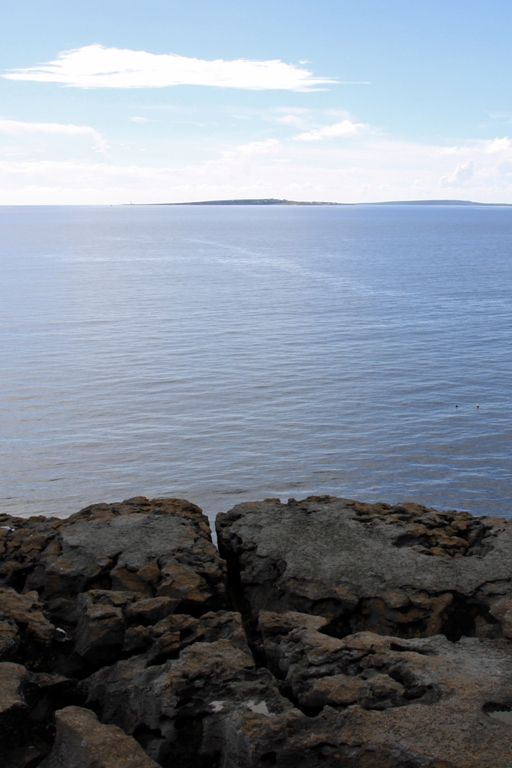
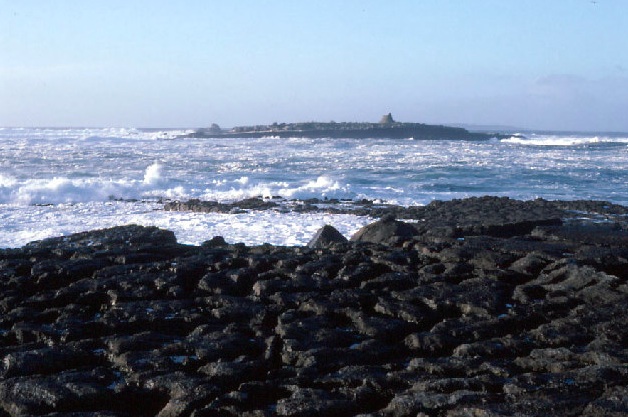
Crab Island, Doolin, County Clare Photo: Dr Charles Nelson Wikimedia Commons
The County Clare police have arrested a man who entered Crabbe (Crab) Island, in a sheltered inlet of Galway Bay, near Doolin, in a collapsible boat, and who declared that he had escaped from an American ship that had been sunk by a German submarine.
It appears that the ship mentioned was not sunk, and the mysterious visitant of this lonely coast, which is well within the bay, being unable to give a satisfactory account of his presence, was conveyed by the naval authorities to Scotland Yard.
He wore the clothes of an ordinary civilian with a frieze coat, and it appears that he got £45 in silver at an Ennistymon bank. He is a man of education and states that he is a native of Munster.
The collapsible boat is not of the ordinary type but has cork stays and can be rolled up into a small parcel.
He was taken to Dublin on the way to London
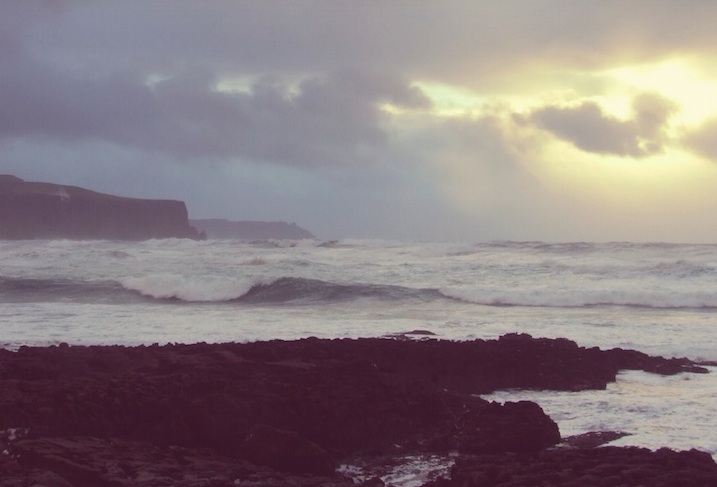
Kildare Observer 22nd January, 1898 p10Cliffs of Moher Photo: Norma Scheibe
Acrostic on County Clare by Mrs Maunsell – Christmas 1897
Can we fitly sing the praises of our native Clare Ocean washed, and verdure coated, hills and lakes and valleys fair, Under trees whose spreading branches ferns flourish, flowers blow; Now we see wild rocky stretches, Shannon ripple, Fergus flow. Time has left his track in ruins, noble halls and castles grand, Yet their stately, silent presence lends a glory to the land.
Cliffs of Moher, proud, majestic, rise unrivalled on the coast Lovely sands, and snowy billows, lost in wonderment we boast; And it cannot pass unnoticed, by all lovers of the sea, Reigning o’er our pleasant homeland, queenly watering place Kilkee Erin’s sons may well be proud and sing her praises long and loud
Road to Doolin Photo: Christine Matthews Wikimedia Commons
In declaring the County Clare Feis open at Ennis recently, his Lordship Most Rev Dr. Fogarty, Bishop of Killaloe, having referred at length to the language and industrial movement, said money was not everything. We should try not only to bring money to the Irish home, and neatness and comfort and industry, but the brightness also and the enlightenment that come from the revival of our Irish customs and music and language.
He drove the previous night, coming to the feis, through sixteen miles of the most charming country, studded with those numerous white painted cottages which were such a feature of the County Clare.
It was evening, and the hour for the day’s labor being over the people would naturally turn to relaxation and enjoyment, but that lovely country was as silent as the grave— not a note of music or a volce was heard— and he felt for our people and said, “God bless every man or woman, young or old, Catholic or Protestant, who is doing his best, however little, to bring back to this lovely country and to its dear people the sound of music and contentment and prosperity.”
West Coast Times, Issue 4491, 15th December, 1883 p5Photo: Brocken Inaglory Wikimedia Commons
TIDAL WAVE ON THE IRISH COAST.(abridged)
The following is an extract from a communication from Kilkee, County Clare, giving an account of a vast tidal wave which occurred there on the 20th September. The writer says:-
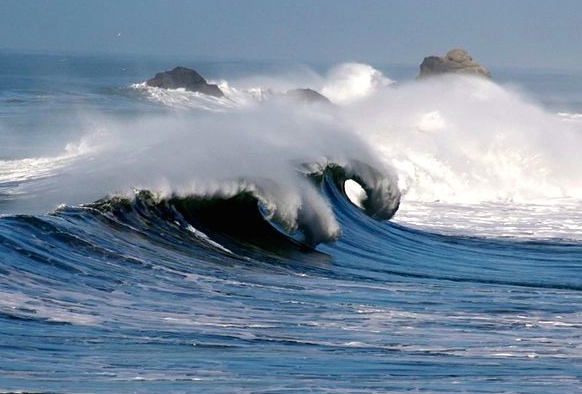
“One of the most splendid scenes I ever witnessed occurred here last Thursday. The day was magnificent, the sunshine as hot as June, not a breath of air in motion, and the bay as still and smooth as a sheet of glass. My daughter and I were sitting on a favorite nook at the ampitheatre, reading, at two o’clock. Shortly after we heard a noise of breakers, and looking out saw the Atlantic in sudden and wild commotion, the waves rushing in with terrific fury, so that we had to run inwards on the land, where we and other parlies had a full view of the majestic phenomenon.
The sea, that a few minutes before was a beautiful emerald green, was suddenly changed into a winter scene of snowy hue. The basin of the ampitheatre was filled with foam, volumes of spray rose 50ft over Duggerna, and swept with fearful velocity over St. George’s Head, 100 ft high, drenching several visitors on the top. The scene at this moment was fearfully grand, the wide expanse of ocean and bay looking like a vast sheet of snow in majestic upheaval.
I have never witnessed during equinoctial gales, or even in the great storm here last October, so magnificent a display of the Creator’s power in the watery element, as this — the most extraordinary feature of the case without a passing breeze.
This continued for half an hour, and the sea was again restored to its previous stillness”.
Recorder 28th January, 1920 p1Photo: EO’D
(abridged)
The Daily News correspondent in Dublin says that 2,000 American rifles were landed on the coast of County Clare and were brought ashore in small quantities. They were distributed before the military authorities knew that any arms had been landed. The Government regards the position in County Glare as serious.
Irish subscriptions to the Sinn Fein national loan amount to £1,500,000. The sum of £4,250,000 has been contributed in America.
Decatur Daily Republican 24th February, 1888
(abridged)
An exhibition of the cruelty of the present rule in Ireland was afforded Wednesday in the adjoining towns of Milltown and Millbay, over in County Clare. A number of people of the neighboring parishes attempted to distribute two hundred and sixty car-loads of turf and the same amount of potatoes among the families of eleven men, who are at present serving terms of imprisonment, having been sentenced for alleged crimes against the coercion law. The police, however, stopped the proceedings, and would not allow the humane work to continue.
——————————-
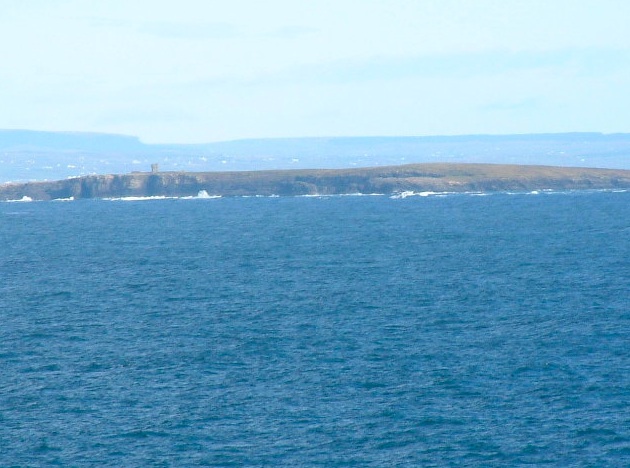
A Sinn Fein tribunal in County Clare sentenced three men to a fortnight’s detention on Mutton Island for refusing the tribunal’s order to rebuild farm wall which they had demolished. The constabulary learned of the incident and sent a boat to rescue the marooned three who, however, stoned their would be rescuers, declaring themselves citizens of the Irish Republic and therefore the constabulary had no authority to intervene. The constabulary withdrew. The prisoners had ample provisions.
The Grenfell Record and Lachlan District Advertiser 9th April, 1934 p4
GOLD COLLAR FOUND.
MADE 2500 YEARS AGO. (abridged)
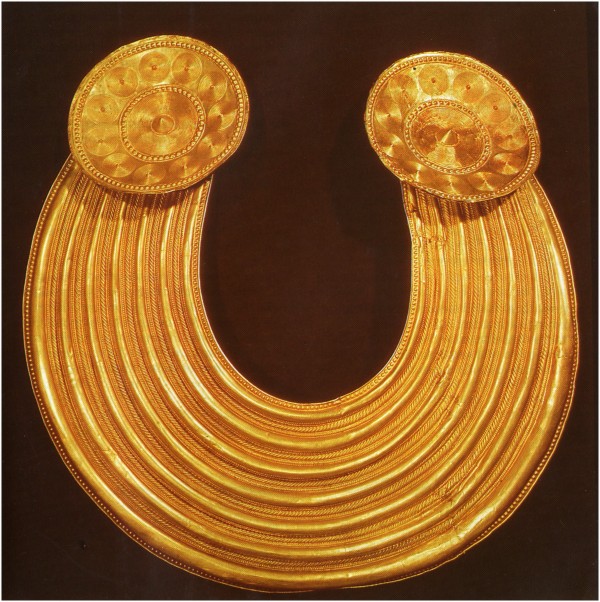
A collar of pure gold which is believed to have been made about 700 B.C., has been found at Burren, County Clare, says the ‘Manchester Guardian.’ The discoverer was a local farmer who noticed it glittering in a cleft of rock. The National Museum has claimed it as a treasure trove. Dr. Mahr, Keeper of Irish Antiquities in the National Museum, has confirmed the belief of its antiquity.
The type is well known, he said in an interview, and four similar ones are in the museum. Three were found in the area through which the Shannon flows. A fourth, like the one now discovered at Burren, has circular bosses and is believed to have been found in Armagh. Two collar’s containing bosses were found in the Rhine, near Worms, and these had probably been exported from Ireland in the middle of the last millennium B.C.
The Burren collar, or gorget, Dr. Mahr said, was the most beautiful find in Clare within the last thirty or forty years. Clare is famous for discovery. When the Limerick Ennis railway was being constructed in 1854 a large hoard was found near a stone fort at Megane, Ballykilty, Quin. Laborers removing a stone which was in their way uncovered a number of gold articles weighing about 160 ounces underneath. ‘Unfortunately, there was nobody to advise them,’ Dr. Mahr said, ‘as to how they should dispose of the articles, and they were mostly bought by local jewellers and melted down, to the great loss of Irish archaeology and kindred studies.’
Only thirteen of the articles reached the museum in Dublin, while about two dozen went to the British Museum.
There is still a friend left here and there says United Ireland, to the evicted and harassed tenants of Ireland. While the majority of their brethren look on indifferently at eviction and consequent suffering, a few faithful friends, priests and payment, are doing what they can to stem the tide of landlord oppression. Among these must be reckoned Father Newell, the parish priest of New Quay, County Clare, on the southern shore of Galway Bay. He recently drew attention to some harsh evictions carried out by Lynch, of Renmore galway in his parish, and he has consequently received some private assistance for the poor people. Father Newell returns to the subject in a public letter published recently. He says;
I regret to have to add that more ‘processes’ were served a day or two ago on the same island. In the early days of the Land League, Major Lynch was one of the first to put down his name for $100 (pounds) for the funds of the;Property Defence Association’, got up by the late A McMurrogh Kavanagh.
I wish he would show a like generosity to the poor tenants in these trying times.’ The moral of this and similar pitiful stories is that the people require again a protective organisation, widespread and powerful, to prevent the landlord fro indulging in his pet pastime of harassing legal process and subsequent eviction.


 The Burren and Beyond