Posted in Posts and podcasts

A Fortnight in Lisdoonvarna – 1887

Supplement to the Cork Examiner 8th October, 1887
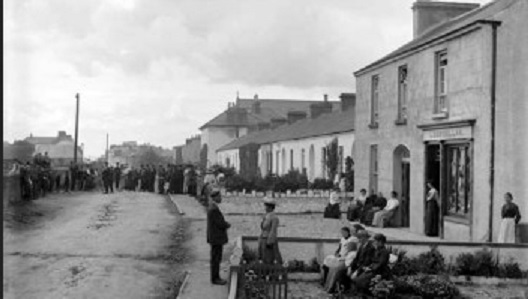
Lisdoonvarna - c 1903 Robert French
Lisdoonvarna – c 1903
Robert French

This beautiful and favourite health resort, which deserves to be better known than it really is, has, since the opening of the West Clare Railway, become much more easy of access, as the station at Ennistymon is only seven miles from the Spa. In the old days the long car journey from Ennis, a distance of twenty miles, was very fatiguing and was enough to deter persons of weakly or delicate constitutions from undertaking it at all.

I arrived in the height of the season and only that I took the precaution of telegraphing from Ennis, I could scarcely have got quarters at the comfortable hostelry where I had sojourned on a former occasion. I had the good fortune to fall in with pleasant and companionable society, including a large sprinkling of the softer sex and, If I had not long ago received my baptism of fire from a pair of Southern blue eyes, and so was armour proof against the shafts of the winged god, I certainly should have not returned heart whole.

I found Biddy at the celebrated sulphur well as youthful looking and full of ready repartee as ever, while her faith in the healing virtues of the spring seems to grow stronger as the years roll by. Our time was mainly spent in drinking the waters, climbing the neighbouring hills, or following the courses of the tortuous ravings, which the mountain torrents have worn, here there and everywhere through the beds of shale. The monotony of this style of existence was occasionally broken by excursions through the various places of interest round the Spa, and two of these outings deserve at least more than passing reference.
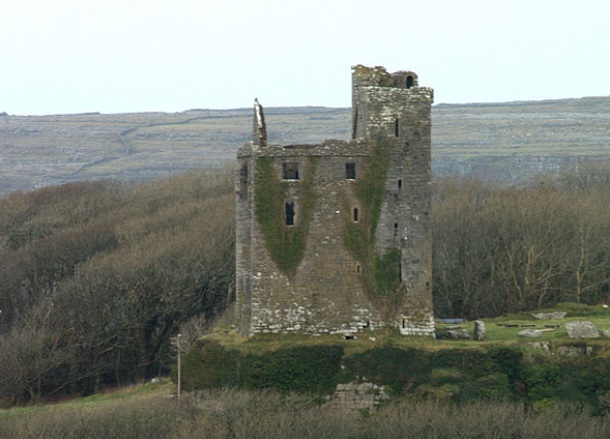
Ballinalackin Castle Bogman Wikimedia Commons
Ballinalackin Castle
Bogman
Wikimedia Commons

We arranged on one day to go by Ballinalacken and Black head to Ballyvaughan, and returned by the famous Crokscrew road, a piece of engineering that would do credit to the genius of the first Napoleon. The road from Ballinalacken to Ballyvaughan runs along the Southern shore of Galway Bay. The country to the right forms portion of the Barony of Burren and presents a chain of rocky and barren looking hills. Yet we were assured by our driver that succulent grasses grew in the interstices of the rocks and that splendid sheep were raised on these hills.

The day was beautifully fine, the blue sky being perfectly cloudless, while Galway bay was a calm as an inland lake. Here and there a hare-legged, sunburned child peered out from some fisherman’s cabin; anon a startled hare fled away from a wayside clump of rare ferns. Ivy clad ruins of ancient abbeys and churches formed a prominent feature in the landscape and bore eloquent testimony to the piety and faith of our Celtic ancestors.Of the old castles, Ballinalacken, once a stronghold of a sept of the O’Briens, claimed most attention and reminded me forcibly of Blarney. Altogether it was a day worth living for and although I have spent many pleasant days in various nooks and corners of our Island, the memory of this golden one shall abide with me forever.

A few days before my departure, I visited Galway.  Galway – quaint, old and decaying! Galway still redolent of the days when dark-eyed Spaniards promenaded its streets and quays, intent on selling their precious cargoes of rare wines! I was very much struck with a curious mixture of the ancient and the modern. In one of the principal streets stands a battlemented castle of the date 1473, with curiously carved escutcheons and leering griffins; the basement being devoted to the utilitarian purposes of a tallow-chandler’s shop!

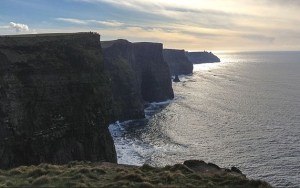
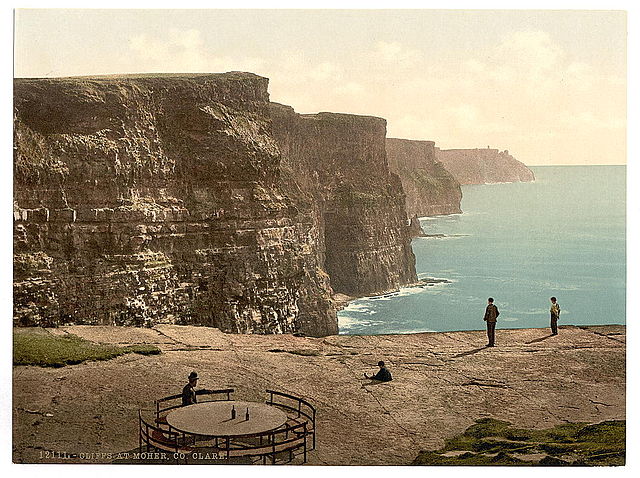
The other places of interest to the visitor or tourist within easy reach of Lisdoonvarna are the Cliffs of Moher, which rise perpendicularly from the ocean to a height of 800 feet; St. Bridget’s well, near Liscannor, the subject of Petrie’s famous picture of “The Blind Girl at the Holy Well”; Corcomroe Abbey and Inchiquin Lake.

When the holiday season comes round again and tired citizens are asking themselves the question, “Where shall we go to?”, I would strongly advise a visit to Lisdoonvarna and West Clare, where pure mountain air, natural scenery, and, to those who may require them, healing springs, cannot fail to please and charm the most fastidious.
Posted in Posts and podcasts

The West’s awake – 1848

The Daily Crescent, 7th September, 1848 p1

Photo:Awesomoman Wikimedia Commons
Photo:Awesomoman
Wikimedia Commons

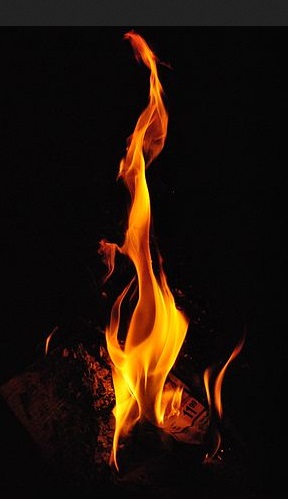
The west of County Clare, including Kilrush, Kilkee, Carrigaholt and Baltard was instantaneously lighted up on Thursday night with signal fires, which flashed from every eminence and illuminated the horizon as far as the brightest eye could discern an object. The exact cause of this telegraphic manifestation, which was responded to from Cape Clear to Moher Cliffs, in a space of time incredibly short, is all conjecture.

Posted in Posts and podcasts

Mr Humphries – 1938

Irish Examiner 13th September, 1938 p.2

Cliffs
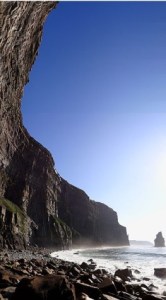
Cliffs of Moher Photo: Bjørn Christian Tørrissen Wikimedia Commons

 
Mr Rd. Humphries of Cork, who recently exported ten tons of stone from Blarney for the purposes of the organisers of the World Fair at San Francisco, America, was on a visit to Lisdoonvarna, Co. Clare, during the weekend.  In an interview, he stated that an additional ten tons would be exported in November next.
Asked exactly what the stone would be used for, Mr. Humphries said he did not really know, but he did know that the organisers of the Fair or Exhibition may be interested in other Irish exhibits.
The Treaty Stone at Limerick was suggested to Mr. Humphries, and he said it was extremely improbable that the Treaty Stone would ever be allowed to be removed from its present site.  The American organisers would not be so much interested in the Treaty Stone as in the material from which it was composed.
“Would your friends be interested in a stone replica of the famous Cliffs of Moher,” asked the interviewer.
“They may be,” replied Mr. Humphries, with a smile.

Posted in Posts and podcasts

Cliffs of Moher – 1929

Irish Examiner 26th March, 1929 p8. (abridged)

Moher
Cliffs of Moher Photo: Michal Osmenda Creative Commons

A plea for the preservation of the public right of access to the Cliffs of Moher, one of Clare’s most famous tourist sights, was made by Mr. P.McGuire and Mr. P. Burke, Lisdoonvarna, to the Clare County Council.  They pointed out that the land leading to the cliffs was being divided.  A gate erected to facilitate the entry of tourists had been removed and the entrance built up. It was suggested that the attention of the Land Commission be directed to the matter, and portion of the land be vested in the Office of Public Works, who should be asked to convert it into a public park.
The Council adopted the suggestion of the deputation and decided to make representations to the Land Commission and Board of works on the matter.

Posted in Posts and podcasts

County Clare – 1898

Kildare Observer 22nd January, 1898 p10

Cliffs of Moher Photo: Norma Scheibe
Cliffs of Moher
Photo: Norma Scheibe

Acrostic on County Clare by Mrs Maunsell – Christmas 1897

Can we fitly sing the praises of our native Clare
Ocean washed, and verdure coated, hills and lakes and valleys fair,
Under trees whose spreading branches ferns flourish, flowers blow;
Now we see wild rocky stretches, Shannon ripple, Fergus flow.
Time has left his track in ruins, noble halls and castles grand,
Yet their stately, silent presence lends a glory to the land.

Cliffs of Moher, proud, majestic, rise unrivalled on the coast
Lovely sands, and snowy billows, lost in wonderment we boast;
And it cannot pass unnoticed, by all lovers of the sea,
Reigning o’er our pleasant homeland, queenly watering place Kilkee
Erin’s sons may well be proud and sing her praises long and loud

Posted in Posts and podcasts

Cliffs of Moher – 1856

O'Brien's Tower Cliffs of Moher
O’Brien’s Tower
Cliffs of Moher

Bendigo Advertiser 8th April. 1856 p3
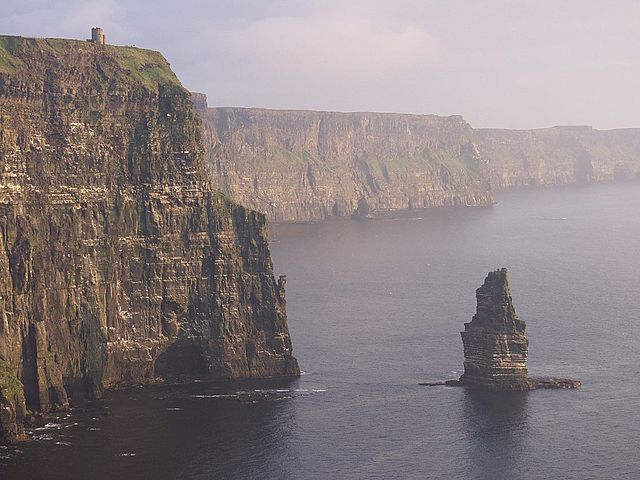
A public subscription is being raised by the inhabitants of Clare, for the erection of a monument in honour of Cornelius O’Brien, M.P. on the celebrated Cliffs of Moher, which he has so elegantly improved and arranged for the convenience of tourists.

Posted in Posts and podcasts

Cliffs of Moher – 1918

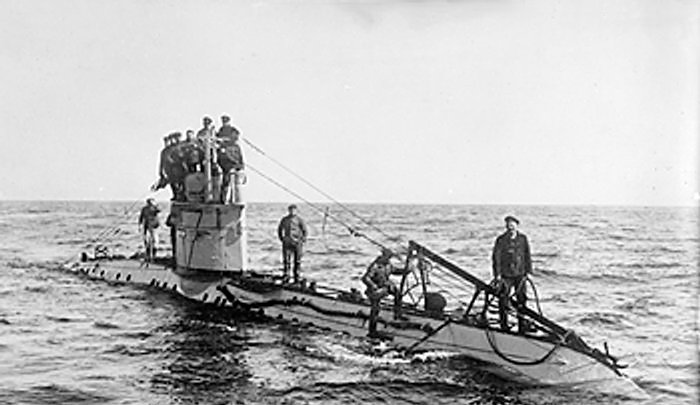
The crew of a German UC-1 class submarine on deck.  wikimedia commons
The crew of a German UC-1 class submarine on deck.
wikimedia commons

The Advertiser 30th May, 1918

LATEST CABLE NEWS

MAROONED (abridged)
The Cork correspondent of the “Daily Chronicle” gives details of the arrest of a man who was put ashore from a German submarine and who is now in the Tower of London awaiting a court martial.

On April 13 near the cliffs of Moher, County Clare two fishermen noticed a man on a barren islet waving a handkerchief violently. When rowed ashore he said his name was O’Brien, and he was the survivor of a torpedoed ship. After he had been provided with food and clothing the authorities became suspicious. O’Brien was arrested and the police soon found that the torpedoing story was untrue. He had a good deal of English silver in his pockets. Moreover, a collapsible boat was found wrecked near the cliffs at Moher. Evidently the spy had landed on the islet at night, mistaking it for the mainland. He endeavored to destroy the boat and only discovered at daylight that he had marooned himself.

Posted in Posts and podcasts

Wreck of the Magpie – Cliffs of Moher – 1864

Cliffs of Moher 19th Century Wikimedia Commons
Cliffs of Moher 19th Century
Wikimedia Commons
Freeman’s Journal 22nd June, 1864 p3

WRECK OF H.M. GUNBOAT MAGPIE.

Galway, April 5.

Yesterday morning I telegraphed to you the intelligence of an unfortunate accident to the screw gunboat Magpie (2) ; and since then, the additional particulars I have gained are of little importance, expect that she did not float last night, as expected and that fears are now entertained that she will become a total wreck.

The accident occurred at two o’clock on Sunday morning during the thick hazy weather which then prevailed, and which has existed since that time up to the present. The Magpie, which had for some years acted as tender to the Coastguard ship Hawke,at Queenstown, was on her way from that port to Galway with store to the Coastguard stations in its vicinity. Every necessary precaution had been taken to ensure the safety of the vessel when the mist came on, and Captain Bell (with whom every one in Galway sympathises) was just consulting his chart when the boat went ashore with a crash. It was found she had struck on Crab Island, which lies to the south of the famous cliffs of Moher, on the western coast of Clare; and, although an immediate effort to get her off was made, the heavy Atlantic swell which, at the calmest season, rolls in against the cliffs drove her farther ashore.

The boats were out, and a party landed. They procured a car, and drove across the country to Ballyvaughan, which is on the other side of Galway Bay, and from thence a coastguard boat was despatched to Galway for assistance. Captain Hawkes, R.N., the Inspecting- Commander of Coastguards, at once engaged the Atlantic Company’s steam-tiff Rover to proceed to the scene of the disaster, and the Pilot also got up steam and went down to render any necessary assistance.

The steamers got down at evening, but the weather was so thick that the Rover was obliged to lie under Arran Island, and subsequently Black Head, without getting to the Magpie. Yesterday morning, however, she got to Crab Island, and at high water every effort was made to pull the unfortunate gunboat from her position. There was a tremendous surf, and just at the moment when she was beginning to move a wave struck the Magpie, and, the hawser breaking, she was driven still higher on the beach. It was then deemed useless to make any further attempt, and the Rover returned to Galway yesterday evening.

Previous to the arrival of the tugs the men had dismantled the Magpie, and landed, and I understand her guns, one of them a 68 pounder, were thrown overboard. No further attempt to save her will be made for a couple of days, but the general opinion is that she will become a total wreck.— Saunders.

Posted in Posts and podcasts

The Sea Eagle – 1842

White tailed eagle Photo: Yathin S. Krishnappa  Wikimedia Commons
White tailed eagle
Photo: Yathin S. Krishnappa
Wikimedia Commons
The Cornwall Chronicle 11th June 1842

THE SEA EAGLE (abridged)

The process of catching birds on the Cliffs of Moher goes on to a great extent in the summer months. It is often attended with great danger. To defend themselves against the formidable sea eagles the men carry long knives. Some six or eight years ago there was an encounter between a bird catcher and a sea eagle which nearly proved fatal to the former.

The man had been lowered from the top of the cliffs and hung suspended from the overhang when an eagle darted at him from out of a fissure in the rock. It commenced a furious attack. The bird catcher drew his knife and defended himself as best he could but the eagle was swift, deadly and persistent. Finally, he dispatched the bird. However the stroke that freed him from the creature also struck his rope nearly severing it. The unfortunate man was left suspended by a single twist of coil over the yawning abyss.

His friends above had perceived this predicament. Slowly, and with the greatest of caution they commenced pulling him up. It required the utmost skill to keep the fractured portion of the rope from chafing against the sharp edges of projecting rocks and snapping completely. The men on the cliff were in a state of anxiety scarcely less than the man beneath.

The rope snapped within an inch of the top, but not before one of the men had seized a firm grip of their friend’s clothing. They were able to drag him to safety. The awful situation was too much for the bird catcher; he lay stretched on the grass without sense or motion. So profound and lengthy was his insensibility that his companions thought he was dead.

It is said he has never completely recovered from the effects of that fearful hour.