A paragraph, extracted from the Clare Journal, has been making the round of Metropolitan papers, with reference to an alleged unprovoked assault of some Claddaghmen on a trawling party from New Quay. Upon the most unquestionable authority we have it that the Claddagh boats were quietly proceeding to their fishing destination when an individual belonging to the trawling party presented a loaded musket at some of the boats when passing and thus provoked the unfortunate rencontre, described in the Clare Journal.
Supplement to the Cork Examiner, 18th November, 1899
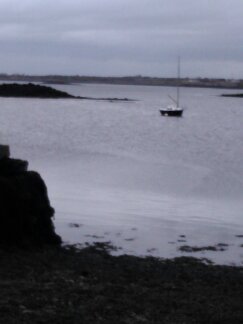
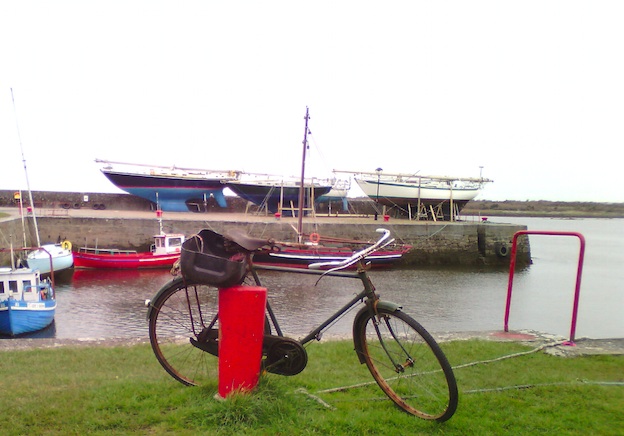
Kinvara c.1950 Photo: Cresswell archives
The finest scenery in Ireland is on the northwest coasts of Connemara, Mayo and Donegal. There are no grander headlands in Europe than these broken, precipitous highland masses towering above the Atlantic.
Galway is the gateway leading into this picturesque region with its invigorating climate. A magnificent seawall leads to it from Loop Head, at the mouth of the Shannon, with the glorious cliffs of Moher midway. Galway Bay is the outlet for a chain of lakes with which the highlands of Connemara are riddled; and the coast is mountainous, with a succession of many-coloured precipices and countless islands all the way from Clifden to Achill Head, where the Croaghaun cliffs are nearly 2,200 feet above the sea and thence along Mayo to Slieve League and the rock-bound highlands of Donegal. In picturesque colouring, grandeur, primeval wildness and elemental power there are few coasts that bear comparison with the north-western outstretch of Ireland.
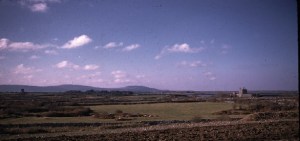
Kinvara c.1950 Photo: Cresswell archives
Galway town is quaint and beautiful, and its charm of local colour comes from a strain of Spanish blood. For centuries it was a port commanding a large trade with Spain, and its merchants and sailors were constantly visiting and there were frequent marriages. While it was not Spanish in origin and attracted few settlers from the South, its architecture, gardens, manners and life were coloured by its associations with the more tropical country. The course of modern improvement has not been so rapid as to obliterate these traces of Spanish taste. While the town is not laid out with the regularity of a chess board, there is a central square or garden where the women are on parade on Sunday afternoon, and many of them have olive skins and coal black eyes and hair. They have the same love of colour which fascinate Spanish women, and are brighter and gayer in dress than the Irish girls of Limerick, Dublin or Cork.
The houses are also painted or kalsomined in pink, blue, yellow and white, so that there is a garish display of colour even in a quiet street like Prospect Hill leading into green meadows. Neglected as the old houses with their central courts and wide entries and stairways have been, Galway still contains many of the distinctive features of a Spanish town.
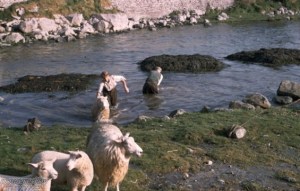
Kinvara c.1950 Photo: Cresswell archives
The Lynch mansion even in its present state of dilapidation goes far to support the composite reputation of this Irish Spanish port. This stronghold of a powerful family has degenerated into a chandler’s shop, but the medallions on the side, the decorated doorways and windows, and the grotesque heads near the cornice attest its foreigh character; and the Lynch stone on the crumbling wall behind St. Nicholas’s Church perpetuates the grim sense of justice of its most famous tenant. James Lynch Fitzstephen, wine merchant and Mayor, was in Spain about the time America was discovered and invited the son of one of his friends to return with him to Galway for a visit. The guest flirted with the Irish girls, and was finally stabbed one night in the streets by a jealous rival. The murderer was the Mayor’s only son, who confessed his crime in an agony of remorse. The father, encouraged by this violation of hospitality, condemned his guilty son to death, and with his own hand conducted the execution, either from his own castle or opposite the church. The Lynch stone commemorates this act of stern, unbending justice, and with skull and bones rudely sculptured enforces the quaint inscription;
“Remember Deathe Vaniti and al is but Vaniti.”
The Claddagh Photo: Joe Desbonnet Wikimedia Commons
That singular body of men, the Claddagh fishermen, have signified their approval of the Royal Irish Fishery Company, and are ready to work for them, thus increasing the number of men who will be employed by the company from the Killeries to the Kenmare River to upwards of 8,100. The oldest fisherman of Dingle: Flaherty, who has been latterly employed as pilot on board of her majesty’s Steam Frigates on the West Coast, and in that capacity surveyed the new fishing bank on board of the Rhadamanthus, has taken shares in the company.
Kerry Evening Post 31st January, 1877 p.2 (abridged)
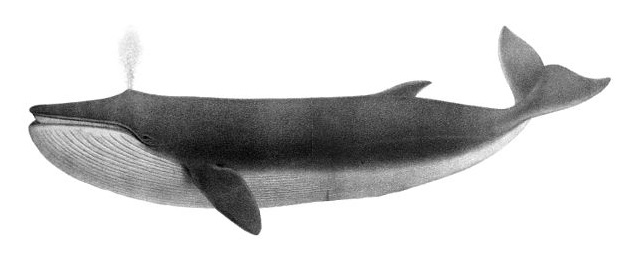
“The Finback” (Balaenoptera physalus) from Charles Melville Scammon’s Marine mammals of the western coast of North America (1874)
The Galway Express reports that a whale was got dead out at the sea on Friday night by a Claddagh man named John Donohoe; he gaffed and strung it to his boat, with the aid of another small boat’s crew. The night was extremely stormy and they got much knocking about, but succeeded in towing it in. It is a rather small fin-whale, about twenty-five feet long, and from three and a half to four tons weight. The blubber has been cut off, and is valued for about £40, a rather handsome booty.
Daniel O’Connell in Galway (abridged)
From an early hour the streets were densely thronged by the country people, who continued to pour into the town in countless thousands, exhibiting in their persons all the wild and picturesque costumes of the west. The women’s short dark-red flannel petticoats were surmounted by the deep blue or brilliant scarlet cloaks. The majority of the younger portion were barefooted, and had their heads uncovered, their hair hanging loosely over their shoulders. Nearby were the dark frieze coats and corduroy breeches of the men from the interior of the country and the light sky blue dress of the Connemara men, who had prepared themselves to come in thousands in boats. Owing to the lightness of the wind, only a comparatively small portion were able to enter the harbour in sufficient time for the meeting.
The dark blue of the Claddagh fishermen, the Aran Islanders in their hairy shoes of untanned calf-skin, and the Iar Connaughtmen, mounted on their untrained and unshod mountain ponies – all mingled together in the old streets, talking Irish in loud accents as they went along.
When twelve o’clock, the hour at which the procession was to set forth, approached, the throng in the neighbourhood of the Square and Market-place became extremely dense, while the excitement was increased by the arrival of the tradesmen, all ornamented with sashes and bands and carrying long white rods surmounted with ribbons, to take their places in the procession, and by the merry strains of the temperance bands, that were each carried in boats placed in carts, and profusely ornamented with flags and green boughs.
At length the loud shouts of that peculiar and most interesting body of men – the Claddagh fishermen – was heard as they approached to take their ascribed place at the head of the procession. They mustered nearly a thousand strong, and a large portion of them wore large white flannel jackets, ornamented with ribbons and pieces of various coloured silk, while their hats were quite concealed with ribbons, flower-knots, and ostrich feathers.
The tailors were allowed to take their position second in the procession, and the remainder of the trades, twenty-four in number, were placed by lot, as arranged at a preliminary meeting held on the preceding day, in the following order;
Millers, Wheelwrights, Hatters, Tobacconists, Bakers, Stonecutters, Ropemakers, Broguemakers, Printers (having a printing press mounted on a richly decorated chariot), Butchers, Plasterers, Shoemakers, Coachmakers, Shipcarpenters, Coopers, Chandlers, Cabinetmakers, Nailers, Sawers, Housecarpenters, Stonemasons, Painters, Smiths, and Slaters.
Freeman’s Journal 8th August, 1861 p4
Monday evening the poor Claddagh fishermen went out in great numbers, hoping to profit by the myriads of herrings that swarm our bay. It was blowing moderately at the time from the N.W., but a few hours later it blew a regular gale from the westward, scattering the hookers in all directions, obliging them to run, some for Kinvara, and others for Ballyvaughan and Newquay. With difficulty they reached those places of shelter, and we regret to learn that many of the poor people lost their nets and fishing gear in the storm. They mostly returned today and loud are the lamentations of many a poor family in the Claddagh for the loss of the instruments of their labours.
Everyone in Galway is aware of the immense quantities of herrings that are at present in the bay but the Claddagh men will only go out every second night to capture them.
On Tuesday night Captain Oliver, one of the pilots, went out in his boat. This being a prohibited night, he soon found that he was being chased by two large hookers – watch boats, as they are termed – each filled with men. Seeing that he could not fight them he ran into Oranmore Bay and thus escaped.
On Friday night the “watchmen” succeeded in committing an outrage. Several boats from Kinvara were fishing when three or four Claddagh hookers, with about twelve men in each, bore down and cut away some of the nets. The boats that escaped came into market with immense quantities of herrings.
Very few of the Claddagh boats are marked, according to law, so that identification in such cases is almost impossible.
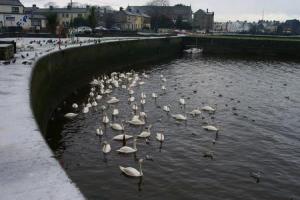
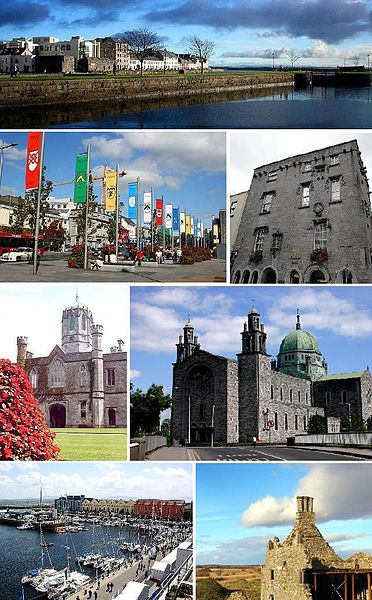
Galway Photo: Creative Commons – Sleepyhead2https://widgetworld3.wordpress.com/podcasts/ THE INTERMOUNTAIN CATHOLIC 15TH JUNE, 1907 P6
GALWAY MEMORIES
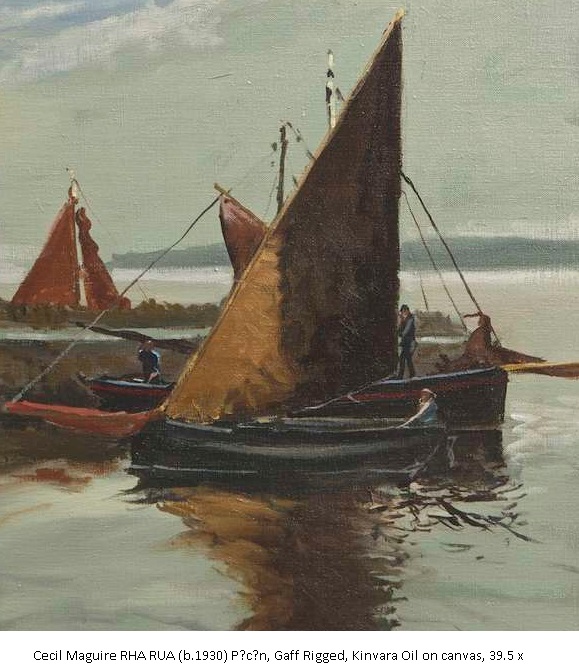
Well worth seeing and well worth remembering, dear old Galway; Galway of the stalwart gray houses that have stood for centuries the storms and buffets and driving rains of the Atlantic; Galway of the narrow, winding quiet streets; Galway of the beautiful bay, where of an evening the sinking sun touches with its dying splendor the quaint-colored sails of the fishing boats rocking at anchor.
Pleasant Galway it is, where the people are erect, and sturdy, and kindly, and the children – real, rosy country children – smile at you out of deep blue eyes as you pass; where you are awakened in the early morning by the complaining, musical cry of the shawled and barefoot fishwives.
“Fresh herring! Fresh herring!” they chant, as they trudge, baskets on hip, along the cobbled street. Oh, a quaint, old-world town is Galway, and a good old-world people are they that live there.
It chanced late last summer that a wanderer, weary of the noise and stress of modern life, strayed into the old town, and instantly felt the rest and quiet comfort of the atmosphere, and, going forth to stroll among the streets, found a throng wending their way on some great purpose bent, and so, following, came to an old arched gateway, in a strange little nook, under which these people disappeared. The curious one, going in, was received with prompt and courteous hospitality by the members of the Gaelic League, and was made a free and delighted spectator of the proceedings.
It was the “Feis Connacht,” the great annual gathering of the local country people, who were assembled to hear the old tongue spoken, the old songs sung, and the old stories told, not, as so familiarly known to them, around the cabin fires or on the breezy hillsides, but in the great “town”, in a hall, where judges would listen to their efforts and award prizes and honors to those they liked best.
So it was in the old, long, low-ceiled, whitewashed hall they met, and they thronged from far and near, young and old, the ancient village favorite, white headed and frieze-clad, who was received with shouts of applause, the worthy matron, conscious of her dignity, the young earnest farmer lad, with deep, ever burning hope of Ireland’s freedom in his deep and earnest eyes, and the troops of sunny-faced children, fresh and sweet material these, for the work of keeping the old tongue alive. The old people knew it; they would pass, but it was these tiny ones whose little lispings were listened to with greatest attention by the judges – for within their curled palms lies the future of the Irish language.
They sang, these children with their clear fresh voices, in the soft accents of the old tongue, the ancient songs of their race, and while they sang, one read in their bright eyes and fair, Greuze-like faces, the hopes of the land for the future. Oh, the sweet old songs, “Kathleen-ni-Houlihan,” solemn and mysterious, “Paistin Fionn,” with its wailing refrain, and the slow, stately strains of the “Coolin.”
Even the wild, gypsy-like children of the famous Claddagh were there sturdily chanting and (yet more to their taste) answering back, in the “conversation contest,” with a free, brisk promptness, the questions put by the judges. It was a Claddagh lassie, with a great shawl drawn about her, like unto her elders, who seated herself with much composure, and begun a long story in Gaelic, which convulsed her hearers with merriment that found its origin in the twinkle of her shrewd gray eye.
And it was a Galway matron who, also draped in her shawl, danced with dignity and decorum, the many and difficult steps of the old Irish jig, to the lively strains of an ancient piper, upon a platform, laid for the occasion, upon the stage.
How independent they were, those Connacht people! No sign of shyness or mauvais honte. They stepped up and recited, sung, danced, whatever it might be, with earnestness, and industry. How fine was that old orator, who had his tale to tell, and his say to say (concerning the legitimate freedom of ireland) and who would say it, ignoring the tinkle of the judge’s bell (intimating that his time limit had expired), and indeed, upbraiding those with upraised hands and nodding heard, as he perforced abandoned the rostrum and descended to his place among his fellows.
Good humor and appreciation are ever the order of the day. One and all, fisher and farmer and kirtled housewife, “old men and maidens, young men and children,” and the “quality” mingle in perfect democratic unison on the common ground of “land and language”.
The very remoteness of this region from the hustle and distraction of the world, would seem to militate strongly in favor as an educational field. There is time here, “all the time there is,” to be given to the study of and development of the language, and there is the earnestness, intelligence and independence of a people whose life is spent in the open air, brightened by God’s sunshine and inspired by God’s free winds, and the ever-sweet, salt breath of the ocean, here in the old historic town, whose every stone, every time-worn arch and buttress, and strange, old gray building is a reminder of ancient glories and sorrows. GERALDINE M. HAVERTY

 The Burren and Beyond