Posted in Posts and podcasts

Budget – 1934

Advocate (Melbourne) 28th June, 1934 p9,

In the new Budget the large sum of £4,500,000 is provided for housing. Money is being circulated in every city and town and village in Ireland through the Government’s housing schemes. Local labour and, as far as possible, local materials are being used.

From being apathetic at first, the local councils are now seeing social light and are enthusiasticallv co-operating with Mr. Sean T. O’Kelly’s department. So are the medical officers of health. Knowing that facilities are now available to build new houses, the doctors are listing large numbers of cottages and houses as “unfit for habitation,” and these are demolished. The face of the country is literally being changed.


Good housing, it is a commonplace, makes good citizens; and the present Government will be remembered, if for nothing else, for its brave housing policy.


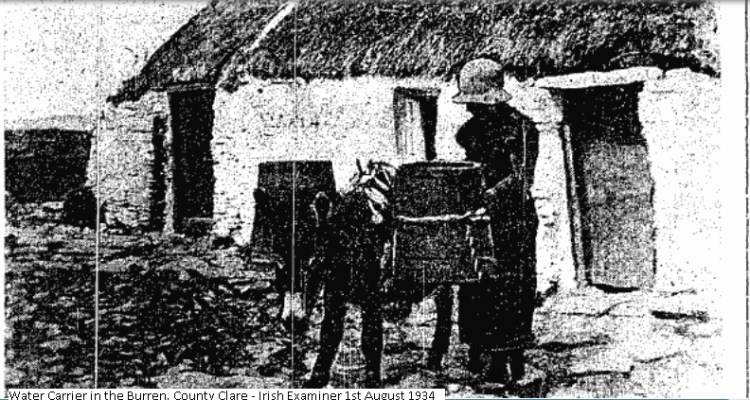
In the Gaeltacht, where there is a centuries old congestion, the problem will take longer to solve than in the less densely populated parts of the country. A special grant of £80,000 is made in the Budget for Gaeltacht housing. At one time there was a notion that the migration, by State suasion(sic.), of the Gaeltacht population to other counties would be the most effective remedy. Anyone who knows the hardship with which the native Irish speakers have built their little homes and the love they bear them, can understand that this policy would prove unworkable.

The present aim is to make the Gaeltacht fit for Gaels to live in; but centuries of bad government cannot be remedied in a day or a decade.
Posted in Posts and podcasts

Dear Gumblossom – 1934

Catholic Freeman’s Journal, Sydney, 24th May, 1934 p.38

Headford, Co. Galway

Dear Gumblossom,
Thanks very much for sending on my letter to Mary Downes. I did not know her whole address. She sent me a lovely long letter full of news. Thanks, dear Gumblossom, for your kind invitation. If any of the Pageites write to me I will answer them during the holidays, as I am only allowed to write one letter home every week during the school term. I am at school in the Dominican College, Galway and I like it well. We have a fairly good time. Our games are tennis, camogie and basketball, and there are swings for the small children. We are let out to matinees at the pictures and Irish plays. We have drill and dancing too. We get a month’s holiday at Christmas, a fortnight at Easter and from the middle of June to the beginning of September in summer.
Now I must tell you about Headford. Do you like the pictures enclosed? One is of the part of the street in which our house is, and the other of Ross Abbey. Ross is about a mile from Headford and is a noted ruin. It is used as a burial ground since the seventeenth century. Before that it was a Franciscan Monastery till Cromwell sacked it. Headford is a small town. It has a population of about 500. It is about seventeen miles from Galway city and Lough Corrib is three miles away. Last summer we did a lot of bathing and boating on the Lough. I even did a little fishing, but I have no patience. I enjoy reading the letters in your Page, the Arrows write such funny ones.
Here is a storyette before I finish. When the English King was sick and had to have a transfusion of blood an Irish man offered himself. After the operation the Royal Physician asked,
“How do you feel, your Majesty?”
“Majesty be hanged,” was the reply.
“Up with the Republic.”
Wishing yourself and all the Pageites every success.
Yours sincerely,
Ruby Canavan

Posted in Posts and podcasts

Kinvara – 1934

Connacht Tribune 5th May, 1934 p.11

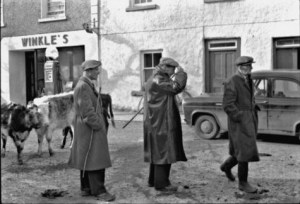
Winkles

At a meeting of the tenants of the Sharpe estate, Kinvara, a letter was read from the solicitor to the estate, offering on behalf of the trustees, a reduction of 15 per cent on the current rents in addition to 15 per cent temporary abatement allowed 25 years ago and now made permanent. This was an advance of 5 per cent on the trustee’s previous offer.
In the matter of the arrears the letter stated these must be left in abeyance as the acting trustee had not the power to cancel them. A motion was brought forward that the trustees’ offer be accepted as the tenants were not in a position to hold out for more favourable terms. After much discussion the motion was agreed.

Posted in Posts and podcasts

St Brigid – 1934

The Catholic Press 1st February, 1934 p8

ST. BRIGID.

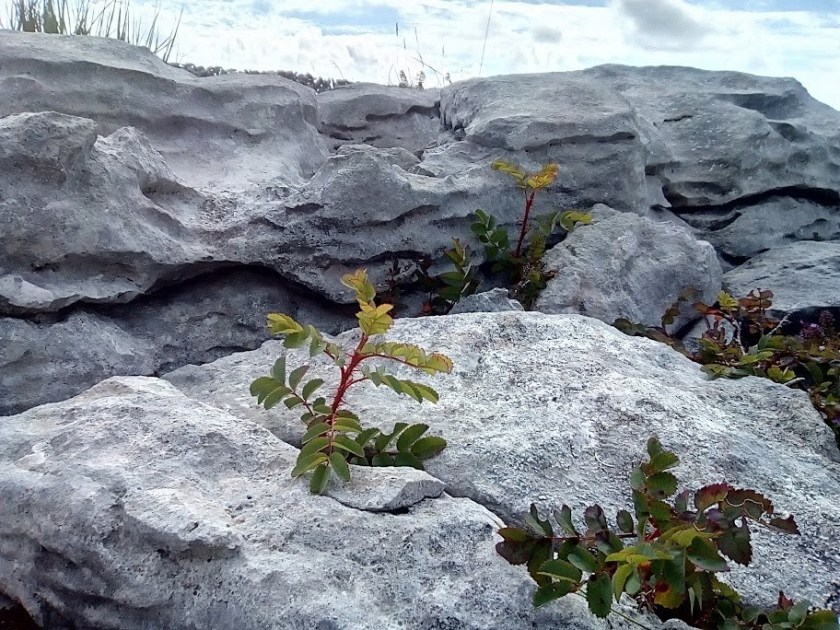
Burren light Photo:EO'D
Burren light
Photo:EO’D

St. Brlgid is the mother, all men know,
Of Erin’s nuns that have been, or shall be,
From great St. Patrick’s time to that last day
When Christ returns to judge the world by flre.
‘Twas summer eve; upon a grassy plain
She sat, and by her side a fair blind nun,
Of them that followed her, and loved her rule,
And sung her nocturn psalms. They spake of God.
The wonder of His dread inscrutable Being
Round all, o’er all, in all; the wonder next
That man, so slight a thing, can move His love,
Can love Him, can obey; the marvel last
Of God made Man; the infinite in greatness
By infinite descent a creature made,
Perchance within the least of peopled worlds,
For saving of all worlds.
The Sun went down;
Full faced the moon uprose; the night wind sighed,
It broke not their discourse. The dawn returned;
It flushed the clouds; it fired the forest’s roof;
It laughed on distant streams.
St. Brigid gazed upon that dawn; a thought
Keen as a lance transfixed her heart; she mused,
‘Alas, this poor blind sister sees it not!’
She clasped that sister’s hand, she raised, she kissed it;
That blessed one spake: ‘Why weepest thou, mother mine?
Thy tears are on my hand.’ The Saint replied:
‘I weep because thou canst not see the dawn
Nor in it God’s great glory.’ Then the nun:
‘If that thought grieves thee, pray and I shall see.’
St. Brigid knelt; and lo! the blind one saw!

AUBREY DE VERE.

Posted in Posts and podcasts

Gleninsheen Gold – 1934

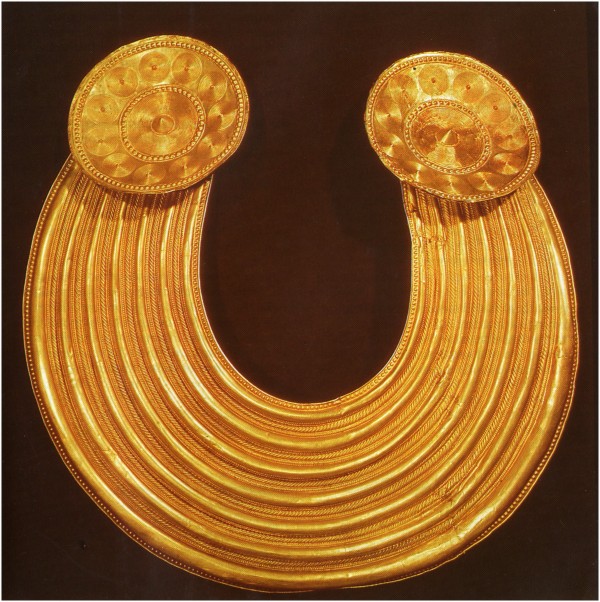
Gleninsheen Gorget
Gleninsheen Gorget

The Grenfell Record and Lachlan District Advertiser 9th April, 1934 p4

GOLD COLLAR FOUND.

MADE 2500 YEARS AGO. (abridged)

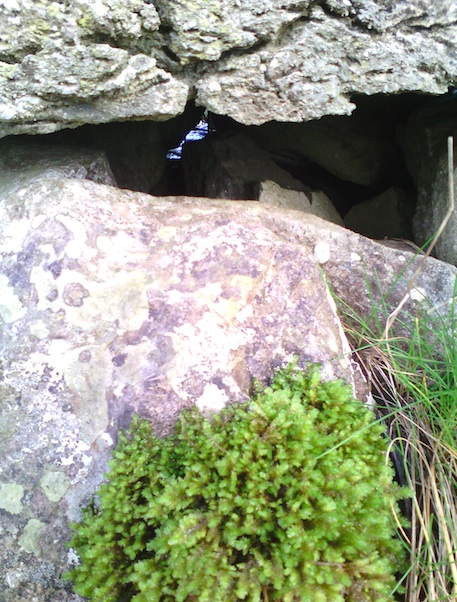
A collar of pure gold which is believed to have been made about 700 B.C., has been found at Burren, County Clare, says the ‘Manchester Guardian.’  The discoverer was a local farmer who noticed it glittering in a cleft of rock.  The National Museum has claimed it as a treasure trove. Dr. Mahr, Keeper of Irish Antiquities in the National Museum,  has confirmed the belief of its antiquity.

The type is well known, he said in an interview, and four similar ones are in the museum. Three were found in the area through which the Shannon flows.  A fourth, like the one now discovered at Burren, has circular bosses and is believed to have been found in Armagh. Two collar’s containing bosses were found in the Rhine, near Worms, and these had probably been exported from Ireland in the middle of the last millennium B.C.

The Burren collar, or gorget, Dr. Mahr said, was the most beautiful find in Clare within the last thirty or forty years. Clare is famous for discovery.  When the Limerick Ennis railway was being constructed in 1854 a large hoard was found near a stone fort at Megane, Ballykilty, Quin.   Laborers removing a stone which was in their way uncovered a number of gold articles weighing about 160 ounces underneath. ‘Unfortunately, there was nobody to advise them,’ Dr. Mahr said, ‘as to how they should dispose of the articles, and they were mostly bought by local jewellers and melted down, to the great loss of Irish archaeology and kindred studies.’

Only thirteen of the articles reached the museum in Dublin, while about two dozen went to the British Museum.