London June 15th 2.15 pm Alcock and Brown after flying sixteen hours twelve minutes, arrived at the wireless station at Clifden. They circled around in aerials looking for a landing. Finally they slightly damaged their machine, landing in a bog. The Marconi staff rushed to their assistance and found Brown dazed and Alcock deaf from shock. The landing staff escorted the aviator triumphantly to the receiving house, where he soon fully recovered. Brown states they were constantly in a thick fog and mist. Sometimes they found themselves flying at 11,000 feet, and at other times upside down ten feet from the water.
The Evening Telegraph, Tuesday 29th July 1919 p.4 THRILLING DIVE Airmen’s somersault into Galway Bay.(abridged) The striking spectacle of an airman diving into the sea from a falling aeroplane, a second officer scrambling from beneath the immersed machine, and both swimming to the shore, was witnessed at Galway Bay. The machine, piloted by Captain Bowen, R.A.F., accompanied by Lieutenant Alcock, R.A.F., was seen flying at a great height over the city. Gradually it descended, when it soon became apparent to the spectators that it was in trouble. The aeroplane eventually got well over the water, where the engine stopped. The machine then turned a somersault in mid air and fell into the water. The observer jumped clear, but the pilot was unable to extricate himself in time, and was carried underneath by the falling aeroplane. With difficulty he managed to scramble out and joined his partner in a twenty-five yards’ swim to the shore, which they reached in safety before a boat dispatched from the naval base immediately the mishap was observed could arrive on the scene. In the evening a motor-launch from the base towed the derelict aeroplane into dock.
Excerpt from The Workhouse or Gaol in Galway. What an American Journalist saw by James M. Tuohy (Staff Correspondent of the ‘New York World’). Freemans Journal (Sydney) 9th October, 1919 p.14
It is not surprising to find that Galway is a strong Sinn Fein centre, and during the Easter rebellion of 1916 there was a futile rising there. A score of men were taken from Galway City and deported to English gaols and internment camps, including Dr. Walsh, bursar of the Galway branch of the National University, where he also holds two important medical professorships. His experience may be taken as a fair sample of the treatment accorded to men against whom no charge was ever preferred, no evidence offered, and to whom no trialwas ever accorded.
In Galway I listened to the stories of a number of men of culture and refinement, professional men and others, who had been arrested not once but twice and even three times, had spent long periods in gaol or internment camps without ever being brought to trial. Space does not permit me to give the details of these statements, of which no one who heard them could fail to be convinced of the truthfulness. They have no desire to advertise the ill-treatment and injustice to which they have been subjected, but their indignation was roused by Mr. MacPherson’s impudent misrepresentations.
As I have said, D.O.R.A. (Defence of the Realm Act) is all powerful in Galway and throughout the west of Ireland. Hardly a night passes that a police raid is not made on some house either in the town or the surrounding country ; searches are made and men arrested without charge, some being taken off into confinement, no one knows whither. These raids are preferably made in the dead of night, the police being accompanied by lorries full of soldiers, fully armed. The victims are handcuffed, placed in the lorries and taken perhaps to the large military barracks at Renmore, across the river. The next that is heard of them usually is that they have been sentenced by court martial for being in possession of ‘seditious’ literature or some similar crime.
Then there is the ‘Customary display of force by the army of occupation — squads of soldiers marching hither and thither with their trench helmets on to overawe people. But the people seem to be unconscious of these provocative demonstrations which, strike the newcomer with amazement. Apparently familiarity breeds contempt.
Note; Mr Lloyd George sent Mr Ian MacPherson to Ireland with ‘the Coercion Act in one hand and the Defence of the Realm Act in the other.’
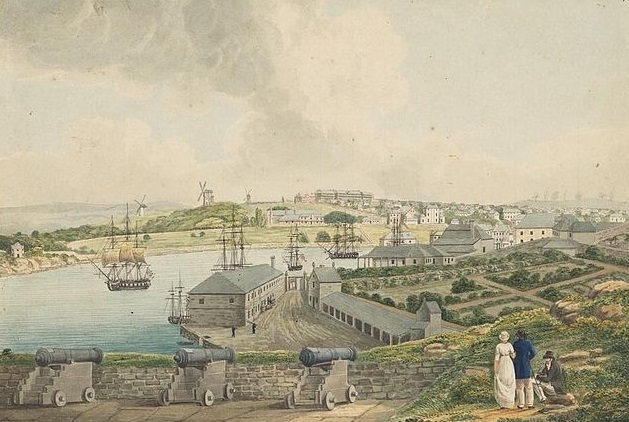
View of Sydney Cove from Dawes Point Source An Historical account of the Colony of New South Wales Author Lycett, Joseph, ca. 1775-1828
Last month was witnessed in Sydney the inauguration of a branch of the Cumann na mBan. The meeting, held for the purpose in the rooms of the I.N.A., Station House, was a very enthusiastic and successful one. After the aims and objects of the association were explained, it was decided by the ladies to place themselves under the patronage of Ethna Carberry, and that the branch be known as An Craob Ethna Carberry (the Ethna Carberry branch). The following ladies were elected office-bearers;
President – Miss B. O’Grady
Vice-Presidents – Miss M. Ryan and Miss Sheehan
Secretary – Miss Amy Ryan
Treasurer – Miss May Maloney
Committee; Mrs Cheetham, Miss Madeline Sheehy, Miss Mary Organ and Miss Kathleen Weber.
The names of Mrs. J. Murphy and Miss Darcy have since been added to the committee.
When the ban has been lifted from the holding of meetings, the Cumann na mBan will meet in the I.N.A. rooms (sixth floor), Station House, at 8 p.m. sharp on Wednesdays and special attention will be given the Irish language, industry, literature, &c. Information as to membership can be had from the secretary Miss A. Ryan, I.N.A., sixth floor, Station House.
Logo of the Oireachtas of Ireland Image: Barryob Wikimedia Commons
Twenty five members of the Sinn Féin society elected to the British house of commons assembled in Dublin this afternoon and formally constituted themselves the “Dail Eireann,” which is Irish Gaelic for “Irish Parliament.” They elected Chas. Burgess, whose Irish name is Cathal Brugha, speaker. They also adopted a declaration of independence and an address to the free nations of the world and appointed a committee consisting of Count Plunkett, Arthur Griffiths and Edward De Valera to present the claims of Ireland to self-determination to the peace conference at Paris. The two last named being in British prisons, only the venerable Count Plunkett can proceed to Paris and then only provided the British government consents to give him passports.
The walls of the hall were quaintly embellished with classic statues in plaster and coats of arms. Past lord mayors have witnessed many more exciting dramas, notably in recent years of conventions of the Nationalist party, when there were impassioned speeches and hot party contests.
The Catholic Press 15th May, 1919 p. 18 (abridged)
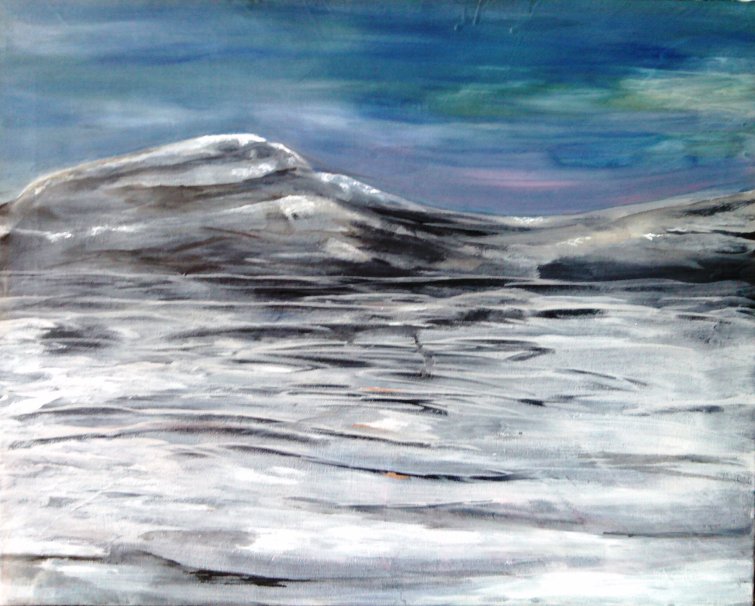
Mullaghmore Acrylic on canvas EO’D
You ask me why, tho’ ill at ease,
Within this region I subsist,
Whose spirits falter in the mist,
And languish for the purple seas.
Within this land which bondmen till
Who cannot call their minds their own,
But into dungeons straight are thrown
If they but speak the things they will.
A land of nameless government,
That hath a wide and dark renown;
Where Freedom hourly shrinken’s down
From precedent to precedent.
Where faction always gathers head
Where by degrees to fullness wrought
The strength of some repressive thought
Hath time and space to work and spread.
Where banded bigots persecute
Opinion, and produce a time
When honest thought is civil crime,
And individual freedom mute.
Yet ’tis the land of mist and wrong,
Wild wind! that claims my homage high;
And I will hear before I die
The shout of her triumphant song.
S.
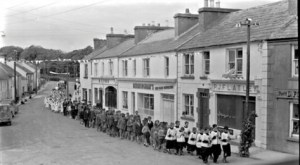
Corpus Christi procession, Kinvara c.1950 Photo: Cresswell archives
We deeply regret the death on the 27th of December at the Parochial House, Kinvara, of the Rev. Thomas Burke, P.P. Deceased was universally respected. He was a native of Ardrahan parish and educated at Maynooth. He had a thorough and intimate knowledge of the history of his country and was a lover of its past, and was particularly well up in the history of his native county of Galway. Few men living better knew the story of the past of this province or of the fall and rise of its families. Father Tom was in delicate health for some years and unable to actively discharge the duties of his sacred office. While able to work he wa zealous and untiring in his daily devotion to duty.
It was but a fitting thing that Dr. MacEvilly should have appointed Father Burke to so historic a parish as Kinvara, where we find the union of ancient parishes of Kiloveragh, Kilena and Duras. On a site given by James de Basterot, of Duras, the present church was erected, and it was one of the first Catholic churches built in these parts. Thus the pro-Cathedral, Galway, was not commenced until 1819 and Tuam Cathedral till 1827 and Gort church until 1828. It cost £2,000 in those days. The parish priest in 1798 was the Rev. Nicholas Archdeacon who was afterwards Bishop of the Diocese of Kilmacduagh, of which Kinvara was a part. He was succeeded by Father O’Fahy, who was followed by Father Acton, a regular, who afterwards became P.P. of Ballindereen and after him came Rev. John Fahy of Peterswell, whose successor was the Rev. Thos Shannon, afterwards P.P. of Gort.
Father Forde succeeded Father Shannon and he died a victim to duty in black ’47 and is buried in the church at Kinvara close to the B. Virgin’s alter. After him came Father Francis Arthur, who hospitably entertained John Blake Dillon when flying from Tuam dressed as a priest in clothes lent him by Father O’Brien, then Professor of St. Jarlath’s, and on a car given and driven by Richard Kelly, Esq., J.P. of Tuam.
He fled to Kinvara from Tuam to go to America, intending to leave as an emigrant in a ship that was sailing from Galway to Boston. He was brought out in a boat from Kinvara by John Holland, a native, to try and catch the ship on its outward journey ere she sailed away for the Far West. The vessel was the brig “Barbara.” The sea, however, was too rough for Holland’s boat, so regretfully he had to put in at Aran from which John Dillon ultimately sailed for the great Republic. Father Burke often related at his hospitable board the story of the sailing which he had fromeyewitnesses. Father Moloney succeeded Father Arthur and after him Father Tom Burke came.
Kinvara saw in the time of these last four deceased priests many sad changes for the worst. It lost its primacy as a bishopric – the old see at Kilmacduagh being united to the modern one of Galway. It lost its shipping trade. The only thing that did not decline was the rent the people had to pay. The old landlords, the Gregorys of Coole Park, and the De. Basterots were obliged to sell out and the new class of speculator came along.
A Mr. Comerford, a timber merchant in Galway, bought the town that belonged to Mr. Gregory and raised the rental from £335 to £1,150, but it did not and could not revive with him or his successors. A Mr. Murray, a pawnbroker in Galway, came along and was equally active in promoting depopulation. The townlandlord of Northampton decreased from 25 families to 11. But Mr. Murray left a bequest of £2,000 for a convent and to him Kinvara owes its present beautiful foundation built on a site given by Captain Blake Foster.
Kinvara was once a thriving market town, but its tolls declined from 200 to 60. It had in 1872 a population of 689 families and in 1890 this sank to 451. Its barley market for Persse’sDistillery in Galway brought in a good deal of money, but Persse’s Distillery, having been closed down owing to the narrow policy of the Bank of Ireland, that industry was lost to Galway and Kinvara.
Father Tom was universally esteemed, and while of recent years his delicate health did not allow him to go about, he was always glad to meet a brother priest or other friend and chat over old times. The regret felt at his demise was manifested in every possible way by the parishioners who felt they lost in him a good priest and friend. There was a great gathering at the funeral and Requiem Mass on Monday at the Parish Church of the priests of the diocese and the people of the district.
R.I.P.
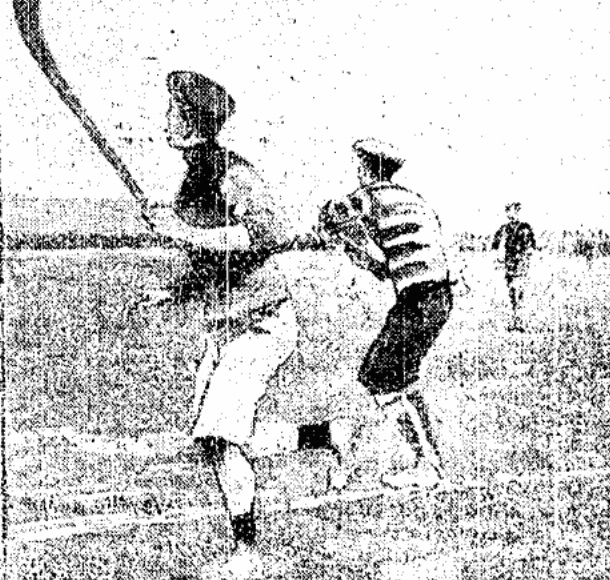
Long puck Wexford v Limerick Irish Independent 20th November, 1910
The Co. Clare Board G.A.A., were obliged to play off a tie between Tubber and Killinana on the Galway side on Sunday. Rumour had it that the hurling was to be prohibited, and for that reason an invitation to Gort to meet a selection from Clare was readily accepted, despite other engagements at home. A couple of platoons of military with full war equipment, assisted by several armoured motor cars, sported themselves on the roadside bordering the playing pitch. Shortly after the game started the “Iron Duke” and his other formidably named companions crossed the Clare border and disappeared amongst the hills unnoticed, except for a few derisive cheers as they motored past.
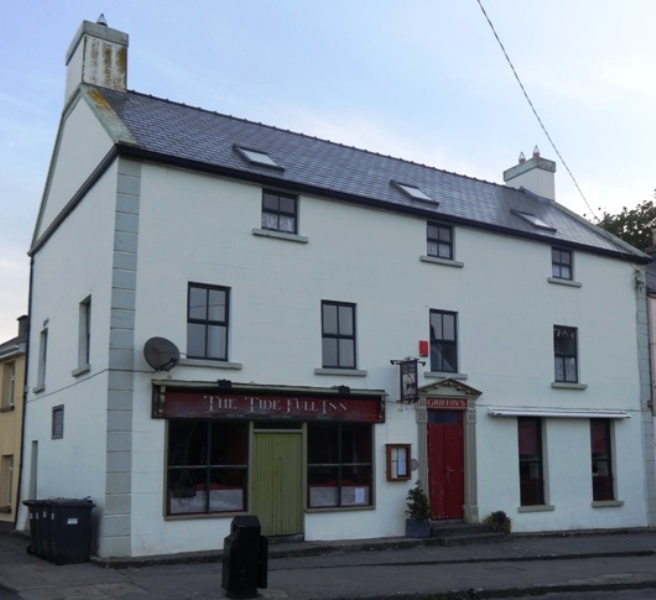
To Mr Patrick Griffin, blacksmith, Kinvara, belongs the credit of shoeing a horse belonging to Hodgins’ Circus that failed all the blacksmiths on their line of march. The horse was one of the wildest type and broke all the available car ropes in the town with which he was manacled but eventually he had to yield to the plucky son of Vulcan.
(abridged)
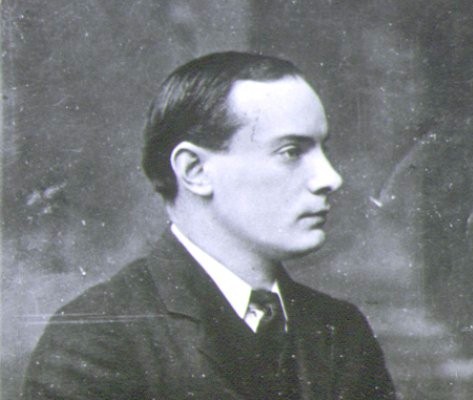
Patrick Pearse was a barrister, but he may be said not to have practiced as he gave himself up to the work of education at which he was most successful. He once appeared in a Galway case. It was to defend the Kinvara Hero who, despite the law, persisted in having his name painted in Irish on his cart. The police prosecuted him and he was duly fined but he triumphed. Lady Gregory and Edward Martyn took up his case and Pearse ably fought it in the Dublin courts with the result that such stupid and silly prosecutions were abandoned and the brave Kinvara man, Bartley Hynes became a hero in spite of himself.

 The Burren and Beyond