Posted in Posts and podcasts

The Countess – 1918

The Argus, 30th December, 1918 p.5the-countess
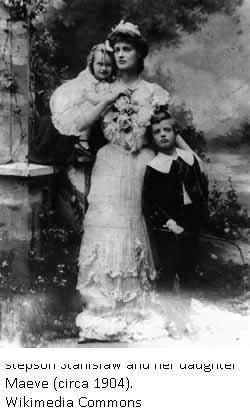
Amongst the Sinn Feiners elected in Ireland is the Countess Markievitch, who took a leading part in the Dublin rebellion at Easter, 1916.
In spite of her name, the Countess Markievitch is an Irishwoman, being the eldest daughter of the late Sir Henry Gore-Booth, Bart., of Sligo. A sister is Miss Eva Gore-Booth, the poetess. In 1900 she married the Polish count Casimir Dunin de Markievich. The two, the wife being the leader, were in the forefront of the most “advanced” party in the intellectual circles of Dublin. But it was when authority had to be defied that the Countess surpassed herself. Then what denunciations of England came from this gaunt, excited figure! What belabourings of Man! For she was a Suffragette as well as a Sinn-Feiner and was a leader in the suffrage disorders in Dublin. One of her chief swoops into notoriety was in the great strike of 1918, when she was one of the most active supporters of Larkin. For her share in the Easter Rising at Dublin in 1916 she was sentenced to death, but the sentence was commuted, and she was subsequently amnestied. Similar treatment was meted out to Professor John MacNeill, the nominal head, or “Chief of staff,” as he styled himself, of the Sinn Fein volunteers, who has also been returned to Parliament, having defeated the Nationalist candidate for the National University of Ireland.

Posted in Posts and podcasts

Duras – 1918

Connacht Tribune 10th August, 1918 p.2

Duras
Duras Photo: BO’D

Large numbers from various districts in Galway and Clare journeyed to Kinvara on Saturday and Sunday to participate in the annual pilgrimage to St. Kieran’s Bed. at Fraugh Kieran, Duras, Kinvara.  St. Kieran’s Bed is charmingly situated close beside the silvery strand at Duras, and commands a splendid view of Galway Bay as far as the Aran Island, with the lofty Burren mountains away in the background. Hundreds of people remained all through Saturday night to do their stations on Sunday and every mode of conveyance from the old Irish jaunting car to the more modern bicycle brought its quota on Sunday. “It is a pity,” our correspondent writes, “that some local Committee would not take charge of the arrangements every year, and see that the religious side of the pilgrimage is strictly observed as its inception dates back centuries.

Posted in Posts and podcasts

Anti-Conscription meeting, Kinvara – 1918

Connacht Tribune 11th May, 1918 p.2

Wikimedia Commons
Wikimedia Commons

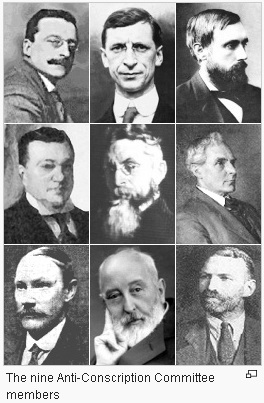
A large and enthusiastic meeting for the purpose of protesting against the conscription menace was held at Kinvara on Sunday week. The meeting was addressed by the Rev. J. W. O”Meehan B.D., C.C. (Chairman); Rev. J. Keeley, C.C; Dr. T.J.Connolly; T.P. Corless; P.J.Flatley; J.Kilkelly and F.J. Johnston.
The nine Anti-Conscription Committee members (image on left);
Arthur Griffith, Eamon de Valera, John Dillon, Joe Devlin, William O’Brien, Thomas Johnson, Michael Egan, Timothy Michael Healy, William X. O’Brien.

Posted in Posts and podcasts

Crab Island, Doolin – 1918

Freemans Journal 17th April, 1918 p3 (abridged)

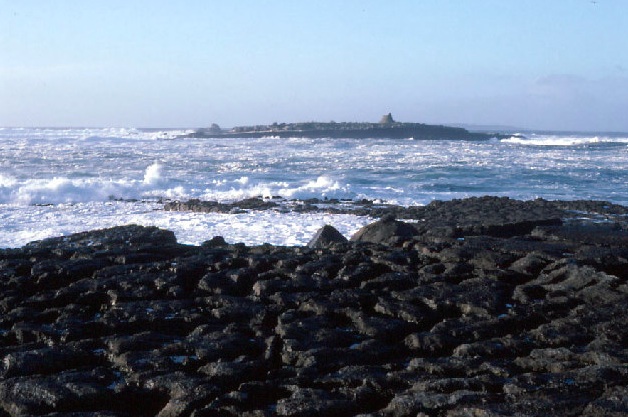
Crab Island, Doolin, County Clare Photo: Dr Charles Nelson Wikimedia Commons
Crab Island, Doolin, County Clare
Photo: Dr Charles Nelson
Wikimedia Commons


The County Clare police have arrested a man who entered Crabbe (Crab) Island, in a sheltered inlet of Galway Bay, near Doolin, in a collapsible boat, and who declared that he had escaped from an American ship that had been sunk by a German submarine.
It appears that the ship mentioned was not sunk, and the mysterious visitant of this lonely coast, which is well within the bay, being unable to give a satisfactory account of his presence, was conveyed by the naval authorities to Scotland Yard.
He wore the clothes of an ordinary civilian with a frieze coat, and it appears that he got £45 in silver at an Ennistymon bank. He is a man of education and states that he is a native of Munster.
The collapsible boat is not of the ordinary type but has cork stays and can be rolled up into a small parcel.
He was taken to Dublin on the way to London

Posted in Posts and podcasts

Ennistymon – 1918

Hawera and Normanby Star Vol LXXIV 4th March 1918 p5

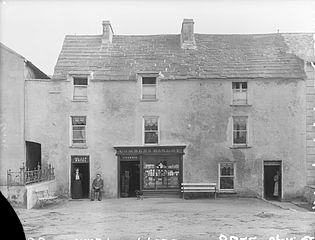
Comber's Bakery, Ennistymon National University of Ireland via Wikimedia Commons
Comber’s Bakery, Ennistymon
National University of Ireland
via Wikimedia Commons

It is reported that the £5,500 stolen from a bank manager at Ennistymon, County Clare has been restored, with a note stating that no robbery was intended and the money was taken merely to prevent its use at the fair to buy cattle, which were to be exported.

Posted in Posts and podcasts

The Irish World – 1918

FJ masthead Wikimedia Commons
FJ masthead
Wikimedia Commons

The Ogden Standard, 22nd January, 1918 p12
The Irish World, The Gaelic-American and the Freeman’s Journal, three of the leading weekly publications in this country espousing the cause of Irish independence have been barred from the mails – it was learned from the editors of these papers today.

Posted in Posts and podcasts

Mat Roseingrave, Gort – 1918

Referee (Sydney) 4th December, 1918 p8 (abridged)

DETROIT ATHLETIC CLUB-1988   Wikimedia Commons -
DETROIT ATHLETIC CLUB-1988
Wikimedia Commons –

Last week when discussing famous Irish athletes in connection with the running hop, step and jump, the name of Mat. Roseingrave, of Gort, cropped up, and I promised to give some particulars of his career in Australasia.

Roseingrave, as we knew him, was the beau ideal of an athlete — tall and symmetrical in build — and he knew from A to Z all the fine points of athletics,especially in the jumping, hurdling and field game departments. I suppose most people who saw him in action will say he was at his best as a jumper in general and a broad jumper in particular.

M. M. Roseingrave arrived in Sydney early in 1896 — I heard of his coming from Mr. T. M. Malone. At any rate he made his debut here at the St. Patrick’s Day sports in Sydney, on March 17, 1896. He had entered in four events, and it devolved upon the writer to handicap the boy from Galway, although I had but a hazy notion of his athletic capacity.

In those days we had two first-class hurdlers in the late W. G. Cole and B. H. Richards. Roseingrave beat Richards by a yard in 19sec. Later on the Irishman won the running broad jump at 22ft l01/2in (a record for these parts.), the running high jump at 5ft 7m, and was second in the 161b shot putt handicap, his actual putt being 30ft 9in. It was quite a sensational start.

Posted in Posts and podcasts

Cliffs of Moher – 1918

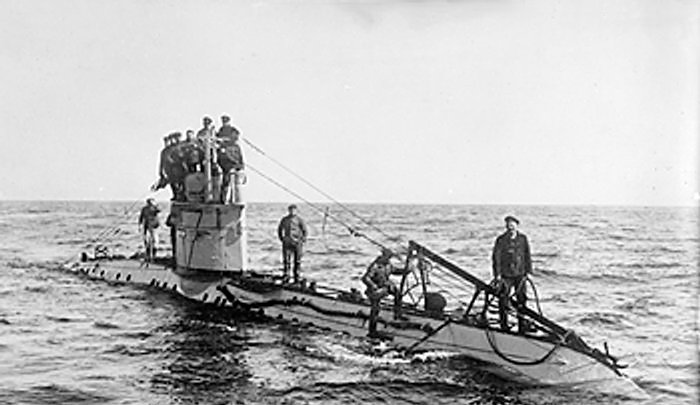
The crew of a German UC-1 class submarine on deck.  wikimedia commons
The crew of a German UC-1 class submarine on deck.
wikimedia commons

The Advertiser 30th May, 1918

LATEST CABLE NEWS

MAROONED (abridged)
The Cork correspondent of the “Daily Chronicle” gives details of the arrest of a man who was put ashore from a German submarine and who is now in the Tower of London awaiting a court martial.

On April 13 near the cliffs of Moher, County Clare two fishermen noticed a man on a barren islet waving a handkerchief violently. When rowed ashore he said his name was O’Brien, and he was the survivor of a torpedoed ship. After he had been provided with food and clothing the authorities became suspicious. O’Brien was arrested and the police soon found that the torpedoing story was untrue. He had a good deal of English silver in his pockets. Moreover, a collapsible boat was found wrecked near the cliffs at Moher. Evidently the spy had landed on the islet at night, mistaking it for the mainland. He endeavored to destroy the boat and only discovered at daylight that he had marooned himself.