Posted in Posts and podcasts

St. Colman

Irish Times 8th October 1904, p9 (abridged)
We drove through a rocky defile for about three miles, where large boulders on either side of the roadway were apparently so lightly poised it seemed as if a strong puff of wind might dislodge them and send them down on our path.
“Now, we must get out here. I believe the oratory is somewhere there,” and my friend waved her hand to include a three mile circuit.
“Let us have tea first,” I mildly suggested. So we sat on the grassy fence and produced our tea pasket. Then we rose like giants refreshed, first giving the old man a cup of powerful tea to “cut the drouth.” We made for the nearest Galway wall, and patiently made a gap to get through, my conscientious friend building it up when we had got through. You see galway walls are made of large loose stones with the daylight visible through them; this is done purposely so that the wind can pass through them, an ordinary wall would offer too much resistance to the winds from sea and mountain which alternate and prevail in these parts. I have heard the “Galway Blazers,” when pursuing the crafty fox, take the fences at a flying leap, but I do not believe any one else could perform such a feat. Crossing the extensive field of “praties,” we came to the conclusion there was no church or ruin within two miles, so back we plodded, took down and re-built the wall again, but when this was repeated in a wheat field, and once more in a field of turnips my ardour began to abate and I even murmured “some other day perhaps.” Just then we heard a man’s voice, “If ’tis lookin’ for St. Colman’s Church, yez are all wrong. You’d never find it. Hould on a bit and I’ll show ye the way,” and putting the scythe with which he was at work against a wall, he told us to follow him. We coinjointly deprecated taking him from his work, but he replied with Irish politeness, “I am only working for myself so ’tis no odds.” Leading the way we followed through fields of tangled mountain grass and bog myrtle, through purple heather and rushes; it was slow work, as the growth hid the stones, which were truly a trap to the unwary. After slips and stumbles, we stopped to take breath in a hazel coppice; on emerging from thence our guide, pointing to the slop of the mountain, said “There it is before you now,” but it was some time ere we could distinguish the tiny grey ruined church from the back ground of the limestone rock.
“Here we are,” we exclaimed simultaneously. Such an out of the world spot even in these days of hurry and bustle and sight seeing; not a sound but the murmur of a mountain stream; here indeed it might truly be said, “Grim silence held her solitary sway.” We stopped at the stone covered holy well of the old-world saint; in a niche placed by some pilgrims we found two scallop shells. On a hot August day one need not be reminded to “drink deep of the wave.” Hanging down in luxuriance from the roof were flourishing fronds of the Asplenium Tricomanes and Scolopendrium Vulgare ferns.
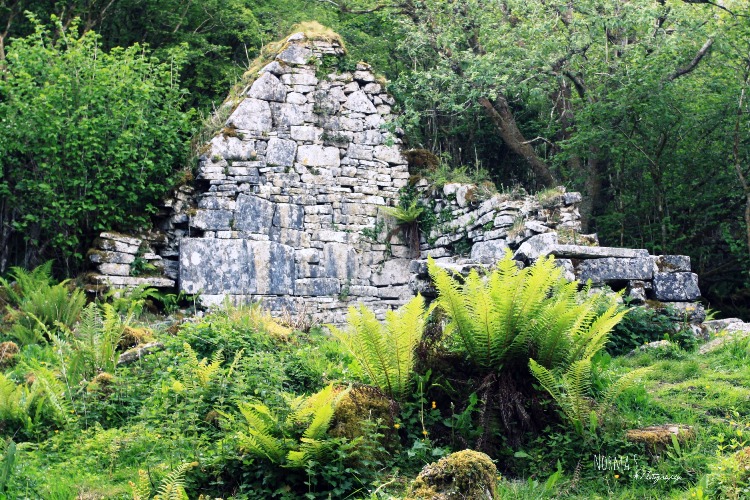
The present day followers of the saintly St. Colman Macduagh who carry away stones and plants from his hermitage, and who marvel at the legendary powers of fasting credited to the ascetic, seem to overlook entirely his abstemiousness from all drink save that of his mountain well. We climbed about amongst the fallen masonry till we stood in the oratory itself, which consists of one side wall and the two gables.
The Reverend J. Fahey in his interesting work on the ruins in the Diocese of Kilmacduagh says:-
It must have been previous to A.D. 597 when St. Colman entered on his seven years’ retirement here. At this time the now treeless Burrin hills were clothed with dense forests, so that the spot chosen by the Saint for solitude and contemplation was doubly more different of discovery than at present.

The existing ruin shows signs of restoration, as is supposed in the eleventh century, which is indicated by the difference in the masonry. Like all those of that period, the church is very small, being only 16 feet long, by 12 broad. Dr. Petrie has observed that these tiny churches were merely erected for the private devotion of the founders, for in the immediate vicinity of these oratories is usually found a cave or cell which served as habitation for the hermit. We saw St. Colman’s grotto about 30 feet above the church in the mountain side. We can hardly fancy this being the above for seven years of the recluse, for the grotto is only 15 feet by 5; it is, however high enough for a tall man to stand upright in, and doubtless the hermit’s contemplation was chiefly out of doors where his eyes would wander to the blue heavens, where his spirit loved to soar, and at night-fall would gaze on “the ocean hung on high, bespangled with those isles of light so wildly, beautifully bright.” Ah, if that old rugged peak of Ceanaille could tell us all it saw of the good man’s life at its foot, how much more interesting would it be than the stories invented by later day monks, and accredited to him as showing the miraculous powers they supposed St. Colman to be possessed of. Here is one:-
The saint lived here quite alone save for one youthful disciple, and the story is, that after the long Lenten fast – which, doubtless, the mountain air must have aggravated – there was nothing to be found in the scanty larder of the hermitage save a little wild fowl and the usual herbs wherewith to celebrate the approaching high festival. The Saint urged that God could provide a dinner if He thought fit. Now, it came to pass that the King of Connaught was staying at his palace at Kinvarra for the Easter festivities, but he had no idea that his saintly kinsman was only five miles distant in his retreat. So the legend goes on to tell that as his Majesty King Quain (sic.) was about to seat himself at his sumptuous repast, his aspiration was that so rich a banquet might be set before some true servants of God who needed it.
With this thought, the dishes were speedily whipped off the table by invisible hands! King Quain and his followers mounted their steeds and followed the dinner, when lo! it was placed before St. Colman and his hungry disciple. The arrival of the King of Connaught and his cortege caused considerable alarm to the hermit and his disciple. Then St. Colman, raising his hand, commanded the horsemen to remain where they were, and move they could not till the Saint had finished his repast, and prayed for their release.
The smooth limestone plateau upon which the horsemen’s progress was stayed is full of small round holes which the faithful believe to be the hoof marks of King Quain’s (sic.) horses. This spot was from its appearance at one time the bottom of the lake, and the supposed hoof marks are apparently water-worn holes, but of this we did not hint to our simple guide.
Posted in Posts and podcasts

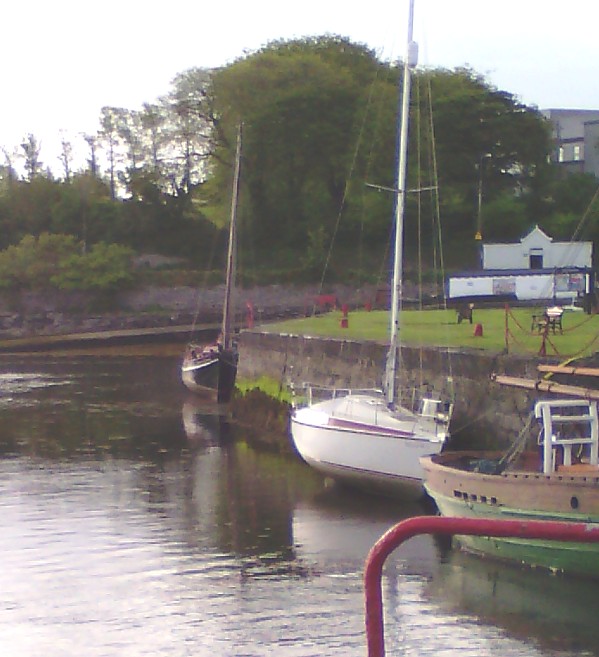
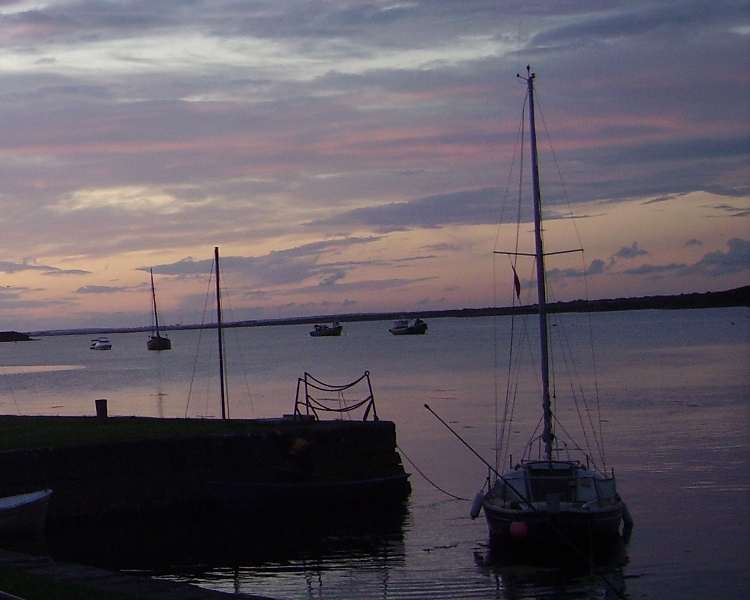
Kinvara Harbour – 1904

Photo: EO’D

The Irish Times
May 4, 1904
Kinvara Harbour and Pier
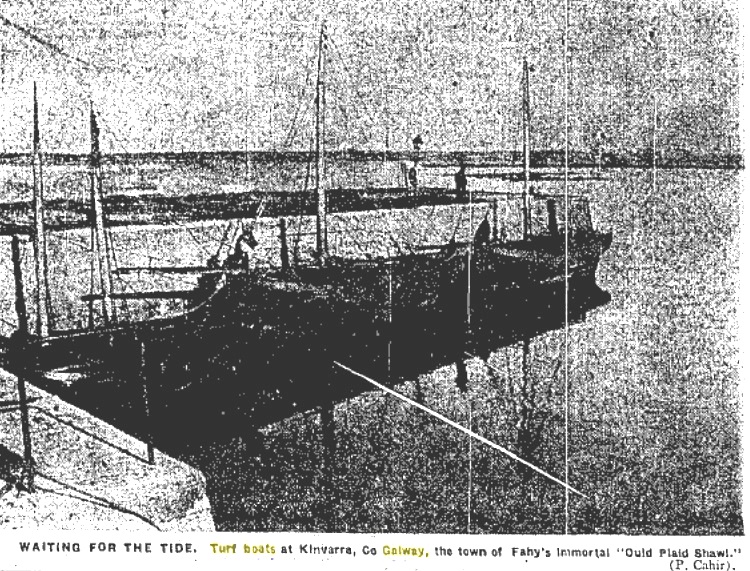
After 34 years continuous effort on behalf of the inhabitants of Kinvara, a start is at length to be made with the new works. Hitherto the great difficulty has been that the pier was private property, but the trustees of the owner, Miss Sharpe, through Messrs. Kirwan and Sons, of Tuam have now consented to hand over the pier, with its tolls, to the Galway County Council. The County Council have agreed to raise £1,000 for the rebuilding of the pier and the dredging of the harbour. The Agricultural Board, through Sir Horace Plunkett, have given a grant of £1,000 and a further sum of £1,100 has been allotted under Mr. Wyndham’s Marine Works Act, thus bringing up the total to £3,300, the amount estimated as necessary by the County Surveyor, Mr. James Perry, C.E. At the last meeting of the County Council on the 26th ult. a communication was addressed to the Congested Districts Board asking them to undertake the completion of the work. On receipt of the news in Kinvara the town was brilliantly illuminated; bonfires blazed from the surrounding hills, and a procession of torchbearers and musicians paraded the principal streets, the Rev. T. Burke, P.P., and Mr. Thomas P. Corless, Chairman Gort Rural Council, who have been so largely instrumental in the successful negotiations, receiving an ovation. It is expected that Kinvara will now become a port of call for the new Glasgow service of steamers which are to visit the principal harbours of the west coast, and that in addition to a revived barley market and trade development, a regular tourist traffic with Galway by steamer will now be re-established.

Posted in Posts and podcasts

Two hundred years ago

Irish Examiner 6th August, 1904 p.9

Meeting
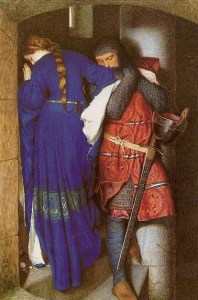
Hellelil and Hildebrand, the Meeting on the Turret Stairs Frederick William Burton (1816-1900) National Gallery of Ireland

I stand in the gallery quaint and old,
And there on the tapestried wall,
I read the names of the knights and dames
Who have passed beyond recall:
And a faint dream-perfume comes to me
That carries me, ere I know,
Back to the world that used to be,
Two hundred years ago.

Out of her ruffle of costly lace,
And out of his armour old,
Look down a maid with a smiling face
And a cavalier brave and bold.
And I know that she was his lady fair.
And he her courtly beau;
They were lovers true in the days that were,
Two hundred years ago.

I recall the legend that links her name
To his in a wreath of gold –
How he died to save his love’s fair fame
In the chivalrous days of old,
And her eyes still gleam with love’s deep trust,
And his with courage glow,
Though her spirit and his were laid to dust
Two hundred years ago.

As they gaze at me from their place on high,
“Believe” they seem to say,
“Though centuries pass and customs die,
Love passeth not away!”
And as long as men are true and bold,
And women that high trust know,
Shall Love be the gift that it was of old
Two hundred years ago.

Posted in Posts and podcasts

Kinvara Pier and Harbour Committee – 1904

Freemans Journal February 6th, 1904

Kinvara Pier Photo: Connacht Tribune
Kinvara Pier
Photo: Connacht Tribune

At a specially convened meeting of the Kinvara Pier and Harbour Committee held on Sunday last, the very Rev. Thomas Burke, P.P., in the chair – the following resolution proposed by Mr. Thomas P. Corless J.P., M.C.C. and seconded by Mr John Flatley (Flatley and Joyce) was unanimously adopted;
Resolved;
That we, the members of the Kinvara Harbour Committee, desire to thank the Galway County Council for their generous grant of 1,000 pounds towards the improvement of the harbour. That, as the County Council have carried out the conditions mentioned in the letter of their secretary, dated March 6th, 1903, we now call upon Mr. Wyndham to at once allocate a sum of £1,200 out of the Marine Works fund to carry out the much-needed improvements of the pier and harbour, as the matter can no longer brook delay.

Posted in Posts and podcasts

Kinvara Notes – 1919

WESTERN PEOPLE 7TH NOVEMBER 1903 P.5   (abridged)

Photo: EO'D
Photo: EO’D

Kinvara notes;
Kinvara lost its primacy as a bishopric, the old see of Kilmacduagh was united to the modern see of Galway. It then lost its shipping trade. The old landlords, the Gregorys of Coole Park, and the De Basterots were obliged to sell out.
Mr Comerford, a timber merchant in Galway bought Kinvara from Mr Gregory and raised the rental from 335 to 1,150 but it did not and could not survive with him or his successors. A Mr Murray, a pawnbroker in Galway, came along and was equally active in promoting depopulation.   The townland of Northampton decreased from 25 families to 11. Mr Murray however left a bequest of 2000 for a convent and to him Kinvara owes its present beautiful foundation built on a site given by Captain Blake Foster. Kinvara was once a thriving market town but its tolls declined from 200 to 60. It had in 1872 a population of 689 families and 1889 this sand to 451. Its barley market for Persse’s Distillery in Galway brought in a good deal of money but Persse’s Distillery having been closed down owing to the narrow policy of the Bank of Ireland, that industry was lost to Galway and Kinvara.
Father Francis Arthur assisted in the escape of John Blake Dillon to America. Kinvara man, John Holland brought Dillon to Aran.
The tenants on the O’Donnellan Blake Foster Estate held a meeting in Kinvara in October 1919 to arrange terms for purchase with the agent, Mr Holmes. The Rev Father Burke P.P. Kinvara put the tenants’ case before the agent, with the result that 18 and a half years was agreed upon as the sale price. The reduction which the tenants have obtained through these terms amounts to 8s in the pound or 40% on their present rents

Posted in Posts and podcasts

Kinvara – 1904

Tuam Herald 9th April, 1904 p.4

Photo: Cresswell Archives

W.H.Stuart, Esq., Estate Commissioner Inspector, visited Kinvara last week for the purpose of conferring the Mr Thomas P. Corless, J.P. Chairman Gort District Council on the evicted tenants question. The Estate Commissioners have, it is said, in contemplation the purchase of large and valuable grazing farms in the district for the purpose of dividing them out amongst the people. The ever vigilant P.P., Father Burke, interviewed the inspector at Corless’ Hotel during his stay and gave him every aid in his good work.

Posted in Posts and podcasts

Kinvara Harbour Committee – 1904

Freeman’s Journal 6th February 1904 p 19KK
At a specially convened meeting of the Kinvara Pier and Harbour Committee held on Sunday last, the Very Rev Thomas Burke, PP in the chair, the following resolution, proposed by Mr Thomas P Corless, JP., MCC and seconded by Mr John Flatley (Flatley and Joyce) was unanimously adopted;
Resolved;
That we, the members of the Kinvara Harbour Committee, desire to thank the Galway County Council for their generous grant of £1,000 towards the improvement of the harbour. That, as the County Council have carried out the conditions mentioned in the letter of their secretary, dated March 6th, 1903 we now call upon Mr Wyndham to at once allocate a sum of £1,200 out of the marine Works Fund to carry out the much-needed improvements of the pier and harbour, as the matter can no longer brook delay.

Posted in Posts and podcasts

Michael Lynch – Omaha, Chile, Scotland, Ballyvaughan – 1904

The Omaha Daily Bee; 31st May, 1904 p12. (abridged)

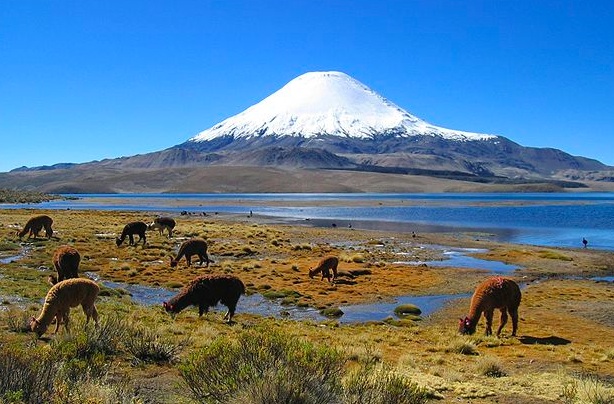
Parinacota volcano, Chile Photo: mtchm  Creative Commons
Parinacota volcano, Chile Photo: mtchm
Creative Commons

After spending more than a year visiting every country on the globe with the exception of China, Michael Lynch, a young blacksmith and a brother to Omaha City Gas Inspector John C. Lynch, met his mother in the little town of Ballyvaughan, Co. Clare, Ireland.

Michael is but 20 years old and had established himself in the blacksmith business in Omaha after learning the trade. The wandering fever, however, seized him a year ago last March and he set out to see the world. His family heard from him only occasionally, once from Chile and next from Scotland.

His own mother, Mrs Lynch was returning to Ireland to visit her mother, a hale and hearty 91 years old. It was just after Mrs Lynch had started homeward from Omaha when John heard from Michael in Scotland. He replied to him immediately and advised him of his mother’s trip to County Clare. The lad succeeded in beating her to Ballyvaughan. The reunion was filled with happy surprise.

Posted in Posts and podcasts

Guaranteed Irish – Tobacco – Part II – 1904

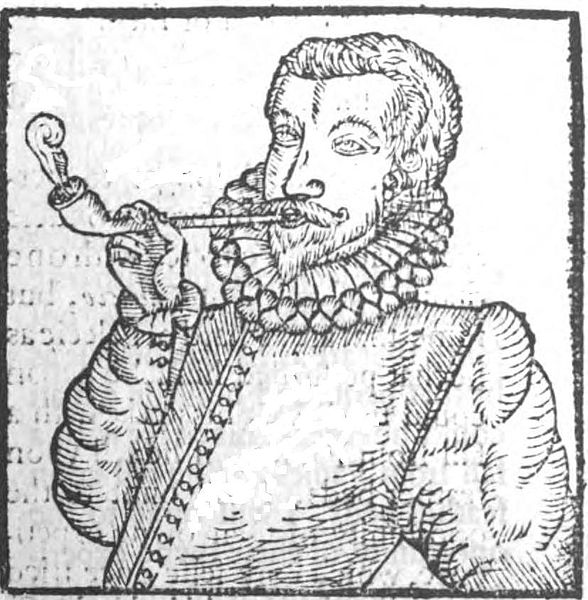
From Chute's pamphlet "Tabaco" 1595 Parker Burnette Wikimedia Commons
From Chute’s pamphlet “Tabaco” 1595
Parker Burnette
Wikimedia Commons
THE INTERMOUNTAIN CATHOLIC 1ST OCTOBER, 1904 P1
TOBACCO IN IRELAND – PART II

On this interesting subject a correspondent writes:
“A visit to The Farm, Kilmainham, Kells, County Meath, would satisfactorily show that there can bee little doubt as to the possibility or indeed, ultimate success of tobacco culture in Ireland. The plants are very fine and well grown, all seeming in robust health. The variet grown is Yellow Prior, an earlier and dwarfer variety than Virginian, hitherto planted.
The plants were raised under cover and planted out three feet apart. They promise to require all the space given and should indeed produce well. No pains seem to have been spared in their culture and the gratitude of all Irishmen is due to Colonel Everard for the practical philanthropy with which he has taken up and worked out to such a successful issue this important industry, which if carefully nurtured and upheld, will soon be the means of giving healthy employment to thousands of our rural population. Already numbers of women and children are being employed. It but remains for Irish tobacco manufacturers to prove themselves equal to the occasion and with the usual skill of the craft to second the efforts of Colonel Everard and the department of agriculture by producing a good sound Irish-grown tobacco”. Drogheda Independent.

Posted in Posts and podcasts

Raftery – the Roving Poet – 1904

Coole Mist EO'D
Coole Mist
EO’D
https://widgetworld3.wordpress.com/podcasts/
Freeman’s Journal Saturday 21st may, 1904
AN IRISH MINSTREL
THE BLIND BARD OF CONNAUGHT – RAFTERY THE ROVING POET (edited
)
Anthony Raftery was born in Killedan, County Mayo in 1779. He was smitten with smallpox when he was a little lad and the disease left him blind.

Someone taught him to play the fiddle and when he was still a young man he left his native place to go tramping the Galway roads, fiddling and singing songs for his meat and lodging. He was a poet of a type then fairly common – there were over two hundred wandering Irish poets when Raftery was on the roads, and each one of them, wherever they went, was welcome at the fireside and the fair. Raftery was the most famous, a man one was proud to entertain. He would play dance music at Kiltartan Cross “of a Sunday evening'” and it is said he could “turn a marriage into a wedding” with his music.

Out the back, Ballybuck EO'D
Out the back, Ballybuck
EO’D

His chief poems are “Eanach Dhiun”, “Mairin Stanton,” and a long solemn poem of great beauty, called “The Vision of Death,” which he made from a vision that came to him some seven years before he died. Of his life, there were many anecdotes, telling how he was once worsted in a dispute with a farmer poet, called Callinan, how he liked whisky, and was ever too fond of money, and how, at his death, the poor house where he lay “was all lighted up as bright as the day, and a flame in the heavens above it.” Blind though he was, it was said he could walk the roads with neither dog or stick, taking the turns rightly and leaping the bog-holes without a guide.

Raftery died in Killeeneen in 1835 and was buried in the graveyard there, with all the villagers to play him home. Lovers of his poetry placed a simple white stone above his grave.