Posted in Posts and podcasts

Dungora/Carranamadra-1893

IN THE HIGH COURT OF JUSTICE IN IRELAND

CHANCERY DIVISION – LAND JUDGES

COUNTY OF GALWAY.

SALE

On FRIDAY, the 2nd day of JUNE, 1893.

In the Matter of the Estate of

HYACINTH GOLDING, the most Reverend John McEvilly, Archbishop of Tuam, the Reverend Peter Dooley, and the Reverend John Greaven, or some or one of them, Owners; Exparte, Denis Clarke, Administrator, with the Will annexed of Maria Teresa Donelan, deceased, Petitioner; continued in the names of Rose St. Leger Clarke and Margaret St. Leger Clarke, Executrices of the said Denis Clarke, deceased, and personal representatives of said Maria Teresa Donelan, deceased, as Petitioners.

TO BE SOLD BY PUBLIC AUCTION.

Before the Right Hon. Judge Monroe,

At his Court, Four Courts, Inns quay, Dublin

On FRIDAY, the 2nd day of JUNE, 1893

At the hour of 12 o’clock Noon,

In Four Lots.

LOT 1.

The Lands of Dungora, now known on the Ordnance Survey as Dungory East, containing 132a Ir 29p statue measure, situate in the Barony of Kiltarton, and County of Galway, producing a net annual rental of £41 15s.

LOT 2.

Portion of the Lands of Cartron, containing 13a Ir 14p statute measure, situate in the Barony of Kiltarton, and County of Galway,producing a net annual rental of £18.

LOT 3.

The remaining portion of said Lands of Cartron, containing 116a  Ir 39p statute measure, situate in the Barony of Kiltarton, and County of Galway, producing a net annual rental of £78 13s 6d.

LOT 4.

The Lands of Carranamadra, Poulnegan, Rockfarm and Poulenogan, which said lands are known on the Ordnance Survey as Carrownamaddra, containing in all 774a Ir 23p statute measure, situate in the said Barony of Kiltarton, and County of Galway, producing a net annual rental of £2150s 9 1/2d, all held in fee-simple.  Dated this 24th day of March, 1893.

J.M. KENNEDY, Examiner.

DESCRIPTIVE PARTICULARS

LOT 1.

The Lands of Dungory East are situate about half a mile from the town of Kinvarra, which is a post town and sea port, and about 6 miles from Ardrahan Railway Station on the Waterford and Limerick Railway Line.

LOT 2.

Portion of the Lands of Cartron, adjoining the town of Kinvarra aforesaid, known as Mrs Eliza Hynes’ holding. Upon this holding are several substantial slated houses set to under-tenants, and include a dispensary and police barrack.  The tenant has a valuable interest in her holding; the rent is £18, and the valuation is £795s.

LOT 3.

The remaining portion of Lands of Cartron adjoin the town of Kinvarra aforesaid, and is situate about 6 miles from Ardrahan Station, on Waterford and Limerick Railway Line.

LOT 4.

The Lands of Carrownamaddra are situate about one mile from said town of Kinvarra, and 7 miles from Ardrahan Station, Waterford and Limerick Railway Line.  For rentals and further particulars apply to the Registrar’s Office, Land Judges, Four Courts, Inns quay, Dublin; or to

JAMES CAMPBELL, Solicitor having carriage of Sale, 20 Rutland Square, Dublin.

Posted in Posts and podcasts

Hallow E’en – 1893

Irish Examiner 2nd December, 1893 p.12

"Banshee" by W.H. Brooke Wikimedia Commons
“Banshee” by W.H. Brooke
Wikimedia Commons

Hallow E’en
by J. Lenehan

‘Tis Hallow E’en, ‘Tis Hallow E’en,
What memories the night revives
Of many a face and many a scene,
Bright oases throughout our lives.
A father’s stern, though mild rebuke,
Should youthful ardour run too high;
A gentle mother’s smiling look
Surveying our fun with loving eye.
The grass above their graves is green,
God rest their souls this Hallow E’en.

And whilst the whirling apple flew,
In spite of our vain endeavour,
And whilst the candle far more true,
Successful was in kissing over,
And whilst the pinioned diver plunged
For smallest coin with miser’s eye.
And grate with roasting nuts was fringed,
For lover swain and cailín coy
We ne’er forgot when fun was o’er
The prayer for those who’d gone before.

And Hallow E’En may come, may go,
And Time, the soother of all sorrow,
May even change our locks to snow,
E’er comes for us the “no tomorrow.”
But be it late, or be it soon,
At home, abroad, no matter where
Kind heaven, I pray thee, grant the boon
That I may have some friend still there
To say when Hallow comes again,
“God rest his soul this Hallow E’en.

November 1st, 1893

Posted in Posts and podcasts

At the mercy of the waves – 1893

Irish Daily Independent 22nd May, 1893

Kinvara Bay Photo: Norma Scheibe
Kinvara Bay
Photo: Norma Scheibe

Sir,
A report appeared in the Independent of the 29th April from the Cork Evicted Tenants’ Association, inquiring if there was any evicted tenants who did not get grants for the last twelve months.

I wish to inform you that I was evicted in 1887.  Immediately after the eviction I took forcible possession in presence of the sheriff and the evicting party. The property being in Chancery, I was arrested on an attachment order and sent to Galway Jail for twelve months, my wife and children keeping possession during my confinement. After my release I joined my wife and children, where were laid up with typhoid fever.  I was rearrested and sent back to jail for another twelve months. My wife was also arrested.

After my liberation the Kinvarra Branch of the National League made an application to the Central Branch in Dublin, and I received two grants in succession. Some time afterwards the Kinvarra Branch broke up, and since 1889 I was left to provide for a helpless family, and never since then got a penny from any quarter. At the late general election I was asked to vote for the McCarthyite. I refused to do so, and voted for the Parnellite. Some time after I got forms down from the Evicted Tenants’ Commission. I took them to the parish priest and he told me to take them to the Parnellites, that he would not do anything for me being one. I am now in a helpless condition, and am appealing to your association to do something for me. If not I will be left at the mercy of the waves.

Michael Treacy,
Kinvara,
Co. Galway

Posted in Posts and podcasts

Irish Fairy Tales – 1893

Freemans Journal 1st November, 1893 (abridged)

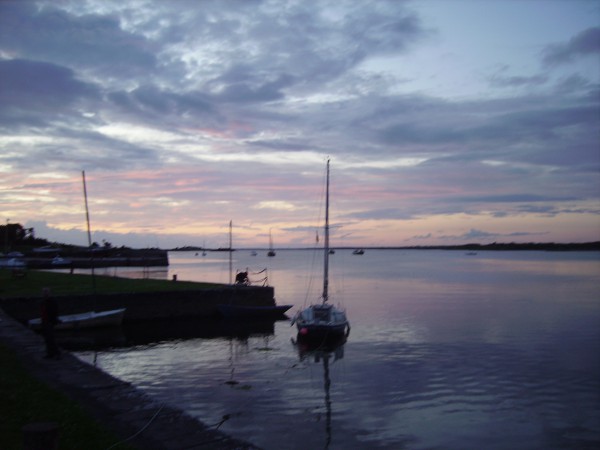
Kinvara Twilight Photo: BO'D
Kinvara Twilight
Photo: BO’D

Mr W. B. Yeats delivered an interesting lecture on “Irish Fairy Tales” at 15 D’Olier Street last evening, under the auspices of the Young Ireland League. Mr Henry Dixon presided.
Mr Yeats, who was received with applause,  said that night was sacred to the fairies in general and to the phouca in particular. The phouca sometimes appeared as a horse, sometimes as a donkey, sometimes as an eagle and, indeed, took innumerable four-footed and two footed shapes.

The night of Samhain in old Pagan days was the commencement of winter, over which presided the phouca, whom the people considered the spirit of decay. They believed it was dangerous to go abroad on that night because the fairies might carry them off into their kingdom.  That night also the dead were believed to come out of their graves and ride upon the white sea waves, and there were stories of fishermen, who, having escaped the waves and come ashore, found the dead grasping them from behind.

Mr Yeats related a number of interesting fairy tales and said that folklore afforded the most beautiful material for literature and they could not do better than encourage people to use it for such. Every country in the world had these beliefs and universal belief like that meant some universal need for it. If there was not deep down in the human soul some need to think about imaginary beings more beautiful and more powerful than the men and women they met in ordinary life, these things would not have arisen.   Forelore gave a beautiful and most ample expression for their vast emotions –  emotions which were always struggling to express themselves but were beaten down by the sordid interest of real life.  Poets were folklorists who had listened to the voice of the people.  They had taken the stories of the old men and women and had made them the delight of the most profound minds of all nations.

Posted in Posts and podcasts

Kinvarra to Penzance – 1893

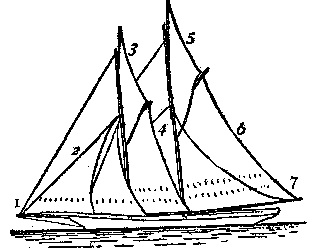
Schooner rigging: 1) Bowsprit; 2) Jib, followed by fore staysail; 3) (Fore) gaff topsail; 4) Foresail; 5) Main gaff topsail; 6) Mainsail; 7) End of boom Wikimedia.org
Schooner rigging: 1) Bowsprit; 2) Jib, followed by fore staysail; 3) (Fore) gaff topsail; 4) Foresail; 5) Main gaff topsail; 6) Mainsail; 7) End of boom
Wikimedia.org
THE TEESDALE MERCURY 1ST MARCH, 1893 P3

SAD FATALITY AT SEA

The schooner Jeffery, of Jersey. Captain Davey arrived in Penzance Harbour on Sunday afternoon from Kinvarra, Galway Bay and reported having experienced terrific weather on the voyage.

In her voyage from Ireland the Jeffery has been out between four and five weeks, and some anxiety had been felt respecting her safety. On Wednesday last E—- C—-, one of the seamen, was washed overboard. Captain Davey threw a lifebuoy to him and he succeeded in getting inside it. An attempt was then made to get a boat out, but there was such a tremendous sea running that on getting over the side of the ship the bottom of the boat was stove in, thus rendering it useless.

The crew then tried to get the vessel down to the man by wearing round, but they were unable to reach him.

Posted in Posts and podcasts

Fahy – 1893

The history and antiquities of the diocese of Kilmacduagh

Rineen Mill, Doorus National Inventory of Architectural Heritage, www.buildingsofireland.ie via Landed Estates Image NUIG
Rineen Mill, Doorus
National Inventory of Architectural Heritage, http://www.buildingsofireland.ie
via Landed Estates Image
NUIG

J. Fahy 1893

McGill and Son Dublin

The Parish and Church of Kinvara-

In the existing parish of Kinvara we have the union of the three ancient parishes of Kiloveragh, Kilena, and Durus. We cannot say when they were united, but we have no doubt that the union exists for some three centuries at least. As regards the existing ruined church in the town of Kinvara, it may be interesting to know that, in the opinion of Mr. O’Donovan, it is not more than five hundred years old, and that it stands on the site of the old church of St. Coman.

The ancient church of Durus does not appear to have attracted the attention of antiquarians. We would wish to think it may have been the church of St. Colman Hy Fiachrach, but feel obliged to confess that we have no historical data to support the supposition. It is situated on a gentle eminence overlooking the bay. There was an oratory to St. Kyran on the adjoining strand, where the patron’s day was. Hardly a trace of the oratory remains. The ancient church of Kilena is still extant.

Posted in Posts and podcasts

By the roadside – 1893

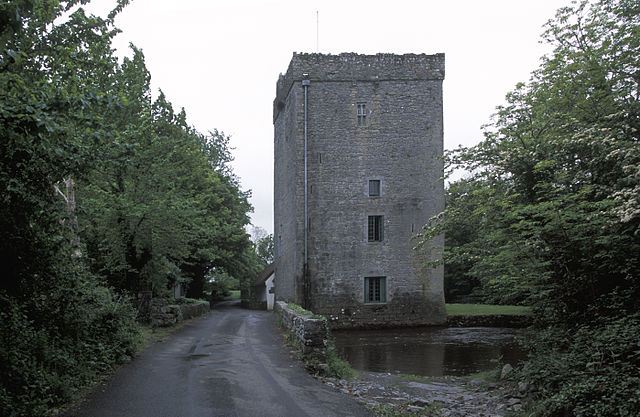
Thoor Ballylee Photo: Jerzy Strzelecki Wikimedia Commons
Thoor Ballylee
Photo: Jerzy Strzelecki
Wikimedia Commons
Excerpt from The Celtic Twilight – W.B. Yeats (1893) abridged
p232/3
LAST night I went to a wide place on the Kiltartan road to listen to some Irish songs. While I waited for the singers an old man sang about that country beauty who died so many years ago, and spoke of a singer he had known who sang so beautifully that no horse would pass him, but must turn its head and cock its ears to listen. Presently a score of men and boys and girls, with shawls over their heads, gathered under the trees to listen. Somebody sang a Muirnín Díles, and then somebody else Jimmy Mo Mílestór, mournful songs of separation, of death, and of exile. Then some of the men stood up and began to dance, while another lilted the measure they danced to, and then somebody sang Eiblín a Rúin, that glad song of meeting which has always moved me more than other songs, because the lover who made it sang it to his sweetheart under the shadow of a mountain I looked at every day through my childhood.

The voices melted into the twilight and were mixed into the trees, and when I thought of the words they too melted away, and were mixed with the generations of men. Now it was a phrase, now it was an attitude of mind, an emotional form, that had carried my memory to older verses, or even to forgotten mythologies. I was carried so far that it was as though I came to one of the four rivers, and followed it under the wall of Paradise to the roots of the trees of knowledge and of life. There is no song or story handed down among the cottages that has not words and thoughts to carry one as far, for though one can know but a little of their ascent, one knows that they ascend like medieval genealogies through unbroken dignities to the beginning of the world.

Folk art is, indeed, the oldest of the aristocracies of thought. Because it refuses what is passing and trivial, the merely clever and pretty, as certainly as the vulgar and insincere, and because it has gathered into itself the simplest and most unforgetable thoughts of the generations, it is the soil where all great art is rooted.

Posted in Posts and podcasts

Rent reduced – Kinvarra – 1893

NEW ZEALAND TABLET VOLUME XXI, Issue 23, 24th March 1893 p9

J Brady Murray, 11 Pembroke Road, Dublin and Northampton House Kinvarra, has given a reduction of fifty per cent to his kinvarra tenants. Mr Murray is son of the late P Brady, Soliitor, Danby, Ballyshannon, and nephew of Mrs John Stephensen, Castle Street, Ballyshannon