Posted in Posts and podcasts

Kinvara railway – 1879

Freemans Journal 13th December, 1879 p. 7
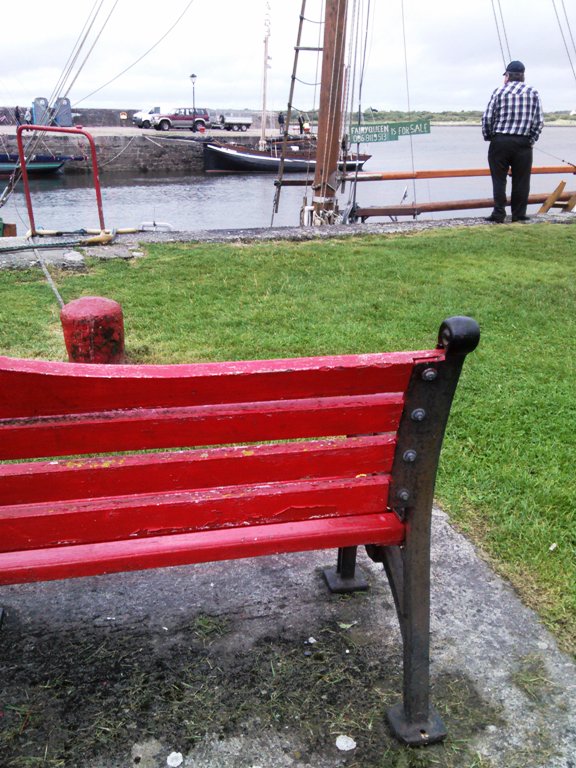
Kinvara Quay Photo; EO'D
Kinvara Quay
Photo; EO’D

To the Editor of the Freeman
Kinvara, December 11th
Dear Sir,
I regret very much that the distress in the west, on which you so seasonably commented in your leader in Wednesday’s Freeman, is not confined to Clifden nor to Connemara, but is to be met with as severely elsewhere.
We have in Kinvara, with its population of over 350 families, want at present bordering on starvation, while the people in the rural districts all round are not much, if anything, better off, and unless our paternal Government open up public works in some form, actual starvation, with its usual sad and sickening train, will be the result before the 1st February.
Our rulers may shut their eyes to and pretend to ignore the present crisis, but there can be no question as to the existence of deep and general destitution among the labouring classes. This distress seems to be more keenly felt by a certain class of small farmers than it is by those who have nothing to fall back on but their daily pay, for the latter are more or less familiar with want, though not to anything like the present extend; while the former were before now comparatively comfortable, but this year an accumulation of misfortunes, for which they were unprepared, came upon them, and crushed them to the very earth. Rot among the sheep, consequent on the severe autumn and winter of last year; losses in the sale of stock, the partial destruction of their crops this year by blight, storms, and a wet summer and autumn – these were the casualties that crowded in rapid succession on the small farmers, and reduced them to a state worse, if possible, than that of the purely labouring class.
How miserable the condition of many among the small landholders is at present no person knows better than the priest who goes among them with all the freedom of a father, and is made their confidant in their weal and woe. It requires no prophet to tell how those poor people are to eke out an existence during the next six months, for starvation and pestilence will victimise many of them unless something is done to give employment to the many hands among them who are able and willing to work.
If, as we are assured, the solas pupuli be the suprema lex, surely the Government of the country is bound to save the people, and when this can be done without any loss to itself, as in the present emergency by opening up reproductive works. The obligation becomes so grave and solemn that no Government can overlook or disregard it without laying itself open to the charge of being anxious to get rid of its subjects “with a vengeance.”
In Kinvara a great deal might be done in the way of giving employment to the labouring classes. We have a beautiful bay, but no trade, except in turf; a good harbour, which we require badly, would do much to encourage and promote trade with Galway; opening a communication between Kinvara and Gort, a distance of seven miles, by means of a railroad, which could be laid down at present, would not only serve the poor by giving them employment, but would also materially benefit both towns. Then again, though it might sound paradoxical to assert it in the depth of winter, still it is perfectly correct to say that we are at the present time suffering from a dearth of fresh water, as the only one spring which supplied the whole town, and neighbourhood, has ceased (not an unusual occurrence) to yield its usual refreshing beverage, and in consequence we are compelled to put up with a substitute of a very muddy description, while never-failing wells of the most crystal like water are to be found on the burren hills about three miles off. But as far as we are practically concerned at present they may as well be thirty miles; for, like the lakes that “shone in mockery nigh” they are untouched and untasted by us. However, it would be very easy and by no means expensive to convey the water from those hills by pipes to Kinvara, and as employment is required for the poor, the present would be a very favourable opportunity for doing a very useful, if not a necessary work.
I am, dear Mr. Editor, faithfully yours,
J. Molony P.P.
Posted in Posts and podcasts

Kinvara – 1879

Freemans Journal 3rd October, 1879 p7 (abridged)

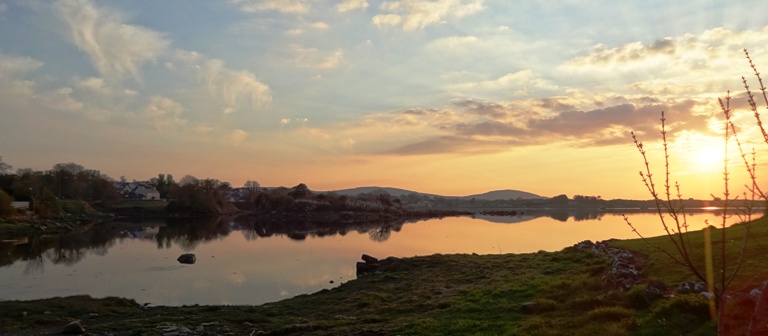
Kinvara Sunset Photo: Norma Scheibe
Kinvara Sunset
Photo: Norma Scheibe

On Sunday last a large and influential meeting of the people of Kinvarra and the surrounding districts was held in the chapel yard after last Mass. The meeting was convened to consider the present general depression, which is telling very severely on the tenant farmers in the neighbourhood. Kinvarra is essentially an agricultural district and the principal crops, being potatoes and barley, have been very seriously damaged by the constant wet and the late severe storms. The Rev. John Molony P.P., presided and Mr. James Curtin acted as secretary. The following resolutions were unanimously adopted:
Proposed by Mr. Henry Fanagan, Esq., and seconded by Mr. John Lynch;
That this meeting is of opinion that the agricultural produce of this district, on which the people have almost entirely to depend for the payment of their rents and the support of their families, has been so much injured by the unprecedented wet summer and the late storms as to render it impossible for the tenant farmers to pay their present rents; and moreover to give just grounds for learning that the coming winter and spring will find many of them almost destitute.
Proposed by Mr. William Flatley and seconded by Mr. Stephen Leech;
In the face of the great losses we have sustained, caused by three successive bad harvests and the depreciation of agricultural produce arising from foreign importation, we are compelled to make an earnest but respectful appeal to our landlords to make such a reduction in our rents as will enable us to pass through the present severe crisis and save us from utter ruin.
Proposed by Mr. Thomas Corless and seconded by Mr. Michael Kelly;
That we feel we have good grounds to hope that our appeal will meet with a favourable response, as many of our landlords reside outside the parish, and consequently there is not so much employment given to the labouring classes in the district, nor that encouragement to local trade which might naturally be expected from resident proprietors.
Proposed by Mr. Peter Burke and seconded by Mr. John Burke;
That copies of these resolutions, signed by their respective tenants, be forwarded to the landlords of the parish, and that another copy, signed by the chairman and secretary, be sent to the Freeman’s Journal, the ever-faithful friend and advocate of the rights of the tenant farmers in Ireland.
(signed)
J. Molony, P.P., Chairman
James Curtin, Hon. Sec.

Posted in Posts and podcasts

The Lost Island – 1879

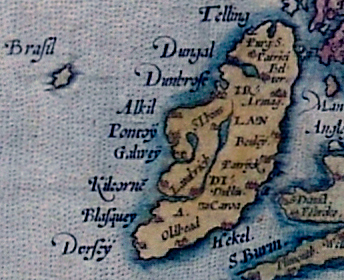
Ireland as depicted on the 1572 map of Europe by Abraham Ortelius. Interesting are the prominent featuring of St. Patrick's Purgatory and the curious island of Brasil. Wikimedia Commons
Ireland as depicted on the 1572 map of Europe by Abraham Ortelius. Interesting are the prominent featuring of St. Patrick’s Purgatory and the curious island of Brasil.
Wikimedia Commons
New Zealand Tablet, Volume VII, Issue 327, 25 July 1879, Page 17

At a recent meeting of the Royal Dublin Society Dr. W. Frazer exhibited a copy of Tassin’s maps of the fortified towns of France, which was additionally interesting by its containing several original plans drawn by Tassin and bird’s-eye views of Casal and Evreux. It also contained a manuscript map of the opposite coasts of France and Britain, apparantly of the most scrupulous accuracy, and a Chart ot the Islands and Maritime Coasts of Europe, in which is to be seen the route and navigation of the Hollanders by the north of Ireland and Scotland during the wars with the English for the German Ocean.
The course is laid down from Holland along the Norwegian coasts then passes between Fair Island and Foula. It then continues along the western coast of Ireland passing Brazil, which is laid down much in the position now ascertamed to be occupied by the Porcupine Bank and hence the course continues direct to Rochelle.
This map is evidently no fanciful sketch. Every sailing point and headland has been skilfully laid down, either by one who has passed over the track itself, or by one who compiled it from most competent authority, and this at a time when no British ships appear to have sailed over these western seas, though we know that the Dutch and French sailors almost daily did.
The probable date of the unpublished and apparently unique work is 1640. This copy appears to be in the very handwriting of Tassin himself, who was geographer to the King, and it would, indeed, appear most probable that Brazil did, as an island, at this or about this time, hold its head over the waters of the North Atlantic Ocean, though over its site, and after a lapse of more than two centuries, those very waters, to the depth of from 80 to 100 fathoms, now roll.

The evidence, then, would be in favour of Brazil having existed as an island off the entrance to Galway Bay in A.D. 1640, or thereabout, and of its having gradually subsided into the bosom of the ocean.

Posted in Posts and podcasts

Sunday closing – 1879

 Photo; Decatur Wine & Spirits Wikimedia

Photo; Decatur Wine & Spirits
Wikimedia
NEW ZEALAND TABLET VOLUME VI 10TH JANUARY, 1879 P17 (abridged)

It is nearly eight years since the Most Rev. Dr. M’Evilly, Lord Bishop of Galway, impressed upon the people of the diocese and of the diocese of Kilmacduagh and Kilfenora, of which his Lordship is Apostolic Administrator, the propriety of closing public houses on Sundays and his Lordship was almost implicitly obeyed. Since that time nearly all the respectable traders in Galway, in Gort, in Oughterard, in Ennistymon, in Kinvarra, and all the large towns in the dioceses mentioned, have kept their establishment closed on Sundays. Hence the law makes very little difference in this part of Ireland.
Two, or at most three, obscure public houses were kept open on Sunday in Galway, and these were frequented by a straggling lot of persons. It is a remarkable thing about Galway that when the bill for Sunday closing was before Parliament a petition was sent forward from the vintners of Galway in favour of that measure. There are about 120 public-house-keeepers in the county of the town of Galway, and over 100 signed the petition. Some of the others were absent at the time. But, as I have said, nearly all obeyed the Lord Bishop, so that virtually the operation of the Sunday closing Act will make very little change in the City of the Tribes.

Posted in Posts and podcasts

Diaspora – 1879

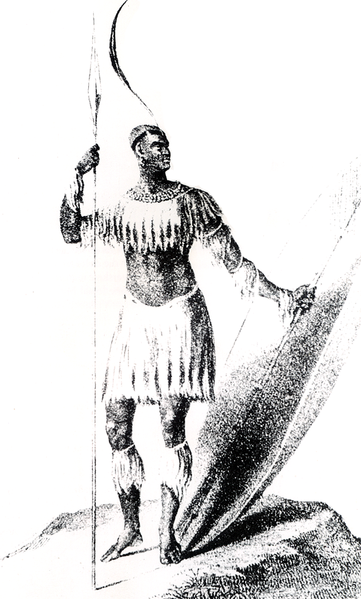
Shaka, king of the Zulu. After a sketch by Lt. James King, a Port Natal merchant.

Freeman’s Journal, Saturday 16 August 1879, page 6/ 7

(abridged)

The manner in which Irish men are turning up among the Zulu people is much noticed. John Dunne, Cetewayo’s Prime Minister, is ascertained to be from Ballymena in Ulster. Renter’s telegrams to-day brings news of a chief called M’Carthy (sic.), captured in a battle by the English is an Irish emigrant to the South African diamond fields. He arrived in the year of the Fenian rising.

The formidable chief, Moirosi, who is reported to be besieged by the British forces, is really one Morrissy.