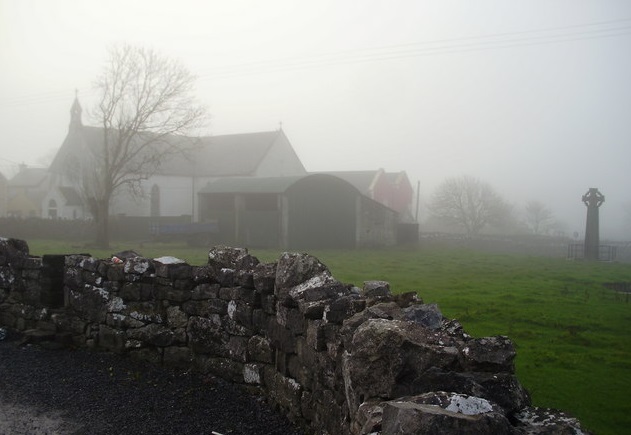
Church of St.Fachta and one of the Kilfenora High Crosses Photo: Eirian Evans Wikimedia Commons
To the editor of the Nation
Lisdoonvarna, County Clare, 13th July, 1864
Dear Sir,
Within the last ten days, in the vicinity of this far-famed watering-place, near the ancient town of Kilfenora, a statue of the Virgin and Child was discovered by a poor man who had been employed in cutting turf in an adjacent bog. The statue is of carved oak. The face of the Virgin is in perfect preservation, the folds of the dress most accurately delineated, and although the face of the infant in her arms is somewhat disfigured, it is wonderful how perfect the statue is after the lapse of perhaps several centuries. The statue is about two feet six inches in height, and was found some eight feet beneath the surface of the bog. Several persons, not only from this locality, but from the adjoining districts, have felt particular pleasure in observing this memorial of the past, which is now to be seen in the sacristy of the Catholic Church of Kilfenora, County Clare.
I am, dear sir, your obedient servant.
A. Visitor
Everyone in Galway is aware of the immense quantities of herrings that are at present in the bay but the Claddagh men will only go out every second night to capture them.
On Tuesday night Captain Oliver, one of the pilots, went out in his boat. This being a prohibited night, he soon found that he was being chased by two large hookers – watch boats, as they are termed – each filled with men. Seeing that he could not fight them he ran into Oranmore Bay and thus escaped.
On Friday night the “watchmen” succeeded in committing an outrage. Several boats from Kinvara were fishing when three or four Claddagh hookers, with about twelve men in each, bore down and cut away some of the nets. The boats that escaped came into market with immense quantities of herrings.
Very few of the Claddagh boats are marked, according to law, so that identification in such cases is almost impossible.
Maryborough Chronicle, Wide Bay and Burnett Advertiser 28th January, 1864 p 15
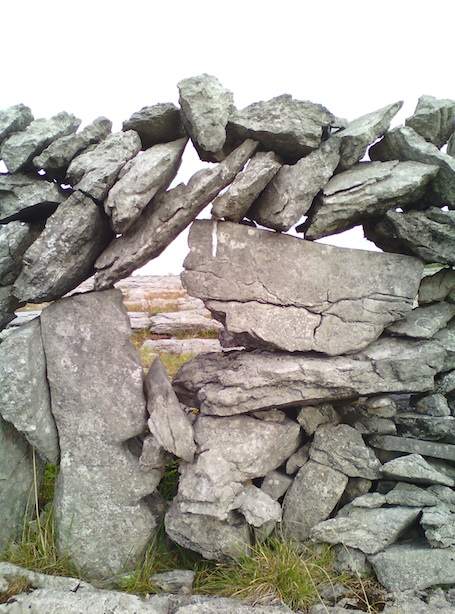
Photo: EO’D
At Dromelihy, County Clare, some men, in digging for potatoes, came on a massive boulder, which required their united exertions to remove. It had been artificially set over four other and formed an enclosure of about two feet square. But well repaid were they for their labours. Having displaced it, they found the contents to be a copper kettle filled with silver pieces, each being worth about tenpence, and some of which bear the date of 1510.
On digging further they perceived some stones set in mason work, which they upturned with renewed energy. They succeeded in entering a vault, which, to their surprise and disappointment, contained nothing but a leaden coffin about nine feet in length. On taking off the lid, (which, by the bye, was considered very daring of them) they beheld a human skeleton of massive proportions, the thigh alone measuring 2ft 11in and the cranium half an inch in thickness.
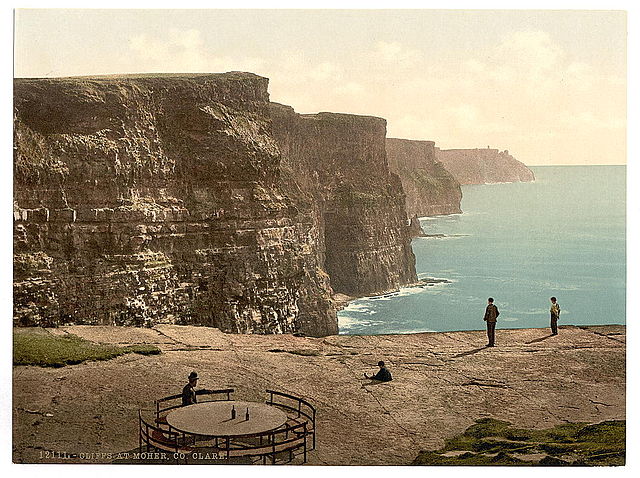
Cliffs of Moher 19th Century Wikimedia CommonsFreeman’s Journal 22nd June, 1864 p3
WRECK OF H.M. GUNBOAT MAGPIE.
Galway, April 5.
Yesterday morning I telegraphed to you the intelligence of an unfortunate accident to the screw gunboat Magpie (2) ; and since then, the additional particulars I have gained are of little importance, expect that she did not float last night, as expected and that fears are now entertained that she will become a total wreck.
The accident occurred at two o’clock on Sunday morning during the thick hazy weather which then prevailed, and which has existed since that time up to the present. The Magpie, which had for some years acted as tender to the Coastguard ship Hawke,at Queenstown, was on her way from that port to Galway with store to the Coastguard stations in its vicinity. Every necessary precaution had been taken to ensure the safety of the vessel when the mist came on, and Captain Bell (with whom every one in Galway sympathises) was just consulting his chart when the boat went ashore with a crash. It was found she had struck on Crab Island, which lies to the south of the famous cliffs of Moher, on the western coast of Clare; and, although an immediate effort to get her off was made, the heavy Atlantic swell which, at the calmest season, rolls in against the cliffs drove her farther ashore.
The boats were out, and a party landed. They procured a car, and drove across the country to Ballyvaughan, which is on the other side of Galway Bay, and from thence a coastguard boat was despatched to Galway for assistance. Captain Hawkes, R.N., the Inspecting- Commander of Coastguards, at once engaged the Atlantic Company’s steam-tiff Rover to proceed to the scene of the disaster, and the Pilot also got up steam and went down to render any necessary assistance.
The steamers got down at evening, but the weather was so thick that the Rover was obliged to lie under Arran Island, and subsequently Black Head, without getting to the Magpie. Yesterday morning, however, she got to Crab Island, and at high water every effort was made to pull the unfortunate gunboat from her position. There was a tremendous surf, and just at the moment when she was beginning to move a wave struck the Magpie, and, the hawser breaking, she was driven still higher on the beach. It was then deemed useless to make any further attempt, and the Rover returned to Galway yesterday evening.
Previous to the arrival of the tugs the men had dismantled the Magpie, and landed, and I understand her guns, one of them a 68 pounder, were thrown overboard. No further attempt to save her will be made for a couple of days, but the general opinion is that she will become a total wreck.— Saunders.
Photo:William (Bill or Liam) Cassidy Wikipedia.orghttps://widgetworld3.wordpress.com/podcasts/ QUEENSLAND TIMES, IPSWICH HERALD AND GENERAL ADVERTISER
28TH MAY, 1864 P4
ORIGIN OF LYNCH LAW
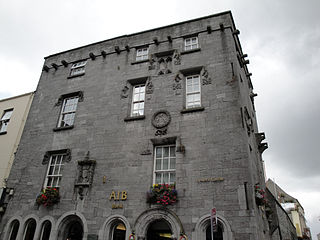
The office of Warden of Galway has become memorable in the literary world since Maturin dramatised the story of the rigid justice administered by Warden Lynch in ordering the execution of his son, in the year 1500. Hardiman, in his History of Galway, gives the particulars at length, which are shortly as follows:-
Warden Fitzstephen Lynch formed a friendship with Gomez, a rich merchant of Cadiz, and had his son, a youth of nineteen, with him on a visit. The Warden’s only son, two years older than young Gomez, and the Spaniard were constant companions and friends. Young Lynch became attached to Agnes, the daughter of a neighbouring merchant, but she preferred Gomez. Lynch, maddened by jealousy, stabbed his friend with a pinnard on the brink of the sea, and hurled the body into the sea. Immediately repentance came, he accused himself of murder, and was conducted to prison.
His own father sat as magistrate in judgment upon him, and from his lips sentence of death was pronounced. The populace became tumultuous, and mediated a rescue, when so rigid was the magistrate in the administration of justice, and so exalted his virtue, that on the night before the day appointed for the execution he embraced his son, led him out, and had him executed from a window!
The house still stands in Lombard street, which is yet known by the name of the “Dead Man’s Lane.” Over the window may be seen, carved in black marble, the representation of a human skull with two bones crossed underneath, and is “supposed,” says Hardiman, “to have been put up by some of his family as a public memorial.” This house is always an object of interest to the tourist, and the first to which his attention is directed by his guide in Galway.

 The Burren and Beyond