
Connacht Tribune 8th September, 1972 p.17
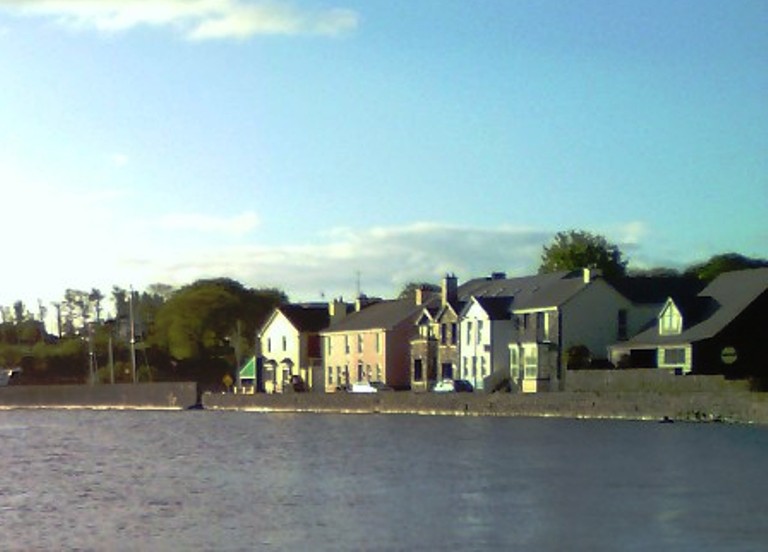
Photo: EO’D
Until such time as a professional archaeologist pronounces on the fine stone window and doorway discovered last week at The Quay, Kinvara, there is nothing to dispel the rumours and opinions circulating concerning their origin.
Their discovery was made by workmen demolishing the first of the old buildings at The Quay, the beginning of the £250,000 housing scheme planned for the town by a private company.
The three-foot window is obviously a church window and it stands fifteen feet from the ground, directly above a stone doorway which is nine feet high. On top of the window are inscribed the figures 1782.
The question is; Where did this window come from? Did it come from St Coman’s Church in the centre of the town at the rear of the main cluster of houses? Were the window and doorway part of a clergyman’s residence in the 18th Century? If this residence was once a Protestant clergyman’s home – and there is a local opinion that a Protestant Bishop lived there – were the ornate stone window and doorway incorporated into the original building? Or were they added to the building having been taken from a nearby church?
The intention of the demolition men at present is to leave these monuments in situ. The discovery of the monuments opens up a vista into a forgotten portion of Kinvara heritage. There is a most interesting history attached to The Quay over which has been passed by Galway County Council for the erection of houses.
It would be a great pity if the once hallowed precincts were to disappear without proper recording under the new structures.
 The Burren and Beyond