The North American Review, Vol. 214, No. 789 (August 1921) pp. 190 – 200
Augusta, Lady Gregory Project Gutenberg eText 19028 From Project Gutenberg’s Irish Plays and Playwrights, by Cornelius Weygandt
by Signe Toksvig
To get from Dublin to Coole Park, the home of Lady Gregory, one normally takes a train from Dublin to Athenry, and another from Athenry to Gort, the village nearest to Coole. But times were not exactly normal in Ireland when my husband and I visited it last summer, and when we got to Athenry we were confronted by the blank fact that for two months or so no trains had been running to Gort. Why? This was a rhetorical question. We knew very well that armed policemen must have been trying to travel on that train, and that the engineer had excused himself for an indefinite period, and that we had better find a Ford. We found one. It was very rickety and full of unwieldy first-aid-to-the-injured-auto things, but Gort was twenty miles away, and hope and beauty had long since left Athenry, and so we squeezed in and began to bump over stony Connaught.
Proceedings of the Royal Irish Academy (1836-1869), Vol. 10 (1866 – 1869), pp. 440-443
M. Brogan – 8th February, 1869 (abridged)
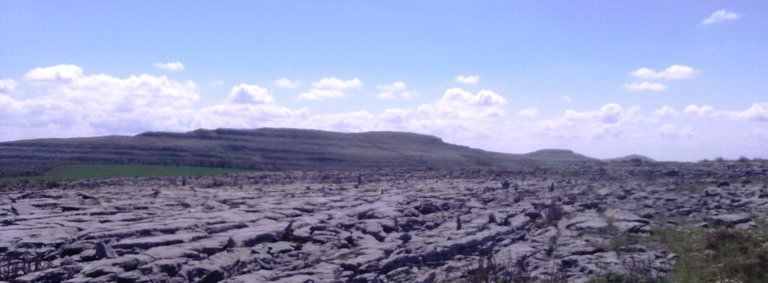
The Hills of Clare Photo: EO’D
When travelling through the country on official duty, I frequently meet with antiquarian remains, some of which may not have as yet been brought under the notice of the Academy. Being recently employed on inspection duty in the county of Clare, my attention was attracted by what I at first conceived to be immense cromleacs, or druidical alters; but which I concluded, on closer inspection, to be sepulchral monuments of some of those stalwart heroes of the olden times who had been “dead and turned to clay” long ere the Milesian adventurers left the sunny shores of Spain to seek and win new home in the green island of Innisfail.
The precise locality of these antiquarian remains is a little south of the public road leading from Gort to Feakle, and about midway between these two towns, in the townland of Druomandoora. The situation is very romantic, being on the northern declivity of the Clare hills, overlooking the deep valley which separates Clare from Galway and which embosoms two beautiful lakes – Lough Graney (Lake of the Sun), and Lough Cooter, with its wooded shores, and islets, and magnificent castle, whose lofty towers and battlements proudly rise over the stately woods by which they are surrounded, and fling their shadows o’er the pellucid lake, “whose tiny wavelets murmur at its base.”
They consist of two sepulchral monuments, distant about a furlong from each other, with two figures inscribed on the adjacent rocks, which in many places present tolerably smooth exposed surfaces. The monument at the greatest elevation on the slope of the hills, though not in the most perfect state of preservation, is the largest. It is called by the people of the locality “Leabadh Diarmaid” (Diarmud’s Bed), while the smaller and more perfect one is called “Leabadh Granu.” I may remark, en passant, that there is a very remarkable sepulchral monument at Coolmore, about three miles north of Ballyshannon, county of Donegal, to which local tradition has assigned the name of “Diarmud and Granu’s Bed.” The rock inscriptions are;
1st. An elaborately and artistically designed figure, somewhat resembling the caduceus of Mercury.
2nd. The impression or outline of the sole of a sandal. I suppose it to represent a sandal; as, if it were intended to represent the naked foot, there would certainly be some attempt, however, rude, to represent the formation of the toes. The foot must have been rather small, probably that of a youth or of a female, as the carving represented it as only ten inches in length, by four and a half inches at the widest part, and two and a half inches at the narrowest part..
My reasons for assuming that the two first mentioned remains are sepulchral, and not cromleacs erected for sacrificial purposes are;
1st. the name accorded to them by local tradition.
2nd. The covering slabs being placed almost horizontally, without the inclination of the covering slabs observable in structures intended for sacrificial purposes; and
3rd. The extreme roughness and irregularity of the upper surface of the covering slabs, formed of the coarse conglomerate rock of the locality. This is most observable in the smaller and more perfect monument, which is covered by a single slab, tolerably smooth on the inner side, but extremely uneven on the outer side, without the slightest mark to indicate that it was ever designed or used for any purpose but that of effectively securing the receptacle underneath. The larger one, of which I give a rude drawing, was covered by at least two large slabs, the end one of which still remains in its original position. The other has been broken into fragments, some of which have been removed; but one large one yet remains, leaning against and overtopping the supporting stones, several of which have also disappeared.
The ghost of Miles Joyce is the latest witness against Saxon tyranny. As the warders of Galway Jail have made application for a transfer to another prison, it is probable that the ghost carries a musket and uses threats. Lord Spencer has personally undertaken the maintenance of the two boys, who are the only remaining members of the Joyce family massacred in County Galway.
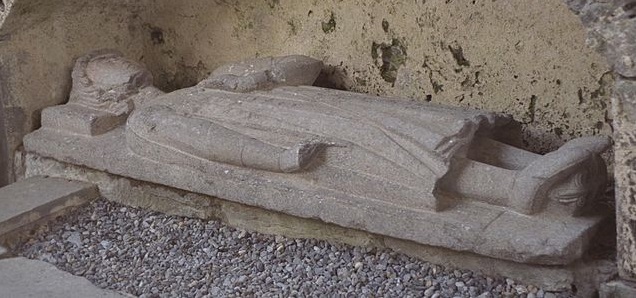
Effigy of King Conor O’Brien († 1268). His grandfather founded the monastery 74 years earlier. Photo: Andreas F. Borchert
(To an effigy in Corcomroe Abbey, Co. Clare, of Prince Conor O’Brien of Thomond, killed in the battle of “Suidhne.” A.D. 1267).
God rest your soul, O’Brien,
Thomond’s Prince so brave,
Proud eagle of the mountains,
Your pride is now the grave.
Your noble head is lowly,
That stooped to no man’s might,
Your eyes are closed for ever
That once could flash so bright.
That blazed with lust of battle,
With vengeance unfulfilled.
For honest, left lone and desolate,
For hearts for ever stilled.
When the war note sounded proudly
O’er echoing hill and vale,
And your clansmen gathered round you.
The bold and fearless Gael.
Whose spears were long and shining.
Whose battle-axe was keen.
Whose hearts were warm and faithful
To your waving flag of green.
Borne by you once so proudly
To many a battle plain.
Then, led by harp and fife
On came your thundering train.
Till that bitter day at “Suidhne”
When you joined the foremost ranks
Till your lifeblood stained the ferns
And your charger’s reeking flanks.
You were the gallant leader,
The bravest of brave kings;
Not a mouth for men to speak through.
Not a puppet drawn by strings.
And the world has nigh forgotten you.
Your fame has passed away,
With the sorrowing hearts that laid you
To slumber in the clay.
With the loving hands that chiselled
Your effigy in strong,
Where you’ve lain for seven hundred years,
In Corcomroe so lone.
As I gaze upon stony features
Time rolls its shade away,
And I look down chains of centuries
Filled with such ruin and decay.
To the time when you wielded the sceptre
With wisdom beyond your years,
When your will was strong and unbending,
Your heart a stranger to fears.
I see you in pride of young manhood
Your noble brow uncreased,
The hope and pride of Thomond
Ready for foray or for feast.
In your “Dun” hospitality lingered,
You shared the wealth of your board
The red wine, the white and the yellow,
In the “Mether” went round at your board.
When the clans gathered round for the feasting,
Brave men and women fair,
But you, great Conor “Na Suidhaineach”
Crowned the revelry there.
But the mirth and the revels are ended,
The song of the bard is not more,
Harper and piper are silent,
The wail of your clans is long o’er
The halls of your home are forsaken
The glories, O long since have fled,
Deserted by all save the night owls,
And the ghosts of forgotten dead.
Can you look from your home with the angels,
On the land of your love and pride,
And see what the long years have brought us,
Since that bitter day you died.
How sad, O how sad, are the changes,
How fallen our greatness since then,
When the crash and the clash of battle,
Resounded o’er mountain and glen.
But the foreigner’s power was stronger,
And Ireland, once as free as air,
Is bound in the chain of oppression,
Her noble head bowed in despair.
Our homes oft set blazing around us,
Our kin forced to flee from the land,
Famine oft stalked through the country,
With sickness and death hand in hand.
Heroes have often arisen,
And shook off the lethargic pall,
Which wrapped us in gloom and oppression,
Since our fair country’s fall.
Then hope sprung anew in our bosoms,
Our pulses throbbed quick as of yore,
We rose at the call of our leaders,
And shouldered our arms once more.
But, alas, our vain hopes of freedom,
‘Twas the same hopes of sorrow oft told
Defeat with the loss of our bravest,
Might over right as of old.
But, thank God, a new day is dawning,
On the future its light is now shown,
When our land shall be free as heaven meant her,
The foreigner’s power overthrown.
Our kindred from over the water,
In thousands shall come at our call,
War cries shall ring o’er the hillsides,
And our banner wave proudly o’er all.
Then peace be with thee, O’Brien,
Thomond’s prince so brave,
And peace to the monks who laid you,
To slumber in the grave.
We have seen in the ultra portion of the Dublin Papers a statement of depredations committed by some Ribbonmen of the County of Galway, on the house and concerns of a Mr. Power of Mount Equity. We confess that the paragraph astonished us, knowing, as we do, that the County of Galway enjoys at this moment the most perfect tranquility. We shall not take it on ourselves to contradict the statement, until we shall have an opportunity of enquiring into the truth or falsity of it; but this we may be allowed to say, that we very much doubt the entire story. If the Gentleman’s house and concerns were attacked, that is no reason that the midnight ruffians should be termed Ribbonmen – for the Dublin Editor should know that there are others than Ribbonmen who can draw a trigger, or set fire to a hay-stack. Those who live by the insubordination of the “mere Irish,” overcharge their faults and vices, and look through green glasses upon the offences which they commit. We shall enquire about this circumstance; and we are of opinion that matters will be cleared up satisfactorily. This, we can assure the public, that the conversations which we occasionally hold with the County Magistrates are of a most agreeable nature, and induce us to think that the County of Galway might dispense with the services of the Police Gentry, whose “valuable labours” are now confined to the extermination of puppy dogs and untraceable scarecrows – may, sometimes, the grouse and wigeon come within the calibre of the loyal cartouche-box.
The unique visit of Crown Prince Akihito and Princess Michito of Japan to Kinvara on Sunday was characterised by expressions of genuine goodwill, and the large crowds greeting them were thrilled by the friendliness of this august couple from the Far East.
Kinvara was en fete with buntings and banners demonstrating the festive spirit which even the discouraging rains could not dampen. The Royal couple were met by the chairman of the Community Council, Mr. Tommy Corless. He accompanied them on their tour, explaining buildings and local heritage and pointing out landmarks. They drove around by the Quays, which had been constructed in the 19th Century with stones from Rath Durlas, seat of King Guaire. They passed Delamaine Lodge, the old smugglers residence and drove along the Green Road to Thornville house, the former home of the Nally family. From there the cavalcade moved onwards to Bothar na Mias, the Road of the Dishes and Mr. Corless recounted the legend associated with this road.
At Kinvara’s Faiche Phadraig Pitch there was a juvenile hurling match in progress and the party drove in there to see it. The Royal Couple met with Toddie Byrne, who was in charge of the game, and the two teams. The Prince asked questions about the posts, the colours of the jerseys and the half-time break. The Princess was concerned lest the boys would get wet.
The Royal Couple went to “The Auld Plaid Shawl” where they sampled an Irish Coffee and met with proprietors, Mr. John Griffin and Mrs Denise Griffin as well as Mrs Florence Corless, Mrs Patricia Moylan, Mr John Joe Conneely, Mr James Conole, Mrs Bridie Corless, Mr Patrick J. Griffin and all three young Griffin children.
From there they went to Seamount Convent and were introduced to Reverend Mother Gertrude. In the reception room were the Japanese Ambassador to Ireland, the Irish Ambassador to Japan, dignitaries of State, Sister Laurence, (Principal of Seamount College) and a delegation from the Kinvara Community, namely Very Rev. Canon Michael O’Connor P.P, President of the Community Council and Mr. Tommy Corless, Chairman, Mrs Mary O’Shaughnessy (Kinvara town), Mrs Anne Kavanagh (Roo), Mrs Mary McInerney (Shanclogh) and Mr. Kieran Moylan.
Presentations were made to the Royal Couple including an Aran Sweater, a white crocheted shawl, doyleys crocheted by Sr. Sacred Heart, a blackthorn stick, a St. Brigid’s cross, copies of ‘Tracht’, the Centenary magazine of Seamount by Sr. de Lourdes Fahy, ‘The Journey of the Queen’ by Dr. Brian O’Rourke of Galway Regional Technical College, and an inscribed hurley.
The pupils of Seamount College formed a guard of honour for the Royal Couple on their way from the reception room to the Seamount College hall where they viewed performances of step-dancing by local members of the Celine Hession Dancers, accompanied by Chris Droney; the Kilkishen (Co. Clare) Mummers; the Ballinderreen set dancers, accompanied by the Oranmore Ceili Band; a sean nós song by Sorcha Grealish of Muchinach, Connemara, and a single dance by Seamus Devane of Connemara.
The Royal Couple were highly complimentary of all they’d seen and thanked the people for their welcome. They departed for a brief visit to Thoor Ballylee and Coole Park and within another hour they had left South Galway again for Dromoland Castle, County Clare.
Connacht Tribune 12th December 1931 p 5 (abridged)
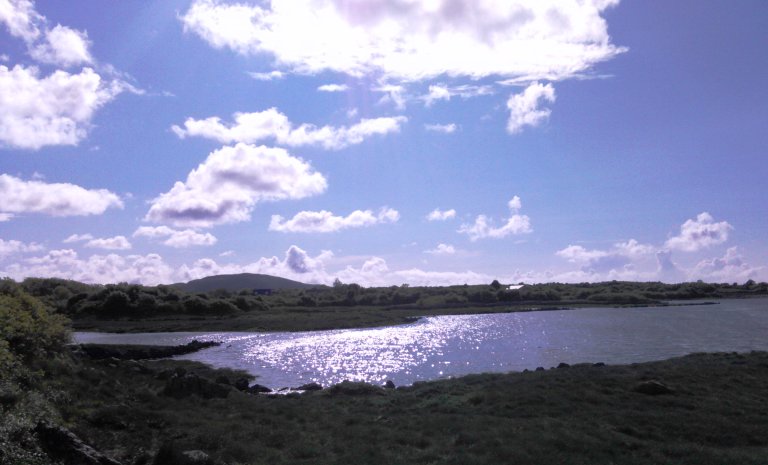
Photo: EO’D
The Danes left their mark in Aidhne with the following incursions;
In 816 A.D. Corcomroe was raided. Glen Columkille and Oughtmama suffered and the northmen went through Aidhne to Oranmore and Loughcorrib. After the plundering of inis Cealtra the marauding vikings used the island as a base from which they plundered the church of Beagh. In 843 the warrior Turgesius, operating from Loughrea sought to establish his authority in Connacht.
The following year the Danes landed at Kinvara and proceeded in their woeful way by Kilmacduagh to Clare.
Papers relating to proceedings for relief of distress, and state of unions and workhouses in Ireland, 1848
Sessional Papers 1847-1848 HMSO
Photo: EO’D
Dippam.ac.uk
(abridged)
P.928
Along the shores of the bay of Kinvarra and bay of Galway, which form a portion of the boundary of the electoral divisions of Kinvarra and Killeenavarra, reside a considerable number of persons, some with and some without land, who have heretofore supported themselves by fishing, and by the sale of sea weed for the purpose of manure. The failure of the potato crop in 1845 and 1846 by its discouragement to the planting of potatoes, completely paralysed the operations of the latter, who are now in a most abject state.
The only portion of the population remaining to be noticed is that which comprises the miscellaneous class of pedlars, hucksters, small dealers in fruit or vegetables, and mendicants, all of whom are affected by the general poverty of the district and are mostly in a destitute state.
As regards the prospects of the Union for the ensuing harvest, we have learned that a considerable quantity of wheat has been put down by the larger farmers, but it is certain there will not be anything approaching to the breadth of corn of the past year. On the other hand, it would appear from the reports of the relieving officers, and from personal observation, that the general success of the potato crop in 1847 has encouraged the larger holders of land to make arrangements for planting in a greater quantity in the spring. Many, however, of the smaller farmers will, we fear, be unable to set any, in consequence of the scarcity and high price of seed, added to their inability to purchase manure, and it is therefore to be apprehended that a much greater quantity of land will remain uncultivated this year than last. In former years most of the labouring population had potatoes in con-acre, but their impoverished conditions now renders them incapable of making any preparations for having a crop in the present season. Even if they were able to procure seed and manure, they have no means of support while engaged in their cultivation.
The amount of agricultural employment at present is very trifling, and we regret to say that after making the most minute inquiries we have no reason to hope that the demand for labour will be much increased for a considerable period.
The Countess de Marcieviecz, whose house in Dublin was raided recently, a printing press found in it being confiscated, published a while back an interesting article on the women of Ninety-eight, which is of more than usual interest in these days when women again are manifesting high courage in the face of danger.
We hear of Henry Joy McCracken being helped more than once by brave women other than his sister, the authoress tells us. Early in ’98 one managed to warn him in time for him to escape from Belfast. Passing along the Hercules road he met James Hope, to whom we are indebted for the story of how he was attacked in Hercules street by some armed yeomen, and would have been killed had not a butcher’s wife, called Hammell, come to his assistance with a large knife. When the yeomen ran away, she led Henry Joy into her house and passed him out in safety by a back way.
Dr. Madden tells of another woman who helped the United Irishmen in the North. He describes her as “a sister to the Sinclairs, and a young woman of great personal attractions.” She constantly met General Lake and owing to his intense vanity and incapacity, was able to extract all the information and the orders given to him by the British Government.
BIDDY MAGEE
Mary McCracken tells of Biddy Magee, a mere child of twelve years, and of a nervous timid temperament. One night she heard a regiment of soldiers passing by the door of the cottage where she lived and she know that they could only be going to pay a surprise visit to a house where some of the United men were hidden. She jumped out of bed, hastily throwing about her a few of her clothes, and rang by a lonely short cut through the fields to the cottage. Her courage was rewarded for she arrived in time to warn and save the rebels, and to slip home safely herself. This child was so nervous that she did not dare to fetch a bucket of water from the well alone in the dusk of the evening. Patriotism gave her courage.
MILES BYRNE’S BRAVE SISTER
Miles Byrne was blessed, like McCracken, with a sister of exceptional character. Though only 18 and of a gay, happy, light-hearted nature, she seems to have been absolutely dependable under the most terribly trying circumstances, and to have been of the greatest assistance to her brother and to many others in evading the English troops, and finally in escaping safely. Self-possession and good sense, courage and spirit were some of the qualities that he credits her with. She had one very narrow escape, which I will give in her brother’s own words;
“If I had not remarked a long scar on her neck, she would not have mentioned anything herself. A yeoman of the name of Wheatley, of the Gorey Corps, the day on which poor Hugh was arrested, threatened to cut her throat with his sabre if she did not tell instantly the place in which I was hiding. The cowardly villain, no doubt, would have put his threat in execution had not some of his comrades interfered to prevent him.”
There are frequent allusions to her all through the memoirs, which I have not space to retail. His step-sister, too, and various other women, are mentioned as helping in his escape; in fact, the whole tone of the book tends to show how, in Wexford, the men were accustomed to rely on the women to keep them posted with information, supply them with food, hide them, and help them escape.
At the end of the rebellion, his sister hid him in a cave, dug out by a neighbour, whom he calls Ned Cane, behind the fireplace on the ground floor. He remained there till she could arrange for his escape. She arranged with another woman, Mrs. Ricards, of Coolafaney, that this lady should drive to Dublin, on the pretence of taking her son to school, and that Miles Byrne should be the man who drove the car for them.
The chiefs of the United Irishmen seem all to have been most fortunate in the women whom they married. I have only met with one woman who was weak enough to implore her husband to save his own life, at the cost of his friends. The husband, Tom Armstrong, who was hung at Lisburn, answered her entreaties and tears by saying, “No, Mary, I will not save my life on such terms. Were I to do so, great numbers of wives would be left widows, and many children deprived of their chief protectors. I will only leave one widow and two children, and the God of the widow and the fatherless will take charge of them.:
Other women
Pamela was a devoted wife to Lord Edward Fitzgerald, though he says somewhere that he never discussed his plans with her, so anxious was he that she should not be put to any annoyance through having his dangerous secrets to keep.
James Hope’s wife was an exceptional woman. Many stories are told of her courage and cleverness. One anecdote is all that I have time for. I have taken it from Madden;
“She was sent to a house in the Liberty, where a quantity of ball cartridges had been lodged, to carry them away, to prevent ruin being brought on the house and its inhabitants. She went to the house, put them into a pillow-case, and emptied the contents into the canal, at that part of it which supplies the basin.”
Putnam McCabe’s wife went by the name of Mrs. Lee and also Mrs Maxwell in order to follow him from France to Ireland, to be near him, and to help him.
James Porter’s wife tried to get him reprieved by every means in her power, and we hear of her and a Miss Jackson accompanying him to the place of execution.
Mrs Neilson, Mrs O’Conner, Mrs Thomas Addis Emmet, and many other women followed the political prisoners to Fort George and remained to cheer and comfort them through their long, weary banishment.
One way in which the woman of ’98 were able to do good service to their country was by carrying, by word of mouth, messages too dangerous to be trusted to paper and ink. Miss Betty Palmer, a confidential agent of Emmet and Russell was the daughter of old John Palmer of Cutpurse Row. Dr. Madden calls her a sort of Irish Mme. Roland, and tells how, when it was dangerous to be seen in the streets, it was she who carried messages between Emmet, Long, Hevey, Fitzgerald and Russell. Margaret Spaight did the same for John Sheares.
The cleverness of Mrs Bond has often been admired. She obtained permission to send provisions to the prisoners, Russell and Neilson. Among the dainties provided by her was a delicious pie. When opened, it was found to contain letters to friends, writing material, newspapers, etc.
Poor Sarah Curran’s sad story hardly comes into the story of ’98 but we hear of Annie Devlin in connection with some of the heroes killed in the Wicklow Mountains. In the summer of ’99 Annie and Mary Dwyer, the wife of her uncle, Michael Dwyer, going with three other young women at midnight to dig up the bodies of Sam McAllister and Tom Costello, and bringing them to Kilranelagh for proper burial.


 The Burren and Beyond