At the international contest between Ireland and Scotland on last Saturday, a wonderful performance was witnessed in the four miles flat, when John J. Daly of Dowras, in this neighbourhood, finished second, minus a shoe. Daly had his man well in hand up to two and a half miles when one of his pumps fell off leaving him at a big disadvantage in his stride as well as having a foot exposed on a hard cinder track. Nevertheless he kept to the shoulder of the leading Scot with a pluck and determination worthy of all praise, and was but beaten by a few yards after a magnificent race. On this event depended the honour of the Emerald Isle, and but for this regrettable mishap Daly would have surely won. His time for that distance at the Irish Championship in Dublin was well inside that returned for the international race.
On Friday last week upwards of eighty tenants of the Gough estate held a meeting at Mr. Lally’s hotel, the Square, Gort. Dr. Comyn, solr., addressing the tenants said; Our purpose in assembling here today is to arrive at some conclusion by which we may be enabled to complete the purchase of the Gough estate. Six years ago we believed the only obstacle that stood in our way was the game rights; we sent a deputation to meet the representatives of Lord Gough to Dublin and the question of the game rights was satisfactorily settled. We then left the completion of the purchase to the Commissioners. They sent Mr. Bailey down to inspect the land, which he did, and if they produce his report, it will be found that there is no question of Ashfield not being included in the sale. Now, after six years anxiously waiting, the requirement of Ashfield for disposal pops up. Therefore, our business is with the Commissioners, not with Lord Gough. We have kept our part of the bargain; they have not. The estate as it is now offered, would only provide about two acres for each tenant. Hence, my object in coming here today is to get the full consent of the tenants to meet Lord Gough with a view to acquiring the lands of Ashfield for inclusion with estate.
Very Rev. Father Nestor, Shanaglish, Gort, called upon the tenants to answer affirmatively by saying in a loud voice “Yes”, or negatively “No”. On a general accordance being given, the meeting terminated.
Sir,
I have much pleasure in remitting you first halves of notes of £2.10s, the amount of the first Repeal subscriptions collected in this parish. Mr O’Connell’s never to be forgotten speech in the corporation has convinced us that there is no hope for Ireland unless from a domestic legislature. He said in that speech he was proud of his countrymen. He called on us to assist him, and cold-hearted and ungrateful must the Irishman be who would not respond to his call.
We have been too long idle spectators of this bloodless battle, and are ashamed of our apathy, but from this forth are determined to exert ourselves, and to rally with the Liberator in the struggle for national independence. May the Almighty crown his efforts with success an may his declining years be rewarded by seeing his country prosperous and happy.
I have the honor to be, sir, your obedient servant.
Michael Hynes.
Eileen-a-Riún (Eileen O secret)
The song Eileen a Riún was written in 1380. Eileen Kavanagh of Polmonty Castle, County Wexford, was the loved one. The lover was Carrol O’Daly, the chief composer of Ireland at the time and Ollave of Corcomroe. Although so distinguished, O’Daly was not like by Eileen’s parents, who forbade him to enter Polmonty Castle, or to speak with her. They engaged her to wed another but on the wedding day, when all was ready, an aged harper entered and craved the privilege of singing a song he had composed in honour of the bride. This was granted. The ‘old harper’ was O’Daly, and when he sang Eileen recognised his voice. Feigning an excuse to speak with the minstrel, she stole away with him and they married.
The song also defied the Statues of Kilkenny. Passed in 1367, these laws made it a penal offence for anyone to receive or entertain Irish bards, harpers, minstrels or rhymers. Many Irish families continued giving their patronage whenever they safely could. Henry VI (1421-1471) gave an order that all Irish poets and musicians should be imprisoned and this order remained in force for nearly two centuries.
On 13th ult. a party of six attacked and hurt a man named H___,
at Loughrea, in the night. Their object was supposed to be the abduction of his daughter, but she went down with a scythe, which she used so effectually that the ruffians were put to flight.
After the Treaty of Limerick in 1691 20,000 Irish soldiers went to France with Patrick Sarsfield. A force of 5,000 had already gone there under the command of Justin McCarthy, Lord Mountcashel. These soldiers formed the “Irish Brigade,” which, for the next hundred years took a leading role in every battle fought by the French army. The Irish Government tried to stop young men enlisting as France was often at war with England, but every year, thousands were smuggled abroad in vessels sailing to French ports. Ship Captains described these unauthorised passengers as “Wild Geese” in the ship’s books.
The Maitland Mercury and Hunter River General Advertiser 20th March, 1847 p.4
Calm day over Curranrue Photo: EO’D(abridged)
(abridged)
On Monday, as the Misses Crow, of Derriwillian, were returning from the sea-shore, to their lodge at Curranrue, they heard a shriek and, on turning, saw a little boy running towards them, exclaiming that his brother was drowning in the sea. Both young ladies hastened to the spot and arrived as the youth made his appearance a second time on the surface of the water. In a moment he was down again, and Miss Crow, throwing away her cloak and bonnet, rushed into the water to save him. The place being very steep, before she was able to reach him she got beyond her depth, and down she went also.
Miss Lucy Crow, seeing her sister in such imminent danger, plunged to her rescue. She had not proceeded many yards when she found she could not go further without placing herself in the same perilous position and that then all would be lost.
In agonising suspense she stretched forth her hand to save her sister and the boy. Alas! it was useless; they were too far asunder. Down her sister went again, overpowered by the weight of the little boy who was entangled with the grasp of the dying in her hair and neck.
But as if Providence would have it, the force of the waves carried them on to a rock in the water. Resting her foot upon it, the brave Miss Crow reached forward to meet the outstretched arm of her intrepid sister. She eventually succeeded in bringing herself and her young charge in safety to the shore.
One is at a loss which to admire, the intrepid bravery of the one or the judgment and presence of mind of the other of these young ladies. On returning to Derriwillin they will carry with them the blessings of the parents and friends of the youth whose life they thus, at the risk of their own, providentially saved. Galway Mercury
(What a beautiful subject for the poet and the painter).
Midsummer’s night was one of the most solemn festivals of the ancient pagan world. It’s also known as the eve of St. John the Baptist.
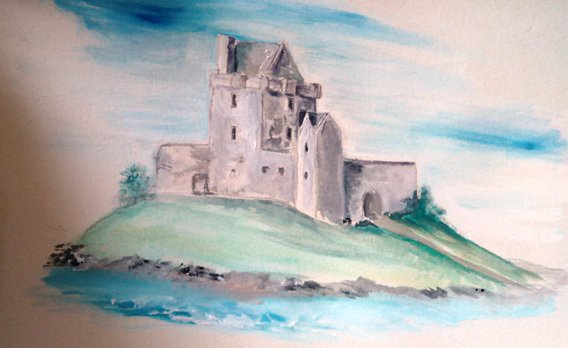
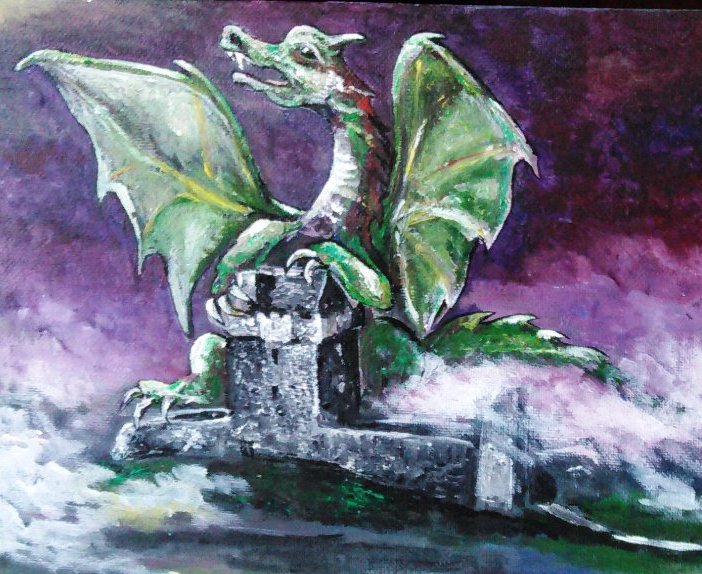
Dunguaire Dragon Acrylic on board EO’D
In pre-Christian times the first fire was lighted on the hill of Howth, on the east coast of Ireland, near Dublin, and the moment the flame appeared through the darkness a great shout went up form the watchers on all the surrounding hill tops, where other fires were quickly kindled. These were viewed by watchers further west, who in turn kindled their own fires and so on, until the flame had ‘travelled’ across the country.
It was also customary to walk three times around the fires, reciting certain prayers to ward off sickness during the coming year.The next morning was considered the proper time to hunt for mushrooms.
Midsummer’s eve is also a favourite fairy season. On this night, they are on the watch to carry off incautious mortals, particularly women and infants who are not protected by a sprig of lusmor (fada over o) or foxglove, or some other safeguard against fairy influence.



 The Burren and Beyond