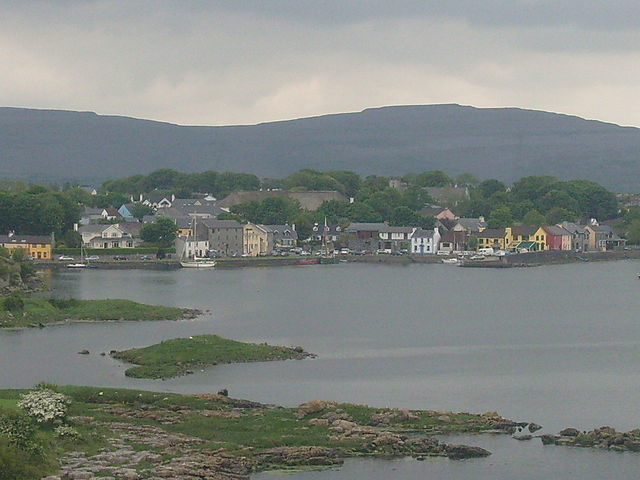
Kinvarra, Kinvara – Co Galway Wikimedia CommonsAustralian Town and country Journal 31st August 1878 p30
Lough Cooter Castle, one of the “slow places” of the western counties, stands on the edge of the lake from which it takes its name, two miles from the town of Gort, in Galway county. The castle is quite modern, having been erected at a cost of about £80,000 by the second viscount, from plans by Nash, the renovator and architect of the newly added portion of Windsor Castle. It is described as built in “the severe Gothic” style. The walls are of massive solidity, and constructed of beautifully chiselled limestone. The lake covers an area of nearly eight square miles, and is studded with wooded islands. One of these has been for years the home of innumerable herons and cormorants; perhaps the only instance on record of an island in a fresh-water lake being inhabited by the latter birds.
The Gort river flows out of the lake and, at a romantic glen known as “The Punchbowl,” falls into a deep rocky abyss, totally disappearing underground until it reaches Cannohoun. Here it rushes out of a rocky cavern and then flows through Gort where it turns several mills and, falling again, makes it way – appearing and sinking several times – through the sands into Kinvarra Bay, six miles from Gort.
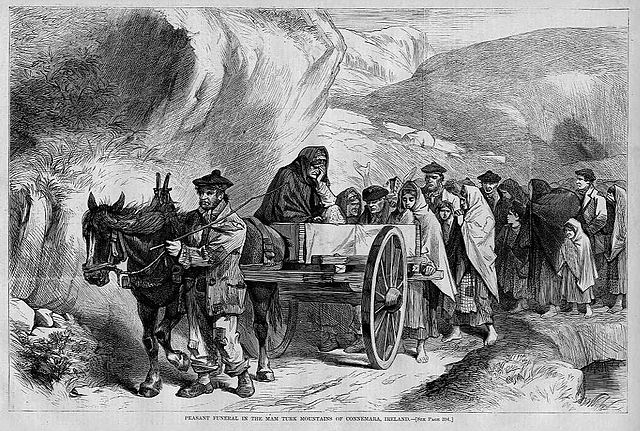
Funeral in the Maamturk Mountains of Connemara, Ireland. Harper’s Weekly June 1870Connaught Journal
Galway, Ireland
May 15, 1823 (abridged)
VESTRY CESS- PARISH COFFINS
We are anxious as any for economy in the concerns of the Parish; and we have so frequently alluded to some matters, in the expenditure of which very important savings may be made.
We made it our business to look over the different items in the levy book; but it never struck us that any saving
could be made in the way of Parish Coffins; and, above all things, we never imagined that the strictest economist or well-wisher of the town could think of doing away altogether with those Parish Coffins for the Poor who are not
able to purchase any.
The new plan for burying the dead Poor is certainly outlandish:-
As soon as one expires, or when it is thought necessary to inter him, a shell, or in other words, a Coffin with a sliding bottom, is sent to his residence. In this new constructed machine he is to be taken to the grave-yard, and there dropped from out of it into the grave.
This, no doubt, may appear very economical; but we may safely assert, that the inhabitants of this town, in general, had rather even increase this impost than to see those poor people hurried into the gound like animals of the brute creation. We are not sticklers for old customs, nor foolish enough to think that it is of any importance where or in what manner the human frame shall be deposited after the vital spark shall have been extinguished; but we do confess, that it is a melancholy reflection for the poor man to think that after having spent his life in honest but unprofitable industry, and paid his town-taxes and vestry-cess regularly, or as well as he was able, his poverty should force him to consign to the grave, after the manner of the brute creation, his relative, whom he esteemed, or his wife, or father, or sons whom he loved, and whose memory he would respect.
A detachment of Free State troops operating from Galway today came into contact with fifty irregulars marching from Kinvarra. A sharp engagement ensued and seventeen irregulars were captured.
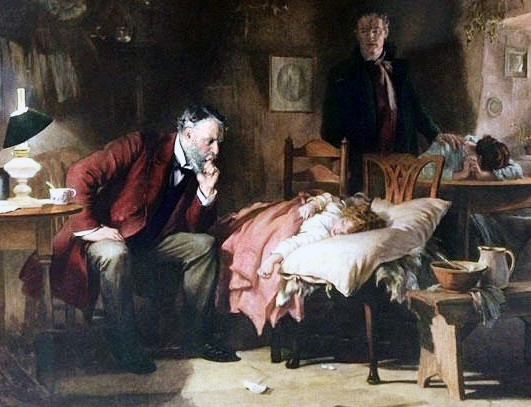
The Doctor – 1891 Luke Fildes (1843–1927) Wikimedia CommonsTHE CONNAUGHT JOURNAL 2ND DECEMBER, 1824
The most prevalent maladies in this town (Galway) and neighbourhood for the last year, are stated from the following Report of Dr. O’MALEY, whose practical intercourse with them through the medium of the Dispensary, affords him an unlimited facility of offering the most correct observations:
Fever has been on the decline; however, many cases have occurred sporadicaly, of the intermediate type, termed Synochus; the remainder mild Typhus, with a few instances of the malignant variety. Pneumonia, (inflammation of the lungs and its coverings,) has occasionally existed; Cattarh, with Pleuralgia, (pain of breast, &c.) being exceedingly frequent. A few cases of Pneumonia Typhoides (inflamed lungs with Typhus fever) have also taken place during the autumn.
Inflammatory sore throat often presents itself, owing to the vicissitudes of our atmosphere; and Hepatitis (liver complaint) is a frequent assailant from the same cause, aerial inclemency, and another powerful agent, immoderate spirituous potation.
That Morbid Proteus Rheumatism, acute or chronic, doth constantly uphold a relentless sway, and concentrates, in many individuals, the keenest pangs of enfeebled humanity. Dispepsia (indigestion) and Corrdialgia (spasmodic pain of stomach) in its different varieties, have been, and must be, incessantly frequent in occurrence, until the scanty food of our squalid poor be succeeded by a more generous and abundant measure. Of all diseases which engage the attention of Nosologists, Dysentery & Diarhoea have for the last months stalked with relentless gripe through these wretched domiciles of incomprehensible misery, the hovels of the poor.
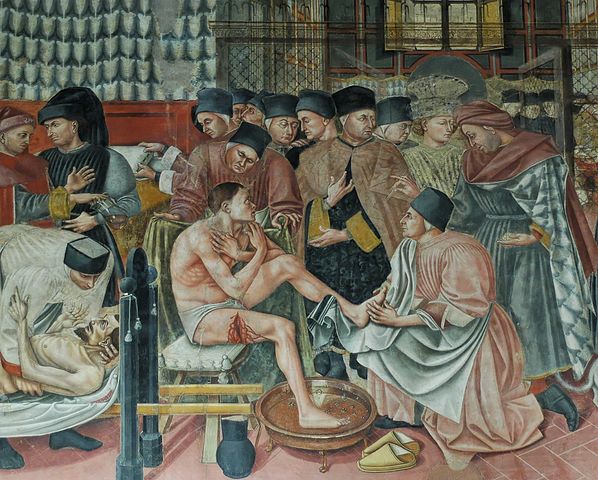
Healing the sick, fresco by Domenico di Bartolo. (1400-1447) Sala del Pellegrinaio (hall of the pilgrim), Hospital Santa Maria della Scala,Siena Wikimedia CommonsThese diseases, so different in their nature, have been principally excited by the same causes, namely, no wholesome diet, and deficiency of warm vesture; dysentery indubitably becoming contagious among them, from the limited extent and offensive uncleanliness of their dwellings. This circumstance is worthy of remark, as the Dysentery of these latitudes is seldom contagious, unless under the conditions already mentioned, or when concomitant with epidemic Typhoid affections.- Colic is a malady that next in order rears is stand and among the indigent; frequent cold and wet and indigestible esculents act as its occasional causes. In many instances it has yielded its grasp in the last mentioned genus Dysentery, and in a few has been the precursor of a more certain harbinger of death, Enteritis (inflammation of the bowels.)
The Cholera of our climate, though comparatively imbecile to that of the southern part of the Asiatic region, is a formidable malady, that has occasionally occurred during the estival and autumnal seasons, but in an immediate and decisive practice has invariably yielded.
Hoemophilis (spitting blood) often appears here, but when unconnected with any other affection, is seldom fatal. It, or inflamed lungs, sometimes is a variety of consumption named Inposthumutous, Phthisis, which, with another variety (Tubercular) have occurred here within the last year much less frequently than could be expected from the vicissitudes of atmospheric temperature. It has been computed that in England this disease carries off one-fourth of the population, in Paris, one-fifth, in Vienna, one-sixth, while in Russia it is by no means common, and in tropical climates still less so, from the greater uniformity of their atmosphere, either frigid or torrid. Asthma also constantly presents itself, and unless when produced from malformation, is generally a senile disease, sometimes closing its career with the induction of others.
Dropsy is one of frequent occurrence among the lower class, because it is for the most part a disease of debility. We usually find that it has been preceded by some species of fever, and in other instances it is nurtured by an abuse of ardent spirits, inanition, hard labour and a long exposure to wet and cold. These sap the body and induce affections of the stomach, particularly the liver, weakening the digestive organs becoming frail and instituting in various ways the complaint in question.
Another opportunity shall be taken to illustrate the most prevalent diseases of females and children.
Daguerrotype with venerable Catherine McAuley circa 1840 Wikimedia commonsThe Tablet 8th May, 1898
His Eminence Cardinal Logue received last week the religious professions of two nuns at the Convent of Mercy, Dundalk. During the ceremony his Eminence delivered a touching address on the duties, obligations, and privileges of the religious life. The young ladies professed were Miss Delia Corless, in religion Sister Mary Ethnia, of Kinvara, County Galway, and Miss Kate Flatley, in religion Sister Mary Lucy, also of Kinvara.
Photo: Oscar Wikimedia CommonsThe Tablet, 22nd October, 1842
MALICIOUS BURNING.—The dwelling-house of a poor industrious man, named Higgins, living at Ballyclary, within a mile of Kinvarra, was maliciously set on fire on the night of the 2nd instant ; the family were all in bed when the wicked act was perpetrated. The cracking noise occasioned by the devouring element very fortunately awoke them in sufficient time to prevent any lives being lost.
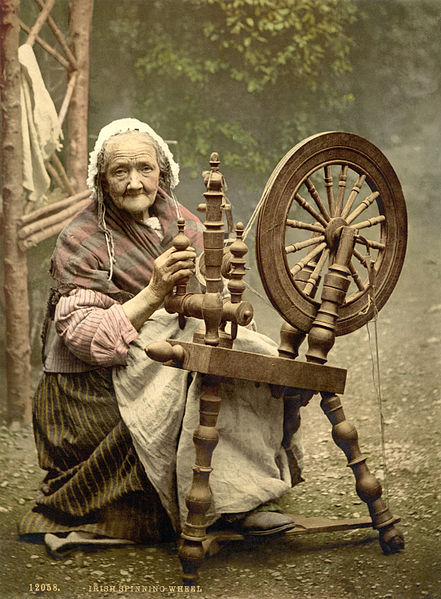
Library of Congress collection Wikimedia CommonsConnaught Journal
Galway March 13, 1823
A spinning wheel of curious construction and very neat workmanship was
exhibited on Monday last to the Ladies’ Association in the Court-house of
Ennis. It is made to have eight persons work at it, and, we understand, fully
answers the purpose. The maker is James RO*A*E, who resides in the town of
Gort.
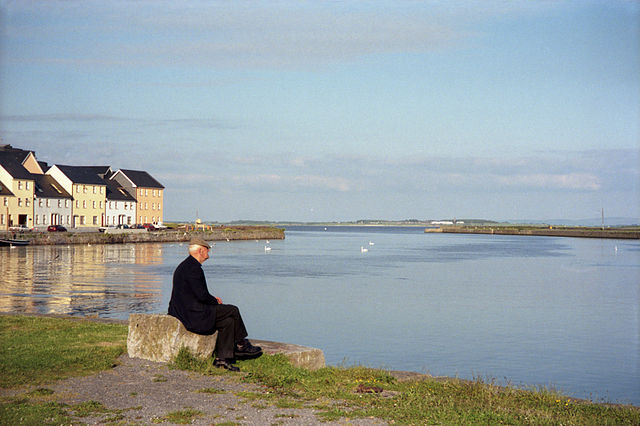
Galway WikipediaConnaught Journal
Galway, Ireland
Thursday, June 12, 1823
On Wednesday, rather an interesting looking woman was observed standing on the verge of the quay, opposite where the brig Fortitude, freighted with passengers for America, was lying; when, on hearing a shot fired, she thought it was the signal for sailing, on which she plunged into the river with a view of reaching the vessel, or abiding the consequences.
She was fortunately taken up, and on being recovered, she said in explanation, that her husband was on board the vessel, having deserted her and her family.
There was an order immediately for his being re-landed. In furture he should atone for having taken a step that was near ending so fatal to a wife that loved him better than he deserved.
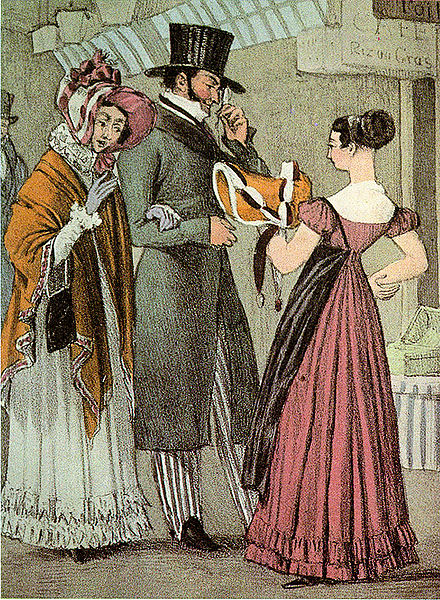
Millinery Shop Paris, 1822 John James Chalon (1778-1854) WikipediaConnaught Journal
Thursday, April 10, 1823
FEMALE FASHIONS FOR APRIL
Morning Visiting Dress
Pelisse robe of mignionette, leaf green, of Gros de Naples, trimmed down
each side in front, and round the border with puffings of same, confined by
straps of satin; the bust ornamented by satin Brandenburgs, each terminated
by a silk tassel. Frill a la Henriette, of Urling’s lace. Small equestrian
hat of fine beaver or satin, of a lavender gray, placed very backward and
crowned with a plume of curled feathers of the same colour.–Sautoir of pale
silk. Green satin half boots, and Limerick gloves.
Connaught Journal 3rd March – Fashionable Millinery
Miss E ROBINSON
Begs to announce to her Friends and the Public her having received, from the
first Houses in Dublin, a select and fashionable assortment of Millinery;
Laces, of a superior quality; and a variety of Satins and Lutestrings, of
different shades for Bonnets, for which she has received the Newest
Patterns.
The above Articles having been purchased for Ready Money, they will be
disposed of on the most moderate terms, at her Shop, next door to the
American Society-room, Shop-street.
Bonnets made in the most fashionable manner, and on the shortest notice.
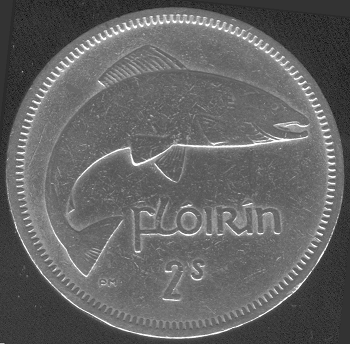
Irish Florin WikipediaA Book of Saints and Wonders – Lady Gregory, 1906
p8
…But if Brigit belonged to the east, it is not in the west she is forgotten, and the people of Burren and of Corcomruadh and Kinvara go every year to her blessed well that is near the sea, praying and remembering her. And in that well there is a little fish that is seen every seven years, and whoever sees that fish is cured of every disease. And there is a woman living yet that is poor and old and that saw that blessed fish, and this is the way she tells the story:
“I had a pearl in my eye one time, and I went to Saint Brigit’s well on the cliffs. Scores of people there were in it, looking for cures, and some got them and some did not get them. And I went down the four steps to the well and I was looking into it, and I saw a little fish no longer than your finger coming from a stone under the water. Three spots it had on the one side and three on the other side, red spots and a little green with the red, and it was very civil coming hither to me and very pleasant wagging its tail. And it stopped and looked up at me and gave three wags of its back, and walked off again and went in under the rock…



 The Burren and Beyond