The Dublin correspondent of the ‘Daily Chronicle” states that reports fiom Donegal, Kerry, Galway, and Connemara disclose that thousands are suffering distress owing to a food and fuel famine due to torrential rain and floods during recent months. The conditions are likened to the potato famines in 1847 and 1879.
Several deaths have occurred, and outbreaks of fever are reported from more than one district. The potato crops have failed. The fact that the lrish have found little employment in England and Scotland during the last harvest adds to the distress. A relief fund has been opened, and the local Government is distributing coal and food. The Free State Government has allocated £250,000 for relief works.
MODERN IMPROVEMENTS (abridged)
It has been thought expedient to place upon the levey book a good round sum
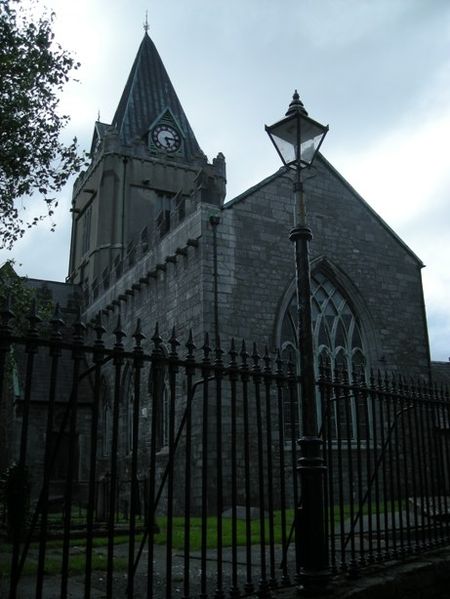
for the erection of two Galleries in the Church of St. Nicholas. One Gallery
is finished, at least the heavy work has been gone through, and has cost the
inhabitants of this miserable place some – (we do not know how many)
hundreds. The other Gallery will, we hear, be as expensive, if not more so-
and will be erected in the identical spot in which the former Gallery stood,
which was taken down a few years back.
Thus it was with us in Galway. We have, as the proverb says, “a time to gather and a time to scatter- a time to build up and a time to pull down.” If a Gallery was considered at all necessary in this beautiful building why was the old one taken down?
It certainly was not removed through any apprehension of its falling, for the
work and materials were found to be excellent; no – this was not the reason
of its disappearing. The Parish saw, that instead of its being at all
useful or necessary, it was calculated for very bad purposes, being nothing
less than a perfect nuisance, and a lurking place for abomination of every
description – a mere profanation of the House of God. In this assertion we
are borne out by every person with whom we have communicated; and, while all
see that it is an unnecessary expence to the Parish, none have had the
firmness to come forward and oppose the impost. Our astonishment at this is
very great; but we must confess that it is wonderfully increased at hearing
that it is intended to remove, or take down, the handsomest ornament in the
Church, for the purpose of making way for this Gallery.
We here allude to Lynch’s Altar. The new Gallery cannot be built so as to avoid disturbing this venerable remnant of antiquity, as the old one was, but Lynchs’ Altar – the finest specimen of mechanism in the entire building. Lynch’s Altar, which has stood the test of so many centuries, and even commanded the protection of a Gothic infuriated Soldiery in the general destruction of Church property and ornaments, must be now set aside, removed or taken down- and by whom? By men who ought to be enlightened – who pretend to taste and judgment, but who do not seem possessed of any strong claims on either. The large tomb will be (we hear) also removed. We shall merely ask – will the
descendants of the LYNCH family suffer this to pass without an observation?
REVENUE SEIZURES
From the 5th ult to the 5th inst, those active and enterprising Officers of
Excise, Messrs. THOMAS and GLYNN, accompanied by Lieut GRAVES, and the
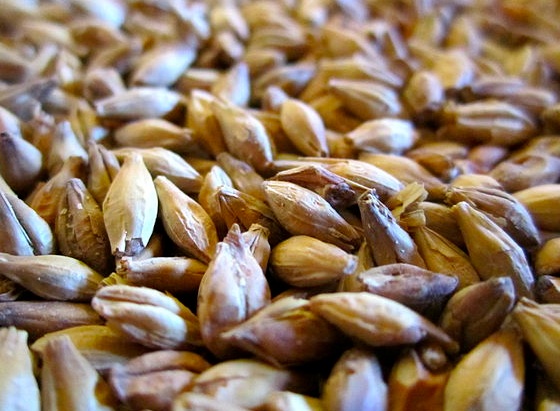
detachment of the 3d Revenue Corps stationed at Gort, seized six copper
stills, still heads and worms; twenty gallons of spirits; 47 barrels of
malt; and destroyed 21 illicit distilleries, with 54 fermenting vessels,
containing 1680 gallons of pot-ale and singlings, and arrested nine persons
found in illicit distilleries and malt houses.
The Brisbane Courier 11th December, 1869 (abridged)
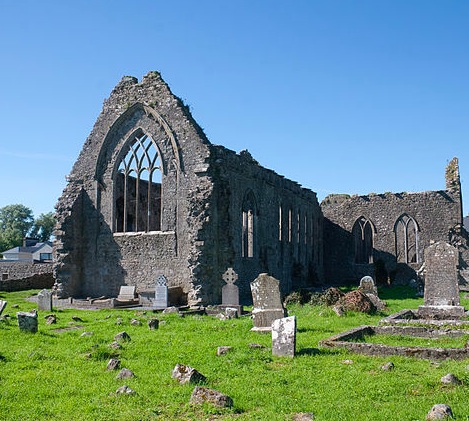
Athenry Priory Photo: Andreas F. Borchert Wikimedia Commons
The trial of the man for shooting at Captain Lambert near Athenry, on the 12th of July, has ended very unsatisfactorily. The jury were not able to agree and he will have to be tried again. A large sum of money has been subscribed for the defence, and one of the jurors, who was understood to have been in favor of a conviction, was pelted by the mob. The window’s of the judges carriage, also, were broken by stones.
On the evening of the day of the attempted murder a young man was found apparently asleep in the train that runs from Galway to Dublin. In reply to the police, he said that he had got into the carriage at Galway, but two fellow passengers corrected him, and insisted it was at Athenry. Suspicion was aroused, and he was taken into custody.
He was then discovered to be the son of a tenant whom Captain Lambert had ejected, and a recently-discharged pistol was found in his possession. He had left London on the 11th of July, ” for a trip into the country,” as he told his landlady, and the pistol was traced to a shop in Tottenham Court Road, where he had bought it. In addition to this Captain Lambert positively swore that, he was the person who had fired at him, Yet the jury were unable to agree upon a verdict!
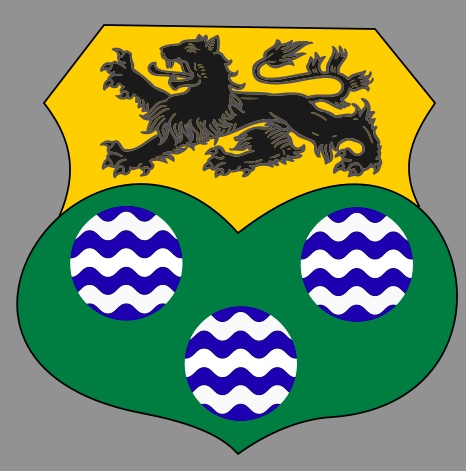
Leitrim Coat of Arms Kanchelskis Wikimedia Commons
On the evening of the landing of the immigrants by the Kapunda at Townsville, a grand scrimmage took place. Some unprincipled vagabonds broke into the single girls’ department about bedtime. The cries of the girls brought the gallant Galway and Leitrim boys to the rescue. They tackled the intruders and a regular fight was started. The police, who are far to few in number on an occasion of this kind, interfered. One got a black eye and another a torn jacket, and the result was that the depot was cleared and four delinquents marched to the lock-up. The most serious charge was against a man who bit off half the ear of one of the new chums. This cannibal is to be sentenced today.
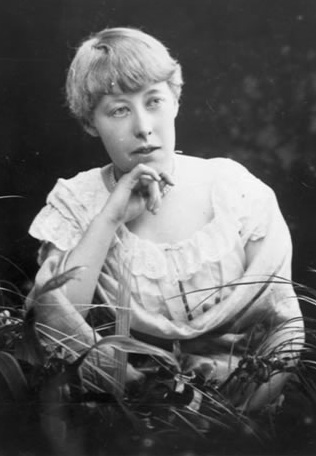
Katharine Tynan (23 January 1859 – 2 April 1931) Wikimedia Commons
from Collected poems of Katharine Tynan
MacMillan and Co., Ltd. London. 1930
As I go home at end of day, the old road,
Through the enchanted country full of my dreams,
By the dim hills, under the pellucid o’er-arching sky,
Home to the West, full of great clouds and the sunset,
Past the cattle that stand in rich grass to the knees,
It is not I who go home: it is not I.
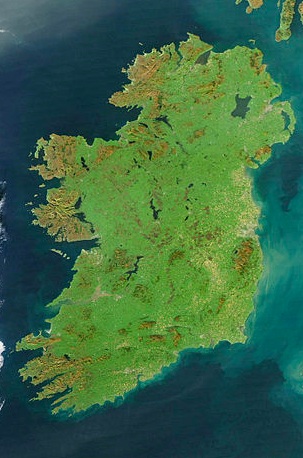
Ireland Jeff Schmaltz – NASA Earth Observatory. Wikimedia Commons
During the swearing in of a batch of Irish witnesses at the General Sessions yesterday to appear at the next Circuit Court it transpired that one of them, from County Clare, was ignorant of all languages but his native Erse.
An interpreter was obtained to make know to him the meaning of the recognisance.
On Thursday last about one in the morning, there was the most violent storm, and floods occasioned by it, that ever was known by any living, or ever heard of here.
It lasted till 9. The water rose so violently of a sudden, and to that height, that most of the cellars in the town were full of water, by which the Merchants, Vintners, Ale-sellers and other People suffered very much. The inhabitants of the suburbs of the town were forced to crawl naked from the inside to the tops of their cabins, whence some fell down being benumm’d and not able to hold longer. God knows what the losses in the country are.
It’s certain all the cattle and corn in the low lands near the Shannon are lost, as well as the corn and rape in stack as that in ground. Many houses in town and country were untiled, and some blown down; two ships that lay at the Key, taking in their lading, and one empty were got on the top of the Key; two are got off, but the third, a Dutch Ship of 80 Tons, lyes now just at Key Gate.
They are taking out her goods and breaking down the Key, in hopes to get her off. I hear the Queen Ann of London of 400 Tuns, from Jamaica, with Sugar, Indigo, etc. is put ashore at a place called Glinn, about 11 Leagues down the River. The Anna of Rotterdam, with Beef, Butter, Hides and Tallow, is driven ashore upon Fines Island, 8 Leagues down, and is 2 or 300 yards higher in the Fields than ever the Tide came before. It’s said the Queen Ann is not bulged but very far up, and buryed in the sand very deep. Our barge was bulged and sunk. The Watch-house and three other houses were blown down on the Key. Two of the garrison gates were blown to pieces. The magazines and guardhouses were almost quite unflated and unglazed, and the sentry boxes broken to pieces.
THE CONNAUGHT JOURNAL
16th December 16, 1824 (abridged)
In the year 1816, the Duke of Devonshire, the present noble proprietor of the ancient Castle of Lismore, in the County of Waterford, gave directions, that that venerable edifice should be repaired and restored to its pristine state and splendour. In pursuance of his Grace’s command, workmen were employed on the building; and, on taking down a wall that had been built in the place of a door; they discovered an ancient Manuscript Book, beautifully written in the Irish Character and Language, on vellum of the largest size.
Some parts of the beginning and latter end of the book were entirely decayed. There are also some leaves wanting in different places in the middle; and , in some other places, the mice have eaten away a part of the upper margin, which leaves a few lines defective on some of the pages. The folios of the book were originally numbered with Arabic figures. The last folio, now legible, is marked 293, which would, if the book were perfect, be equal to 473 pages. The number of the pages now remaining are only 260.
This precious relic of Irish genius contains a variety of Tracts, both curious and interesting. As it stands at present, it begins with the life of St. Patrick, which is followed by those of St. Columbhill, St. Brigid, St. Seanan, St. Finin, of Clonard, and St. Fionaches of Brigoone. These are followed by an account of the establishment of the festival of All Saints; a treatise on King David; the history of Charlemagne; the history of the Lombards; the history of Altrisson of Cashal; son of Fiongaine, King of Munster; Adventures and Wars of Callaghan of Cashel, King of Munster; History of Teigne; Historical Poem on Finin M’Carthy, the M’Carthy reign, the battle of Calonan, Story of Crimthan Cas, King of Connaught; the victory of Drom-dumhghoire; a long tract on Dispersion and Destruction of the Finian Host, or famous Irish Militia; and some other tracts of minor importance.
Saint Brigid’s cross Photo: Culnacreann Wikimedia Commons
The last named Tract is extremely curious, and is most interesting in the Irish Antiquity. It commences at the original folio 201, a sol. 1, now page 185, and continues to folio 239 or present page 260 where it is left imperfect by the loss of the concluding leaves of the book. It is carried on by way of dialogue between various persons; the principal speakers of whom are St. Patrick and Coolte Mac Ronan. The chief subjects treated of are, the unities of the Feal or Irish Militia, in which the great actions of Fionn Mac Cubball (Finn Mac-Coo-all), the Fingal of Mac-Pherian Ossian; Coll Mac-Moran, and his brother, Conan the bold; the Thereafter of the Irish Nisin; Desmond O’Dabhan, and other famous heroes are recited in the course of this Tract are introduced many popular tales of the Irish, and the origin of many ancient customs is accounted for; and, what is most important to the ancient Irish Topographer, the names of innumerable places remarkable in the History of Ireland, but the sites of which are almost totally unknown to the modern Historian, are given; together with the names by which they are called in latter times.
There is nothing in the book, that served to ascertain the period at which it was written, but it contains a poem in the M’Carthy rough, which helps to throw some light on the subject and shows that it could not be written earlier than the 15th century.