Posted in Posts and podcasts

St Brigid – 1934

The Catholic Press 1st February, 1934 p8

ST. BRIGID.

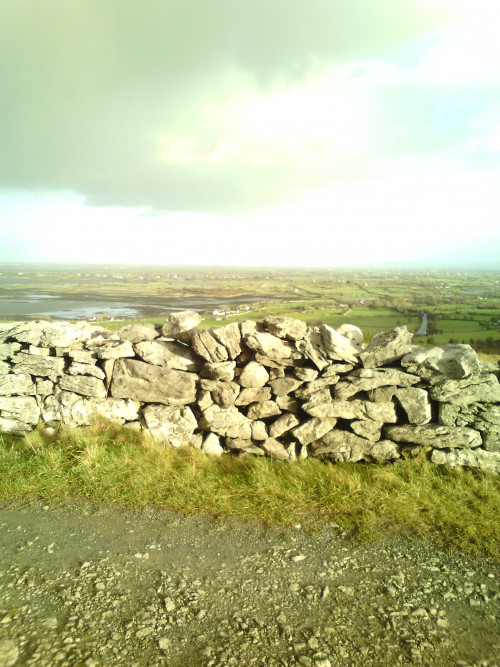
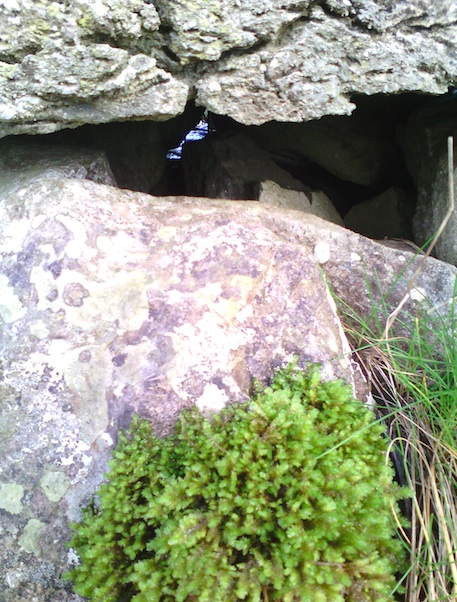
Burren light Photo:EO'D
Burren light
Photo:EO’D

St. Brlgid is the mother, all men know,
Of Erin’s nuns that have been, or shall be,
From great St. Patrick’s time to that last day
When Christ returns to judge the world by flre.
‘Twas summer eve; upon a grassy plain
She sat, and by her side a fair blind nun,
Of them that followed her, and loved her rule,
And sung her nocturn psalms. They spake of God.
The wonder of His dread inscrutable Being
Round all, o’er all, in all; the wonder next
That man, so slight a thing, can move His love,
Can love Him, can obey; the marvel last
Of God made Man; the infinite in greatness
By infinite descent a creature made,
Perchance within the least of peopled worlds,
For saving of all worlds.
The Sun went down;
Full faced the moon uprose; the night wind sighed,
It broke not their discourse. The dawn returned;
It flushed the clouds; it fired the forest’s roof;
It laughed on distant streams.
St. Brigid gazed upon that dawn; a thought
Keen as a lance transfixed her heart; she mused,
‘Alas, this poor blind sister sees it not!’
She clasped that sister’s hand, she raised, she kissed it;
That blessed one spake: ‘Why weepest thou, mother mine?
Thy tears are on my hand.’ The Saint replied:
‘I weep because thou canst not see the dawn
Nor in it God’s great glory.’ Then the nun:
‘If that thought grieves thee, pray and I shall see.’
St. Brigid knelt; and lo! the blind one saw!

AUBREY DE VERE.

Posted in Posts and podcasts

A shrinking land – 1903

Southland Times, Issue 19179 17th October, 1903 p8

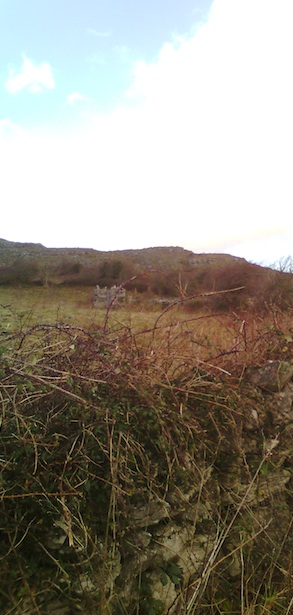
The Burren Photo: EO'D
The Burren
Photo: EO’D

Ireland is smaller than it was, only to an inappreciable extent, it is true, and apart from any action of the waves or weather which may have a tendency to affect its size by natural means. The truth is that some Ireland has been shipped to America in barrels.

Turf from Connaught and Clare, soil from Limerick and Mayo, heather from Croagh Patrick, shamrocks from Donegal, peats from the bogs of Ulster, turf from every county in Ireland, have been sent to Chicago to be used in building a miniature Ireland in the Coliseum. The soil will carpet the floor of the big building during an Irish fair which is to be held in that city. There were thirty-two casks of the soil, and it will be arranged in the shape of the counties from which it waa dug. There were eight great crates of peat, which will supply fuel for the miniature shops, stores, and houses that will be erected in each county.

Posted in Posts and podcasts

Lisdoonvarna – 1897

New Zealand Tablet 16th July 1897 p 9

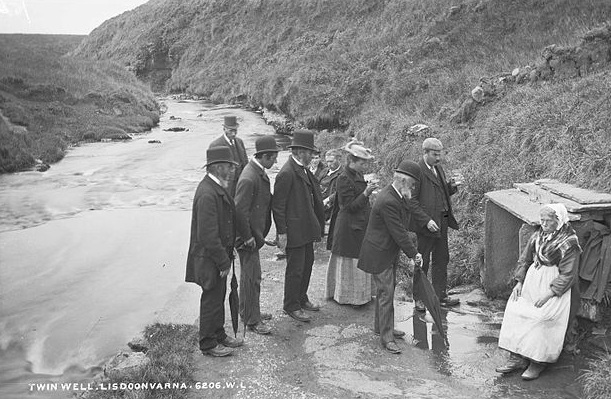
The Twin Wells on the banks of the River Aille at Lisdoonvarna c 1900 National Library of Ireland Wikimedia Commons
The Twin Wells on the banks of the River Aille at Lisdoonvarna c 1900
National Library of Ireland
Wikimedia Commons

CLARE.— Threatened Confiscation of the Famous Spa at Lisdoonvarna Public Meeting of Protest

On Sunday, May 9th an important meeting was held in Lisdoonvarna to protest against the action of the Representative Church Body of Ireland in their endeavour to grab the Lisdoonvarna sulphur springs, the use of which has been free to the public for a number of years. The people of the far-famed watering place have determined to resist by every legal means the threatened invasion of the public rights, and to fight out to the end the pretensions raised by the Representative Church Body. On the facts as disclosed the action of that body cannot be described other than as most unjustifiable.

Something like the same claim endeavoured to be sustained now was put forward thirty years ago by Captain Stackpoole, the former landlord of the district. He built a well house on the site ot the principal Spa which was walled in, the people being denied the access that up to that time they had freely enjoyed. The indignation felt by the people manifested itself in a practical manner. The gates set up by the landlord were blown up and the house damaged

A claim for compensation by Captain Stackpoole was opposed, and the judgment of the late Chief Baron Pigott was that the putting up of the gates constituted an infringement of the public rights. For the injury to the house some slight compensation was allowed, and there the matter rested until, some years after practically the same decision was delivered by Judge O’Brien

Subsequently the estate went into Chancery, and a local improvement committee having been formed, a lease of the house, grounds and wall was obtained at a rent of £15 a year. Since then the committee by the aid of voluntary subscriptions have improved and beautfied the Spa for the benefit of visitors. The house has been enlarged, modern pumps have been bought, new baths have been erected out of the funds collected by the committee. Now it appears that the Church Representative Body, who were the largest incumbrancers on the estate have bought out the other interests having claims upon the property, and as a consequence of their ownership the court lease given to the committee lapses. One of the first acts of the new landlords, regardless of the monies spent by the committee, has been to advertise the letting of the Spa, and even though the Improvement Committee made an offer to rent what is virtually the property of their own creation it has been rejected, it is said, in favour of a syndicate proposal to take over the springs and baths at £300 a year. These tacts demonstrate pretty clearly the injustice of the proceeding comteinplated by the Church Representative Body, and it is to be hoped that the people of Lisdoonvarna will succeed in defeating snch an aggressive and unwarrantable interference with public rights.

Posted in Posts and podcasts

The Clareman’s Farewell – 1897

New Zealand Tablet Vol XXI Issue 34, 31st December, 1897 p9

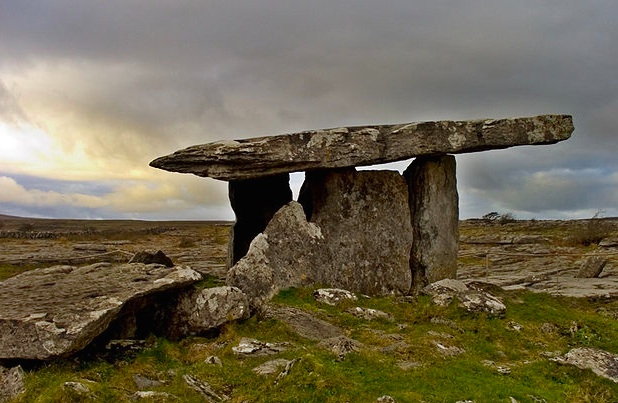
Poulnabrone dolmen, the Burren, County Clare Photo: Steve Ford Elliott  Wikimedia Commons
Poulnabrone dolmen, the Burren, County Clare
Photo: Steve Ford Elliott
Wikimedia Commons

To gallant Clare – my native vale,
I bid a last adieu.
Farewell you every hill and dale,
Farewell ye waters blue.

Farewell ye fields of gallant deeds,
And streams renowned in song,
Farewell ye mossy rocks and meads
My heart has loved so long.

Home of my love, my native home,
How oft I’ll sigh for thee.
When the raging billows, white with foam,
Shall part both you and me.

Then, fare thee well my lovely Clare;
Farewell to home and thee.
I ne’er shall find a spot so fair
As home and Clare to me

P.J.H.

Posted in Posts and podcasts

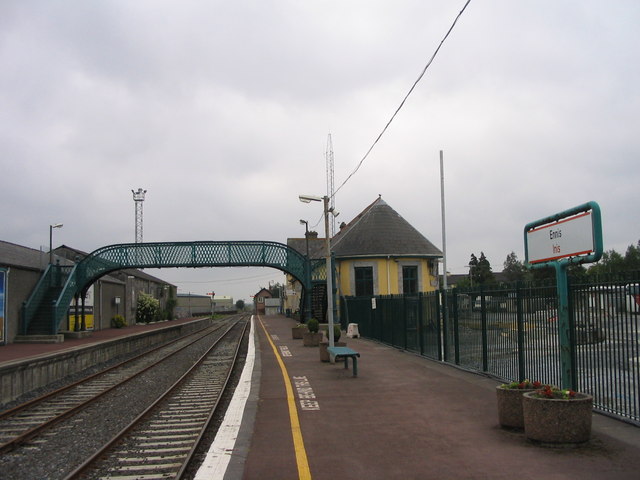
Mr Cullinane – Ennis – 1906

Star Issue 8616 7th May 1906 p2(abridged)

Ennis Station Photo: Francoise Poncelet Wikimedia Commons
Ennis Station
Photo: Francoise Poncelet
Wikimedia Commons

WOMAN RESCUED FROM AN ONCOMING TRAIN.
The brave deed for which Mr Patrick Cullinane, railway traffic inspector, Ennis, County Clare, has received the Albert Medal from Lord Aberdeen at Dublin Castle, in the name of the King, occurred on November 6 last. An elderly woman fell over the platform in front of an approaching train. Mr Cullinane jumped down on the rails to her assistance. It was impossible to pull her aside, and the only way was to drag her directly forward until the train had time to slow up. For some yards the woman was dragged along by the powerful inspector in front of the train. At one point in this race with death the woman’s clothing was touching the engine.
When safe, they were found to be completely exhausted.

In presenting the medal, the Viceroy said that deeds such as that were part of the national assets, and in honouring the individual they were also honouring the qualities he displayed.

Posted in Posts and podcasts

Tidal wave – Kilkee – 1883

West Coast Times, Issue 4491, 15th December, 1883 p5

Photo: Brocken Inaglory  Wikimedia Commons
Photo: Brocken Inaglory
Wikimedia Commons

TIDAL WAVE ON THE IRISH COAST.(abridged)

The following is an extract from a communication from Kilkee, County Clare, giving an account of a vast tidal wave which occurred there on the 20th September. The writer says:-
“One of the most splendid scenes I ever witnessed occurred here last Thursday. The day was magnificent, the sunshine as hot as June, not a breath of air in motion, and the bay as still and smooth as a sheet of glass. My daughter and I were sitting on a favorite nook at the ampitheatre, reading, at two o’clock. Shortly after we heard a noise of breakers, and looking out saw the Atlantic in sudden and wild commotion, the waves rushing in with terrific fury, so that we had to run inwards on the land, where we and other parlies had a full view of the majestic phenomenon.

The sea, that a few minutes before was a beautiful emerald green, was suddenly changed into a winter scene of snowy hue. The basin of the ampitheatre was filled with foam, volumes of spray rose 50ft over Duggerna, and swept with fearful velocity over St. George’s Head, 100 ft high, drenching several visitors on the top. The scene at this moment was fearfully grand, the wide expanse of ocean and bay looking like a vast sheet of snow in majestic upheaval.

I have never witnessed during equinoctial gales, or even in the great storm here last October, so magnificent a display of the Creator’s power in the watery element, as this — the most extraordinary feature of the case without a passing breeze.

This continued for half an hour, and the sea was again restored to its previous stillness”.

Posted in Posts and podcasts

Song of the little villages – 1914

Evening Post Volume LXXXVII Issue 14 17th January, 1914 p 13

Kinvara Photo: Cresswell Archives
Kinvara
Photo: Cresswell Archives

The pleasant little villages that grace the Irish glynns,
Down among tho wheat-fields up amid the whins.
The little white-walled villages crowding close together,
Clinging to the Old Sod in spite of wind and weather:
Ballytarsney, Ballymore, Ballybodei, Boyle,
Ballingarry, Ballymagorry by the Banks of Foyle.
Ballylaneen, Ballyporeen, Banaha, Ballysadare,
Ballybrack, Ballinalack, Barna, Ballyclare.

The cosy little villages that shelter from the mist,
Where the great West Walls by ocean spray are kissed;
The happy little villages that cuddle in the sun
Where blackberries ripen and the harvest work is done.
Corrymeela, Croaghnakeela, Clogher, Cahirsiveen,
Cappaharoe, Carrigaloe, Cashel, and Coosheen,
Castlefinn and Carrigtohill, Crumlin, Clara, Clane,
Carrigaholt, Carrigaline, Cloghjordan, and Coolrain.

Kinvara Photo; Cresswell Archives
Kinvara
Photo; Cresswell Archives

Leave the little villages, o’er the black seas go,
Learn the stranger’s welcome, learn the exile’s woe,
Leave the little villages but think not to forget
Afar they’ll rise before your eyes to rack your bosoms yet.
Moneymore, Moneygall, Monivea, and Moyne,
Mullinahone, Mullinavatt, Mullagh, and Mooncoin,
Shanagolden, Shanballymore, Stranorlar, and Slane,
Toberahcena, Toomyvara, Tempo, and Strabane.

On the Southern Llanos north where strange light gleams,
Many a, yearning exile sees them in his dreams;
Dying voices murmur (passed all pain and care),
“Lo, the little villages, God has heard our prayer.”
Lisdoonvarna, Lissadil, Lisdargan, Lisnaskea,
Portglenone, Portarlingtpn, Portumna, Portmagoe,
Clondalkin and Clonogowan, Cloondara, and Clonae,
God bless the little villages and keep them night and day

Rev. J. B. Dollard. Literary Digest.

Posted in Posts and podcasts

Killaloe – 1929

Evening Post Vol CVIII Issue 108 2nd November 1929 (abridged)

St Lua's church, Killaloe Uploaded by Chris55  Wikimedia Commons
St Lua’s church, Killaloe
Uploaded by Chris55
Wikimedia Commons

AN ISLAND GOES.

Friar’s Island, Killaloe, where eight centuries ago the pious monks of St. Lua’s Oratory preached Christianity to the Irish, will soon be a memory that has sunk beneath many waters. The waters are those of the Shannon, which will rise to cover it when the reservoirs for the new power scheme for distributing electricity about the countryside are filled.

Ireland could not see the old place go without a look, without a sigh, and without a prayer, so on a Saturday in July many people from Tipperary, Limerick, and County Clare gathered there to bid the island farewell and hear the priests celebrate Mass there for the last time. Mass had not been said there since the Oratory fell to ruin all those centuries ago. The monks have gone, the voices which were heard at Matins or at Vespers are for ever silent, and now the island itself has followed them to rest.

Posted in Posts and podcasts

Ennistymon – 1918

Hawera and Normanby Star Vol LXXIV 4th March 1918 p5

Comber's Bakery, Ennistymon National University of Ireland via Wikimedia Commons
Comber’s Bakery, Ennistymon
National University of Ireland
via Wikimedia Commons

It is reported that the £5,500 stolen from a bank manager at Ennistymon, County Clare has been restored, with a note stating that no robbery was intended and the money was taken merely to prevent its use at the fair to buy cattle, which were to be exported.

Posted in Posts and podcasts

County Clare – 1920

Recorder 28th January, 1920 p1

Photo: EO'D
Photo: EO’D

(abridged)
The Daily News correspondent in Dublin says that 2,000 American rifles were landed on the coast of County Clare and were brought ashore in small quantities. They were distributed before the military authorities knew that any arms had been landed. The Government regards the position in County Glare as serious.
Irish subscriptions to the Sinn Fein national loan amount to £1,500,000. The sum of £4,250,000 has been contributed in America.