
NEW ULM REVIEW, MAY 25, 1892 P2
TWO MILLIONS AHEAD
KANSAS CITY, MAY 23
The attorneys of James Monahan yesterday received a cablegram from London, Eng., stating that Mrs Monahan’s suit for the recovery of a large amount of property from the English government has been successful. The property consists of 17,000 acres of land near Limerick, county Galway (sic.), Ireland, and a valuable sheep ranch in Australia. The whole property is valued at $2,000,060.
It was seized from Timothy Brady in 1798 by the English government for some reason which is now known here. Mrs Monahan being Brady’s only surviving relative, the property descends to her. Mrs Monahan now lives at Independence, Mo., and is ninety-four years of age. She has a numerous family
Category: Posts and podcasts
Posts and Podcasts
Bridget – 1900
https://widgetworld3.wordpress.com/podcasts/
THE INTERMOUNTAIN CATHOLIC, 30TH JUNE, 1900. P3
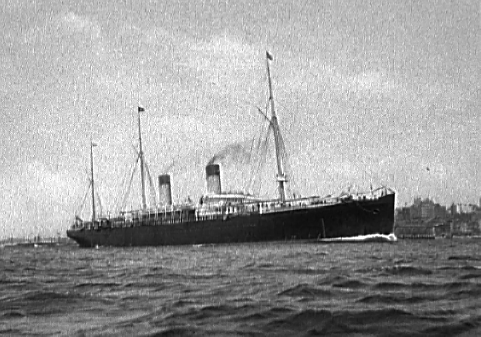
Photo:John S. Johnsten
wikipedia.org
LONESOME IRISH LASS
Had Only the Gaelic Language and a Shilling to Begin New World With.
A lonesome blue-eyed little Irish girl from County Galway landed the other day at the barge office in New York from the White Star line steamship Teutonic. She would not have been so lonesome if she had not been the only person in the ships company who had
no English. There was not a soul among all the Irish immigrants who could talk the Gaelic with her and she made herself understood by signs and smiles. She had so many of the latter
that she made friends of all the Irish aboard who all regretted for her sake that they were not of the stock that have regained a knowledge of the language of their fathers.
All the baggage the child had was a big valise and all the money she displayed to the inspectors was a bright I shilling piece. The interpreters tried to make out what was her object in coming to America. None of them succeeded. Then somebody recalled that
Peter Groden the barge office plainclothes cop was an expert in Gaelic. He was sent for and came in a hurry. There is nothing delights Peter more than talking Gaelic.
The girl opened her eyes when Peter began crooning to her in her only tongue. Then her smile broke out like a sunburst and she clasped her hands about Peters neck, greeting him as a cousin. Peter is not her cousin but she considered that anybody who could talk her language in America must be at least a cousin.
Peter was much impressed with the girl. She told him between smiles that she was Bridget Coughrey and that she was the eldest of five children. Her parents rent a farm at Clifden, County Galway for which they pay $80 a year. She had learned from letters in Gaelic written by her uncle, Patrick Coughrey of Plttsburg, that there was a chance in America for an energetic girl to make a good living and she had persuaded her father and mother to let her come to her uncle.
They said they would and the uncle sent her a ticket entitling her to passage from Queenstown to New York aboard the Teutonic. She told Peter that times were hard at Clifden and she expected to make enough by working in Pittsburg to pay a good part of the yearly rental of the Galway farm.
Peter took her over to the Mission of Our Lady of the Rosary at 7 State street and Father Henry took care of her She said that the buildings in the lower part of the town were much bigger and finer than any at Clifden or Cork.
Her uncle has been asked to send her fare to Pittsburg. He probably will but if he does not Bridget will be sent
to Pittsburg at the expense of the mission.
Claddagh v New Quay – 1844
COLONIAL TIMES (Tasmania) 5th November, 1844
EXTRAORDINARY OUTRAGE IN THE BAY OF GALWAY
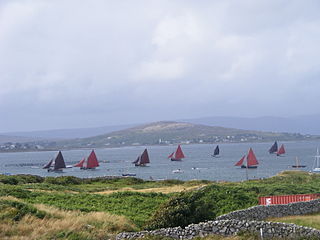
On Tuesday the 25th ult. while Mr. J. H. Hynes of New Quay, and the Rev Mr Fullam, Protestant clergyman, were out traul (sic.) fishing, with a crew of three men, in the Bay of Galway, a fleet consisting of 80 to 100 boats from the Galway Claddagh, bore down on them, and nine or ten of the boats having surrounded the fishing boat, 50 or 60 of the Claddagh fishermen suddenly boarded her, and after cutting away the traul, rushed on Mr Hynes and his party with the most awful imprecations and savage yells, armed with open knives, poles etc., knocked them down, beat them most unmercifully, leaving them apparently lifeless on the deck; they then cut down the sails, which along with the anchor, cables, ropes, poles and oars, they threw overboard. Finally they tore up the deck, and with the stones that formed the ballast, made many fruitless attempts to scuttle the boat, after which they departed, leaving her a complete wreck to drift along the sea; fortunately, she was rescued from her perilous situation by a New Quay boat, and towed into harbour.
An investigation was held on Monday at Correnrue (sic.), concerning this most daring outrage, before Messrs Bell and Kernan, stipendiary magistrates, and G. Macnamara, Esq J.P Harbour Hill. Although the lives of two of the crew and that of Mr Hynes were considered in imminent danger for four or five days, they are now supposed to be convalescent – Clare Journal.
Plague of…Locusts (?!)…Galway – 1689

https://widgetworld3.wordpress.com/podcasts/
The Sydney Gazette and New South Wales Advertiser 6th May, 1841
PLAGUE OF… LOCUSTS(?!) …GALWAY – 1689
According to the best account I can get of the swarms of insects which of late years have much infested the kingdom of Ireland, I find that this flying army was first taken notice of in the year 1688. They appeared on the south west coast of Galway, brought there by a south-west wind, one of the common, I might say, trade-winds of this country. From hence they made their way into the more inland parts, towards Bedford, a place belonging to George St. George, Bart., about twelve miles from the town of Galway. Here and in the adjacent country, multitudes of them showed themselves among the trees and hedges in the day time, hanging by the boughs, thousands together in clusters, sticking to the back of one another, as in the manner of bees when they swarm. In this posture or lying still and covered under the leaves of the trees or clinging to the branches, they continued quiet, with little or no motion, during the heat of the sun.
But towards evening or sunset, they would all arise, disperse and fly about with a strange humming noise much like the beating of drums at some distance and in such vast incredible numbers, that they darkened the air for the space of two or three miles square. Those that were travelling on the roads, or abroad in the fields, found it very uneasy to make their way through them, they would so beat and knock themselves against their faces in their flight, and with such a force as to smite the place where they hit and leave a slight mark behind them.
A short while after their coming, they had so entirely eaten up and destroyed all the leaves of the trees for some miles round-about that the whole country, though it was in the middle of summer, was left as bare and naked as if it had been in the middle of winter; and the grinding of the leaves in the mouths of this vast multitude, altogether made a sound very much resembling the sawing of timber. They came also into the gardens and destroyed the bulbs, blossoms and leaves of all the fruit tree, that they were left perfectly naked; nay, many of them that were more delicate and tender than the tree, lost their sap as well as leaves, and quite withered away, so as they never recovered it again particularly several trees in the curious plantation of one Mr Martin.
Nay, their multitudes spread so exceedingly, that they got into the houses, where numbers of them crawling about, were very irk-some; and they would oft to drop on the meat as it was dressing (sic) in the kitchen, and frequently fall from the ceiling of the rooms into the dishes as they were stood on the table while they ate – so extremely offensive and loathsome were they.
Their numerous creeping spawn, which they had lodged underground next the upper sod of the earth, did yet more harm in that close retirement than all the flying swarms of their parents had done abroad; for this young destructive brood, being underground, fell to devouring the roots of the corn and grass, and eating them up, ruined both the support of man and beast. This spawn, when first it gave sign of increasing every day, became a bigger worm, till at length it grew as big as a great white caterpillar; from whence according to the usual transformation natural to those smaller animals, came forth thus our flying insect.
The rage of this plague of vermin was fortunately checked several days. High winds, wet and mysting (sic.) weather, destroyed many millions of them in one day’s time.
Whence I gather, that though we have them in these southern moist climates, they are more natural, and more peculiarly belonging to warm and dry countries. Wherever these ill constitutions of the air prevailed, their bodies were so enfeebled they would let go their hold and drop to the ground from the branches where they struck; and so little a fall as this, at this time, was of sufficient force quite to disable, and sometimes perfectly kill them. Nay it was observable, that even when they were most alive and vigorous, a slight blow or offence would for some time hinder their motion if not deprive them of life. During these unfavourable seasons of weather, the swine and poultry of the country watched under the trees for their falling and ate them up in abundance, being much pleased with the food, and thriving well upon the diet. Nay I have been assured, that the poorer sort of the native Irish (the country then laying under a scarcity of provision), had a way of dressing them, and lived upon them as food.
In a little time it was found, that smoke was very offensive to these flies, and by burning heath, fern, and such like weeds, in this or that corner of their dardens or orchards which lay most convenient for the wind to disperse it among the trees, they would secure their gardens and prevent their incursions; of if they had entered, drive them out again.
Philosophical Transactions
Moving Bog – Village overwhelmed – 1909
Wikipedia.org
The Intermountain Catholic, February 27, 1909 p 6
VILLAGE OVERWHELMED BY VAST MOVING BOG
Details have just begun to reach Boston of a disaster in the west of Ireland, which in many respects has had no parallel in recent years.
Because of heavy rains and a severe frost, which was again followed by a thaw and more rain, a great section of a bog detached itself from the side of Mount Mary in County Galway and moved along silently in the night, overwhelming an entire village.
The people were all asleep and the first intimation they had of the disaster was the houses began to rock and move from their foundations. Some of the people, on trying to escape, found themselves waist deep in mud. The disaster came so suddenty and the bog moved with such rapidity that it was with the utmost difficulty that the people could get to safe ground, and in spite of all efforts one woman lost her life.
Cattle and livestock of all kinds were lost, and, or course, the people lost all their personal property. Ten houses were totally destroyed and fully 100 were damaged, some of them very seriously.
The latest accounts received in Boston state that 200 acres in the villages of Ballygar and Kilmore were covered with mud to a depth of twelve feet and that the bog is still moving, but much more slowly that at the outset.
The disaster attracted general attention in the west of Ireland.
Outfoxed! – 1898

Creative Commons
THE APPEAL, DECEMBER 24 1898 P3
Off the west coast of Ireland is a small Island where rabbits abound and when the tide is out the place may be reached by wading, the water being then only a few inches in depth. Two fishermen one day rowed to the island for bait, it being high tide, and on landing saw a fox lying on the beach. The fur of the animal was all wet and dirty, and he seemed to have been drowned.
One of the men, remarking that the skin was worth something, pitched the fox into the boat, and after they had returned to the mainland, he picked him up by the tail and threw him ashore. As soon as the cunning animal struck the beach, he jumped up and shot off like a flash among the cliffs, while the men stood staring at each other in mute astonishment. The men concluded that the fox had crossed over to the island during the night, while the tide was low, in search of rabbits, and finding in the morning that he was cut off from the mainland, he counterfeited death, with the expectation of getting a passage to the shore in a boat.
It may be that the fox was really stunned and almost drowned when found by the men, and had had time to recover on the way to the mainland; but the manner in which he jumped up and ran away the moment he touched land, indicated a clear case of “playing possum”.
National Bank 1907 – no cheques in Irish please

Wikipedia.org
THE INTERMOUNTAIN CATHOLIC JANUARY 26, 1907
A resolution passed by the Galway County Council condemning the action of the National bank for refusing to accept checks signed in Irish, has been adopted by several popular bodies in the country.
The Passing of the Shee – 1902
https://widgetworld3.wordpress.com/podcasts/
on Wikipedia.org
THE CATHOLIC PRESS SATURDAY 5TH APRIL 1902
THE PASSING OF THE SHEE
And did you meet them riding down
A mile away from Galway town?
Wise childish eyes of Irish gray,
You must have seen them, too, to-day.
And did you hear wild music blow
All down the boreen, long and low,
The tramp of ragweed horses’ feet,
And Una’s laughter, wild and sweet.
Oh, once I met them riding down
A hillside far from Galway town;
But not alone I walked that day
To hear the fairy pipers play.
They lighted down the kindly Shee,
They builded palace walls for me;
They built me boker, they built me bawn,
Ganconagh, Banshee, Leprechaun.
They builded me a chamber fair,
Roofed in with music, walled by air,
And, in its garden, fair to sight,
Green wallflowers, windflowers, brown and white.
Bouchaleen bree, if you should see
One riding with the happy Shee,
One with blue eyes and yellow hair,
Less light of heart than many there-
Ah, tell him I’m seeking still
Our fairy hold by fairy hill-
Following the fairy pipes that play
Over the hills and far away.
NORA HOPPER
The Banshee
https://widgetworld3.wordpress.com/podcasts/
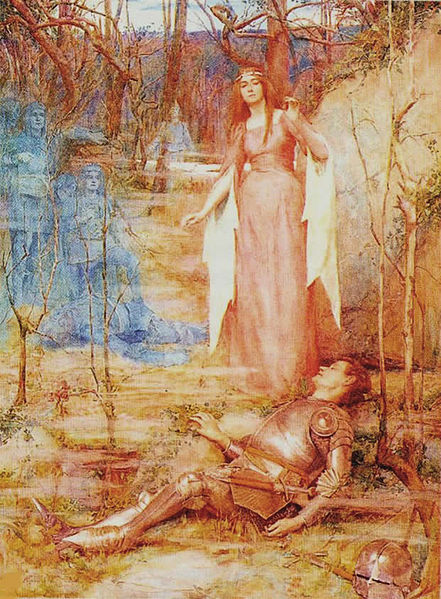
Henry Meynell Rheam (1859-1920)
THE BANSHEE
The single superstition of which every one has heard, and which is almost universal in Ireland, is of the banshee. Bean-sidhe is the Irish name for this wonderful creature and it literally means ‘the woman of the fairy mansions’. Her office is to announce a coming death. For several nights she appears, sometimes as a radiant maiden, sometimes as a decrepit old woman with long flowing hair, and wails her plaintive lamentations for the approaching death. If the death is to occur by natural ailment, the ‘keening’ of the banshee is simply measured and pathetic; but if accident or untoward calamity are to be associated with it, then her lamentations are loud and clamorous.
But she is easily disturbed and vexed, and if ever frightened away will never return during the same generation. This would be a calamity; for while the Irish banshee favors no particular class, cast or religion, she only comes to families of long and respectable line. She comes as a friendly spirit to these, not as an inimical one, and to be known as a family deserving and possessing her pathetic guardianship, is regarded as an honor of a very tender and sacred character. Many truly believe the banshee to be the spirit of some former member of the family.
Cor. New York Commercial Advertiser.
Emer
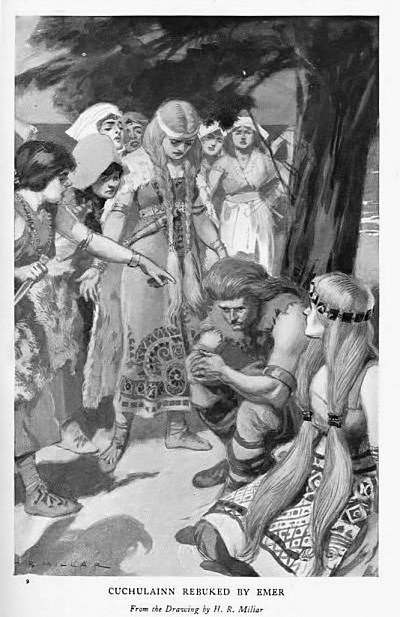
The only jealousy of Emer was Fand – a beautiful spirit who seduced Cu Chulainn and tried to coax him away with her. Fand was unsuccessful.
Emer is featured in the Ulster Cycle of Irish Mythology. My mum put a poster of her in our kitchen, just behind my chair. She was amazing … my mum – and Emer.
 The Burren and Beyond