
Photo: Teo Romera
Creative Commons
http://obrienclan.com/the-legends-of-maire-rua
FREEMAN’S JOURNAL 24TH FEBRUARY, 1927 P23
THE STRONG WOMAN OF THOMOND.
Maureen Rhua. THREE THOUSAND YEARS AGO.
Maev of Connacht is a name of light romance. For nigh a hundred years that strong untameable spiirit moulded and, perchance at times, marred the destiny of every notable life , that came under her influence.
To this day children are named Maev, gently nurtured children, to whose parents the Irish softness of the name appeals ; and the poetic remembrance the mists of ages have spread around the warrior Queen. Tradition tells us her hair was red — a flaming glory blent of copper and gold.
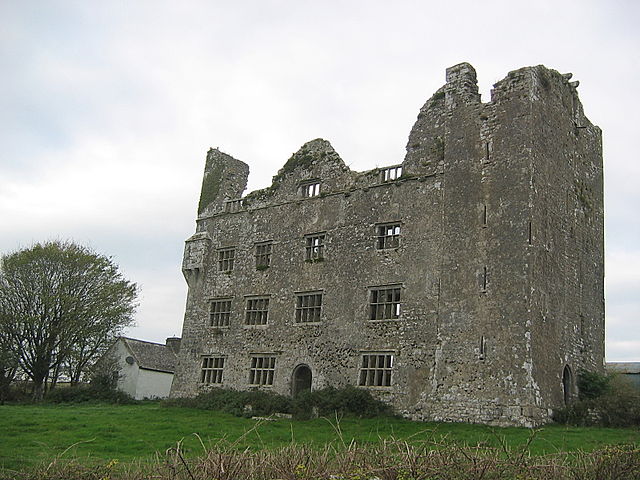
Of a much later date another red haired woman made of life a thrilling story, holding points of close resemblance to that of Maev. She lived in the earlier half of the ‘ Seventeenth ‘Century in that part of Clare where whole pages of Irish his tory are written in the stones. There are Cromlechs and forts scattered thickly around, telling of primitive strength and the human lust for supremacy. Cahercuttine (sic.) with walls of huge blocks of stone, 12 feet and more thick, and 10 feet high; another with part of it ‘veneered’ with- great slabs, and the great Doon, probably dating back to the days of the Firblogs, the Teach n’ennach, which was on a double sourced river, the Daelach, which rises thus in’ a hill north of the fort. To stand on it is to find poetry in the very names of the prominent places seen. Lisdoonvarna, Kilfenora, Liscannor Bay, where the At antic comes to be caressed by the shore of Ireland. -And across the limestone flats lies the ruined home of Maureen Rhua (Red Mary), the Castle of Lemaneagh or horseleap.
‘On lonely hills where the rabbits burrow,
Are forts of kings men name not now.’
On mountain tops I have tracked the furrow
And found in forests the buried plough.
For one man living the strong land then
Gave kindly food and raiment for ten.’
So do the lone hills of Ireland call wistfully to her children to arise and find again her sleeping resources; to make the places of burrowing rabbits yield food and raiment for men.
Lemaneagh, a ruined relic no doubt of the endless strife for the possession of Ireland, was a fine picturesque Tudor house, built on to a tall peel tower dating from 1480, the house a century later. Roofless, it showed triple pointed walls and very fine stone-mullioned windows, and the three stories and attics were still at the highest point lower than the ancient tower. A small courtyard in front was entered by a massive outer archway, bearihg two richly Carved coats of’ arms, the quarterings of Conor O’Brien- and of his son, Sir Donat O’Brien, 1690.
The worn letters below bore record that — ‘This was built in the year of our Lord 1643 by Conor O’Brien and by Mary ni Mahon, Nvife. of the said Conor.’ Gardens lay at either side, and a long fishpond fed by a little stream. The high surrounding walls had a turret at one angle and a house with niches beside the door. In this it was said Mary, wife of Conor, kept a ‘blind stallion,’ a horse of so fierce a temper that her grooms had to instantly hide in the niches when they opened the ,door to give the horse freedom. In the deerpark there is a fine cromlech, and the stone fort of Caherscrebeen lies close behind. The long avenue and still longer road named in several places ‘Sir Donat’s Road,’ tell mournfully of greatness not so long gone, greatness that had kinship with those who built the forts and raised the cromlechs, but for whom it was unwise to dwell in Tudor houses and defy the results of Tudor supremacy.
Mary was the daughter of Sir Turlough MacMahon, and she belonged to a time when English influence and Iris determination were constantly clashing.
Murrough, the first Earl of Thomond, gave Lemaneagh and Dromoland to his third son. That was in 1550; and thirty tNvo years later this son, Donough, was hanged in Limerick under martial law. It was one of the times when English supremacy over-reached itself. Donough’s little son could not be disinherited be cause his father died under a military sentence. When he died, however, in 1603, Lord Inchquin made a claim to the castle through some transaction made with Perrot several years previously. This claim, however, was not pressed for twenty years, and then un successfully.
Conor O’Brien had a strong hand to aid him in his wife Maureen Rhua. Many a strange tale has been told of her raids upon the English, and one Gregory Hickman made depositions in 1642 that: ‘Conor O’Brien, gentleman, in a most rebellious manner seized upon the deponent’s corn’; and, later, ‘Conor O’Brien, of Lemaneagh, accompanied by Mary Brien’ (and others) ‘with force of arms came to the deponent’s house and took away fourteen English swine and a parcel of household stuff; also 400. sheep.
Small wonder the Tudor house has been roofless and lone this many years. Yet, Red Mary was a dauntless soul,, not tender-hearted— but who now may say what hammer blows hardened her on the anvil of her time? Conor, mortally wounded in a fight with General Ludlow, was carried home. From a window Mary saw what she thought was a corpse, and cried out: ‘We need no dead men here,’ but, finding that life lingered in her husband she cared him tenderly enough till evening, when he died. The strait she was in spurred her courage. Donat, her son, at least was dear to her. Donning her bravery of ‘magnificent blue velvet and silver,’ she drove to Limerick and sought to make terms through surrender to Ireton. He doubted her truth, and did not believe Conor was dead. As proof she said: ‘I will marry any of your officers that asks me. ‘
Not without courage, a Cornet Cooper proposed, . and they were married the same day, and the castle and lands were saved for her son, Sir Donat O’Brien. Strength breeds stories, and many a wild tale is told of this ‘ masterful woman. ‘ The gentle benignity of her name found no counterpart in her char acter; it is said that she killed the fool hardy Cornet with a kick because he ventured to make some adverse remark about her late husband. Tradition gives her many husbands,’ and to few of them a natural death. She also sought to close a right-of-way for the people of Burren, but Terence O’Loughlin, of a neighboring castle, broke her gates and kept the way open; and she is said to have hanged all her men servants by their necks, and the women servants by their hair from the corbels of Lemaneagh, probably, if true, because they were not able to enforce her will.
It may not also be true, that she was finally enclosed in a hollow tree at Carnelly and left to starve. The tale of her. ghost along the tree-shaded ave nue Avas long believed. Her portrait shows a strong, plain, red-haired woman, with rather coarse features and a fierce mouth, wearing curious ornaments, one, a pendant, very like a. bit of carving at Clonfort, and a celebrated Italian jewel. The pendant was shaped like a mermaid.
Where, I wonder, is it now? Not so very long ago Maureen Rhua lived, and little is left of all she fiercely strove for. She is but a link in the great chain of history.— H.C.M., in ‘Irish Weekly.’
Category: Posts and podcasts
Posts and Podcasts
Carrying the Kelp – excerpt – 1912
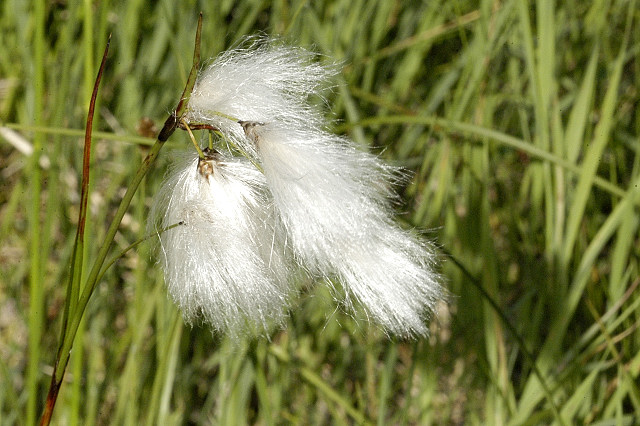
Photo: James K. Lindsey
Wikimedia Commons
THE QUEENSLANDER 25th of June, 1912
Excerpt from The Carrying of the Kelp by Helen Porter (in “Chambers Journal”)
The district known as the Burren is one of the bleakest spots in Ireland. The whole country seems petrified, as if a devastating blast from the Atlantic had turned it into stone. Then, nature appears to have repented her roughness and the cold monotony of her hand-work; for, after laying a groundwork of rocks, she covered it with a carpet of exquisite and delicate loveliness. Feathery fern, autumn-tinted bramble, golden moss, geranium, harebells, and blue scabious run riot over all, and in the damp patches between the grey stones, silvery bog cotton waves in the breeze…
Bananas from Galway – 1907
Wikimedia Commons
THE CATHOLIC PRESS 17TH JANUARY, 1907
HOW THE WORLD WAGS
Irish Bananas.
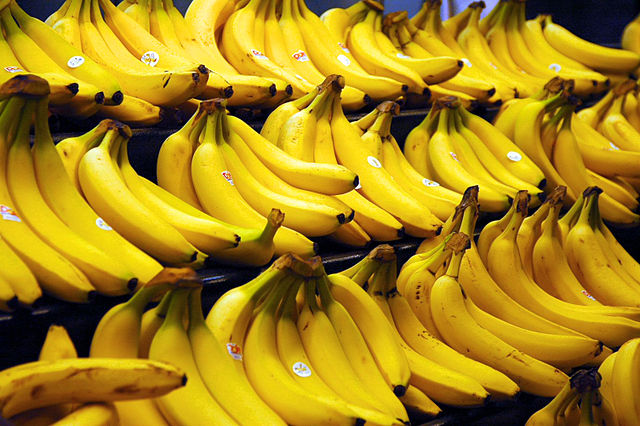
In the Dublin Corporation Fruit Market last month, the first consignment of Irish-grown bananas will be offered for sale. They were grown in County Galway, and are said to have surpassed the foreign kind for sweetness and flavour.
Rooks – Cholera – 1831/2
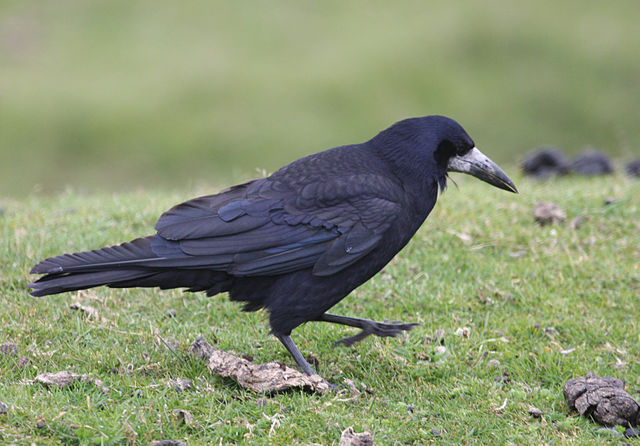
Photo: Brian Snelson
Wikimedia Commons
THE NEWPORT MINER 24TH NOVEMBER, 1910 P4
ROOKS AND CHOLERA
The present day security of this country against all danger of a cholera epidemic is matter for thankfulness not only in human circles, but in the rookeries too. When the cholera slew nearly 60,000 people in the insanitary United Kingdom of 1831-2 the rooks appear to have suffered with them. This was stated, at any rate, to have occurred on the estate of the Marquis of Sligo, which boasted one of the largest rookeries in the west of Ireland. On the first or second day of the epidemic’s appearance an observer noted that all the rooks had vanished.
During the three weeks through which it raged there was no sign of them about their home, but the revenue police found immense numbers of them dead on the shore, ten miles away. When the epidemic abated the rooks returned, but some were too weak to reach their nests, and five-sixths of them had gone. London Chronicle
Riders of the storm – 1912
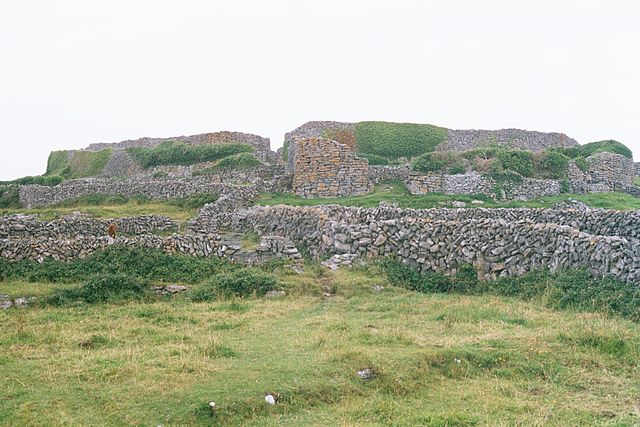
Photo: Eckhard Pecher
Wikimedia Commons
HOPKINSVILLE KENTUCKIAN 14TH MAY, 1912 P3
HEARD ONLY CALL OF DUTY
Brave Irish Physician Scorned Danger when welfare of patient was at stake.
The talk of how Dr. O’Brien of Innismore braved the Atlantic storm to help a sick patient has made all the western Ireland ring with his praises.
He received a wire that his services were urgently needed on the island of Innismaan, but the storm was raging so fiercely that he had difficulty in finding a crew willing to put to sea. At last he succeeded and the corragh (sic.) – a small canvas boat – started on its four and a half mile journey through the surging waters that ran with terrific force between Innismore and Innismaan.
It was a life and death battle all the way, half the men striving to keep the boat headed across the straits while the rest bailed out the water that was continually shipped. At length Innismaan was reached, the patient’s life was saved and the return journey began.
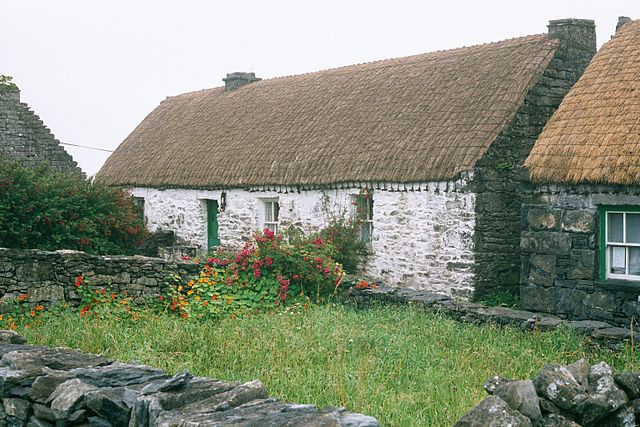
Photo: Eckhard Pecher
Wikimedia Commons
Galway cheek – 1913
EO’D
CHEEK (abridged)
“Cheek” in the sense of impudence is an old term. The earliest quotation in Sir James Murray’s dictionary is from Captain Marryat (1840). But it has lately been found in the sixteenth century records of Galway, in the west of Ireland. The municipal rulers decreed that any person giving “cheek” to the mayor should “forfeit 100 shillings and have his body put in prison”.
Extreme pilgrimage – 1905
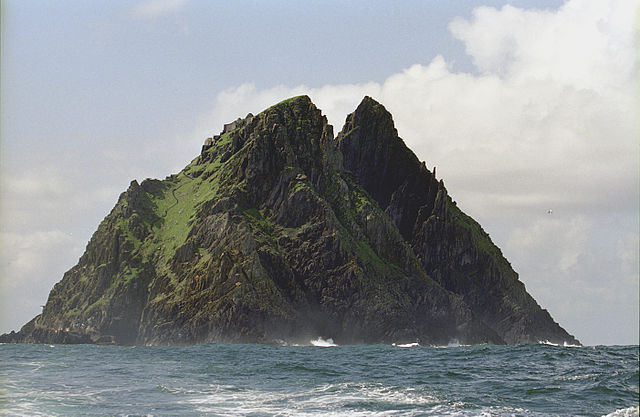
Photo: Jerzy Strzelecki
Wikimedia commons
Daily Press, 5th March 1905 P5
IRISH PILGRIMS TO THE SKELLIG ROCKS RISK THEIR LIVES
Ten miles off the coast of Kerry, in the west of Ireland, lie the Skellig rocks, one of which has been for years the scene of a difficult penance. A zig-zag path leads up some 700 feet to a lighthouse, but 700 feet more must be climbed before the summit is reached, where stand the ruins of St. Finian’s monastery and a cross of St. Michael.
Here on the anniversary of St. Michael devotees risk their lives in performing their devotions. First they have to squeeze themselves through the Needle’s Eye, a tunnel in the rock thirteen feet long, the passing up which is like the ascent of a chimney. Then they creep on all fours up the Stone of Pain, on whose smooth surface one false step is fatal: then, getting astride the Spindle, a rock 1,500 feet above the Atlantic and projecting some ten feet, each pilgrim must “ride a cock horse to St. Michael’s cross,” say a Paternoster and shuffle back as best he can.
Pearson’s weekly.
Slán agus beannacht Dé Libh – 1863
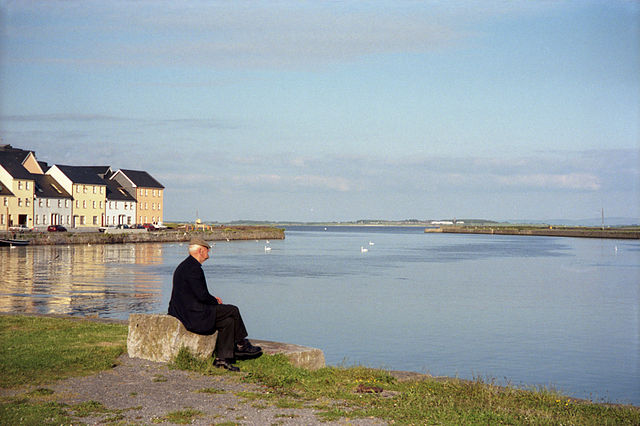
Photo: Greg O’Beirne
Wikimedia Commons
THE IRISH EXODUS
(From the London Times – October 30th) – ABRIDGED
On Monday night there steamed into Galway Bay a very large ship, with some goods on board, about three hundred steerage passengers, and a select party in the cabin. Under the protection of the Isles of Arran, thirty miles off, and favored by wind and tide, the ship steamed up to an anchorage on the safe side of a small island, on which stand a lighthouse and a battery, and thence, by means of a steam tender, communicated with the port of Galway…
Besides the four hundred steerage passengers and the twenty-three sacks of letters, she took in at Galway two puncheons of whisky and the latest telegrams…
But putting out of the question that desolate waste of waters, that strange old medieval city, its still stranger suburbs, the twenty-three sacks of letters, the twenty-eight cabin passengers, the latest telegrams, and the two puncheons of whiskey, out and out, beyond all comparison, the most important article in that departure from Galway Bay were the seven hundred steerage passengers.
They were robust, healthy young people; very few of them married; what people used to call the “sinew and bone” of a country…
This is a fact which overrides every other Irish question. The current, in every town and village, every street, every family, every breast, has set in, and it is beyond the power of Governments, of laws, of priests, of politicians, to do more than just lash and disturb the great tide of emigration… there is scarcely a cottage in the west of Ireland where the promise of the family, the elder sons and daughters – their voices and their features still fresh in memory as young and old gather round the turf fire – are now in some far Western State, sending home their hearts’ best wishes for the reunion of the circle.
While writers at home are angrily debating what is to be done with the Irish, they are fast settling the question for themselves by a universal departure.
Home
Wikimedia commons
THE INTERMOUNTAIN CATHOLIC 24TH NOVEMBER, 1906 P2
HOME SWEET HOME (abridged ) J.J. Fleming, Allegheny P.A
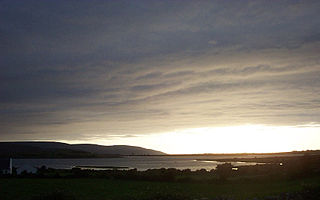
I love to be in Galway when the tide breaks on the shore,
And the silver mists are rising from the lea.
When the summer sun in brightness lights the valleys all around.
And nature’s jewels are sparkling, I can see
The little old thatched cottage and the ivy creeping round,
And the skylark thrilling in the vaulted dome;
Among quiet nooks and dells fairy music softly swells,
I love to be in Galway, “Home Sweet Home.”
All the way to Galway – 1926
DIDSBURY PIONEER 7TH OCTOBER, 1926 P2
CLAIMED BY IRELAND
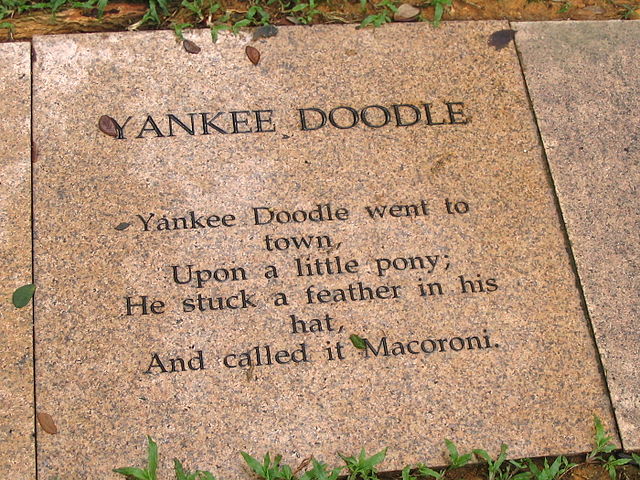
British National Anthem and “Yankee Doodle,” Old Irish Tunes.
“Yankee Doodle” is not American at all – it’s Irish, according to Dr. Grattan Flood, an Irish authority on musical history. He asserts that “Yankee Doodle” was originally an Irish Air known as “All the way to Galway,”
“God Save the King,” the British national anthem, Dr. Flood says, also is an old Irish tune which originated about 1595 and has been going strong ever since.

