Photo: Gregory David Harington Creative CommonsTHE IRISH SLAVE TRADE – THE FORGOTTEN ‘WHITE’ SLAVES
JOHN MARTIN
GLOBALL RESEARCH JANUARY 27 2013
oped news and global research 14th april, 2008(abridged)
African slaves were very expensive during the late 1600s (50 Sterling). Irish slaves came cheap (no more than 5 Sterling). If a planter whipped or branded or beat an Irish slave to death, it was never a crime. A death was a monetary setback, but far cheaper than killing a more expensive African. Masters quickly began breeding the Irish women for both their own personal pleasure and for greater profit. Children of slaves were themselves slaves, which increased the size of the master’s free workforce. Even if an Irish woman somehow obtained her freedom, her kids would remain slaves of her master. Thus, Irish mothers, even with this new found emancipation, would seldom abandon their kids and would remain in servitude”.
Photo: André Karwath Wikimedia CommonsThe Times
London, Middlesex, England
October 25, 1788
Cyder is so cheap this year, that on the condition of giving two hogsheads, in either the counties of Limerick or Waterford, one of them is filled (or tilled) land given in return for the other. Cyder is certainly an healthy beverage, but should not be drank too fresh, or in great quantities. It is known by experience that those who drink nothing but this liquor, are stronger, more healthy, and look better than those who drink wine; of which Lord Bacon gives a remarkable instance of eight old people, who were near, and others above one hundred, who during their whole lives drink nothing but cyder, and were so vigorous, that they danced and jumped about like young men.
Ballinderreen Wikimedia CommonsGalway County Council Archives ‘…to acquire, preserve and make accessible the documentary memory of county Galway’ U:\Archives – Collection Management\Descriptive Lists\Rural District Councils, G00 & G01\G01-10 Gort RDC.doc
17 December 1910 – 17 June 1922 p9
‘Resolved – That we disapprove of the action of the County Council in endeavouring to change the route proposed by the Road Board from Kinvara to Kilcolgan (through Ballinderreen) and having it changed in another direction from Kinvara to Kilcolgan (through Ardrahan) as we believe the former road is through a congested area, and by the sea, would be more frequented by tourists, and would be the better road to have steam rolled as it is the mail road between Galway and Clare through Ballyvaughan’ (p122).
Wikimedia CommonsNAI REFERENCE: 10 Jun 1822-3 Jul 1822
NAI REF: CSO/RP/1822/348
ORIGINAL REF: CSORP1822/857 (abridged)
The Registered Papers of the Chief Secretary’s Office (National Archives) includes a letter
‘from Alexander Nimmo, civil engineer, Dublin, to Alexander Mangin, clerk, Civil Department, Dublin Castle, offering observations respecting implementation of public works schemes in region of Connemara, County Galway: also indicating intention to report on a road at Kinvarra, with a view to making repairs, as proposed by Arthur St George…’
Wikimedia CommonsEducation in Kilmacduagh in the 19th Century
Parish:Kinvara
Description of School: Hedge School at Killina, kept by James JOYNT
Sources of support: Payments by the children
Number of children on roll at time of inspection: No list produced
Average daily attendance: about 50
Increasing, stationary, diminishing during last 5 years: Established 12 Jan 1835
Kind of instruction: Reading, writing, arithmetic, catechism
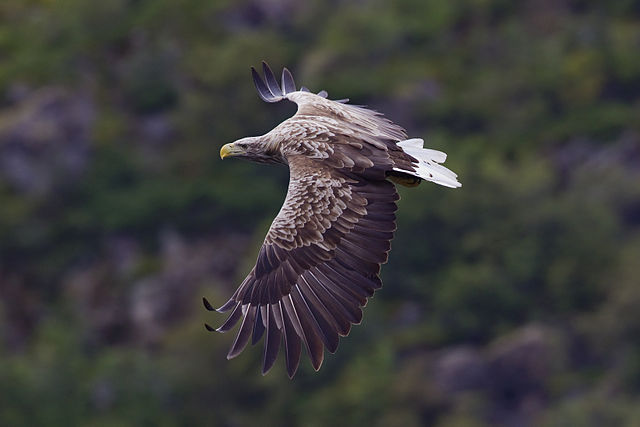
White tailed eagle Photo: Yathin S. Krishnappa Wikimedia Commons The Cornwall Chronicle 11th June 1842
THE SEA EAGLE (abridged)
The process of catching birds on the Cliffs of Moher goes on to a great extent in the summer months. It is often attended with great danger. To defend themselves against the formidable sea eagles the men carry long knives. Some six or eight years ago there was an encounter between a bird catcher and a sea eagle which nearly proved fatal to the former.
The man had been lowered from the top of the cliffs and hung suspended from the overhang when an eagle darted at him from out of a fissure in the rock. It commenced a furious attack. The bird catcher drew his knife and defended himself as best he could but the eagle was swift, deadly and persistent. Finally, he dispatched the bird. However the stroke that freed him from the creature also struck his rope nearly severing it. The unfortunate man was left suspended by a single twist of coil over the yawning abyss.
His friends above had perceived this predicament. Slowly, and with the greatest of caution they commenced pulling him up. It required the utmost skill to keep the fractured portion of the rope from chafing against the sharp edges of projecting rocks and snapping completely. The men on the cliff were in a state of anxiety scarcely less than the man beneath.
The rope snapped within an inch of the top, but not before one of the men had seized a firm grip of their friend’s clothing. They were able to drag him to safety. The awful situation was too much for the bird catcher; he lay stretched on the grass without sense or motion. So profound and lengthy was his insensibility that his companions thought he was dead.
It is said he has never completely recovered from the effects of that fearful hour.
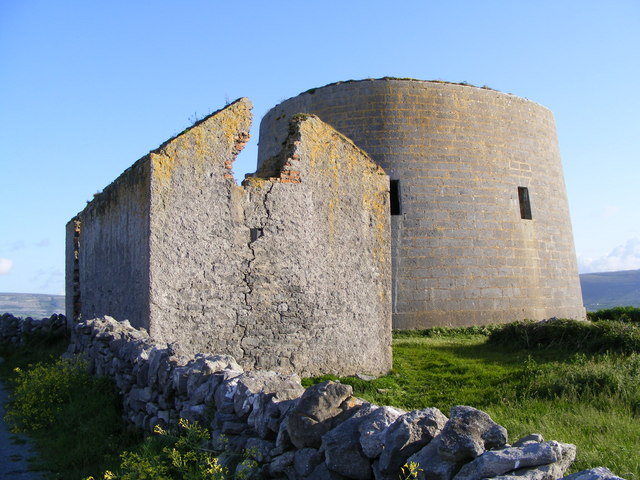
Finavarra Martello Tower at Finavarra Point, County Clare, Ireland A McCarron Wikimedia CommonsQUEENSLAND TIMES 28TH NOVEMBER, 1863 abridged
Owing to the great revolution which has taken place in war material, both for naval and military purposes, it has been decided to reconstruct (sic.) a great many of the martello towers around the Irish coast, it having been found from experiments with the Armstrong guns against similarly constructed towers in some parts of England, that they are entirely useless as works of defence.
At a late inspection of all the fortifications in Ireland, it was found that in some parts of the coast some of these towers were manned, armed, and kept in a state of repair at great expense to the public. As much from their position as from their useless construction, they were quite incapable of rendering the slightest service, either offensive or defensive. Consequently the whole of the towers in Galway Bay, also the tower and battery at Drogheda, have been dismantled, and the guns, stores, and artillerymen withdrawn. The buildings have been taken posession of by the the Barrack Department. We believe it is in contemplation also to withdraw the guns and stores from the towers in Dublin Bay, north and south.
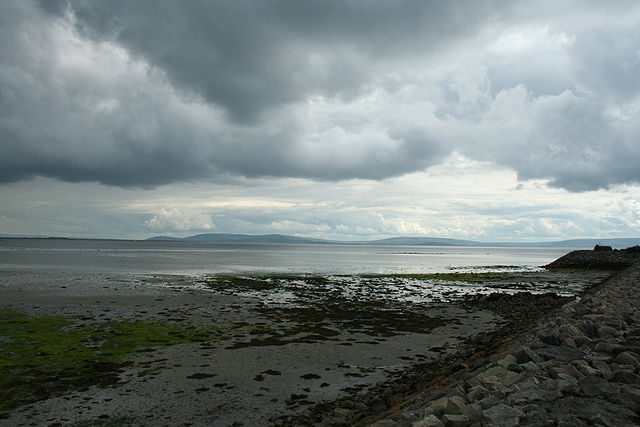
Galway Bay from Salthill Photo: Peter Clarke Wikimedia CommonwIRON COUNTY RECORD 7TH MARCH, 1913
“Cheek” in the sense of impudence is an old term. The earliest quotation in Sir James Murray’s dictionary is from Captain Marryat (1840). But it has lately been found in the sixteenth century records of Galway in the west of Ireland. The municipal rulers of that city decreed that any person giving “cheek” to the mayor should “forfeit 100 shillings and have his body put into prison.”
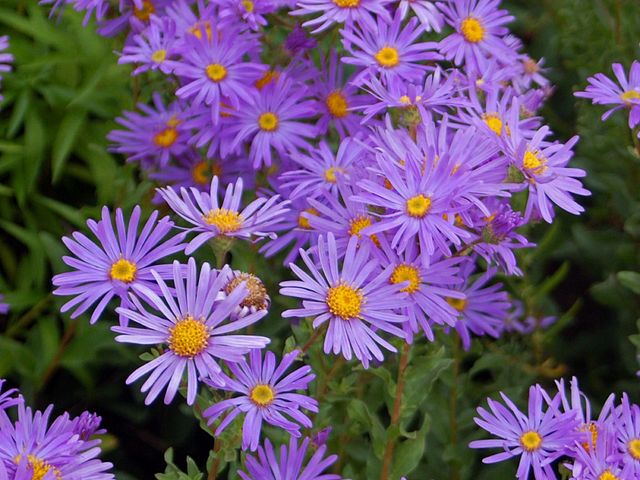
The Minneapolis Journal 14th March, 1905 p10 Aster amellus Wikimedia Commons
Kerosene emulsion, frequently and liberally applied will prevent black lice from injuring your asters. I have got rid of them many times by showering the plants and dusting tobacco dust over them.
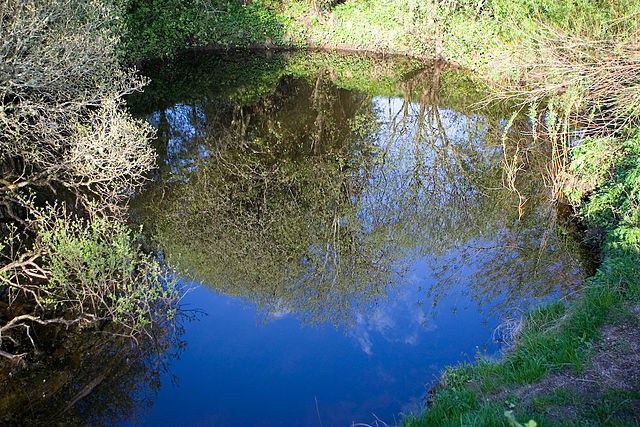
The Shannon Pot – traditional source of the River Shannon Photo: Gerard Lovett Wikimedia CommonsTHE SALT LAKE TRIBUNE 27TH MARCH 1910 P5
Ireland has had her share of floods and can sympathize with France. Along the Shannon in some places the water invaded the country for miles at each side, compelling people living near to hasten from their homes. In one or two places the inhabitants of entire villages sought shelter elsewhere. Some of these people suffered great loss as their entire farm produce was swept off on the swollen river. So great was the flood that the powerful cargo boats could scarcely make headway.
The district near Athlone suffered much and a considerable number of men were thrown out of work. The greatest sufferers are the inhabitants of the islands in Lough Ree, where the water rose to an alarming height. They were completely cut off from the mainland for days and unable to obtain supplies of food or fuel.