Posted in Posts and podcasts

A peculiar fascination – 1907

Nenagh News 17th August, 1907p3    (abridged)

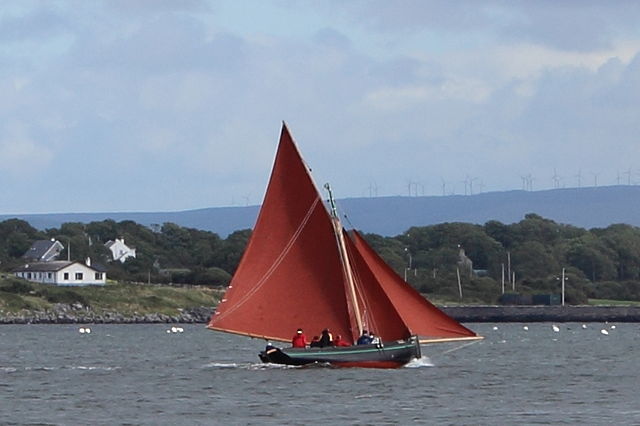
Hooker at Kinvara Photo: Cqui Creative Commons
Hooker at Kinvara
Photo: Cqui
Creative Commons

To witness an ordinary sailing open boat, built-in tonnage to ply between Connemara and the coast of Clare, a distance of about 60 miles, ploughing the waves in the full breeze of ordinary sailing weather,  is a novelty to the visitor or tourist uninitiated in the art of steering or sailing such a craft. There is something very taking in this style of sailing boat, away from the ordinary sailing yacht.

The boat is locally known as a hooker, rigged with mast and bowsprit, and carrying a reddish-brown suit of three sails, a jib, foresail, and mainsail, comprising over one hundred square yards of fine canvas. This style of boat, with all sails set to the Atlantic breeze, presents a very picturesque appearance, ploughing the surging waves, tacking and retacking to gain the point of destination against a head wind, bending to the breeze, with the hull of the boat disappearing at intervals between mountain waves, to reappear again on the surface, soon again to be engulfed in a valley of sea with sails trailing along the waters in obedience to gusts of strong wind, and the sea rolling in a grand curl high over the weatherboard, with nothing to keep it from engulfing the open boat but the speed of the boat itself, and the skill of the seamen to keep the rudder, sails and boat in touch with the motions of the wind and seas.

To see this entire stretch of sea strewn with every style of sailing boat crossing and recrossing each others paths in a regular breeze is a sight one could never tire of seeing and admiring. There is a peculiar fascination about sailing in open boats or decked sailing yachts of any description, that one feels uncomfortable in the stately steam or motor vessel from the loss of excitement experienced in open sailing boats and rolling sea.

Posted in Posts and podcasts

Kinvara Courthouse – 1939

Connacht Tribune 30th September, 1939 p23 (abridged)

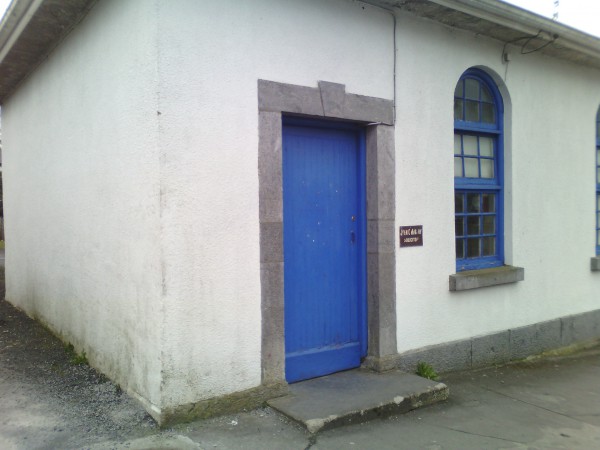
Courthouse, Kinvara Photo: EO'D
Courthouse, Kinvara
Photo: EO’D

At their weekly meeting in the County Buildings, Galway on Saturday, Mr Martin Quinn, chairman, Galway County Council finance committee, gave the tenders for repairs to the Kinvara courthouse to Mr Patrick Burke, Ballinderreen, Kilcolgan at £39. Mr G. Lee, county surveyor, reported that Messrs, Griffin Brothers, Gort, who had tendered at £28.15s were not prepared to carry out the work at that figure as they had made a mistake in the matter. Recently the County Council secured a long lease of the Kinvara Courthouse.

Posted in Posts and podcasts

The hills of Clare – 1922

Sunday Independent 18th March, 1922p8

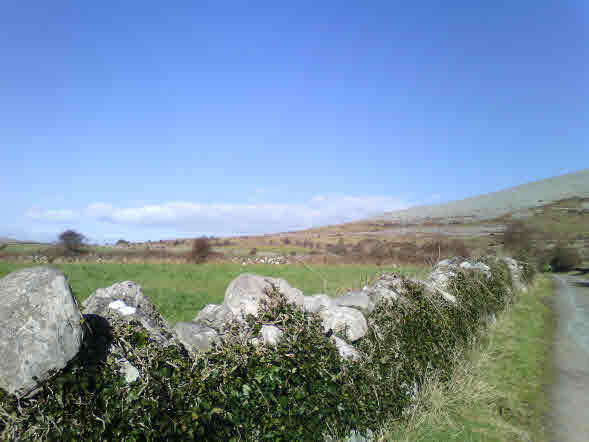
The Burren Photo:EO'D
The Burren
Photo:EO’D

The prize of half-a-guinea for the best poem this week to “Irish Verse,” is awarded to Liam P. Clancy for his “Hills of Clare.”

Och, drear and lone this London is,
And cold and bleak and bare,
And day and night I’m missing still
My own beloved Clare.

I miss the mountains hid in mist
When skies are dawning grey,
And, in the valleys shadow-kist,
The hush at heel o’day.

I miss the low wind’s lonesome croon
In the winter drear and long,
I miss the trill of the thrush’s tune,
The lilt of the blackbird’s song.

There’s grandeur here and wealth untold,
And mansions proud and fair,
I’d give them all – their gloss and gold –
For a hut on the hills o’Clare.

I miss the cross-road dances gay,
The laughter, light and loud and free
Och, here it’s lonesome, long’s the day,
Here is no place for me.

Then I’ll be going where my heart is set
‘Mid heath-blooms fresh and fair,
Where the gold-lights glow in the dawn dew-wet
On the gorse-gilt hills o’Clare.

Posted in Posts and podcasts

Mr Thomas P Corless – 1911

Connacht Tribune 17th June, 1911 p.8 (abridged)

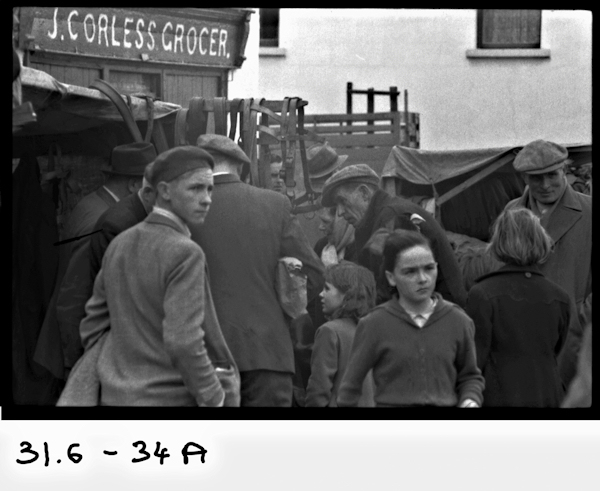
Fair Day, Kinvara c1950s Cresswell Archives
Fair Day, Kinvara c1950s
Cresswell Archives

When the news reached Kinvara on Monday evening that Mr Thomas P Corless, president U.I.L headed the poll for co-option at the annual meeting in Gort, the greatest enthusiasm prevailed. A huge tar-barrel was set ablaze in the Square, and from the top of Newtown castle a great blaze could be seen for miles around.

In the patriotic village of Crushoa a similar scene could be witnessed, and Dungora castle had a number of fires lighting on every side, which showed how the people appreciated the act of the District Council.

Posted in Posts and podcasts

A fair point – 1907

Nenagh News 17th August, 1907 p3 (abridged)

Kinvara Photo: BO'D
Kinvara
Photo: BO’D

About one hundred thousand pounds of the estimated two and a half millions annual over-taxation of Ireland would build a small link of railway between Ardrahan and Ennistymon by Kinvara, New Quay, Ballyvaughan and Lisdoonvarna and throw open to the public the enjoyment of the open sea and means of transit for the famous Burren oysters, Redbank oysters and Pouldoody oysters, whose banks are along this particular section of the coast of Clare, particularly New Quay.

Posted in Posts and podcasts

Kinvara – the best barley – 1902

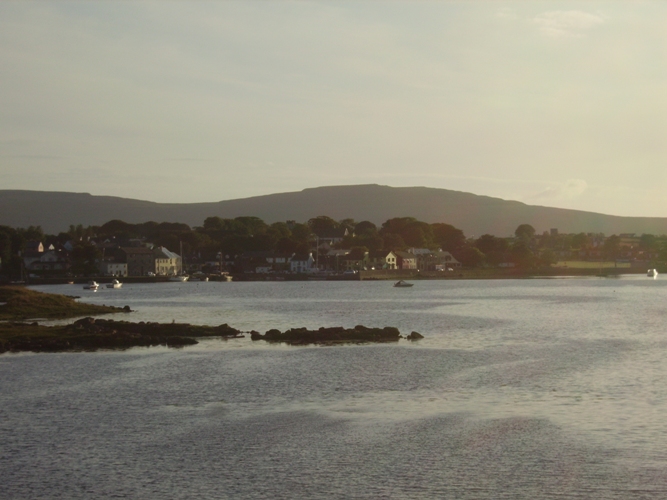
Kinvara Harbour    Photo: BO'D
Kinvara Harbour Photo: BO’D

Freemans Journal October 2nd, 1902 p13 (abridged)

It may not be generally known that the largest barley markets in Ireland are carried on at Kinvarra. Throughout yesterday and today business in the barley market has been in progress. From four to five hundred carts of barley arrived yesterday and were disposed of, and about the same number today. Yesterday some hundred tons of the corn were taken by an agent at Ardrahan Railway Station for the Dublin distillers.

Mr W. H. Persse, of the Galway Distillery, who attended the market, accompanied by a large staff of men, loaded a ship with two hundred tons of barley at sixteen shillings a barrel. The loading of another vessel for the same gentleman is going on today and the carts of grain are coming in hundreds.

The barley markets were established in Kinvarra thirty years ago by the late Mr H.S. Persse, founder of the Galway Distillery, because the place is so centrally situated and the climate and soil of the district were found to be most favourable to the growth of barley. After various experiments, it was proved that Webb’s Kinver Chevalier barley gave the finest results and the grain grown in the district about Kinvarra is held to be the best in Ireland.

Posted in Posts and podcasts

Irish Fairy Tales – 1893

Freemans Journal 1st November, 1893 (abridged)

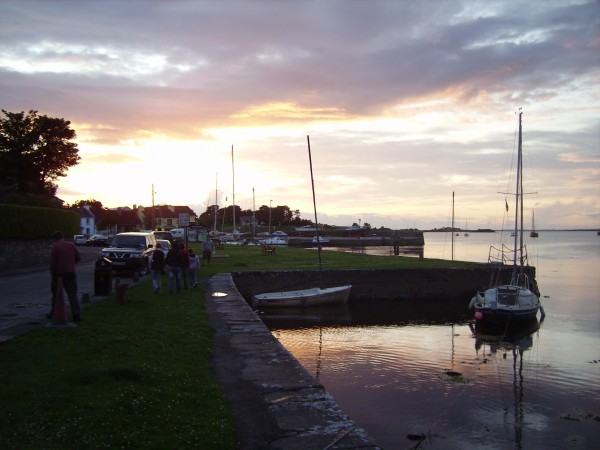
Kinvara Twilight Photo: BO'D
Kinvara Twilight
Photo: BO’D

Mr W. B. Yeats delivered an interesting lecture on “Irish Fairy Tales” at 15 D’Olier Street last evening, under the auspices of the Young Ireland League. Mr Henry Dixon presided.
Mr Yeats, who was received with applause,  said that night was sacred to the fairies in general and to the phouca in particular. The phouca sometimes appeared as a horse, sometimes as a donkey, sometimes as an eagle and, indeed, took innumerable four-footed and two footed shapes.

The night of Samhain in old Pagan days was the commencement of winter, over which presided the phouca, whom the people considered the spirit of decay. They believed it was dangerous to go abroad on that night because the fairies might carry them off into their kingdom.  That night also the dead were believed to come out of their graves and ride upon the white sea waves, and there were stories of fishermen, who, having escaped the waves and come ashore, found the dead grasping them from behind.

Mr Yeats related a number of interesting fairy tales and said that folklore afforded the most beautiful material for literature and they could not do better than encourage people to use it for such. Every country in the world had these beliefs and universal belief like that meant some universal need for it. If there was not deep down in the human soul some need to think about imaginary beings more beautiful and more powerful than the men and women they met in ordinary life, these things would not have arisen.   Forelore gave a beautiful and most ample expression for their vast emotions –  emotions which were always struggling to express themselves but were beaten down by the sordid interest of real life.  Poets were folklorists who had listened to the voice of the people.  They had taken the stories of the old men and women and had made them the delight of the most profound minds of all nations.

Posted in Posts and podcasts

Burren – 1847

Nation 27th November, 1847 p.13

The Burren, and beyond Photo: BO'D
The Burren, and beyond
Photo: BO’D

Seventy labourers, with their families, employed on works of reclamation by Mr P. Creagh in Burren, County Clare, have employed a clerk or storekeeper to distribute or re-sell provisions to them without any profit, under the surveillance of a committee of management from among themselves, thus making a saving of about 30 per cent.