Early this morning, the General, the Duke of Wirtemburgh and Lieutenant-General Scravenmore, with all our horse and dragoons, ten regiments of foot, taking with them seven day’s provisions and fourteen guns; ten three pounders and four twelve pounders, marched over our bridge of boats into the county of Clare.
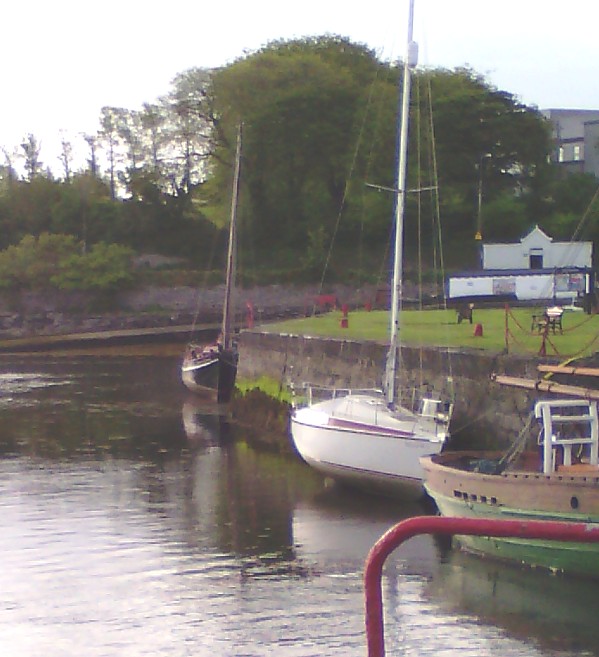
Photo: EO’D
Kinvara notes;
Kinvara lost its primacy as a bishopric, the old see of Kilmacduagh was united to the modern see of Galway. It then lost its shipping trade. The old landlords, the Gregorys of Coole Park, and the De Basterots were obliged to sell out.
Mr Comerford, a timber merchant in Galway bought Kinvara from Mr Gregory and raised the rental from 335 to 1,150 but it did not and could not survive with him or his successors. A Mr Murray, a pawnbroker in Galway, came along and was equally active in promoting depopulation. The townland of Northampton decreased from 25 families to 11. Mr Murray however left a bequest of 2000 for a convent and to him Kinvara owes its present beautiful foundation built on a site given by Captain Blake Foster. Kinvara was once a thriving market town but its tolls declined from 200 to 60. It had in 1872 a population of 689 families and 1889 this sand to 451. Its barley market for Persse’s Distillery in Galway brought in a good deal of money but Persse’s Distillery having been closed down owing to the narrow policy of the Bank of Ireland, that industry was lost to Galway and Kinvara.
Father Francis Arthur assisted in the escape of John Blake Dillon to America. Kinvara man, John Holland brought Dillon to Aran.
The tenants on the O’Donnellan Blake Foster Estate held a meeting in Kinvara in October 1919 to arrange terms for purchase with the agent, Mr Holmes. The Rev Father Burke P.P. Kinvara put the tenants’ case before the agent, with the result that 18 and a half years was agreed upon as the sale price. The reduction which the tenants have obtained through these terms amounts to 8s in the pound or 40% on their present rents
Freeman’s Journal 12th September, 1829 p 4. (abridged)
We went to Lady Honor O’Brien’s; she was the youngest daughter of the Earl of Thomond – there we staid three nights; the first of which I was surprised by being laid in a chamber, when about one o’clock I heard a voice that awakened me, and I drew the curtain. In the casement of the window I saw by the light of the moon a woman leaning into the window, in white, with red hair, and pale and ghostly complexion. She spoke aloud, and in a tone I had never heard, thrice, “a horse” and then she vanished. To me her body looked more like a thick cloud than substance.
I was so much frightened that my hair stood on end and my night-clothes fell off. I pulled and pinched my husband, who never woke during the disorder I was in; but at last was much surprised to see me in this fright; and more so when I related the story and showed him the window opened.
Neither of us slept any more that night, but he entertained me with telling me how much more these apparitions were usual in this country than in England. We concluded the cause to be the great superstition of the Irish and the want of that knowing faith which should defend them from the power of the devil, which he exercises among them very much.
About five o’clock the lady of the house came to see us, saying she had not been in bed all night because a cousin O’Brien of hers, whose ancestors had owned that house, had desired her to stay with him in his chamber and that he died at two o’clock. She said “I wish you to have had no disturbance, for ’tis the custom of the place when any of the family are dying, the shape of a woman appears in the window every night till they be dead. This woman, many ages ago, got with child by the owner of this place. He murdered her in his garden and flung her into the river under the window, but truly, I thought not of it when I lodged you here, it being the best room in the house.”
We made little reply to her speech, but disposed ourselves to be gone suddenly.
Lady Fanshawe’s Memoir
Six of the French children brought to this country by the Irish Red Cross Society are now pupils of the Mercy Convent, Kinvara, Co. Galway. They travelled from Dublin to Galway by train, and completed the journey by road, on Friday last. The girls, whose ages range from ten to fifteen years, were accompanied from Dublin by Miss Aughney, an expert linguist. At Athlone they were hospitably entertained by Mrs McCorley, wife of Col. McCorley, O.C. of the Western Command, and other members of the local branch of the Red Cross. The girls were given a meal at the G.B.C. restaurant, and then four of them were taken by Mrs Blake on a short trip through the city in a pony trap. They enjoyed the run very much and expressed themselves delighted with Galway. The two eldest preferred to make a brief excursion on foot, accompanied by Miss Aughney. When they all got together again they set off for Kinvara.
When a six years old boy fell into the sea at Kinvara Quay, Mr P. Green, a fisherman, raised the alarm. Mr John Holland, who lives on the quayside, taking off his coat, dashed from his house and dived into the water, which was 10 feet deep at the time. With the aid of a lifebuoy, thrown by Mr Green, Mr Holland brought the boy ashore. This is the second life save there by Mr Holland.
Count John McCormack United States Library of Congress Wikimedia Commons
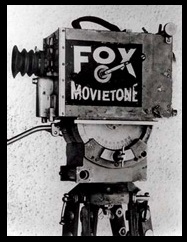
Members of the Fox Film Company visited St. Nicholas’s School, Claddagh, Galway today and filmed scenes for a “talkie” of Irish life in which Count John McCormack plays the principal role. Count McCormack himself visited Galway last week and selected this school as the most suitable for the purpose of the film, in which he will be depicted as a poor Irish boy who leaves his native land when quite young, and achieves fame in America. The scenes filmed today are supposed to show Count McCormack’s School days. The children assembled in front of the school and sang an Irish Song, while there were also Irish step dances, and final picture was of a rush by the children leaving school, amongst them supposed to be the youthful McCormack.
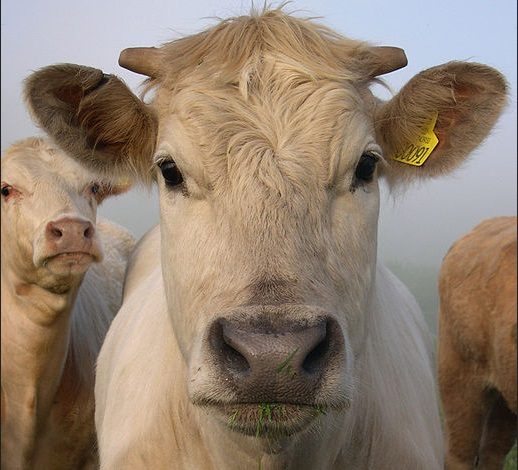
THE CATTLE FAIR
Kinvara cattle fair was held on Wednesday last, March 4, and must certainly be allowed to be voted the most successful since the fair was first held some twenty years ago. The street was packed about eleven o’clock, and the cattle were something splendid to look at, every one of them being in the pink of condition and of the best description. Buyers were present from all parts of the country and to Mr.Culligan, of Briarfield, belongs the honour of securing the biggest lot of well finished animals. He purchased over eighty, and was accompanied by Mr John Clune. Several other buyers were present from Limerick, Maynooth, Dublin and other places throughout Ireland, and prices unheard of for years were paid for two and three-year old cattle. In fact people were astonished with the prices they obtained. Dealers from Gort, Kilbeacanty, and Scariff made large purchases for other fairs. Many hundreds exchanged hands in a few hours at fancy prices. Even local dealers offered strong competition. The success of the fair now seems to be well assured for all future time.
HORSE AND CALF FAIR
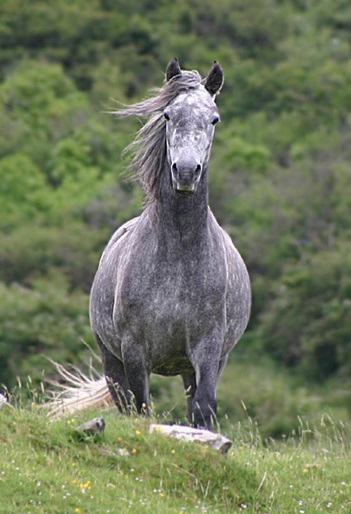
Connemara Pony Photo: Olaf Kleinwegen Wikimedia Commons
Kinvara horse and calf fair was held on Wednesday last in February and was better than people expected. A big supply of colts and working horses, which were selling so cheaply for the past twelve months changed hands at prices very much enhanced in value for the approaching spring. The demand for the show horse is coming back to take his usual place in the farm again, notwithstanding the attempt that was made to oust him on the farm and road. A big number of calves from six months to twelve months brought from Limerick and Cork, found a ready market, and good prices seemed to rule all round.
THE POTATO MARKETS
Kinvara markets are just now going strong, and are well supplied with potatoes of the best kind. A great variety of new seed, notably Kerr’s Pink, whose name as disease resisters is famous, are now raised in the district, and command big prices, followed up by Arran Victors a good second, and Aran Chiefs, and a variety of others too numerous to mention. The Department of Agriculture is purchasing largely in the district, and sending the seeds all over the country. Early potatoes are realizing up to 3s per stone, and there seems to be an abundant supply of all kinds.
THE PIG FAIR
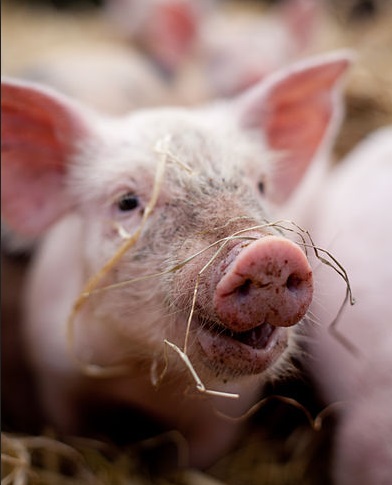
Photo: Sander van der Wel Wikimedia Common
Kinvara pig fairs have taken a most decided upward tendency. The last one showed a most decided improvement in prices, the only fault being that people did not ask enough. Pigs paid over 70s per cwt and a hundred were disposed of at that price. A great number of buyers were present from Limerick, Cork and Waterford, and Galway is now sending its quota to swell the number and promises to continue it. The monthly fairs are a great boon now for years, and people are more than satisfied with results and competition. The fairs and markets’ committee should now hold monthly fairs and markets all the year round. Large bonham markets are now held as a result and prices have gone up as high as £2 10s each, and in some cases more.
Fox movietone 2 by Twentieth Century Fox Wikimedia Commons
During Oireachtas week the popular manager of the Galway Cinema Theatre will provide an unusually attractive programme for his numerous patrons, and in addition to the films given below, two sensational pictures, procured at enormous expense, will be shown during the week.
Lovers of exciting incidents and dramatic situations will be catered for largely.
Amongst the dramatic pictures are;
“The Making of Bronco Billy,”
“The Truant’s Doom,”
“Revolutionary Romance,”etc.
The humourous pictures include;
“How they Outwitted Father,”
“The Invisible Hand,” etc.
“Bee-keeping,” a highly interesting and instructive film will also be shown, and should attract a large number of those engaged in the bee-keeping industry. A special feature will be the Gaumont Graphic, which shows news of the week in pictures. A musical treat of a very high standard will be given by the orchestral band each evening. There will be a complete change of programme on Sunday, Monday and Thursday.
Sweltering sun, choking dust, and a dome of bunting surmounting a riot of animated colour were the order at Gortshanvogh. The meeting differed from the usual “flapper.” Of course, all the “trickies” and “habituals” were there, but the neighbours, who feel they have a proprietary interest in “the races” and who assume the responsibility with a genial “You are welcome to Kinvara” air predominated. There was some indefinable something – something inherent, though unobtruding – which marked Kinvara meeting, apart from the usual type, and the day a pleasant outing (sic.). The course was hard, and many riders parted company with their mounts to meet its unwelcome embrace.
Details;
The VOLUNTEER PLATE £12; Hurdle – 2 miles
Mr P. Torpey’s Master McGuire
Mr J. O’Neill’s Distant Shore
Mr T. Quinn’s Waverley
Also ran – Silver Ring.
The TRADERS’ PLATE £10 Hurdle – 2 miles
Mr T. Quinn’s Waverley
Mr P. Donnelly’s Paravid
Also ran – Home Dock (fell)
KINVARA PLATE £20 Steeplechase – 2 1/2 miles
Mr P. Murphy’s Clare Girl
Mr J. O’Neill’s Distant Shore
Also Ran – Paravid
STEWARDS’ PLATE £8 Flat 1 1/2 miles
Mr J. O’Neill’s Distant Shore
Also ran – Solid Gold (fell) and Paravid
GORTSHANVOGH PLATE £8 Flat 1 1/2 miles
Mr T. McKenna’s Home Dock
Mr J. O’Neill’s Distant Shore
Mr T. Quinn’s Waverley
Also ran – Solid Gold (fell) and Golden Cherry