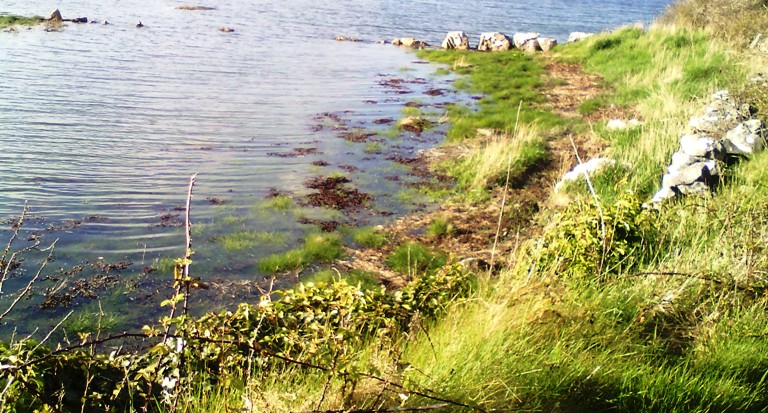
Foy’s hill Fever Hospital Kinvara, Photo: Norma Scheibe
It is today our melancholy duty to record the deaths of four of our medical friends, who, within a few days, have been sacrificed to fever, with which they were afflicted during the discharge of their professional duties:-
On the 23rd inst. Doctor George Seymour, Surgeon to the Kilconnell Dispensary;
On the 24th inst. Doctor Charles Donnellan, of Winterfield, Medical Attendant to the Annadown Dispensary;
On the 25th inst. Francis Bodkin Esq., for many years Apothecary to the Clifden Poor House;
On the 26th inst. Doctor Edward Lambert, of Oranmore, a gentleman much beloved, leaving a widow, with a young and interesting family, to deplore his loss.
Independent of the above, we are sorry to add that serious apprehensions are entertained for the recovery of Dr. Mulville of Gort, and Dr. Hynes, of Kinvarra. Galway Vindicator
Turlough Hynes was parish priest of Kinvara and lived at Poulnegan. Archbishop James Lynch of Tuam ordained him priest in Cong in 1674. It seems likely that he was of the same family of Frs. Edward and Terence Hynes. A chalice in Kinvara bears this inscription: The gift of Pa French Esq., to the Rev. Fa. Ther. O’Heyne and his successors in the Parishes of Kinvarra and Duras.
The chalice was stolen, broken and repaired. A second inscription on the base records that the cup was replaced by Vicomte de Basterot in 1886.
Rev. Fr. Martin Coen
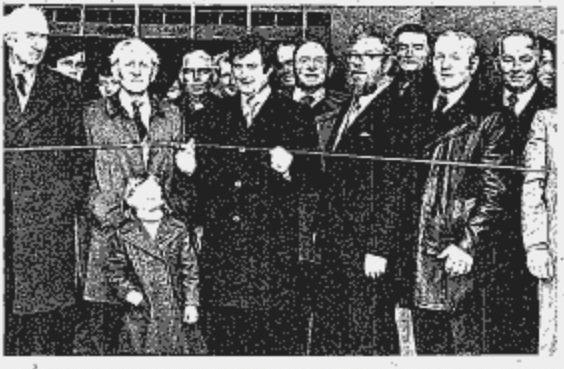
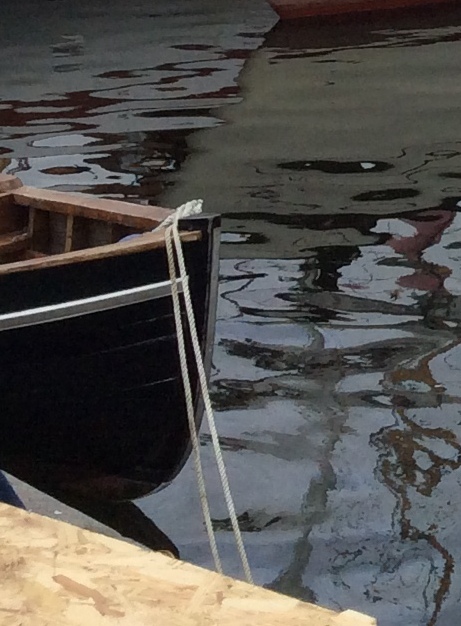
Mr. Robert Molloy, Minister for Defence, cuts the tape to mark the opening of Kinvara Boat Factory in Kinvara. Also in the picture are Mr. Joe Muldoon, Chairman, Kinvara Co-op., Toddie Byrne, Manager of the Co-op. and Mr. Bill Crampton, Manager, Kinvara Boats. Connacht Tribune 23rd March, 1979 p.31
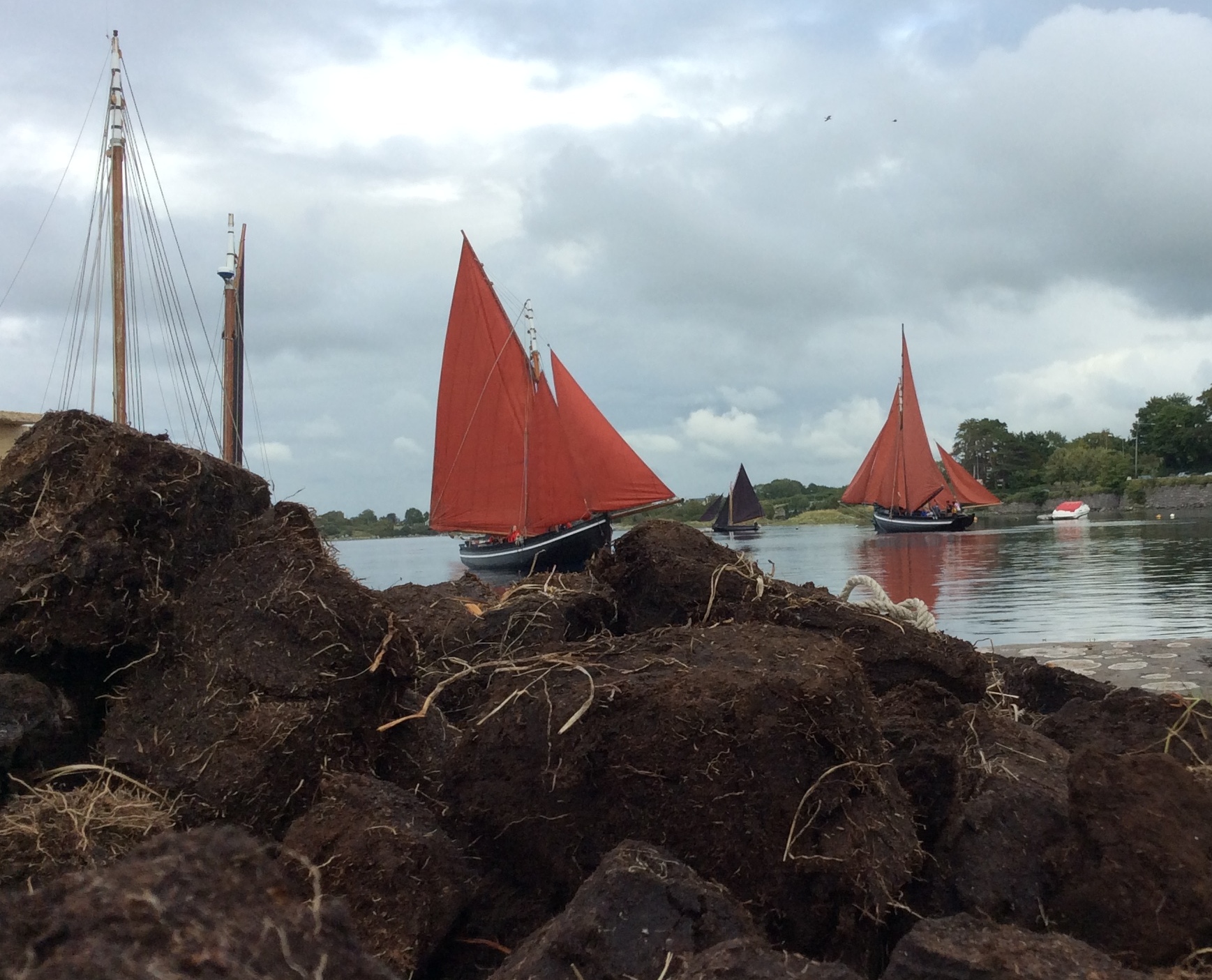
Last Tuesday, January 1st, the world priemere of the new film “Turf Boats of Galway” was shown in Kinvara and the local makers of this hour long film have made arrangements for marketing 2,000 copies of it, mainly in the U.S. market. If the country at large needs an example of enterprise, this is it.
Behind the film is local man Gerard Conneely, who produced and directed the filming. Shooting totalled five hours and it was conducted earlier this year. Tomás Rua Mac An Iomaire of Carraroe was the cameraman and his brother Liam, was the narrator. Because there are two tracts attached to the film there can be two narrations, and one of these in Irish. Dolores Keane, the popular ballad singer, provides background music. The film will be made into a video cassette tape, suitable for use in the most ordinary video equipment both at home and abroad.
The main target for this tape will be the identified market of Boston, Philadelphia and San Francisco, where people with Galway connections live. At present the issue of 2,000 tapes is looked on as sufficient for this first venture.
Gerard Conneely said yesterday; “Our aim is to break even with this venture and with the capital outlay recouped, to undertake another similar video later on in the year.”
The film basically concerns the history of turf boats in use in Galway Bay, from the earliest visual records to the last boats in the 1940’s. There are several old photographs intermingled in the story, as well as such historic photographs as that of the family group conversing with Charles Sturt Parnell at the Quay, Kinvara on November 9th, 1886, two days before the famous Galway Election, involving Captain O’Shea, husband of Parnell’s subsequent wife, Kitty O’Shea.
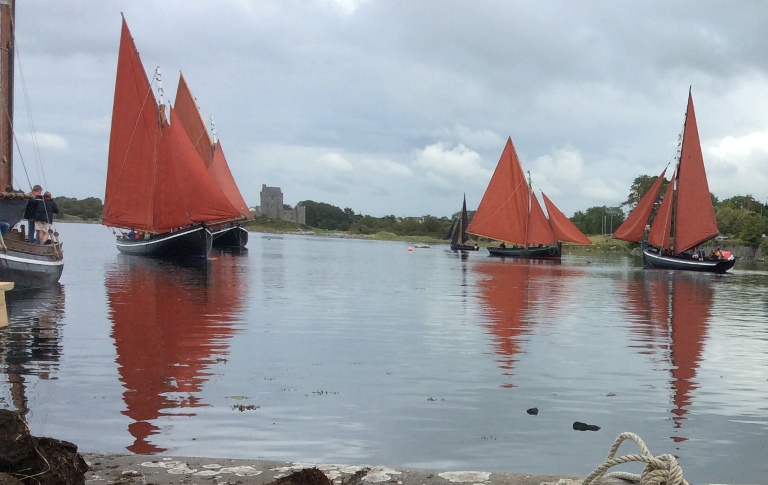
There are many delightful shots of Cruinniú na mBád and the revival of the Hooker Festivals in recent years. All in all a delightful film and one to be seen for its visual quality and the nostalgia evoked. The exiles will be pleased with its content and the expertise displayed throughout its production.
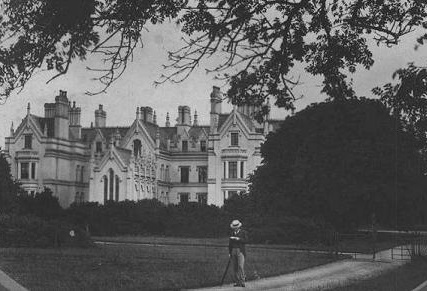
Kilcornan was a 16th century castle of the de Burgo. In the 1830’s the Redington family built a mansion around it and incorporated the old tower in the design. http://clarinbridge.galway-ireland.ie
Irish Examiner 31st December, 1881 p.3
Yesterday the County Galway Hunt was to have its meet at Kilcornan Castle at ten o’clock. Long before that hour horns were sounded in all directions for miles around. As early as nine o’clock no less than five thousand persons had assembled at the entrance gate to the Castle. A pile of stones were placed before the gate, and it was evident by the demeanour of the crowd that the hunt would be stopped at any cost. At ten o’clock Mr. Burton Persse, the master of the hounds, together with several gentlemen and the pack, arrived. The crowd moved in front of the gate.
The master asked what had they against him. A young man stepped forward and said, “No hunting will be allowed until the suspects are released (great cheering). Mr Persse said they could not release them. The young man said they had done their best to bring about coercion. Mr Persse denied that they did. The young man;
“You cannot deny the evidence you gave before the Bessborough Commission.”
Just then fifty soldiers and about seventy policemen, under the command of sub-inspectors and a resident magistrate arrived. The officers had a brief interview with Mr Persse and the young man again came forward and asked,
“Why did you bring police and military?”
Mr.Persse denied having any knowledge of their coming and said that he was always anxious to have the goodwill of the people.
The resident magistrate, addressing the crowd, said if they did no disperse he would give an order to cut them down.
The crowd was about to move when a young man, a stranger to all, rushed and in a loud voice said, “Halt! Death or glory.”
The crowd halted, and two policemen placed him under arrest and threatened to fire. He retorted and said that they would lose their lives or stop the hunt. With a desperate effort he shook off the two policemen, one of them falling over a low wall, and was soon lost in the crowd. All the efforts of the police failed to recapture him.
The huntsmen then rode off in the direction of Oranmore, but were met by another immense crowd, who hooted, groaned, and pelted mud at them. A gentleman was apparently looking for something in his pocket and a report went out that he was searching for his revolver, whereupon sticks and stones were freely flung at him, and he escaped by riding off at full speed. The master was informed if he let the hounds into any of the coverts not one of them would be allowed out alive. A report has just arrived that three gentlemen were more or less injured. In consequence of the opposition to the hunt the following circular has been sent to all the members; Ballinderry, Dec29th Sir, In consequence of the opposition to the hunting on Wednesday at Kilcornan, I am requested by the master of the hounds to call a meeting of the members of the hunt for Saturday next, 31st instant, at the Railway Hotel, Athenry, at two o’clock, where you attendance is particularly requested. Yours truly, J. W. Comyn, Hon. Sec.
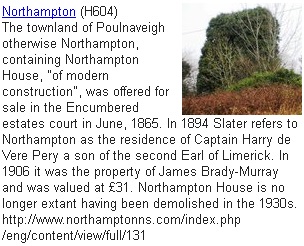
The fund for the building of a new Cathedral in Galway had its origin in a bequest of 500 pounds made by Mr Murray of Northampton House, Kinvara, in the year 1876. Connacht Tribune 14th January, 1922 p1
For Sale;
NORTHAMPTON HOUSE, KINVARA, CO. GALWAY
This splendid and up to date Mansion contains about 25 apartments, comprising Drawing Room, Dining Room, Bedrooms, Billiard Room, etc., in thorough repair. The woodwork is all pitch pine (nearly new). The fire places are fitted with marble and ornamental mantel pieces. The building is of cut stone, and could be dismantled at a very little outlay.
Northampton is one mile from Kinvara Port and three miles from Ardrahan Railway station (G.S. and W. railway). Offers in writing will be taken and considered up to Monday, 23rd January 1922.
For further particulars apply to
Edward M.Kennedy
Connacht Tribune 15th October, 1910 p.4
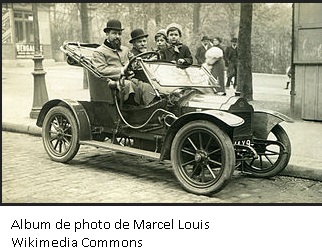
A report spread around Kinvara early on Tuesday that the Sheriff’s men were “marching” on Kinvara with up-to-date motor cars from Galway, to make seizures on the town tenants on the Sharpe estate. The people were beginning to take things easy when at the toot of a motor car on the Castle road all shops were closed and the situation calmly surveyed from the upper windows. The motor belonged to a well known Galway trader, who looked amused when he heard the consternation his arrival had created. Developments are hourly expected, and the situation is growing serious as time advances.
Tuam Herald 4th September, 1920 p.2 (abridged)
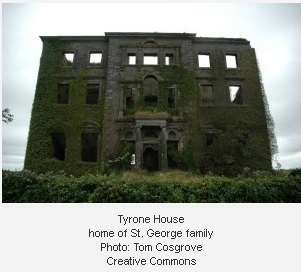
A correspondent sends us some interesting details of the malicious burning of Tyrone House, the ancestral home of the St. Georges – a family settled in Ireland for over three hundred years, and for over one hundred, the most prominent and influential in the county of Galway. This splendid and imposing structure, which could be seen for miles around, was built by the late Christopher St. George, D.L., at a cost of over fifty thousand pounds. It could not be built now for two hundred thousand pounds. It was in the late Georgian style and the finest house in Ireland. The ceilings were all painted by Italian masters and were regular works of art. The mantle pieces were of rare Italian marble and very costly. In the hall was a fine full-sized marble statue of Baron St. George, again the work of an Italian artist. The head was broken off the night of the raid. All the ceilings and mantle pieces are now ruined, and the entire structure an empty shell and ruin.
There was no grounds for the report that the military or police intended or were to occupy the house, and agrarian motives are believed to have inspired and instigated this act of purely wanton destruction.
Of late years the place was freely allowed to be used by pleasure parties who came out from Loughrea and other places to have a dance which cost them nothing, and who were never prevented from having their pleasure and a dance on the spacious floor of the dining room. They can now no longer do so, where in olden days the finest balls in the county Galway took place.
A report spread around Kinvara early on Tuesday that the Sheriff’s men were “marching” on Kinvara with up-to-date motor cars from Galway, to make seizures on the town tenants on the Sharpe estate. The people were beginning to take things easy when, at the toot of a motor car on the Castle road, all shops were closed and the situation calmly surveyed from the upper windows. The motor belonged to a well known Galway trader, who looked amused when he heard the consternation his arrival had created. Developments are hourly expected, and the situation is growing serious as time advances.