The Advertiser 22nd November, 1932 p5
A woman in a motor boat chased and caught a 16,000 ton liner off the Irish coast recently. She had travelled more than 100 miles to do it. She had intended to board the east-bound Hamburg-America boat, Milwaukee, at Galway, but owing to two days of dirty weather, with the prospect of more to come, the captain had decided to cut out the Galway call and go on to Queenstown.
When the intending woman passenger, a Miss Ward, heard of this change, she left Galway by car for Queenstown. She arrived there, after a night ride, to find that the tender had already left to meet the Milwaukee. Miss Ward chartered a motor boat. The liner was now steaming off for Hamburg. Miss Ward made signals, which were seen by the Milwaukee’s captain from the bridge. Captain Molchin stopped his vessel and had a ladder lowered. Miss Ward climbed triumphantly up the liner’s side.
Logo of the Oireachtas of Ireland Image: Barryob Wikimedia Commons
Twenty five members of the Sinn Féin society elected to the British house of commons assembled in Dublin this afternoon and formally constituted themselves the “Dail Eireann,” which is Irish Gaelic for “Irish Parliament.” They elected Chas. Burgess, whose Irish name is Cathal Brugha, speaker. They also adopted a declaration of independence and an address to the free nations of the world and appointed a committee consisting of Count Plunkett, Arthur Griffiths and Edward De Valera to present the claims of Ireland to self-determination to the peace conference at Paris. The two last named being in British prisons, only the venerable Count Plunkett can proceed to Paris and then only provided the British government consents to give him passports.
The walls of the hall were quaintly embellished with classic statues in plaster and coats of arms. Past lord mayors have witnessed many more exciting dramas, notably in recent years of conventions of the Nationalist party, when there were impassioned speeches and hot party contests.
It would seem that Galway is not going to be behindhand in the matter of belief in the supernatural, judging from the state of excitement created a few nights ago by the rumour that a ghost had made its appearance at one of the windows of a house in Abbeygate Street, directly opposite the sacristy of the Pro-cathedral of St. Nicholas. This house, it must be mentioned, was lately occupied by a woman who died after a very short illness. Since her death it became tenanted by another person, but from some cause or other the last mentioned left, and the place remained unoccupied till last week. On the night it was occupied some children were passing to attend devotions at the chapel, when they say they observed a sort of unusual light in the house, and a woman standing near the open window who, in a sepulchral voice said, “offer one prayer for me.”
Some of the children fainted on the spot, and this caused others going to their devotions to inquire into the cause. The tale of the spectre at the window spread like wildfire, and in a quarter of an hour no less than 2000 persons had congregated outside the haunted house. The streets on each side became blocked. The crushing and jostling to get a glimpse at the “visitor from the other world” was such as has never been equalled in Galway. Several persons were thrown down and trampled upon, and it was with the greatest difficulty a strong force of police, after about three hours’ incessant labour, succeeded in clearing the streets sufficiently to allow pedestrians and cars to pass. The tramcars were even compelled to stand still in the streets.
The following night the same state of things have prevailed, but up to the present, the real cause of the rumour has not been satisfactorily explained. Several versions of what the object really was that created such a sensation are given, but the adult portion of the community say that fifty years ago there was also “something seen” in the house, it having been the scene of a most brutal murder – namely, the assassination of a woman named Maxwell by her husband. From the description now given of the late apparition by the children, who say they saw it, the older people say it is one and the same ghost, which has to put up alternate half-centuries in this world and the other. The police are stationed near the place, where four streets meet, and it is as much as they can do to keep the curious from congregating.
15th January, 1923 p.5
Prisoners in Galway Gaol attempted to escape by excavating a tunnel under a wall with two old bayonets and a broken spade. They reached a point outside the wall but a great rock stopped their progress. While they were burrowing up a sentry heard and discovered them.
During Lord Mulgrave’s, or a preceding Lord Lieutenant’s rule in Ireland, there was a curious thing never traced to its source and never explained. In the east of Kildare, at Kill, a strange woman gave a piece of kindled peat to a man, with the injunction to pass it along to the next person on the Naas road, that person to repass it westward still alight, and so on westward. If the turf were let go out before a new piece were substituted from a living hearth, misfortune would come. That was on an autumn evening. Within twelve hours the ‘burnt turf’ had been carried to Galway Bay, across Kildare, the Queen’s and King’s counties, and Galway. No one has ever published an explanation of the affair.
The Catholic Press 15th May, 1919 p. 18 (abridged)
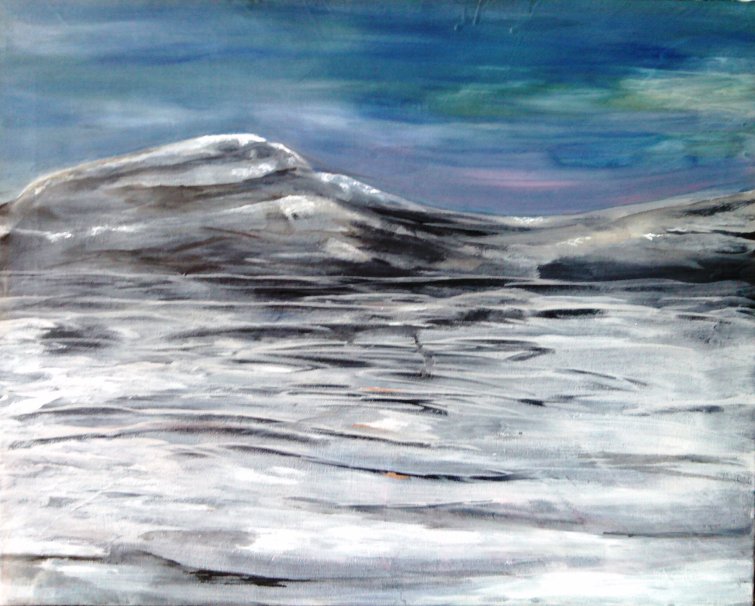
Mullaghmore Acrylic on canvas EO’D
You ask me why, tho’ ill at ease,
Within this region I subsist,
Whose spirits falter in the mist,
And languish for the purple seas.
Within this land which bondmen till
Who cannot call their minds their own,
But into dungeons straight are thrown
If they but speak the things they will.
A land of nameless government,
That hath a wide and dark renown;
Where Freedom hourly shrinken’s down
From precedent to precedent.
Where faction always gathers head
Where by degrees to fullness wrought
The strength of some repressive thought
Hath time and space to work and spread.
Where banded bigots persecute
Opinion, and produce a time
When honest thought is civil crime,
And individual freedom mute.
Yet ’tis the land of mist and wrong,
Wild wind! that claims my homage high;
And I will hear before I die
The shout of her triumphant song.
S.
Mr. Horace Plunkett, an enterprising Irishman, is actively engaged in fostering the production of an oyster warranted to pass the most vigilant analyst in search for bacilli. From a gentleman conversant with the oyster in a scientific as well as a gastronomic sense, I have just had direct information as to the experiments which the Irish agricultural department are carrying out.
These experiments begin when the tiny specks of protoplasm settle on the sea bed and continue until the oyster finds its way to the restaurant bar. The temperature, the effect of currents, the suitability of various kinds of beds for feeding purposes, methods of packing and marketing, and other things appertaining to the oyster too abstruse for the lay mind, are being found and “made a note of”.
In due time a gray book will appear containing information which will be at the disposal of everybody. Meantime the red bank of Burrenco, Clare, the scene of the experiments, is sending its oysters to the Dublin and to some extent to the English markets. The part of the Irish coast involved in the oyster industry is said to be absolutely free from the possibility of sewage and contamination. For example, the only habitations within any reasonable distance of the Burren beds are in the village of Burren,(sic.) and consist of a telegraph office, a grocer’s store and public house – not quite as dangerous as London for the oyster.
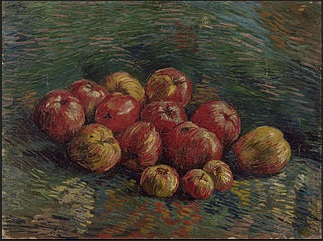
Apples Vincent van Gogh (1853-1890) Van Gogh Museum Wikimedia Commons
The record long distance for a box of gift apples was established last week when the Apple Growers Associated received an order to forward a box of Spitzenbergs to County Galway, Ireland, for Miss Kathleen Conoly, of Portland. The box went to F.X. Twohy, of Ballinahinch. The cost of the box was $6. It was forwarded by boat to Liverpool along with a cargo of association apples.
The following is clipped from a west of Ireland newspaper. It is the protest of an Irish priest against what, on the facts related, seems to be a mean, petty prying system practised upon the people of Kinvara for the purpose of extracting evidence for use against the rebels. Such irritating measures exercised for the production of incriminating information are bound to foment strife and discord, and are well described as stupid. Father J. W. O’Meehan writes;
As a priest I feel bound to warn our people against the danger of revealing anything whatsoever, either under blandishment or threat, to armed men concerning the most sacred subject of Confession. Unfortunately it has fallen to my lot to inform the people of the fact that in this catholic parish of Kinvara, questions of a most improper character were recently put to a parishioner – a decent but simple country boy – by one of two armed men concerning the boy’s Confession. Lest in present circumstances I should be regarded as a prejudiced person, I think it better to set down in writing, coolly and deliberately, the bold facts of this sad occurrence.
On Monday evening, May 29th, two armed “gentlemen” (?) approached this young man, and having put him several questions, which, as a Catholic priest, do not concern me now, one of these armed “gentlemen” then proceeded to ask him about the Confession which he made at the Convent Church on Easter Saturday evening. I shall allow yourselves, Catholics of Kinvara, to form your own judgment on the propriety of an Irish Catholic armed “gentleman” asking an Irish Catholic youth the four following questions;
First question: Who told you to go to Confessions on that particular evening?
Second question: Where did you meet Father ________ when he told you to go to Confession?
Third question: What reasons did the priest give you for asking you to make your Confession, or why did he ask you to go on that particular Saturday evening rather than any other evening?
Fourth question: How long was it since your last Confession?
I have ample evidence to show that these four questions have been asked on the evening of May 29th. The boy who was so questioned and two other persons who were present on the occasion and prepared to swear to the truth of the statement. May it be my privilege now to ask four questions?
First: Had this armed “gentleman” authority from his superiors to pry into this most intimate and sacred subject of a man’s Confession?
Second: Does the Defence of the Realm Act empower armed “gentlemen” in Ireland to invade the sealed realm of the Confession?
Third: Can this armed “gentleman” be too ignorant or too stupid not to realise that questions of this nature would outrage the most tender feelings of Irish Catholics?
Fourth: who really are the “gentlemen” who are now exasperating the people and helping in this most peaceful district to manufacture crime?
Catholics of Kinvara, even if there are vile tongues amongst you, which blab when they should not, let those of you at any rate who still remain faithful to birth and fatherland guard even with your lives, the sanctity of Confession against all the agents of stupidity in this land.
(Signed) J.W. O’Meehan