To talk is quite a pleasant thing,
When themes are grand and bright eyes glisten.
In glad approval of our strain,
Yet sometimes we would sit and listen.
In some low valley sweet with bloom,
Where forest trees have rocked for ages;
Through birds, and bees, and running brooks
Learn wisdom fres from Nature’s pages.
There shut our eyes and hear the hum
Of summer life that never ceases;
But, with the advent of the stars
Goes on and on, and yet increases.
And when the winds of winter blow
And gone is sumer’s balm and glory,
We fain would sit at some dear hearth,
And listen to a touching story.
Some tale of human love and toil
A heart made glad – a broken fetter
A couple joined in holy ties
Something in life to make us better.
Something to turn us from ourselves,
And make us long to do for others;
To stem the tide of hate and wrong,
And deal as brothers should with others.
There’s music sweet in this our world.
In country town, and teeming city,
The children’s song, and hymn of peace,
The lay of love, the tale of pity.
Ah, yes, ’tis sweet to sit and learn,
Or bend the ready ear when walking,
To catch the flow from other hearts,
To listen more and do less talking.
THURSDAY, JULY 23, 1840 The Irish in 1644 as described by a Frenchman of that period (from the Irish Penny Journal) translated by Crofton Croker. the French traveller was M. De la Boulfaye Le Gouz
“Ireland, or Hibernia, has always been called the Island of Saints, owing to the number of great men who have been born there. The natives are known to the English under the name of Iriche, to the French under that of Hibernois, which they take from the Latin, or Irois, from the English, or Irlandois from the name of the island, because land signifies ground. They call themselves Ayrenake, in their own language, a tongue which you must learn by practice, because they do not write it; they learn Latin in English characters, with which characters they also write their own language; and so I have seen a monk write, but in such a way as no one but himself could read it.
Saint Patrick was the apostle of this island, who according to the natives blessed the land, and gave his malediction to all venomous things; and it cannot be denied that the earth and the timber of Ireland, being transported, will contain neither serpents, worms, spiders, nor rats, as one sees in the west of England and Scotland, where all particular persons have their trunks and the boards of their floors in Irish wood; and in all Ireland there is not to be found a serpent or toad.
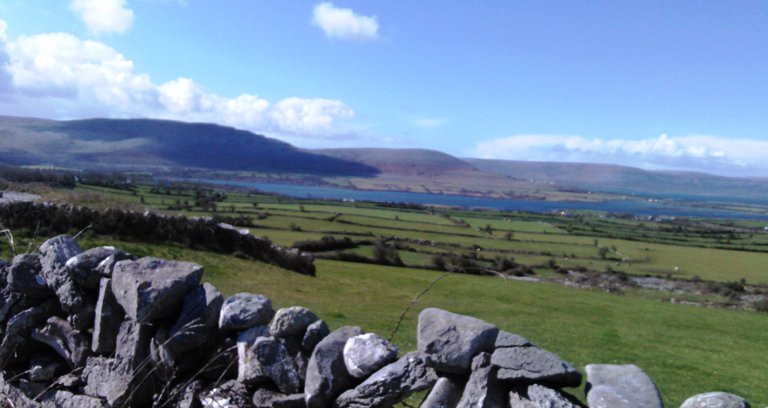
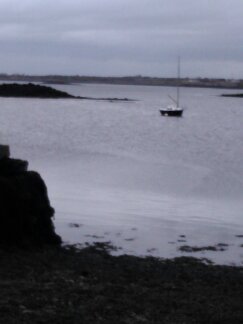
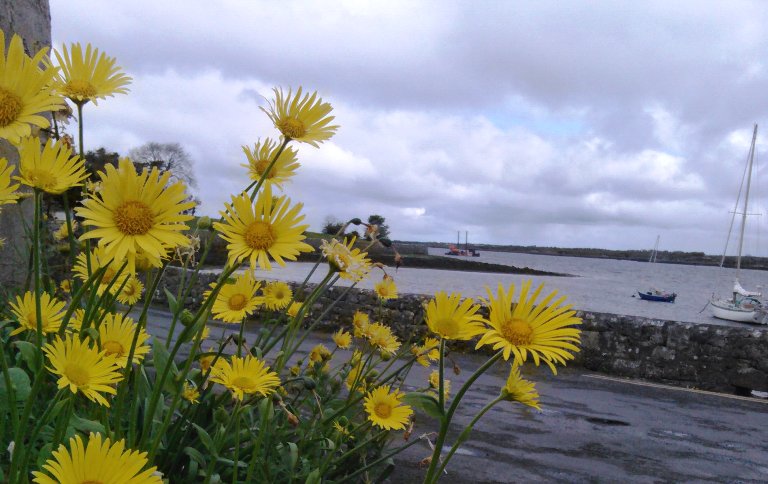
Burren beauties Photo: EO’D
The Irish of the southern and eastern coasts follow the customs of the English; those of the north, the Scotch. The other are not very published, and are called by the English savages. The English colonists were of the English church, and the Scotch were Calvinists, but at present they are all Puritans. The native Irish are very good Catholics, though knowing little of their religion those of the Hebrides and of the North acknowledge only Jesus and St. Columbo (Columbkill), but their faith is great in the church of Rome. Before the English revolution, when an Irish gentleman died, his Britannic majesty became seized of the property and tutelage of the children of the deceased, whom they usually brought up in the English Protestant religion. Lord Insiquin (Inchiquin) was educated in this manner, to whom the Irish have given the name of plague or pest of this country.
The Irish gentlemen eat a great deal of meat and butter, and but little bread. They drink milk and beer, into which they put laurel leaves, and eat bread baked in the English manner. The poor grind barley and peas between two stones, and make it into bread, which they cook upon a small iron table heated on a tripod; they put into it some oats, and this bread, which is the form of cakes they call harann, they eat with great draughts of buttermilk. Their beer is very good and the eau de vie, which they call brandovin [brandy] excellent. The butter, the beef, and the mutton, are better than in England.
The towns are built in the English fashion, but the houses in the country are in this manner: – Two stakes are fixed in the ground, across which is a transverse pole to support two rows of rafters on the two sides, which are covered with straw and leaves. They are without chimneys and make the fire in the middle of the hut, which greatly incommodes those who are not fond of smoke. The castles or houses of the nobility consist of four walls extremely high, thatched with straw; but to tell the truth, they are nothing but square towers without windows, or at least having such small apertures as to give more light than there is in a prison. They have little furniture, and cover their rooms with rushes, of which they make their beds in summer, and of straw in winter. They put the rushes a foot deep on their floors, and on their windows, and many of them ornament the ceilings with branches.
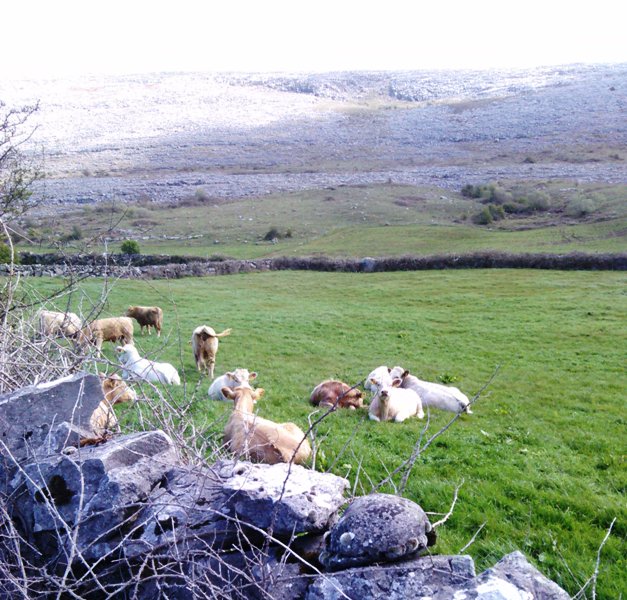
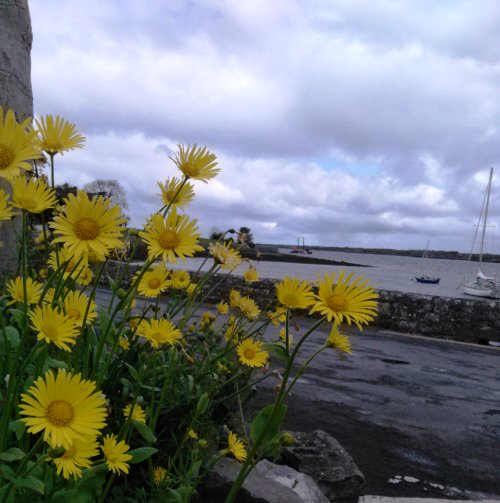
Burren light Photo: EO’D
They are fond of the harp, on which nearly all play, as the English do on the fiddle, the French on the lute, the Italians on the guitar, the Spaniards on its castanets, the Scotch on the bagpipe, the Swiss on the fife, the Germans on the trumpet, the Dutch on the tambourine, and the Turks on the flageolet.
The Irish carry a sequine [skein] or Turkish dagger, which they dart very adroitly at fifteen paces distance; and have this advantage, then if they remain masters of the field of battle, there remains no enemy; and if they are routed, they fly in such a manner that it is impossible to catch them. I have seen an Irishman, with ease accomplish twenty-five leagues a day. They march to battle with the bagpipes instead of fifes; but they have few drums, and they use the musket and cannon as we do. They are better soldiers abroad than at home.
The red-haired are considered the most handsome in Ireland. The women have hanging breasts; and those who are freckled, like a trout, are esteemed the most beautiful. The trade of Ireland consists in salmon and herrings, which they take in great numbers. You have one hundred and twenty herrings for an English penny, equal to a carolus of France, in the fishing time. They import wine and salt from France, and sell there strong frize cloths at good prices.
The Irish are fond of strangers, and it costs little to travel amongst them. When a traveller of good address enters their houses with assurance, he has but to draw a box of sinisine, or snuff, and offer it to them; then these people receive him with admiration, and give him the best they have to eat. They love the Spaniards as their brothers, the French as their friends, the Italians as their allies, the Germans as their relatives, the English and Scotch as their irreconcileable enemies. I was surrounded on my journey from Kilkinik [Kilkenny] to Cachel [Cashel] by a detachment of twenty Irish soldiers; and when they learned I was a Frankard (it is thus they call us) they did not molest me in the least, but made me offers of service seeing that I was neither Sezanach [Saxon] nor English.
The Irish, whom the English call savages, have for their head-dress a little blue bonnet, raised two fingers-breadth in front and behind covering their head and ears. Their doublet has a long body and four skirts; and their breeches are a pantaloon of white frieze, which they call sers. Their shoes, which are pointed, they call brogues, with a single sole. They often told me of a proverb in English, ‘ Airische borgues for English dugues’ [Irish brogues for English dogs] ‘ the shoes of Ireland for the dogs of England’, meaning that their shoes are worth more than the English.
For cloaks they have five or six yards of frieze drawn around the neck, the body, and over the head, and they never quit this mantle, either in sleeping, working or eating. The generality of them have no shirts, and about as many lice as hairs on their heads, which they kill before each other without any ceremony.
The northern Irish have for their only dress a breeches, a covering for the back, without bonnets, shoes, or stockings. The women of the north have a double rug, girded round their middle and fastened to the throat. Those bordering on Scotland have not more clothing.- The girls of Ireland, even those living in towns, have for their head dress only a ribbon, and if married, they have a napkin on the head in the matter of Egyptians. The body of their gowns comes only to their breasts, and when they are engaged in work, they gird their petticoat with their sash about the abdomen. They wear a hat and mantle very large, of a brown colour [ coleur minime] of which the cape is of course woollen frieze., in the fashion of the women of Lower Normandy.”
A paragraph, extracted from the Clare Journal, has been making the round of Metropolitan papers, with reference to an alleged unprovoked assault of some Claddaghmen on a trawling party from New Quay. Upon the most unquestionable authority we have it that the Claddagh boats were quietly proceeding to their fishing destination when an individual belonging to the trawling party presented a loaded musket at some of the boats when passing and thus provoked the unfortunate rencontre, described in the Clare Journal.
Anglo Celt 12th August, 1911 p.4 (abridged)
Stone throwing was once usual in warfare, as, for example in the days of Giraldus Cambrensis, (c.1180); at the battle of Corcomroe in 1317 and at the breach of Limerick in 1690. Special “champion” stones are mentioned in early and mythic times – they were supposed to have some magical power of destruction.
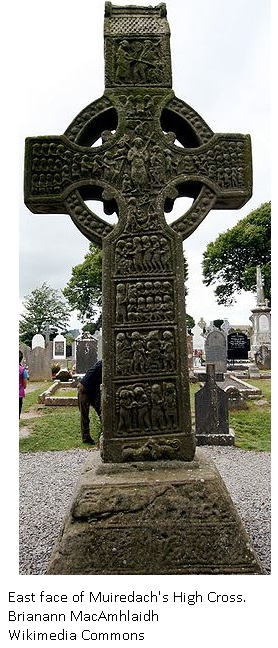
The sling (tailm, teilm or taball) was in use in pre-Christian times. A carving of a sling is depicted on a panel from the east face of Muiredach’s high cross, (a cast of which can be found in the National Museum, Dublin). Good carvings of bows and arrows occur on the base of the cross of Monasterboice, and on the door of Cormac’s chapel at Cashel.
Accident at Kinvara races
Two rather serious accidents occurred at Kinvara race meeting on Jun 28th. In the second race J. Norris, who was riding Mr. P. Donnelly’s Paravid, had the misfortune to fall and break his leg. In the fourth race, the Stewards’ Plate, M. Holland, who was riding Mr T. Wall’s Solid Gold, had a very nasty fall on his head. He was taken to St. Bride’s Home, Galway suffering from concussion of the brain. He is receiving treatment there and is progressing favourably.
Numerous reports of mines having been seen in Galway Bay and along the west coast have been made during the last week by fisherman, including one proceeding from Connemara to Kinvara with a boat load of turf on Wednesday. It is worth recalling that, during the last war, only two mines drifted into Galway Bay. Both exploded with fatal results, but the stringent precautions now being taken should avert any repetition of such tragedies.
Captain Hamilton, competent Port Authority at Galway told our representative on Friday that a drifting mine had been reported to him about half a mile south-west of the Margaretta Buoy on Thursday night. He immediately reported the matter to the authorities at Renmore Barracks. “I know,” he said, “that there is a mines expert in this area at present and he went to Furbough yesterday where he dismantled a mine that had come ashore. I understand that the expert has gone to Clifden this morning where he is dismantling two more mines that came ashore there.”
Asked if he thought there was a danger of any of those mines coming ashore at Salthill, Captain Hamilton asked “Why not? Of course,” he said. “There are look-out posts all along the west coast who are keeping a constant watch and they report immediately any sign of mines.” Asked if he could give any explanation for the presence of the mines, Captain Hamilton said that in his opinion they broke away from a minefield in the English Channel and the easterly wind which has been blowing from some time, drove them out into the Atlantic and now they are drifting back in again.
Kinvara sports were held on Sunday, in summery weather. A most enjoyable day’s sport was witnessed by a very large crowd of spectators who were assembled all around the quays, taking a keen interest in the events. Results:
Juvenile swimming race – 1. P.Pigott, Gort; 2. R. Ford, Kinvara; 3. P. Fahey, Kinvara.
100 yards swimming race – 1. N. Brady, Gort; 2. P. Brady, Gort; 3. M. Carroll, Gort.
300 yards swimming race – 1. T. Whelan, Kinvara; 2. M. Maclin, Gort; 3. D. Picker, Kinvara.
Diving Competition – 1. N. Brady, Gort; M. Maclin, Gort; D. O’Dea, Kinvara, tied for 1st.
Long Distance Diving Competition – 1. D.O’Dea, Kinvara; 2. M.Maclin, Gort; 3. H.O’Neill, Ballyvaughan.
Greasy Pole Competition – 1. M. Linnane,Dooras; 2. T. Noone, Kinvara; 3. M. Keane, Kinvara.
Messrs. W. Ryan, T. Quinn and T. St. George acted as judges for all the events.
At a meeting of the sports committee held on Sunday evening the following resolution was unanimously passed;
“That we tender our sincerest thanks to all those who contributed to the sports fund and we wish to thank in a special manner the people of Kinvara who gave us such wholehearted support, thereby enabling us to organize an ‘admission free’ sports in the town.”
The Sydney Gazette and New South Wales Advertiser 6th December, 1817 p.3 (abridged)
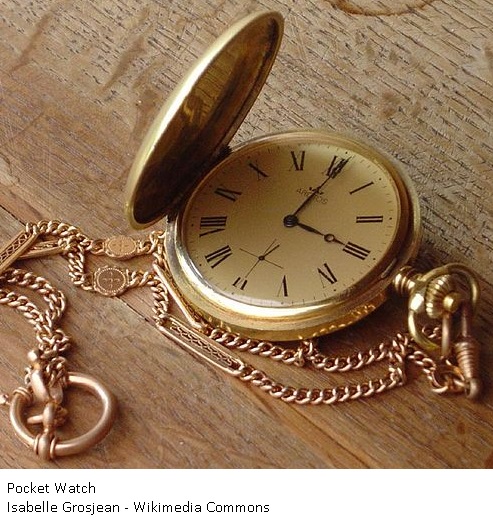
Last Tuesday, (April 22) Roger O’Conner, Esq., was apprehended at Palace Anne, near Badon, and is now in custody in this city on a charge of having been an accomplice in the robbery of the Galway mail coach in the year 1812, when it was attacked at Cappagh Hall, county Kildare, and robbed of a considerable sum in Bank Post Bills, and a gold repeating watch, the property of Mr. Pearse of Loughrea.
It appears that the Magistrates of the Head Police Office, Dublin, having received information of Mr. O’Connor having been concerned in the above robbery, dispatched Mr. R. Gilbert, a police officer in their employment, with warrants for the apprehension of Mr O’Connor and his son, and the warrants having been duly backed by the Mayor of Cork, Mr. Gilbert proceeded in the first instance to Fort Robert in this county (N.S.W), where he arrested the son, who was confined by severe illness to his bed. Being authorised by a search warrant, he made a search at Fort Robert and found a pawnbroker’s ticket for a gold repeating watch, which had been pawned in this city by the son, under a fictitious name. The watch is now in Mr G.’s possession. There is yet, however, no proof of its being the same as that which was taken at the robbery of the Galway mail coach.
Mr. G. then proceeded to Palace Anne, and arrested the father. On their arrival in this city, bail was tendered to the Mayor for Mr. O’Connor’s appearance to answer the charge, but was refused on the ground of its being not legally bailable. A magistrate of this county, having guaranteed the appearance of Mr. Arthur O’Connor when called on, and his state of health not permitting his removal with safety, was suffered to remain for the present at Fort Robert.
(Cork Advertiser).
Special cable despatch to The Sun from the London Times Services;
Whereas by our special proclamation dated July 3, 1918, in pursuance and by virtue of the criminal law and procedure of Ireland, Act of 1887, we declared from the date thereof certain associations in Ireland known by the names of Sinn Fein organization, Sinn Fein clubs, Irish Volunteers, Cumann na mBan and Gaelic League to be dangerous, and whereas the association known by the name of Dail Eireann appears to us to be a dangerous association and to have been after the date of said special proclamation employed for all purposes of the associations known by the names of Sinn Fein organization, Sinn Fein clubs, Irish Volunteers and Cumann na mBan, now we the Lord Lieutenant-General and General-Governor of Ireland, by and with the advice of the Privy Council in Ireland, by virtue of the criminal law and procedure of Ireland Act of 1887, and of every power and authority in this behalf, do hereby, by this our order prohibit and suppress within the several districts specified and named in the schedule, and association known by the name of Dail Eireann.