The air-minded fisher-folk of this district gave enthusiastic welcome to Col. Lindbergh and Mrs Charles A. Lindbergh today.
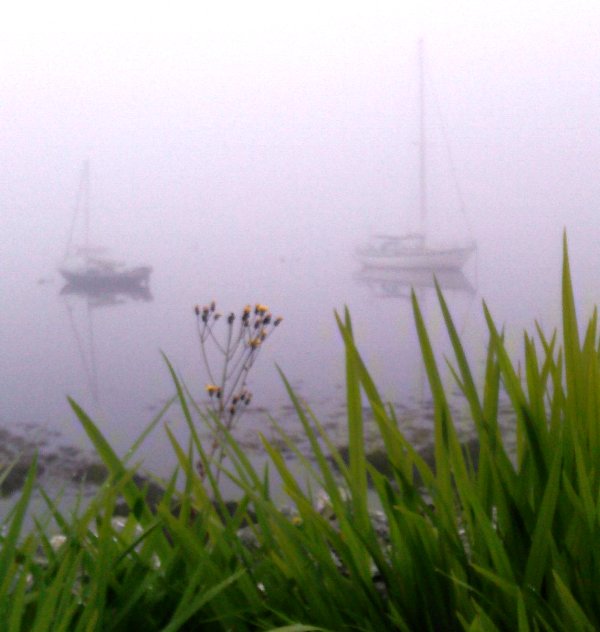
The flying American couple made a perfect landing in the great harbour of Galway shortly after 5 p.m. after a five and a half hour flight from Southampton, England.
Last season 400,000 Forest Trees were exported from the celebrated Waterford Nurseries of Messrs Wm.Power and Co., to help in the reafforesting of England, Scotland and Wales. Nevertheless we hear of some people sending outside Ireland for forest trees. What a world we live in.
On day of Galway August Fair, a cow sold to a countryman by Mr Martin Ashe was afflicted by the great heat. It dashed towards the docks and jumped into the water below the dock gates. Sergeant O’Neill, availing of a boat in which there were two soldiers, went after the animal, which must soon have been carried away by the tide and the current from the river. Assisted by two or three civilians he got a rope around the cow and brought her successfully to the shore at Tip Head, where she was restored to her grateful owner.
TOWN OF GALWAY SESSIONS (abridged) – This case came on on Friday last. Mr. M. had been conveying corn from Oughterard, west of this town, to
Tyrone, Ballinderreen, the seat of his master, Arthur French ST. GEORGE, Esq. On arriving at the toll-gap, toll was demanded of him by the traverser. Mr. M said, that he had no right to pay toll as the corn was not being taken into town for a market. The traverser insisted on what he considered his right, and a scuffle ensued in which Mr. M. was severely beaten.
When the traverser was called for trial, he was not forthcoming, and it was then discovered that no bail had been offered or taken for his appearance! Thus the case rests. Mr. M., a poor man, has been in town for some days at expense, which he was not well able to bear, and the traverser has escaped, for the present, from the inflictions of the law.
Proceedings of the American Philosophical Society Vol. 26 No. 130 (July – December, 1889)
Whitsunday, in Gaelic called Cingcis, is a moveable festival occurring generally about the end of May or the beginning of June, and deserves notice on account of the mysterious fatality connected with it, as well as with the following Monday and Tuesday. It is an unlucky season, and should a man born on any one of these three days ever throw a stone it will inevitably kill or cripple someone. No water must be sold during the same period, and for this reason no clothes are washed from Saturday until Thursday, nor are any sheep washed for shearing. Neither must one start on a journey or begin any important work, but, above all, no one must go near the water, either for bathing or boating, or even to cross a stream, for at this season one may be drowned in a cup of water. There are ancient legends to prove the truth of this belief, and every old woman can tell of instances within her own knowledge where a neglect of these precautions has resulted fatally. Death is not inevitable, however, for only one hour of all this time is fatal, but as no one may know which is the hour, or even on which of the three days it occurs, the only way to avoid the evil consequences is to observe the prohibition until the period has terminated. According to Lady Wilde, the fairies are also to be feared at this season, so that holy water must be sprinkled about the house to keep them away, and at this time also the water spirits come up out of the sea to hold their revels on the shore, and the water horse rises from the lough to graze at midnight in the green pastures upon its banks. A dance was formerly held also on Whitsunday.
The North American Review, Vol. 214, No. 789 (August 1921) pp. 190 – 200
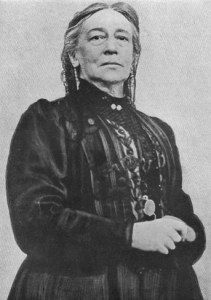
Augusta, Lady Gregory Project Gutenberg eText 19028 From Project Gutenberg’s Irish Plays and Playwrights, by Cornelius Weygandt
by Signe Toksvig
To get from Dublin to Coole Park, the home of Lady Gregory, one normally takes a train from Dublin to Athenry, and another from Athenry to Gort, the village nearest to Coole. But times were not exactly normal in Ireland when my husband and I visited it last summer, and when we got to Athenry we were confronted by the blank fact that for two months or so no trains had been running to Gort. Why? This was a rhetorical question. We knew very well that armed policemen must have been trying to travel on that train, and that the engineer had excused himself for an indefinite period, and that we had better find a Ford. We found one. It was very rickety and full of unwieldy first-aid-to-the-injured-auto things, but Gort was twenty miles away, and hope and beauty had long since left Athenry, and so we squeezed in and began to bump over stony Connaught.
Proceedings of the Royal Irish Academy (1836-1869), Vol. 10 (1866 – 1869), pp. 440-443
M. Brogan – 8th February, 1869 (abridged)
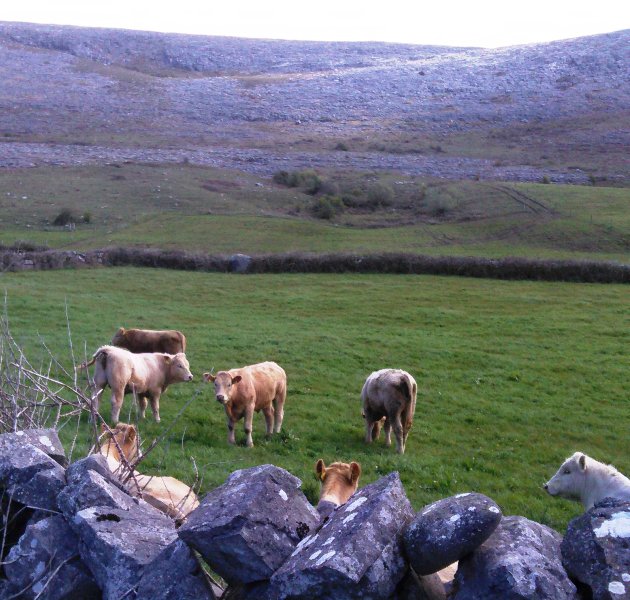
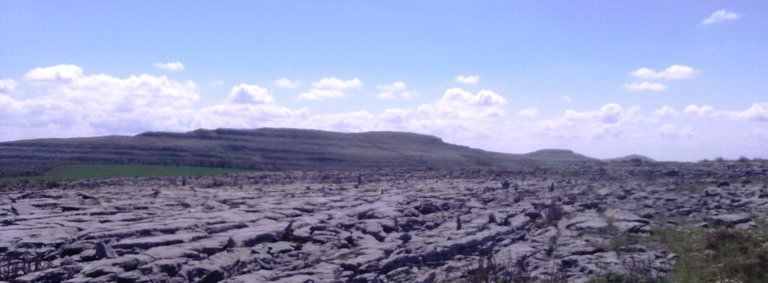
The Hills of Clare Photo: EO’D
When travelling through the country on official duty, I frequently meet with antiquarian remains, some of which may not have as yet been brought under the notice of the Academy. Being recently employed on inspection duty in the county of Clare, my attention was attracted by what I at first conceived to be immense cromleacs, or druidical alters; but which I concluded, on closer inspection, to be sepulchral monuments of some of those stalwart heroes of the olden times who had been “dead and turned to clay” long ere the Milesian adventurers left the sunny shores of Spain to seek and win new home in the green island of Innisfail.
The precise locality of these antiquarian remains is a little south of the public road leading from Gort to Feakle, and about midway between these two towns, in the townland of Druomandoora. The situation is very romantic, being on the northern declivity of the Clare hills, overlooking the deep valley which separates Clare from Galway and which embosoms two beautiful lakes – Lough Graney (Lake of the Sun), and Lough Cooter, with its wooded shores, and islets, and magnificent castle, whose lofty towers and battlements proudly rise over the stately woods by which they are surrounded, and fling their shadows o’er the pellucid lake, “whose tiny wavelets murmur at its base.”
They consist of two sepulchral monuments, distant about a furlong from each other, with two figures inscribed on the adjacent rocks, which in many places present tolerably smooth exposed surfaces. The monument at the greatest elevation on the slope of the hills, though not in the most perfect state of preservation, is the largest. It is called by the people of the locality “Leabadh Diarmaid” (Diarmud’s Bed), while the smaller and more perfect one is called “Leabadh Granu.” I may remark, en passant, that there is a very remarkable sepulchral monument at Coolmore, about three miles north of Ballyshannon, county of Donegal, to which local tradition has assigned the name of “Diarmud and Granu’s Bed.” The rock inscriptions are;
1st. An elaborately and artistically designed figure, somewhat resembling the caduceus of Mercury.
2nd. The impression or outline of the sole of a sandal. I suppose it to represent a sandal; as, if it were intended to represent the naked foot, there would certainly be some attempt, however, rude, to represent the formation of the toes. The foot must have been rather small, probably that of a youth or of a female, as the carving represented it as only ten inches in length, by four and a half inches at the widest part, and two and a half inches at the narrowest part..
My reasons for assuming that the two first mentioned remains are sepulchral, and not cromleacs erected for sacrificial purposes are;
1st. the name accorded to them by local tradition.
2nd. The covering slabs being placed almost horizontally, without the inclination of the covering slabs observable in structures intended for sacrificial purposes; and
3rd. The extreme roughness and irregularity of the upper surface of the covering slabs, formed of the coarse conglomerate rock of the locality. This is most observable in the smaller and more perfect monument, which is covered by a single slab, tolerably smooth on the inner side, but extremely uneven on the outer side, without the slightest mark to indicate that it was ever designed or used for any purpose but that of effectively securing the receptacle underneath. The larger one, of which I give a rude drawing, was covered by at least two large slabs, the end one of which still remains in its original position. The other has been broken into fragments, some of which have been removed; but one large one yet remains, leaning against and overtopping the supporting stones, several of which have also disappeared.
The ghost of Miles Joyce is the latest witness against Saxon tyranny. As the warders of Galway Jail have made application for a transfer to another prison, it is probable that the ghost carries a musket and uses threats. Lord Spencer has personally undertaken the maintenance of the two boys, who are the only remaining members of the Joyce family massacred in County Galway.