Kinvara – Politics, as they go, are still matters of conversational interest here. The Sinn Fein movement is mentioned by some with sympathy for motive and contempt for methods and organisation. The rising came as a surprise, if not a shock, to some persons, but there were, or are, scattered sympathisers or objectors to the more drastic of the methods of repression among the middle as well as the working classes. For among those who paid the inevitable penalty of revolt in time or war were some leaders of ripe scholarship and, in other respects, stainless lives; “Poets of the Insurrection” as they were called, whose mistakes of judgment, policy and method are lightly regarded by those of emotional temperament to whom disinterestedness primarily appeals. Discontent now turns on the recent check to Home Rule as expressed in the Government of Ireland Act 1914. There is a feeling that the political system – Union Government – is still the source of any economic maladjustment and that the country will at once flower under the working of autonomy.
the Hon. P.McM.Glynn K.C. Minister for Home and Territories.
This fine verse, which appeared in the “Bulletin” of the 19th ult. was, says the editor, censored while a Labour Government was in power in the Commonwealth. An appeal was made from the Censor to Ministers. Hugh Mahon came into conflict with his colleagues over it; but permission to publish it was still refused.
Ireland – 1916
All I revered was this my Island, she
Whom through the granite years I wept and loved;
All that I wished, to make my Island free
Of blood from mine a universe removed;
To seat here where the younger nations sit,
Her soul stripped clean of ancient sorrowings,
To dream my dream of Brian and the Kings,
To clothe my dream in flesh and worship it.
For this I bound the falcon to my side
In sinless sinning! For these things I died!
Right of the stronger, when the Norman came,
Rogued me and ravished me and buffeted,
Blackened and scotched my heart with steel and flame,
Cinctured with thorns my felon-shaven head.
The needy Frank and Gascon venturer,
Glutted from Senlac, hot for gear and gold,
Parcelled my land in march and baron-hold,
Hoarse-laughing at the comely shame of her,
Tortured but could not tame my plaintless pride.
This I remember, and for this I died!
Bruised and unbroken, swathed in sweat and rags,
Sobbing, yet valiant, shattered but unspent,
Housed in the bogland, hiding in the crags,
Dying a dog’s death, grim and well-content,
My poet soul out-daring dearth and death
Bondman of every motley creed and crew
Drank at the bitter cup of cycles, knew
The “spacious days of great Elizabeth”
If this I should forget, Christ and the Bride
Forget me also! For this, too, I died!
I was the spoil of all the centuries,
And am forgotten. Later wrongs outweigh
Mine, for the grief of men looks overseas,
And Belgium was the spoil of yesterday.
Can Time’s effluxion make injustice just?
Men’s memories are facile to forget
Poland’s Gethsemane and bloody sweat,
And the long grief that stamped my heart to dust!
O age-sought recompense by men denied,
By this I seek you, and for this I died!
Scotland I know, and how her valour’s crown,
Hard-won, scarce-held by scarp and mountain sleep,
Shone on her helm the hardy decades down,
Guarding the freedom that I could not keep;
And by the crown she linked at last with hers,
As by the nationhood I loved as she,
I swore it on my cross-hilt wistfully
My sons should be my land’s real worshippers.
And this my oath, sworn by the Crucified,
I held and hold to – and therefor I died!
Shall mercy spring from dull hearts trebly stoned?
Shall alien blood and alien creed allot
Betrayal where no fealty is owned,
Disloyalty where loyalty is not?
My blood upon the roadway reddens yet,
The iron of the years is in my soul,
The pen of Fate is set upon the scroll, I am what you have made! Can I forget?
These things I cherish; is it marvel, then,
I died for them, as I shall die again!
As will be seen from our advertising columns, Doorus annual sports will be held in Traught on Sunday, July 31. The committee have secured the services of the Athenry Pipers’ Bank. As this is the Band’s first visit to South Galway they are sure of a hearty cead mile failte, both in Dooras and Kinvara. The sports field is in close proximity to the already famous strand of Traught where tourists from all over the West come every summer to enjoy the beautiful scenery and natural bathing facilities offered there. Given a fine day, the public may be assured of enjoying the day’s outing.
This beautiful and favourite health resort, which deserves to be better known than it really is, has, since the opening of the West Clare Railway, become much more easy of access, as the station at Ennistymon is only seven miles from the Spa. In the old days the long car journey from Ennis, a distance of twenty miles, was very fatiguing and was enough to deter persons of weakly or delicate constitutions from undertaking it at all.
I arrived in the height of the season and only that I took the precaution of telegraphing from Ennis, I could scarcely have got quarters at the comfortable hostelry where I had sojourned on a former occasion. I had the good fortune to fall in with pleasant and companionable society, including a large sprinkling of the softer sex and, If I had not long ago received my baptism of fire from a pair of Southern blue eyes, and so was armour proof against the shafts of the winged god, I certainly should have not returned heart whole.
I found Biddy at the celebrated sulphur well as youthful looking and full of ready repartee as ever, while her faith in the healing virtues of the spring seems to grow stronger as the years roll by. Our time was mainly spent in drinking the waters, climbing the neighbouring hills, or following the courses of the tortuous ravings, which the mountain torrents have worn, here there and everywhere through the beds of shale. The monotony of this style of existence was occasionally broken by excursions through the various places of interest round the Spa, and two of these outings deserve at least more than passing reference.
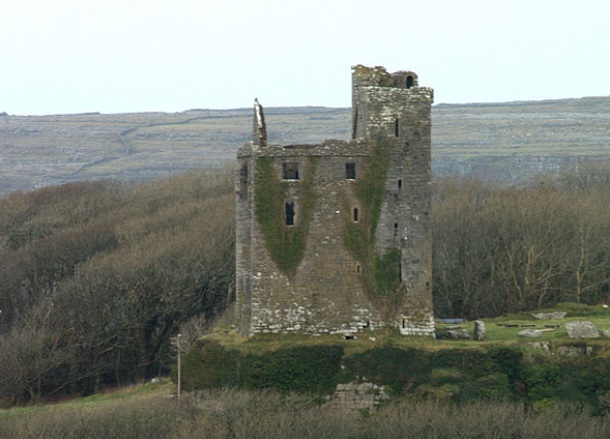
Ballinalackin Castle Bogman Wikimedia Commons
We arranged on one day to go by Ballinalacken and Black head to Ballyvaughan, and returned by the famous Crokscrew road, a piece of engineering that would do credit to the genius of the first Napoleon. The road from Ballinalacken to Ballyvaughan runs along the Southern shore of Galway Bay. The country to the right forms portion of the Barony of Burren and presents a chain of rocky and barren looking hills. Yet we were assured by our driver that succulent grasses grew in the interstices of the rocks and that splendid sheep were raised on these hills.
The day was beautifully fine, the blue sky being perfectly cloudless, while Galway bay was a calm as an inland lake. Here and there a hare-legged, sunburned child peered out from some fisherman’s cabin; anon a startled hare fled away from a wayside clump of rare ferns. Ivy clad ruins of ancient abbeys and churches formed a prominent feature in the landscape and bore eloquent testimony to the piety and faith of our Celtic ancestors.Of the old castles, Ballinalacken, once a stronghold of a sept of the O’Briens, claimed most attention and reminded me forcibly of Blarney. Altogether it was a day worth living for and although I have spent many pleasant days in various nooks and corners of our Island, the memory of this golden one shall abide with me forever.
A few days before my departure, I visited Galway. Galway – quaint, old and decaying! Galway still redolent of the days when dark-eyed Spaniards promenaded its streets and quays, intent on selling their precious cargoes of rare wines! I was very much struck with a curious mixture of the ancient and the modern. In one of the principal streets stands a battlemented castle of the date 1473, with curiously carved escutcheons and leering griffins; the basement being devoted to the utilitarian purposes of a tallow-chandler’s shop!
The other places of interest to the visitor or tourist within easy reach of Lisdoonvarna are the Cliffs of Moher, which rise perpendicularly from the ocean to a height of 800 feet; St. Bridget’s well, near Liscannor, the subject of Petrie’s famous picture of “The Blind Girl at the Holy Well”; Corcomroe Abbey and Inchiquin Lake.
When the holiday season comes round again and tired citizens are asking themselves the question, “Where shall we go to?”, I would strongly advise a visit to Lisdoonvarna and West Clare, where pure mountain air, natural scenery, and, to those who may require them, healing springs, cannot fail to please and charm the most fastidious.
Irish Independent 4th December, 1934 p.12
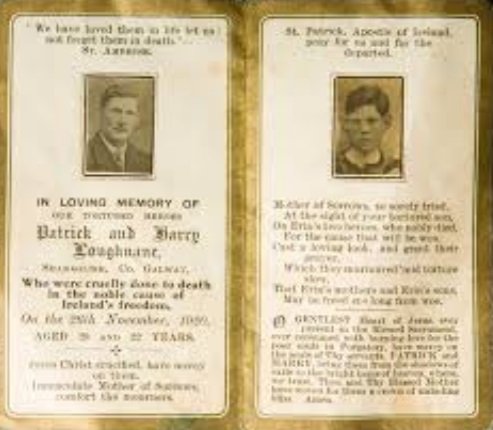
Mr. Sean Russell, I.R.A. unveiled a memorial cross, and delivered an oration, near the spot where the mutilated bodies of Patrick and Harry Loughnane (brothers) were found in November, 1920 at Carragaroe, Kinvara.
The brothers were members of the Volunteers, and were taken from home by the Black and Tans; their bodies being discovered in a pond some weeks later. Members of the I.R.A. from many districts, including many old comrades in the Volunteers, paraded to the spot, where they formed a guard of honour, and recited a decade of the Rosary in Irish.
To the Editor of the Freeman
Kinvara, December 11th
Dear Sir,
I regret very much that the distress in the west, on which you so seasonably commented in your leader in Wednesday’s Freeman, is not confined to Clifden nor to Connemara, but is to be met with as severely elsewhere.
We have in Kinvara, with its population of over 350 families, want at present bordering on starvation, while the people in the rural districts all round are not much, if anything, better off, and unless our paternal Government open up public works in some form, actual starvation, with its usual sad and sickening train, will be the result before the 1st February.
Our rulers may shut their eyes to and pretend to ignore the present crisis, but there can be no question as to the existence of deep and general destitution among the labouring classes. This distress seems to be more keenly felt by a certain class of small farmers than it is by those who have nothing to fall back on but their daily pay, for the latter are more or less familiar with want, though not to anything like the present extend; while the former were before now comparatively comfortable, but this year an accumulation of misfortunes, for which they were unprepared, came upon them, and crushed them to the very earth. Rot among the sheep, consequent on the severe autumn and winter of last year; losses in the sale of stock, the partial destruction of their crops this year by blight, storms, and a wet summer and autumn – these were the casualties that crowded in rapid succession on the small farmers, and reduced them to a state worse, if possible, than that of the purely labouring class.
How miserable the condition of many among the small landholders is at present no person knows better than the priest who goes among them with all the freedom of a father, and is made their confidant in their weal and woe. It requires no prophet to tell how those poor people are to eke out an existence during the next six months, for starvation and pestilence will victimise many of them unless something is done to give employment to the many hands among them who are able and willing to work.
If, as we are assured, the solas pupuli be the suprema lex, surely the Government of the country is bound to save the people, and when this can be done without any loss to itself, as in the present emergency by opening up reproductive works. The obligation becomes so grave and solemn that no Government can overlook or disregard it without laying itself open to the charge of being anxious to get rid of its subjects “with a vengeance.”
In Kinvara a great deal might be done in the way of giving employment to the labouring classes. We have a beautiful bay, but no trade, except in turf; a good harbour, which we require badly, would do much to encourage and promote trade with Galway; opening a communication between Kinvara and Gort, a distance of seven miles, by means of a railroad, which could be laid down at present, would not only serve the poor by giving them employment, but would also materially benefit both towns. Then again, though it might sound paradoxical to assert it in the depth of winter, still it is perfectly correct to say that we are at the present time suffering from a dearth of fresh water, as the only one spring which supplied the whole town, and neighbourhood, has ceased (not an unusual occurrence) to yield its usual refreshing beverage, and in consequence we are compelled to put up with a substitute of a very muddy description, while never-failing wells of the most crystal like water are to be found on the burren hills about three miles off. But as far as we are practically concerned at present they may as well be thirty miles; for, like the lakes that “shone in mockery nigh” they are untouched and untasted by us. However, it would be very easy and by no means expensive to convey the water from those hills by pipes to Kinvara, and as employment is required for the poor, the present would be a very favourable opportunity for doing a very useful, if not a necessary work.
I am, dear Mr. Editor, faithfully yours,
J. Molony P.P.
By royal warrant, dated the 21st of March, 1911, Mr. James William Brady Murray, B.A., B.L., J.P., of Moyvore, Kinvara, Co. Galway, has been appointed a member of the first governing body of University College Galway, in the room of Mr. William Daly, J.P., D.L., deceased.
The town of Kinvara was brilliantly illuminated in honor of the first visit of the Most Rev. Dr. O’Dea to his episcopal parish since his translation to Galway. His Lordship attended for the purpose of opening the mission conducted by the Capuchin Fathers in connection with the founding of the St. Patrick’s Temperance League of the West, as well as for the purpose of administering the Sacrament of Confirmation to hundreds of children throughout the parish.
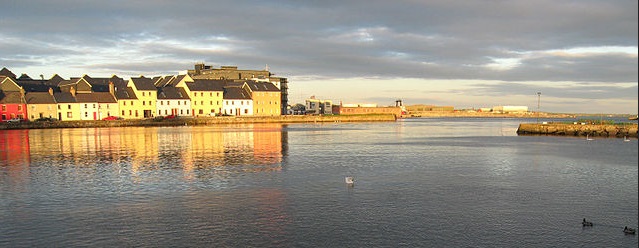
It is well-known that Galway Harbour would be one of the finest in the world but for a reef that prevented large ships from entering. Several catastrophes have been connected with this barrier. The historic rock is now being smashed to smithereens by an 18 ton torpedo-type battering ram, which has a point made of the hardest steel known to scientists. The removal of this obstacle just outside Dun Aengus Harbour forms part of the, gigantic plan to modernise facilities for handling increased traffic at all stages of the tide, and for bringing in much larger ships.
Australians will recall a similar work at Fremantle by the famous Irish engineer, C. Y. O’Connor. The submerged rock barrier rendered navigation not only difficult but at times dangerous, and, more than once, ships have been laid up in the harbour for days, and others have had to stand by in the bay during inclement weather. Out in the harbour men are working to put an end to all that. Day and night, during October and November, the harbour was the scene of intense activity. The improvement scheme is estimated to cost £200,000, and within two years it is hoped to bring Galway into line with the other leading harbours, capable of accommodating seagoing vessels up to 8000 or 9000 tons.
French and Dutch experts, aided by local workmen, are well advanced with the job of removing the reef. A huge dredger first carries away the mud and sand from the reef 3 surface, preparing the ground for the rock breaker.Worked from a specially constructed barge, this battering-ram is dropped through a steel tube on the rock, smashing its way through it like a pneumatic drill breaking concrete. By the middle of this year it is expected that it will have completed its work, and the construction work proper, with an average of 200 men in employment, can begin on the harbour.
It is proposed to deepen and widen the approach channel to the dock to such an extent as to allow vessels to turn before entering or leaving the docks. The Dun Aengus Dock will be replaced by a concrete pier, 450 feet in length, on the south-west side and 320 feet on the north-east side. Passengers alighting from or embarking on the Atlantic tenders, especially during the winter months, must have carried away unfavourable impressions of the pier, bleak and without shelter from the Atlantic gales. It is to facilitate them, the travellers from the Aran Islands, and the Customs officers and other officials, that a concrete shed, 250 feet long, will be built along the pier. It will be equipped with offices and waiting-rooms. On both sides of the new pier it is intended to provide a railway line connected to the main line of the G.S.R. These branch lines will be equipped with travelling cranes capable of dealing with cars, baggage and merchandise. Adequate quays, roads, a car park, and additional space for storage will be made by filling in the disused dock to the east of the Dun Aengus Dock. This portion of the work is also in hand, and two caterpillar excavators are preparing the site. Till now the use of the harbour has been restricted to vessels with a draught of about 12 feet, entering or leaving one hour before or after high water, but when the scheme has been completed it will be possible for vessels up to 350 feet m length, and with a draught of more than 21 feet, to clear the passage with ease. Galway people see in the harbour scheme a new era of prosperity. Its completion, they say, will lead to many more ships making use of the harbour, with a consequent increase in exports and imports, and much-needed employment both at the docks and in the city.



 The Burren and Beyond