Posted in Posts and podcasts

The Headless Coach – Kinvara

The Headless Coach

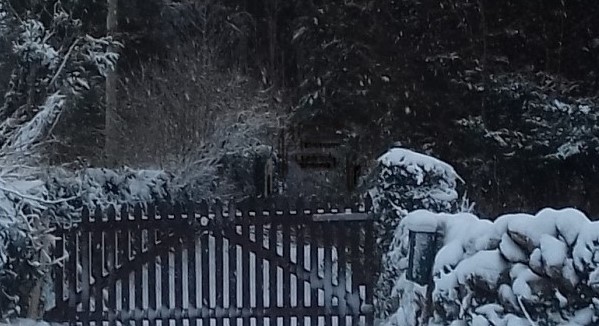
Behind the gate Photo: EO’D

The Headless Coach is a sort of a topic of a story that is talked of in the country inns. But it is not entirely a fairy tale.

When a person sees the Headless Coach they are supposed to die soon afterwards.

I went up for a holiday in Kinvara, and I went down to the small quay where the turf boats used come in to unload and load. I saw a hearse coming up the street and a crowd of mourners behind it “Who is dead” I said to one of the Irish fishermen “Ní thuigeann tú” he said and then he started to fire a flow of Irish questions at me with such speed that I could not understand head nor tail of what he said. When I did not answer him he answered them himself so I took my leave. I went to a group of boys and men who were standing outside a shop. I asked them “Who is dead” and they told me that a man who said that he had seen the Headless Coach a week ago.

A girl in the Convent nearby said that she had heard a great rattling of chains on the night that the man had peofessed to have seen the Headless Coach as if horses werestraining at their traces, so there might be some truth in the story.


Duchas.ie
School: Cill Moicheallóg (B.) (roll number 15740)
Kilmallock, Co. Limerick
Teacher: Conchobhar Mac Raghnaill
Collector: Maurice Power, age 13
Kilmallock, Co. Limerick
Informant: (name not given), age 50
Language: English
Posted in Posts and podcasts

Kinvara – 1889

The Irish Standard, April, 13, 1889 p7.

On Friday the 15th ult., a large force of police, accompanied by Redington’s representative, Malone, and a brace of emergencyment, with a battering ram, invaded the town of Kinvara, for the purpose of carrying out evictions on the property of Major John Wilson Lynch, chairman of the Galway board of Guardians. On the arrival of Mr. Kendall, the agent, the evicting party proceeded to Caherireland, a village some miles distant. Having arrived at their destination, the sheriff’s baliff and agent entered the house of Thomas Cavanagh, and demanded possession. This they took by force, casting all that was inside the house out on the street. The evicting party next proceeded to the house of Pat Cavanagh and cleared it of its occupants and effects. The tenants in those cases farm some thirty acres of land, and were well to do until the depression in the time set in. Before the eviction the tenants offered one year’s rent to the agent. This he refused to accept. The tenants evicted are determined not to advance a single penny on their former offer.

Posted in Posts and podcasts

Snippets – 1920/21

Petrie Photo: EO’D

Freemans Journal 19th July, 1920 p5
Kinvara police barrack, which was evacuated last week, was demolished shortly afterwards. The courthouse was also demolished and the records burned. The empty barrack at Moy has been burned.

Connacht Tribune 18th September, P8
Compensation claims;
20,000 for the burning of Tyrone House, Kilcolgan
5,000 for the wounding of Head constable Elliott at Ardrahan
2,000 for damage to Kinvara barracks etc

Connacht Tribune February files 1921 – awards printed in the Connacht Sentinal 24th February, 1953, page 2
Mrs Fanny Sharp, 76 Prince of Wales Mansions, Battersea Park, London and Edward J. Moore, Dunstive, Co. Kildare, claimed 2,000 for the burning of Kinvara Court house in August of 1920; award 790.
Elizabeth Nally and Ellen Hynes Kinvara were awarded 925 for the burning of Kinvara police barracks in July, 1920. John Bermingham, Kinvara was awarded 60 for the destruction of a side car and harness. John Killeen Dungora, Kinvara, was awarded 275 for bodily injuries received in April.

Posted in Posts and podcasts

Land Law Bill – Ireland – 1895

LAND LAW (IRELAND) BILL.
https://api.parliament.uk/historic-hansard/commons/1895/apr/02/land-law-ireland-bill
HC Deb 02 April 1895 vol 32 cc735-817 735
THE CHIEF SECRETARY FOR IRELAND (Mr. J. MORLEY, Newcastle-upon-Tyne)(abridged)

The late Sir William Gregory. In his autobiography I find this passage. He is speaking of the sale of some portions of his ancestral estates in the county of Galway:— I may here mention that the result of this sale had a very strong influence afterwards in my political career, and rendered me a very advanced politician on the tenants’ side, on the landlord and tenant question.

Shortly after my father’s death, I visited every holding on the estate, and was struck with the results of the unflagging industry of the tenants who occupied the light stony land about Kinvara. They had by their labour, and with no allowance from the landlord, cleared large portions of their farms, and the great monuments, as they called them, of stones attested their industry. From these clear patches they had excellent barley crops, and were in prosperity. My great-uncle and father were both just men, and allowed them to enjoy the fruits of their toil for many years without raising the rent. On the occasion of my visit, when I was about to drive away, I said to these tenants, who had assembled to greet me, that I was surprised to see so much good land, and that I thought it was capable of bearing a higher rent. Of course, this called forth a general protestation, and very sad were their faces; but they soon cleared up when I said to them, ‘Were I to take one shilling out of your pockets on account of the additional value you had given to my property by your industry, I should be a robber and ashamed to look you in the face. You can go on in good heart with your work, and be assured that while I own this property, your rent shall never be raised on account of your improvement.’

Such were my intentions, and such was the confidence of those tenants that they never asked for a lease, or I should have gladly given it to them. When the sale came on I was so occupied with other matters that I quite forgot their danger. Indeed, it never crossed my mind, for I had then heard of no particular instances of rapacity on the part of new purchasers; but I very soon had a terrible account of my remissness in not securing these poor folk.

Mr.——, to whom I have referred, as soon as he was placed in possession of the lots he had purchased, on which those tenants dwelt, lost no time in dealing with them in the most remorseless fashion. The rents were raised so as to pay £5 per cent. on the borrowed capital, and a large income besides for himself. They were almost invariably doubled, and in some cases £5 was charged where £2 had been the rate of the former rent. But he killed the goose for the golden egg, the town of Kinvara was all but ruined, and the best tenants ran away. I met one in Australia, at Ballarat, and he assured me he was well off when I was his landlord, but a pauper three years after, when he emigrated. It is things of that kind that have sent thousands and tens of thousands of Irish across the sea, not only to Australia, but still more to the United States, with hatred in their hearts for the system which exposed them to these abominable cruelties, and for the Government and this Parliament which allowed such wrongs. I am all the more glad to have read that passage, because Sir William Gregory and his ancestors had none of this harsh spirit, and it shows that there were some exceptions, at all events, to Mr. Justice Keogh’s violent description of the Irish lairds as “the most heartless, thriftless, and indefensible landocracy in the world.”

Posted in Posts and podcasts

Biddy Early 1902

Freemans Journal 4th June 1900
Lord O’Brien of Kilfenora was, as everybody knows, more than once a candidate for Parliamentary honours in his native county of Clare. It was, we believe, on the occasion of the death of Lord Francis Conyngham, one of the earliest and staunchest supporters of Isaac Butt in the early agitation for Home Rule, that Mr. O’Brien made a tour of the county and introduced himself personally to the electors. His manner was suave and his speech conciliatory in the extreme. Some of the electors were doubtful as to whether the “man of law” from Ballinalacken was with Isaac Butt or against him. In their perplexity they went to consult Biddy Early, a woman skilled in the suture, who delivered oracles in a sequestered glen between Lough Greany and O’Callaghan’s Mills. Biddy arranged her philtres, put on her sagest look, and deliberately pronounced that the cattle of any man who voted for a recreant descendant of Boru would die of black quarter. Further than this she could not be induced to go. The people were by no means satisfied, for they thought the O’Gorman man bore a much greater family likeness to Brian Boru than the man from Lisdoonvarna.

Posted in Posts and podcasts

Ballinderreen 1915

Connacht Tribune 20th November, 1915 page 4Photo: EO'D
DASTARDLY OUTRAGE AT BALLINDERREEN

On Wednesday night, 10th inst. a startling explosion was heard in the vicinity of Ballinderreen village. At about 9.15 p.m. a loud report rang out in the direction of the schools, and at once the cry was raised that a German bomb had been thrown some few hundred paces from the village. Four policemen, including Acting-Sergt. Walsh, Kilcolgan, were quickly on the scene, but failed to discover the source of the mysterious report. In the morning, however, it was discovered that a portion of the National School wall had been blown up with gelignite, it is thought. The reason for the occurrence remains a mystery and the police are “all at sea” regarding the dastardly outrage.

Posted in Posts and podcasts

Kinvara 1992

Connacht Tribune July 7th July, 1992 p6

Kinvara

The people of Kinvara have asked Councillor Toddie Byrne to raise with Galway County Council the condition of the old Church of Ireland graveyard at New Road, Kinvara. This graveyard has an unknown number of graves with only two headstones still erect over the graves of Joseph Staunton (died November 3, 1866, aged 66 years) and Eliza Jackson (died January 2, 1866, aged 60 years).
The public disquiet surrounds the manner in which walls and ground surface of the graveyard were interfered with.
They have asked Councillor Toddy Byrne to bring the matter to the attention of the County Engineer, Mr. P. Flood. This week Councillor Byrne, following his representations to Mr. Flood, expects the matter to be resolved.