Kinvara will have a world-class sewerage treatment plant when construction on the new facility is completed in early 2017.
That’s according to Irish Water, who have today signed a contract for the long-awaited facility at the Merriman Hotel, Kinvara. It concludes decades of campaigning for a new plant to tackle raw sewerage in Kinvara Bay.
The utility is investing 5 million euro to construct the new plant and upgrade the towns sewer network. The new plant will be located at Ballybranagan and Irish Water says its design, now entering its final stages, will allow for future population growth and tourist numbers.
Over the next two weeks, Irish Water will host meetings and community groups to address local concerns over the 14 month project.
Speaking to Galway Bay fm news at this morning’s contract signing, Environment Minister Alan Kelly says he looks forward to people swimming in Kinvara Bay once more.
On Sunday night next Kinvara Dramatic Society will stage “The Troubled Bachelors” in the local hall. The production is by Mr. Kieran Moylan, star of many pantomimes, who will himself fill the leading role of “Peter Carmody.”
The play is in aid of the local G.A.A. and the artistes who will take part are Messrs K. Moylan, N.T; T. Byrne, N.T; P. Geraghty, M. Glynn and J. Mitchell, and the Misses F. Ryan, B. Quinn N.T; M. Connolly and S. Regan. A concert by local artistes will support the play.
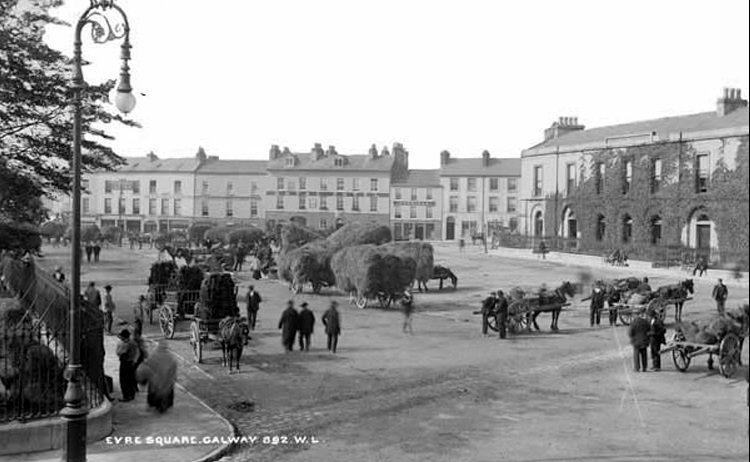
Eyre Square, Galway c.1897 National Library of Ireland Wikimedia Commons.
The great public banquet to Mr. O’Connell took place this evening at the magnificent and extensive pavilion, erected for the purpose in Eyre Square, and served as a fitting conclusion to the grand and imposing scene of yesterday. The preparations were all on the most extensive scale, and no trouble or cost was spared to render the banquet worthy of the great importance of the occasion. The pavilion was large enough to contain upwards of 1,000 persons, and was fitted up with great taste and effect. Over the two principal entrances the word “Repeal” appeared in gas lights, and behind the head table several beautiful devices were also formed in the same brilliant material. The tickets collected by the stewards at the dinner amounted to 560 in number, and when the occupants of the principal table and the stewards were enumerated, the entire of the gentlemen present somewhat exceeded 600 in number.
Daniel O’Connell in Galway (abridged)
From an early hour the streets were densely thronged by the country people, who continued to pour into the town in countless thousands, exhibiting in their persons all the wild and picturesque costumes of the west. The women’s short dark-red flannel petticoats were surmounted by the deep blue or brilliant scarlet cloaks. The majority of the younger portion were barefooted, and had their heads uncovered, their hair hanging loosely over their shoulders. Nearby were the dark frieze coats and corduroy breeches of the men from the interior of the country and the light sky blue dress of the Connemara men, who had prepared themselves to come in thousands in boats. Owing to the lightness of the wind, only a comparatively small portion were able to enter the harbour in sufficient time for the meeting.
The dark blue of the Claddagh fishermen, the Aran Islanders in their hairy shoes of untanned calf-skin, and the Iar Connaughtmen, mounted on their untrained and unshod mountain ponies – all mingled together in the old streets, talking Irish in loud accents as they went along.
When twelve o’clock, the hour at which the procession was to set forth, approached, the throng in the neighbourhood of the Square and Market-place became extremely dense, while the excitement was increased by the arrival of the tradesmen, all ornamented with sashes and bands and carrying long white rods surmounted with ribbons, to take their places in the procession, and by the merry strains of the temperance bands, that were each carried in boats placed in carts, and profusely ornamented with flags and green boughs.
At length the loud shouts of that peculiar and most interesting body of men – the Claddagh fishermen – was heard as they approached to take their ascribed place at the head of the procession. They mustered nearly a thousand strong, and a large portion of them wore large white flannel jackets, ornamented with ribbons and pieces of various coloured silk, while their hats were quite concealed with ribbons, flower-knots, and ostrich feathers.
The tailors were allowed to take their position second in the procession, and the remainder of the trades, twenty-four in number, were placed by lot, as arranged at a preliminary meeting held on the preceding day, in the following order;
Millers, Wheelwrights, Hatters, Tobacconists, Bakers, Stonecutters, Ropemakers, Broguemakers, Printers (having a printing press mounted on a richly decorated chariot), Butchers, Plasterers, Shoemakers, Coachmakers, Shipcarpenters, Coopers, Chandlers, Cabinetmakers, Nailers, Sawers, Housecarpenters, Stonemasons, Painters, Smiths, and Slaters.
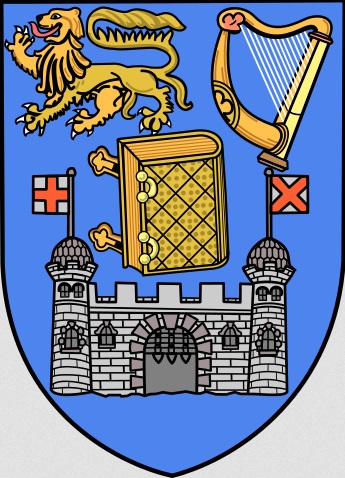
Line drawing of the arms of Trinity College, Dublin, as illustrated in “College Histories: Trinity College Dublin” by W Macneile Dixon. Creative Commons.
All Saint’s Day irresistibly revives the recollection of the fact that Trinity College Dublin occupies the site of the dissolved Monastery of All Hallows, or All Saints, and is thus not only in receipt of the revenues of plundered abbeys, like the Abbeys of Kilmacrenan and Asseroe in Donegal but actually is built on the ground once occupied by an “essentially Catholic” institution.
All Hallows Monastery was literally razed to the ground. In Trinity College at the present day there is only one relic from the time of the existence of All Hallows – a mulberry tree in the Provost’s garden is shown to the visitor as the sole survivor in that institution of the “pre-Reformation” period. In St. Werburg’s Protestant Church, in whose vaults Lord Edward Fitzgerald is buried, there are two antique monumental slabs with effigies. They are supposed to have formed portions of the tombs of the Abbots of All Hallows, which were preserved by pious hand from absolute destruction of the “suppression” of that home of religion and useful learning.

 The Burren and Beyond