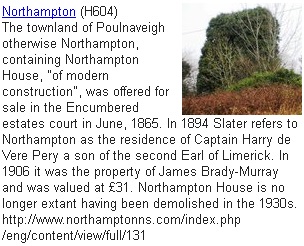
The fund for the building of a new Cathedral in Galway had its origin in a bequest of 500 pounds made by Mr Murray of Northampton House, Kinvara, in the year 1876. Connacht Tribune 14th January, 1922 p1
For Sale;
NORTHAMPTON HOUSE, KINVARA, CO. GALWAY
This splendid and up to date Mansion contains about 25 apartments, comprising Drawing Room, Dining Room, Bedrooms, Billiard Room, etc., in thorough repair. The woodwork is all pitch pine (nearly new). The fire places are fitted with marble and ornamental mantel pieces. The building is of cut stone, and could be dismantled at a very little outlay.
Northampton is one mile from Kinvara Port and three miles from Ardrahan Railway station (G.S. and W. railway). Offers in writing will be taken and considered up to Monday, 23rd January 1922.
For further particulars apply to
Edward M.Kennedy
Connacht Tribune 15th October, 1910 p.4
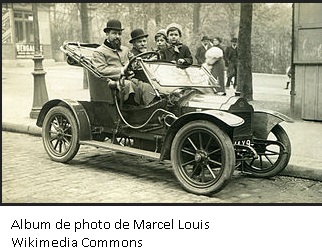
A report spread around Kinvara early on Tuesday that the Sheriff’s men were “marching” on Kinvara with up-to-date motor cars from Galway, to make seizures on the town tenants on the Sharpe estate. The people were beginning to take things easy when at the toot of a motor car on the Castle road all shops were closed and the situation calmly surveyed from the upper windows. The motor belonged to a well known Galway trader, who looked amused when he heard the consternation his arrival had created. Developments are hourly expected, and the situation is growing serious as time advances.
Tuam Herald 4th September, 1920 p.2 (abridged)
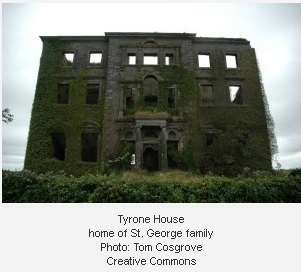
A correspondent sends us some interesting details of the malicious burning of Tyrone House, the ancestral home of the St. Georges – a family settled in Ireland for over three hundred years, and for over one hundred, the most prominent and influential in the county of Galway. This splendid and imposing structure, which could be seen for miles around, was built by the late Christopher St. George, D.L., at a cost of over fifty thousand pounds. It could not be built now for two hundred thousand pounds. It was in the late Georgian style and the finest house in Ireland. The ceilings were all painted by Italian masters and were regular works of art. The mantle pieces were of rare Italian marble and very costly. In the hall was a fine full-sized marble statue of Baron St. George, again the work of an Italian artist. The head was broken off the night of the raid. All the ceilings and mantle pieces are now ruined, and the entire structure an empty shell and ruin.
There was no grounds for the report that the military or police intended or were to occupy the house, and agrarian motives are believed to have inspired and instigated this act of purely wanton destruction.
Of late years the place was freely allowed to be used by pleasure parties who came out from Loughrea and other places to have a dance which cost them nothing, and who were never prevented from having their pleasure and a dance on the spacious floor of the dining room. They can now no longer do so, where in olden days the finest balls in the county Galway took place.
A report spread around Kinvara early on Tuesday that the Sheriff’s men were “marching” on Kinvara with up-to-date motor cars from Galway, to make seizures on the town tenants on the Sharpe estate. The people were beginning to take things easy when, at the toot of a motor car on the Castle road, all shops were closed and the situation calmly surveyed from the upper windows. The motor belonged to a well known Galway trader, who looked amused when he heard the consternation his arrival had created. Developments are hourly expected, and the situation is growing serious as time advances.
Kinvara was the scene of feverish activity on Sunday when the Ballinderreen Platoon, under Lieut. E. Quinn; Dooras Platoon, under Cpl. M. Fahy, and Kinvara Platoon under Vol. M. Quinn, held a Field Day for the purpose of holding star grading tests. Forty volunteers were tested and although the standard of examination was high, 32 were successful in gaining the coveted “stars”.
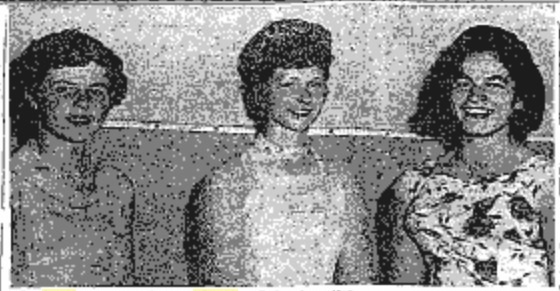
The Queen of the Carnival at Kinvara with two attending ladies left to right Miss Concepta Callanan, Caherglissane, Miss Kathleen Forde, Ballybuck (Queen) and Miss Annie Nolan, Crushoa. Connacht Tribune 1959
Sunday evening was Carnival Evening in Kinvara, when large crowds, including many visitors, watched the Fancy Dress Parade and the Crowning of the Queen of the Carnival. The town was en fete, decorated with flags and bunting. The Carnival is run jointly by the Kinvara Guild of Muintír na Tíre and the Kinvara Club G.A.A., one of its principal objects being the development of the G.A.A. pitch recently purchased. There were over two hundred competitors in the Fancy Dress Parade.
The Parade Marshall rode in front on horseback, followed by the Tulla Pipers’ Band. There were at least three “Tom Dooleys.” “Mr. de Valera” passed by holding out a pair of boots with the caption, “Who’ll fill Dev’s boots now?”. A boy and girl festooned with authentic exam papers, bore a card calling for the abolition of the Primary Cert; “Padraig O’Conaire” drove by on his ass and card; “Liberace” escorted his “Mum.” There were several editions of the Dalai Lama, Billy the Blacksmith was a “Museum Piece,” a tiny pair with costumes made up of the “Noughts and Crosses,” portrayed the “Referendum on P.R.”.
Others included – “The Queen of the Shear”; “Christy Ring”;”No Council Houses for Kinvara”; a “Sultan”; the “Four Seasons”; the “Latest Fashions”, including Onion Line, Sack Line, Balloon Line and 1960 Line; the “Result of the Bantry Explosion.” The magnificent Puck Goat drawing a tiny car and driver was among the cowboys and other foreign gents in fancy costumes.
At the quayside the Mayor of Kinvara, Mr. Michael Leech, and his aide de camps awaited the State Coach bearing the Royal Party. The “messenger” riding a penny farthing bicycle, arrived to announce to the M.C., Mr Tom Donnellan, the election of the Queen and her imminent arrival.
The election of Miss Kathleen Forde of Ballybuck, Kinvara, was greeted with acclamation. She arrived in her coach, attended by her four ladies in waiting, the Misses Annie Nolan of Crushoa, Concepta Callanan of Caherglissane, Rosemary Silke and Mary Keane of Kinvara .Having welcomed all visitors the Mayor took the crown from the hands of the “Court Equerry,” Kieran Moylan and crowned Kathleen I. The new Queen, in her “Coronation Speech”, promised that all taxes would at once be doubled but would be payable to the Royal Treasury for such worthy projects as the repair of the roads around Kinvara and the extension of the fishing limit to twelve miles.
Kinvara, Killina and Duras, Galway – Reverend F. Arthur (abridged)
Deaths by famine, 148, in addition to 98 occasioned by a melancholy subsistence on sea weed, nettles, “Bliskane,” & c. Last year the mortality was 52, so that the increase amounted to within a fraction of 400 per cent. Over 1,100 persons were cast out to perish by the order of reduction. There is the parade of relief under the act, but the committee are fastidiously select. Out of a population of 10,000 “there is not 100 who would not be ranked under the first class paupers.”
The reverend gentleman regrets the absence of a Protestant rector “to assist in the great work of charity,” a regret inspired with the most sublime Christianity. And yet the Mail not long since made merry, with that divine desire which proved how well the Rev. Mr Arthur could share the brotherhood of benevolence with one of a difference creed. We seek to introduce no unworthy bickering into the neutral ground of charity, or to interrupt the “truce of God,” with reflections derogatory to any class embarked in the sacred cause of humanity; but if stones have been cast, the Catholic clergy did not originate or perpetuate the quarrel. They calmly bore the faint ebullitions of the old intolerance – which even the fate of thousands of perishing fellow Christians could not altogether repress.
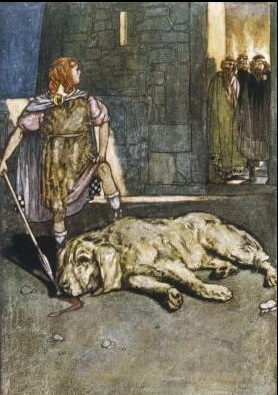
“Cuchulainn Slays the Hound of Culain.” by Stephen Reid According to legend the young man used his hurley and sliotar to defend himself against the huge beast. Illustration from “The Boys’Cuchulain” by Eleanor Hull (1904)
Hurling was played in Ireland from the time of the Celts. It was essentially a military game, designed to keep the warriors in perfect condition and training for battle. No other exercise could equal it in training the eye and the hand. Napoleon, upon witnessing a hurling match among the men of his Irish brigade, remarked that “the race who invented such a game could whip the world.”
In the ancient schools of Ireland, civil and military, the youth had to be instructed in hurling, commencing at a very tender age. Each youth had to have his own hurley and ball, and practice until he learned the fine points of the game. This formed part of the instructions which an Ollamh imparted. In ancient laws the rights and privileges of a hurler were well-defined and protected.
Injury, while engaged in a game seldom happened, for not only would the hurler who injured an opponent suffer disgrace by being considered unskillful, but furthermore he was compelled by law to support the injured man and all others dependent on him while he was incapacitated.
Connacht Tribune 10th February, 1934 p.6
According to legend, Galway Bay was formerly a large lake and known as Lough Lurgan, and at one time the islands formed portion of the mainland, but the lake burst its boundaries, leaving the Aran Islands as the remains of the land that used to separate it from the sea. This statement was made by Rev. Co Senatlebury, S.J. Dublin, during the course of an interesting lecture on “The Saints and Shrines of the Aran Islands.”
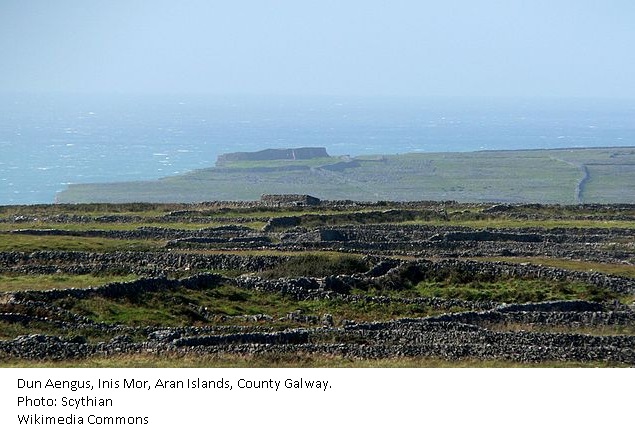
Each of the islands is rich in archaeological remains. Practically every kind of ancient structure, from the dolmen to the 17th Century castle, may be studied in Aran. The huge stone fortresses, which are so conspicuous landmarks as one approaches the islands from Galway Bay, testified to the importance of the islands in pagan times. From ecclesiastical remains and from the Annals, the role that Aran played in the history of the early Irish Church may be judged. There are four forts on the largest island, two on the second largest and one on the smallest. The most famous is Dun Aengus, which stands on a promontory at the edge of the sea. It was said it got its name from the dark colour of the stones of which it was built.

 The Burren and Beyond