The United Irish League visit Aughnish
Ever since the evictions on the island, or rather, peninsula of Aughnish, the Galway branch of the United Irish League have taken a deep interest in the condition of the islanders, and it was with a view of learning the true state of affairs that the energetic Secretary, Mr. P. Ussher, accompanied by a representative of the “Tribune,” paid a visit to Aughnish island on Sunday. A stout sailing boat was requisitioned and the trip across the Bay in ideal weather was much enjoyed. After a cruise of nearly two hours the party landed at New Quay, and then took a smaller boat across the narrow channel to the island.
full article in Kinvara and beyond at theburrenandbeyond.com
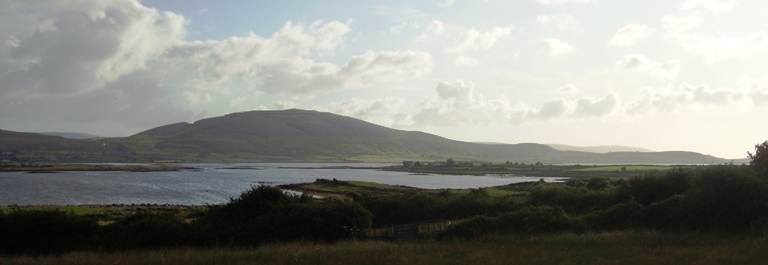
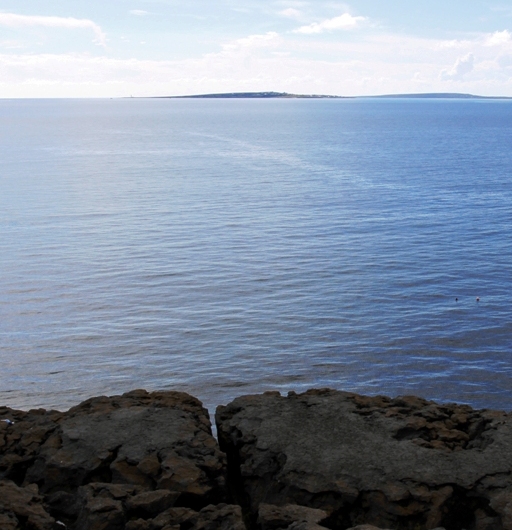
View from Duras, on the way to Aughnish Photo: BO'(abridged)
Dear Mr Moran,
In last week’s issue of the “Tribune”, I read an account of the serious damage done to the sea wall at Aughnish by the storm. This, I think, calls for a little plain speaking from someone in the locality. In the interests of the heavily-muleted ratepayers of the Gort Rural District, I am prompted to write and I hope to convince you that my remarks are more than necessary.
The sea wall, or “Coch,” at Aughnish, as you are aware, is a causeway connecting the densely populated village of Aughnish Co. Clare, with the mainland at Geeha – an appropriate name, for every wind that blows, run riot there. The road runs along by the Atlantic for about a thousand yards, two-thirds of it being in the Gort Rural District, and one-third being in the Ballyvaughan District, County Clare. For the past half century the causeway has been repaired times out of mind at considerable cost to the County Galway, but at a very trifling cost to the County Clare. More money has been spent by the Galway Grand Jury and the Gort Rural District Council on repairing breaches after every storm than would steamroll all the roads in Kinvara and Duras for the next ten years.
The people are heartily sick voting huge sums away year after year for repairs that, for all practical purposes might as well have been thrown into the sea.
Your predecessors applied for small sums varying from £50 to £100 for repairing the sea wall, and the work was always entrusted to a Gubaun Saor, whose only ambition was to draw his money and not care a straw if it fell the day after, as it did a number of years ago under the Grand Jury regime.
The Clare Grand Jury did things better, they expended a decent sum twenty golden years ago, and they never had to expend a penny on repairing it ever since. The Clare county surveyor insisted on a competent clerk of works superintending the contract from start to finish and he insisted on the proper materials being used, and on the specification being carried out to the letter. I am sure if you visit Aughnish and see for yourself what is required and insist on having it done (as I am sure you will), in a proper manner and by competent mechanics under a resident engineer, such as you have amongst your assistants, it will be a long time again before the Aughnish sea wall comes up before the Gort District Council. Unless you take action at once, and put an end to botching and tinkering for ever, I fear the ratepayers of Kinvara and Duras will rise in rebellion against the District council at the next quarterly meeting.
Hoping that you take my advice to heart.
Your obedient servant.
SPEX
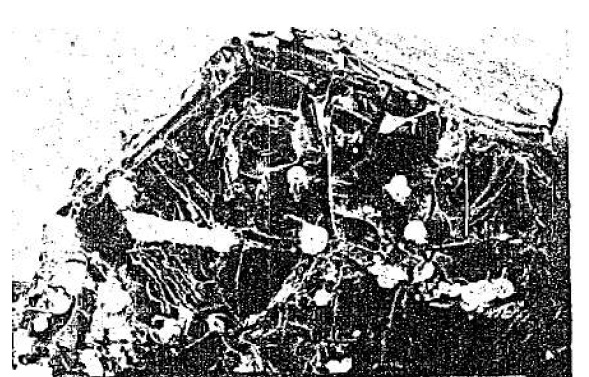
This piece of stone is a portion of one of the walls of the G.P.O. which was burned during the 1916 Easter Rising and it is now on public display at the Bank of Ireland, Eyre Square, Galway.
It was given to the bank for display purposes by Mr G. Nally of Kinvara. His mother came into possession of the stone soon after the Rising and later Mr. Nally took it with him across the Atlantic where it was displayed in America. Some years ago it was returned to this country.
The peculiar colour of the stone is explained by the fact that there is a good deal of glass solidified on the surface. This occurred when glass bottles and jars holding food supplies for the Volunteers occupying the G.P.O. melted when the building burned. Peas can be clearly seen still imbedded in the glass and stone. The piece weighs about two stone and is about one foot long. There are a number of similar unique souvenirs of the Battle of the G.P.O. still in existence in parts of the country but this is believed to be the only piece in the west of Ireland.
The Council of the Galway Chamber of Commerce had an interesting discussion at its meeting on Friday evening last on the question of linking up the towns around Galway Bay more closely with the city, and developing traffic on the Corrib. Prof. A. Eraut, M.A. occupied the chair; and the discussion was mitigated by Mr J.O’Kelly-Lynch, who said that Mr Winkle, Mr Feeney and other merchants in Kinvara had pointed out to him that much of the trade of that town was done with Ennis and Limerick, and that it could be diverted to Galway provided regular communication were established across the Bay. The pier at Kinvara was available even for a boat like the Dun Aengus. The gentlemen mentioned had sent him a telegram that day saying that they would offer their utmost support to any proposal to establish closer communication by sea.
Mr. M.J.Crowley, H.C., thought it would be well to discuss the whole matter with Captain Meskill of the Dun Aengus, who was an expert on these matters. The Galway Bay Co.’s boat had only nine feet of a draft, but he believed that at times she had to be in the mud at Kinvara.
Mr. Sp. P. Corbett said that Commander Hanan had a small boat at the docks, and he had made an effort to establish a commercial trade with Kinvara, but it had not been a success.
Mr C.C. Copeland, of the City of Galway Shipping Co., said he thought that Commander Hanan had some trouble with his engines at Kinvara, and the wages he was compelled to pay for repairs over there took away anything he could earn on the venture.
It was resolved that the secretary should communicate with the traders of Kinvara as to what traffic they could guarantee and consult Captain Meskill and the owner of the boat on the Corrib.
Connacht Sentinel 13th April, 1943 p.2
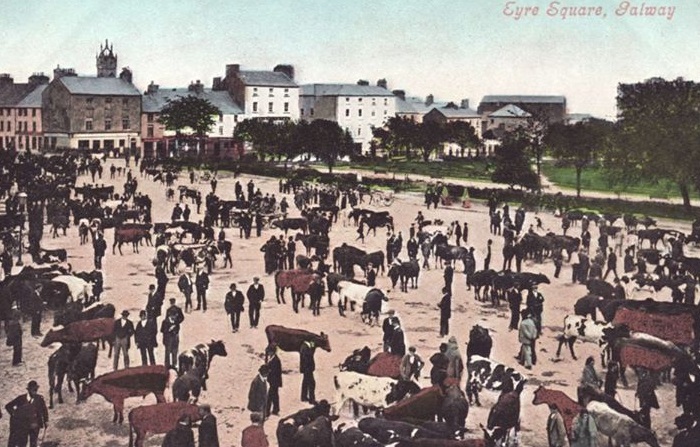
In 1935 Eamon de Valera veiled a statue of Padraic O’Conaire in Eyre Square, Galway. The Square was used for a variety of purposes including a turf dump during the Emergency. The storage of turf at Eyre Square ended in the late 1940s. Mr Kevin McDonagh marked its departure, from Padraic’s perspective, with the following poem.
O dreadful change! O piercing sight!
O prospect ugly, bleak and bare!
I’ve half a mind to stand upright
And part forever from the Square.
The crafty folk who jeer and scoff
At things that poets find most sweet.
Have tumbled down and carried off
Those noble piles of rich brown peat.
I’d fondly hope they had been stacked
To lend a rustic atmosphere
To my surroundings and distract
My brooding mind from every care.
‘Tis many a time they raised in me
A thrill as when (with eyes agog)
I’d notice floating lazily.
The Mist That Does Be On the Bog!
I’d e’en had hopes – a foolish batch
That soon a cottage might arise
Amid the peat with golden thatch
And blue smoke curling to the skies.
Exit now, my dreams are shattered quite,
And, like the peat, dissolved in air,
I’ve half a mind to stand upright,
And part forever from the Square.

 The Burren and Beyond