
Cork Examiner, Supplement 23rd July, 1881
(abridged)
About the commencement of the present century, the Connaught gentry, who seldom thought of going to Dublin, used, besides rigging themselves out at Ballinasloe Fair, to have their common and occasional wants in the way of raiment, jewellery, and spicery, supplied by pedlars. These pedlars went about the country with large and strong chests stowed on carts, and which contained often valuable assortments of goods of all kinds. They were of such respectability, that some of them dined at the tables of the gentry, and giving, as they generally did, credit, they were very acceptable, and were treated with all possible consideration. In fact, there was a considerable smuggling trade carried on along the whole western coast. In return for our Irish wool, the French silks and jewellery, and the Flanders goods, came in without the intervention of a custom house. In promoting this traffic, many of the western proprietors were concerned, and it is said that families who wear coronets became right wealthy by the export of wool, and the import of claret and French fabrics.
Be this as it may, the itinerant pedlars I have just alluded to were the convenient purveyors of this contraband, and their good offices were on all hands acknowledged. Of these, Mrs Bridget Bodkin was not the last active, or ingenious. She sprang from one of the tribes of Galway, and though the gentry of the west looked down on regular traders and shopkeepers, Biddy Bod, as she was called, was considered honourable, for she was very useful. Many a wedding as well as wedding gear, was the result of her providence. More...
Month: July 2015
The Pooka – 1891
Nation 4th April, 1891 p.4 (abridged)

Wikimedia Commons
There are few villages throughout Ireland near which there is not a hill, cliff, glen or cave which takes its name from the Pooka, but very few indeed know what sort of spectre the Pooka is. A poet once said that he is in existence “since the time of the flood,” and he assumes many shapes – a huge black dog, a cat, a horse, human, rabbit or hare.
The Pooka is wont to give a ride to anyone he meets out at night when he is on the walk; and he does it in two ways. When you meet him in human shape he claps you up on his back, head towards the ground, feet aloft, facing his back. The creature then seizes your ankles and carries you off over mountain and glen, over lake and lakelet, up and down the hills until you, poor rider, are tired, worn and weary. Only then will the Pooka fling you on the ground and let you on your way.
When the Pooka takes the shape of a horse it is up to the poor traveller to keep his grip or bones could well be broken.
Now and then the Pooka meets a smart fellow, who lets him know he can’t play his tricks always. There was a merchant long ago who came to Connemara ere roads were made. He got lodgings of course, for in those days “a welcome and twenty of them” awaited the traveller and wayfarer, and the hospitality of the people of Iarconnaught was spoken of with praise near and far. The merchant let his horse out in the fields and went to sleep. When he had slept his fill, he took his meal and prepared for the road.
He called his horse to harness it but what came across the field instead was the Pooka. The Pooka clapped the merchant on his back and off he started. At first he went in a trot; soon this became a gallop. He went like the wind, over marsh and crag, across river, up and down hill, but failed to throw the man. He gave another rush and came near a large river. The Pooka was on the point of jumping it when the merchant remembered he had his spurs on his heels. He gave a strong dart with his two heels and sent the rowels to the quick into the Pooka. The creature shivered and quaked with fear and besought the merchant to take off the spurs, and that he would let him off. The merchant did so and the Pooka flung him down and away with him across the river in a jump.
But the merchant regretted he had let him off so easily and thought to coax him back so that he would make him cease his pranks. So he asked him to cross the river again.
“Have you the spurs on yet?” said the Pooka.
“I have so.”
“If you have,” says the Pooka, “you may stay as you are. I’ll not go next or near you. But if I ever find you without the spurs, I’ll let you know the differ, or ‘lose a fall’ by it.”
The Knight of County Clare – 1828
Freemans Journal 14th July, 1828 p.3 (abridged)

George Hayter National Portrait Gallery
Wikimedia Commons
The return to the writ for the Election of a Knight to serve in Parliament for the County of Clare was received at the Crown office, London, on Thursday. The following is a copy of the return and the Indenture accompanying it;
By virtue of this writ, to me directed, I did within two days after the receipt of the same, (that is to say), on the 19th of June, 1828, cause proclamation to be duly made for holding an election, to be held at the County Court house of the County of Clare, at Ennis, on the 30th of June, 1828, of a Knight to serve in Parliament for said county.
Sir Edward O’Brien and Sir Augustine Fitzgerald, Bart., two of the said electors of Knights, did then nominate and propose the Right Hon William Vesey Fitzgerald, being a Protestant, as the most fit and discreet person to be elected. James Patrick O’Gorman Mahon and Thomas Steele, Esqrs, two other said electors, did nominate and propose Daniel O’Connell Esq., as the most fit and discreet person to be elected a Knight. Daniel O’Connell did, at said Court, publicly declare and profess that he was a Roman Catholic, and that he intended always to continue a Roman Catholic.
The poll commenced on the 1st day of July, 1828 and continued until the 5th day of July, when same finally closed.
During the said poll electors did publicly protest against the election of said Daniel O’Connell insomuch as he was, and declared that he intended to continue, as Roman Catholic.
At the final close of said poll 982 electors voted for William Fitzgerald Vesey Fitzgerald, as a fit and proper person o be elected and 2,057 voted for said Daniel O’Connell as a fit a proper person to be elected a Knight to serve for said county.
The Speaking Automation – 1786
Freeman’s Journal 28th January, 1786 p.5 (abridged)
Wikimedia Commons
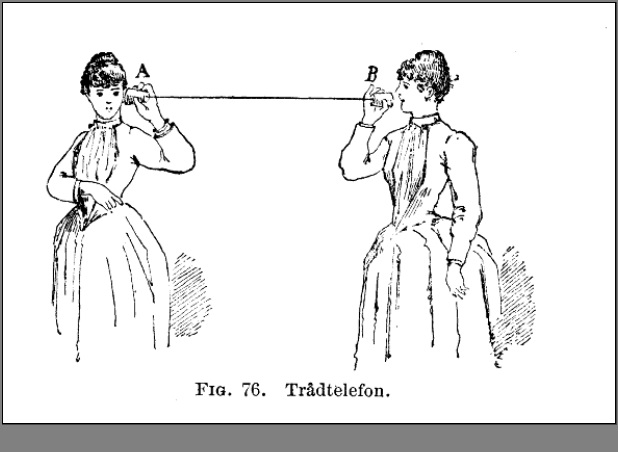
The simplest things not known, may become the most surprising. No doubt this is the very case in regard to the extraordinary exhibition of the Speaking Automation now in town, which is reckoned to bring in above thirty guineas a day to its proprietor. It eludes even conjecture on the principle by which the sound is conveyed.
A small wooden figure, suspended by a piece of common tape, in a room, promises little for the conveyance of sound, particularly where the nicest search cannot discover the least communication.
Some have imagined it to be effected by electricity, others by magnetism, but all that is hitherto known on the subject is merely wonder, from the learned and the unlearned.
Bridge of Boats – 1859
Nation 26th February, 1859 p.11
22nd;
Early this morning, the General, the Duke of Wirtemburgh and Lieutenant-General Scravenmore, with all our horse and dragoons, ten regiments of foot, taking with them seven day’s provisions and fourteen guns; ten three pounders and four twelve pounders, marched over our bridge of boats into the county of Clare.
Kinvara Notes – 1919
WESTERN PEOPLE 7TH NOVEMBER 1903 P.5 (abridged)
Kinvara notes;
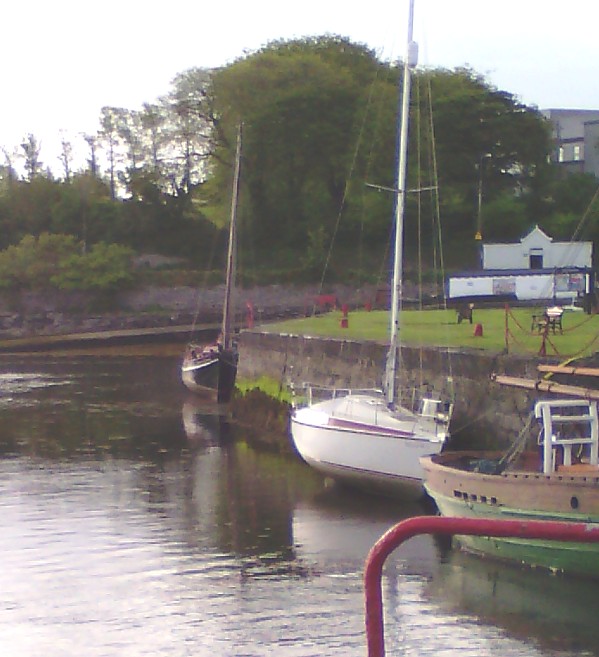
Kinvara lost its primacy as a bishopric, the old see of Kilmacduagh was united to the modern see of Galway. It then lost its shipping trade. The old landlords, the Gregorys of Coole Park, and the De Basterots were obliged to sell out.
Mr Comerford, a timber merchant in Galway bought Kinvara from Mr Gregory and raised the rental from 335 to 1,150 but it did not and could not survive with him or his successors. A Mr Murray, a pawnbroker in Galway, came along and was equally active in promoting depopulation. The townland of Northampton decreased from 25 families to 11. Mr Murray however left a bequest of 2000 for a convent and to him Kinvara owes its present beautiful foundation built on a site given by Captain Blake Foster. Kinvara was once a thriving market town but its tolls declined from 200 to 60. It had in 1872 a population of 689 families and 1889 this sand to 451. Its barley market for Persse’s Distillery in Galway brought in a good deal of money but Persse’s Distillery having been closed down owing to the narrow policy of the Bank of Ireland, that industry was lost to Galway and Kinvara.
Father Francis Arthur assisted in the escape of John Blake Dillon to America. Kinvara man, John Holland brought Dillon to Aran.
The tenants on the O’Donnellan Blake Foster Estate held a meeting in Kinvara in October 1919 to arrange terms for purchase with the agent, Mr Holmes. The Rev Father Burke P.P. Kinvara put the tenants’ case before the agent, with the result that 18 and a half years was agreed upon as the sale price. The reduction which the tenants have obtained through these terms amounts to 8s in the pound or 40% on their present rents
Banshee – 1829
Freeman’s Journal 12th September, 1829 p 4. (abridged)
We went to Lady Honor O’Brien’s; she was the youngest daughter of the Earl of Thomond – there we staid three nights; the first of which I was surprised by being laid in a chamber, when about one o’clock I heard a voice that awakened me, and I drew the curtain. In the casement of the window I saw by the light of the moon a woman leaning into the window, in white, with red hair, and pale and ghostly complexion. She spoke aloud, and in a tone I had never heard, thrice, “a horse” and then she vanished. To me her body looked more like a thick cloud than substance.
I was so much frightened that my hair stood on end and my night-clothes fell off. I pulled and pinched my husband, who never woke during the disorder I was in; but at last was much surprised to see me in this fright; and more so when I related the story and showed him the window opened.
Neither of us slept any more that night, but he entertained me with telling me how much more these apparitions were usual in this country than in England. We concluded the cause to be the great superstition of the Irish and the want of that knowing faith which should defend them from the power of the devil, which he exercises among them very much.
About five o’clock the lady of the house came to see us, saying she had not been in bed all night because a cousin O’Brien of hers, whose ancestors had owned that house, had desired her to stay with him in his chamber and that he died at two o’clock. She said “I wish you to have had no disturbance, for ’tis the custom of the place when any of the family are dying, the shape of a woman appears in the window every night till they be dead. This woman, many ages ago, got with child by the owner of this place. He murdered her in his garden and flung her into the river under the window, but truly, I thought not of it when I lodged you here, it being the best room in the house.”
We made little reply to her speech, but disposed ourselves to be gone suddenly.
Lady Fanshawe’s Memoir
Visitors – 1945
Connacht Tribune 29th September, 1945 p.3 (abridged)

Photo: EO’D
Six of the French children brought to this country by the Irish Red Cross Society are now pupils of the Mercy Convent, Kinvara, Co. Galway. They travelled from Dublin to Galway by train, and completed the journey by road, on Friday last. The girls, whose ages range from ten to fifteen years, were accompanied from Dublin by Miss Aughney, an expert linguist. At Athlone they were hospitably entertained by Mrs McCorley, wife of Col. McCorley, O.C. of the Western Command, and other members of the local branch of the Red Cross. The girls were given a meal at the G.B.C. restaurant, and then four of them were taken by Mrs Blake on a short trip through the city in a pony trap. They enjoyed the run very much and expressed themselves delighted with Galway. The two eldest preferred to make a brief excursion on foot, accompanied by Miss Aughney. When they all got together again they set off for Kinvara.
Mr Green and Mr Holland – Kinvara – 1936
Irish Press 27th August, 1936 p.9 (abridged)

When a six years old boy fell into the sea at Kinvara Quay, Mr P. Green, a fisherman, raised the alarm. Mr John Holland, who lives on the quayside, taking off his coat, dashed from his house and dived into the water, which was 10 feet deep at the time. With the aid of a lifebuoy, thrown by Mr Green, Mr Holland brought the boy ashore. This is the second life save there by Mr Holland.
 The Burren and Beyond