Posted in Posts and podcasts

Leaving Ireland – 1907

The Catholic Press 13th June, 1907 p6IMG_20150116_191121
Father Fitzgerald OFM (abridged)
At the very period of the year when travellers from other lands are trooping to the beauty spots, of Ireland, her own sons and daughters are bidding farewell for ever to her shores. The column of the morning papers devoted to fashionable intelligence relates daily that various honorables with their ladies and retinue have arrived from abroad at Kingstown, but the emigrant ship may bear away her freight of the young and strong unnoticed and unchronicled save by widows wails and the ruined fireside. The emigration season sets in now in Ireland as regularly and as surely as the fishing or the shooting seasons.

To accommodate the thousands, or rather the scores of thousands, who depart yearly, excursion trains are run to the seaports, and large steamers compete with each other in speed and cheapness of transit to America. Indeed, it is a sad thing to meet one of those American excursion trains, still worse to occupy a place in the train even for a short journey, for scenes of great affliction occur at every station.

A bird of ill-omen appeared in Galway Bay on the 27th of the present month of April. This was an emigrant steamer the first of the season. Another will call in ten days more and take up her own portion and those who were left behind through over-crowding on Friday morning. About a fortnight ago a large poster, printed in red lettering, appeared on the dead-walls and gate-piers of Galway, announcing the fact that the Salmatian of the Allan Line would call at Galway on the above date. Details followed concerning the superior accommodation, and the lowness of the fare across. The news was carried through the hills of Connemara and out to the Isles of Aran and along the coast to Inishbaffin, and in answer to the call, like to the beacon-fires of old, many a youth and maiden was up and doing. Many a one humped the last Irish of seaweed up the barren hillside or spent the last dark night watching the phosphorescent gleam on the dark waters that tells of the herring shoal, or walked six miles, if not more, to the town and back to sell a quart or two of milk.

In almost every townland in the surrounding country there are celebrated several American wakes. Your readers may not know that this is the title given to the domestic celebration that is held in every home, however humble it may be. On the eve of the departure of one of its inmates to America, A quarter-cask of porter is provided, or some good poteen, and the neighbours get word, and music is supplied by a piper or an expert on a melodeon or a flute, or a concertina, or all in turn. The boys, and the girls take the floor, and the rinca fada, the curcaher, or the Curuckther are faithfully performed, until day breaks. Then, weeping takes the place of laughter, and the whole house turns out to accompany the parting one to the station, except the old grandfather or grandmother, who rocks the cradle with their foot and minds the house.
Posted in Posts and podcasts

Mother Mary – Gort – 1908

Wairarapa Daily Times, Volume LIX, Issue 9225 19th November 1908 p5

Coole Park, Gort EO'D
Coole Park, Gort
EO’D

One of the most interesting survivors among the few who still remain of the noble band of women who nursed with Miss Florence Nightingale in the Crimea has passed away (writes a London correspondent), in the person of Mother Mary Aloysius Doyle, at the Convent of Mercy, Gort, Co. Galway.

The venerable lady had attained the great age of ninety-four years, but her faculties were unimpaired, and only last July she wrote a beautiful letter of sympathy and good wishes on hearing of the fate of the veterans, destined to help the declining days of the survivors of the Crimea and the Mutiny. The great value of the services rendered by the first party of nurses who went out with Miss Nightingale led Mr Sidney Herbert to request Miss Stanley, sister of the former Dean of Westminster, to select further reinforcements for her and letters were written to all the convents in Ireland for trained volunteers. Two other Roman Catholic Sisters who accompanied Miss Nightingale are happily still with us as Sister Mary Stanislaus RRC and Sister Mary Anastasia RRC who are in the Hospital of St John and St Elizabeth, the former of whom, it is pleasant to record is in good health and has may interesting memories to tell of those stirring days.

Posted in Posts and podcasts

Tír na nÓg – 1900

A Reading Book in Irish History P.W.Joyce LLD – One of the Commissioners for the Publication of the Ancient Laws of Ireland

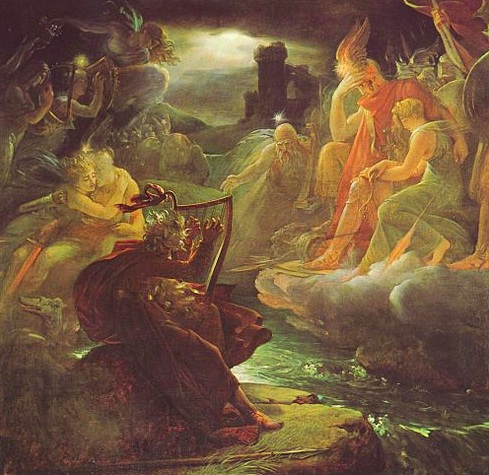
Ossian  François Pascal Simon Gérard Wikimedia Commons
Ossian
François Pascal Simon Gérard
Wikimedia Commons

Longmans, Green and Co. London, New York and Bombay. Dubln: M.H. Gill and Son 1900


THE CHANT OF THE FAIRY TO CONNLA OF THE GOLDEN HAIR.abridged

A land of youth, a land of rest, a land from sorrow free;
It lies far off in the golden west, on the verge of the azure sea.
A swift canoe of crystal bright, that never met mortal view
We shall reach the land ere fall of night, in that strong and swift canoe:
We shall reach the strand of that sunny land From druids and demons free;
The land of rest, in the golden west, on the verge of the azure sea!

A pleasant land of winding vales, bright streams, and verdurous plains,
Where summer, all the live-long year, in changeless splendour reigns;
A peaceful land of calm delight, of everlasting bloom;
Old age and death we never know, no sickness, care, or gloom;
The land of youth, of love and truth,From pain and sorrow free;
The land of rest, in the golden west, on the verge of the azure sea!

There are strange delights for mortal men in that island of the west;
The sun comes down each evening in its lovely vales to rest:
And though far and dim on the ocean’s rim, it seems to mortal view,
We shall reach its halls ere the evening falls, in my strong and swift canoe;
And ever more that verdant shore our happy home shall be;
The land of rest, in the golden west, on the verge of the azure sea!

It will guard thee, gentle Connla of the flowing golden hair,
It will guard thee from the druids, from the demons of the air;
My crystal boat will guard thee, till we reach that western shore,
Where thou and I in joy and love shall live for evermore:
From the druid’s incantation, from his black and deadly snare,
From the withering imprecation of the demon of the air,
It will guard thee, gentle Connla of the flowing golden hair;

My crystal boat will guard thee, till we reach that silver strand,
Where thou shalt reign in endless joy, the king of the Fairy-land!

From “Old Celtic Romances,” by P. W. Joyce, LL.D.

Posted in Posts and podcasts

The Irish Volunteers 1914

Tribune (Melbourne, Vic.) 25th July 1914 (abridged)

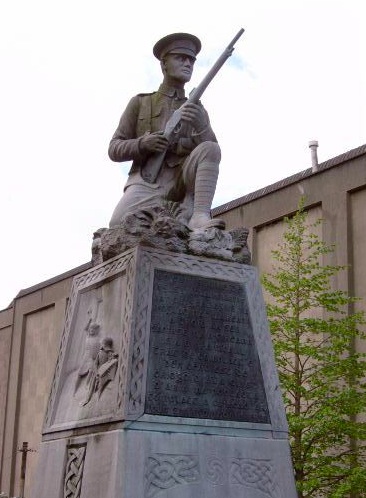
Irish Volunteer memorial - Irish War of Independence  Leo Broe (1899–1966) Photo: Jtdirl   Wikimedia Commons
Irish Volunteer memorial – Irish War of Independence
Leo Broe (1899–1966)
Photo: Jtdirl
Wikimedia Commons

Here is what the London Times has to say in regard to the Irish Volunteers: —

‘We in Great Britain, with our forty-one million people, and with all the resources of civilisation at our backs, have not been able to raise in seven years as many Volunteers as Ireland, with her five million people and against the intentions of the Government, has been able to raise in about as many mouths. The Lord Chancellor calls all the Irish Volunteers illegal and unconstitutional. So undoubtedly they are. It is a lasting reflection upon the Government that their creation should ever have been permitted. But at the same time the Irish Volunteers deserve this credit —namely, that with every obstacle thrown in their way, and with not a shilling of public money paid to them, they are doing better than the Territorials, who have been petted and pampered by all sorts and conditions of men, and cost us three and a half millions of good money annually.’

Posted in Posts and podcasts

Rise Art, Rise! – 1847

Anti-slavery bugle, 25th June, 1847 p4
We find the following poem in a late Irish paper.

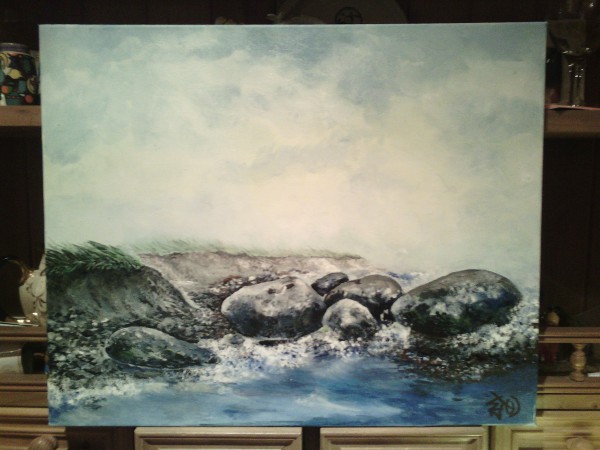
Tides EO'D
Tides
EO’D

I’m loth to wake ye, Art, my dear
But the steps of a stranger are drawing near
Up the rickety stair they come,
Making, I think, for our wretched room;
Rise, Art, rise! the last shilling’s spent
Art, it’s the sheriff – the rent – the rent!

See, daylight has lit on the window-sill
Art! is it you to be slumbering still?
Ye know that at last we must quit or pay,
Though ye didn’t expect the distress today!
Rise, Art, rise! the last shilling’s spent
Art, it’s the sheriff – the rent – the rent!

At the door! Oh a month to make up what’s due!
The landlord, he knows, Art, your word is true;
If he saw how we strive, he’d put off the sale;
’Twas the will of God that the trade should fail!
Rise, Art, rise! the last shilling’s spent
Art, it’s the sheriff – the rent – the rent!

By the shore EO'D
By the shore
EO’D

In days gone by it was Ireland’s pride
To be decked in the web that our looms supplied:
Those were the times, Art, ye took me home,
And told me that love would make business come.
Rise, Art, rise! the last shilling’s spent
Art, it’s the sheriff – the rent – the rent!

It’s hunger, Art, that has made ye weak
What can I think of, your fast to break?
Here, Art, here is my wedding ring,
The lodgers will lend on the blessed thing!
Rise, Art, rise! the last shilling’s spent
Art, it’s the sheriff – the rent – the rent!

God forgive me! my heart is torn
To drag ye from bed this bitter morn;
The bed that they’re coming to seize and sell
Where I’ve nursed and prayed by ye, sick and well!
Rise, Art, rise! the last shilling’s spent
Art, it’s the sheriff – the rent – the rent!

How silent he sleeps! not a stir, or breath!
Poor famishing husband, you’re work’d to death!
At the shuttle before and after the sun
And a morsel of meal when the day is done!
Rise, Art, rise! the last shilling’s spent
Art, it’s the sheriff – the rent – the rent!

Dead! Oh, my God! it is over at last
The wearisome struggle is past – is past!
The heavens be praised! ‘tisn’t you need fear,
’Tis your widow that’s desolate, husband dear!
Rise, Art, rise, to the happy skies,
Where the tear is wiped from the poor man’s eyes!

Posted in Posts and podcasts

Knockmoy Abbey – 1823

Connaught Journal Galway

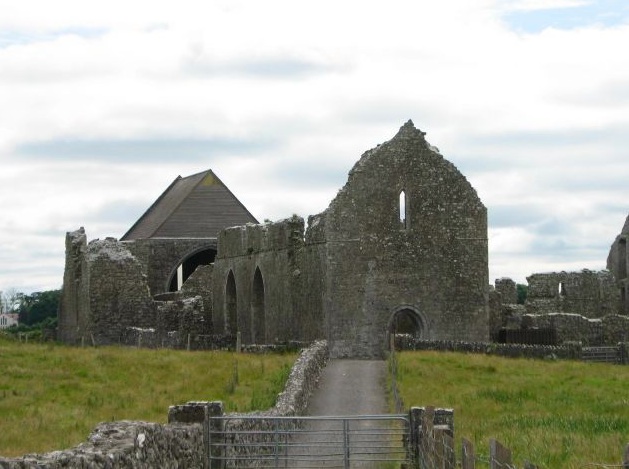
Knockmoy Abbey  Photo: Liam Murphy.   Wikimedia Commons
Knockmoy Abbey
Photo: Liam Murphy.
Wikimedia Commons

15th May 1823
(abridged)
We give insertion to the annexed at the request of a Subscriber:-

The ancient Abbey of this name, so justly celebrated in Irish history, six miles from Tuam, the right to which had been the subject of much contention in the House of Lords recently, was founded by Cathal O’Connor, called
Crobhderg, or Red-handed,in 1189. Among the survivors of the bloody house of Roderick, the most conspicuous for his piety, and romantic courage, and above all, for his unconquerable dislike of the English, stood this illustrious Prince. He formed an extensive alliance with the Munster Chiefs, for the purpose of repelling the invaders. The Lords of Thomond and Desmond, burying their dissentions in the common good, united their forces behind him.

Decourcy, then Lord Lieutenant of Ireland, dreading that the gathering storm would burst on his head, recalled a strong detachment of his army under Armorie of St. Laurence. Decourcy, in the mean time, having been removed from the Government of Ireland, by the appointment of Hugh de Lacy, whose conduct seemed to be both haughty and insolent, felt the deepest resentment. Cathal took advantage of this division, and the consequent weakness of the English interest. He instantly determined on attacking the invaders.

A furious and sanguinary battle ensued, on the hill of Knockmoy, in which the whole almost of Armorie’s army, after committing dreadful slaughter on the Irish, perished on the field of battle. During the contest, while the issue seemed yet balanced in the scale, Cathal, influenced by that religious feeling, promised to build an Abbey on the field of battle, if he should be the conqueror. Cathal, shortly after, erected Knockmoy, in Irish, Cnoc na mBuaidh mugha, the hill of slaughter; and to Monkish writers, Monasterium de Colle Victoriae.

The founder gave the Abbey to Cistercian Monks, the habit of which Order he afterwards assumed. He died in 1224, and was buried in his own Abbey.

The most curious remains, after decay of so many ages, at Knockmoy are Fresco paintings, which adorn the founder’s beautiful mausoleum. One compartment exhibits Christ on the Cross; another exhibits six Kings – three dead and three living. Of the latter, in the middle is Roderic O’Connor, Monarch of all Ireland. He holds in his hand the seam air, or shamrock, a plant in great estimation. From a legendary tradition it goes that by this three-leaved grass, St. Patrick set forth the mystery of the Trinity.

The Princes on each side are his vassals. He, with the hawk on his arm, is the grand falconer, and the other with the sword, his Marshal; these hold their lands by Grand Sergeantry. Below them, sits a Brehon, with his Roll of Laws having pronounced sentence of death on Mac Murrough’s Son, for the crime of the father’s having joined the English.

Geraldus Cambrensis gives a beautiful account of this cruel sentence. The boy is tied to a tree – his body being transfixed with arrows – a useful hint to those who, abetting the cause of oppression and usurpation, trample under foot the sacred ties of kindred and of country. These are the principal remains of this celebrated Abbey. It is true, that the Abbey has fallen into much decay within these twenty years; and much may yet be preserved which will afford the antiquarian ample scope for inquiry and delight.

Posted in Posts and podcasts

The City of the Tribes – Medieval Galway

New Zealand Tablet, Vol XXIX Issue 38, 19th September, 1901 p3 (abridged)

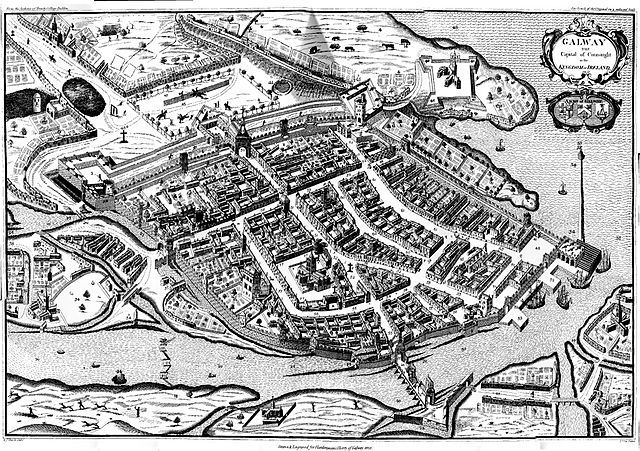
Walled city of Galway, 1651. Wikimedia Commons
Walled city of Galway, 1651.
Wikimedia Commons

Among the publications devoted to the history of families and places in Ireland there are few can compare with the Journal of the Cork Archaeological Society, which is a mine of information regarding medieval Ireland. Among the many interesting articles in the last number is one dealing with town life in Ireland during the fifteenth, sixteenth, and seventeeth centuries. The article which is the result of considerable research among State papers and other sources of information, contains many curious items of information regarding the government of the town, the ruling families, local taxes, and the arbitrary grades into which society was divided. The writer, Professor Butler says ‘The mention of mounted men or knights among the population of New Ross brings us to one of the most curious features of municipal life in Ireland— the growth of a city aristocracy, who, while still remaining merchants, were counted as of noble blood, having a right to a coat of armor, then the distinctive mark of a gentleman and marrying on equal terms with the neighboring country gentlemen.

The Irish merchant families who emigrated to France and Spain during the penal days were able to prove to the satisfaction of the governments of these countries that they ranked as noble in their own land. Accordingly in their new homes they were granted all the rights enjoyed by the native nobles— most valuable rights these were too— which in Spain at all events were not, as a rule, enjoyed by the mercantile class.

We find if we look up the list of mayors and sheriffs of Irish towns that at first, these posts were held in turn by a wide circle of families. As time goes on, however, the circle grows smaller and the same names occur again and again, until finally the whole direction of city affairs falls into the hands of a small group of city nobles as we may call them.

THE CITY OF THE TRIBES.

The most famous group of these burgher oligarchs were the ‘tribes’ of Galway, the 14 families named in the couplet—

Athy, Blake, Bodkin, Browne, Dean, D’Arcy, Lynch, Joyce, Kirwan, Martin, Morris, Skerrett, Ffon’t, Ffrench

who for 260 years so monopolised the government of the city that in that time only two outsiders appear in the list of mayors. These 14 families, as well some lesser ones, attained great wealth by their trade with Spain. Galway is still full of their houses, built square, round a courtyard in Spanish fashion and of solid stone or native marble.

It is to the Cromwellians that the name tribes is due. They found the city families so clannish, that they gave them this nickname, afterwards adopted as a title of honor by the families themselves.

Posted in Posts and podcasts

Mr D. Sheehy M.P. – 1889

Marlborough Express vol XXV, Issue 29, 4th February 1889 p2

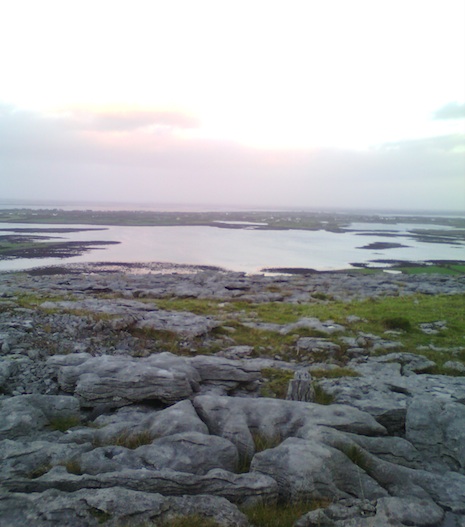
Across the Bay theburrenandbeyond
Across the Bay
theburrenandbeyond

Mr D Sheehy M.P for Galway South, who was sentenced to six months imprisonment for inciting persons to refuse to pay their rent, and who appealed against the sentence, has had an additional four months added to his term.