

MEMPHIS DAILY APPEAL 10TH FEBRUARY, 1880 P 1
A correspondent of the London Standard, travelling in Ireland, narrates an incident which speaks for the hesitancy of the Irish poor to obtrude their misery;
“A starving woman in Galway, after a furtive glance around to see that none who knew her were in sight, told the correspondent that neither she nor her children had eaten food for a day and a half, and she apologetically explained that she only asked for help as his honor was a stranger.”
Month: January 2014
Legends of the County Clare -1855
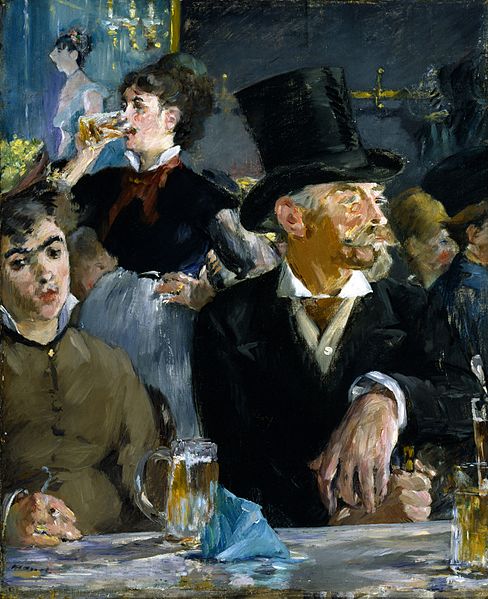
Edouard Manet (1832–1883)
Walters Art Museum
LEGENDS OF THE COUNTY’ CLARE (abridged)
About two miles from the village of Corofin,’in the west of Clare, are the ruins of the Castle of Ballyportree. It is a massive square tower surrounded by a wall, at the corners of which are smaller round towers. The outer wall was also surrounded by a ditch. The castle is so intact the lower part is inhabited by a farmer’s family. In some of the upper rooms massive chimneypieces of grey limestone, of a very modern form, still remain. The horizontal portions of the chimneys are ornamented with a quatrefoil ornament engraved within a circle, but there are no dates or armorial bearings.
From the windows of the castle four others are visible, none of them more than two miles from each other; and a very large cromlech is within a few yards of the castle ditch. The following legend is related to the castle;
When the Danes were building the castle they collected workmen from all quarters, and forced them to labour night and day without stopping for rest or food ; and according as any of them fell down from exhaustion, his body was thrown upon the wall, which was built up over him ! When the castle was finished, its inhabitants tyrannised the whole country, until when the Danes were finally expelled from Ireland.
Ballyportree Castle held out to the last, but at length it was taken after a fierce resistance. Only three of the garrison were found alive, a father and his two sons. The infuriated conquerors were about to kill them also, when one proposed their lives should be spared, and a free passage to their own country given them, on condition that they taught the Irishmen how to brew their famous ale from heather. That secret was eagerly coveted by the Irish, and zealously guarded by the Danes.
At first neither promises nor threats had any effect on the prisoners, but at length the elder warrior consented to tell the secret on condition his sons should first be put to death before his eyes. He said he feared if he returned to his own country, they might cause him to be put to death for betraying the secret. Though somewhat surprised at his request, the Irish chieftains immediately complied with it, and the young men were slain. Then the old warrior exclaimed,
‘ Fools ! I saw that your threats and your promises were beginning to influence my sons; for they were but boys, and might have yielded : but now the secret is safe, your threats or your promises have no effect on me ! ‘
Enraged at their disappointment, the Irish soldiers hewed the stern northman in pieces, and the coveted secret is still unrevealed.
In the South of Scotland a legend, almost word for word the same as the above, is told of an old castle there, with the exception that, instead of Danes, the old warrior and his sons are called Picts.
St John’s Day – 1827
 https://widgetworld3.wordpress.com/podcasts/
The Monitor 10th December 19 1827
(abridged)
—
On St.John’s Day, about 4 o’clock in the afternoon, a crowd of men, women and children were observed, rushing down Marlborough-street, near to Thomas Church, shouting and yelling, and tossing something in the air, which was sometimes caught by one, and sometimes. by another, and occasionally fell to the earth, where there was a scramble for it, and it was again passed from one to another amidst the most diabolical yells, which on a nearer approach, were distinguished to be ” A witch ! A witch ! Burn the witch ! Drown the witch!”
The said witch proved to be a very decently dressed, dwarfish, deformed female, A young gentleman, apparently about 18, appealed to several well-dressed spectators to aid him in saving the poor woman from being torn to pieces. They, from terror of the mob, declined. He rushed into the midst of the crowd and courageously bore the helpless female under one arm, while with the other made his way through the crowd, who directed their vengeance against him pushing, pulling, and tripping him, and pelting him with mud; and whatever came to their hands.He was soon bedaubed from head to foot.
Making his way down Cumberland street and Mecklenburg street, he appealed to three or four soldiers who were looking on. They directly surrounded him, and two gentlemen then aided him. One of them took one hand, and her rescuer the other of the poor sinking dwarf, and pulled her through the increasing crowd, to the Police-office in Henry-street.
At the Post-Office a few policemen luckily came up, and were compelled to do ample justice with their sticks on the savage crowd, before they got the poor creature into the Police-office. She was not able to speak for some time, from ill-usage and terror, and then returned lively thanks to her deliverers. She gave her name, and said she resided with a relative in Camden-street. She said that though she had been frequently gazed at, so as to distress her feelings, she had never before met with violence.
She was sent home the back way, after some time, with an escort of police.
A Narrow Escape – 1859
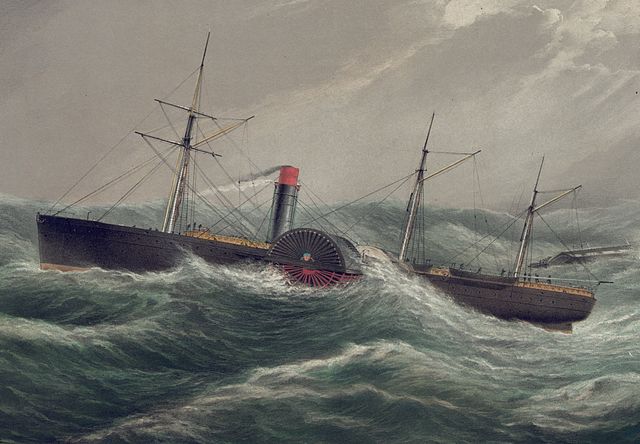
Wikimedia Commons
https://widgetworld3.wordpress.com/podcasts/
The Sydney Morning Herald 12th February 1859
(abridged)
The Pacific had a narrow escape from being caught on the iron-bound cliffs of Clare on her last passage to Galway. The Pacific ran into Liscannor Bay instead of Galway Bay on Monday night, there being no distinguishing landmarks between them, and was actually approaching the shore of Lahinch when some of the fishermen put out in boats, and with lights warned off the steamer from the dangerous coast she was approaching.
The only light at the entrance of Galway Bay is on the Arran Islands. The course of a steamer sailing into Galway should be nearly six miles south of the Arran Light, but miscalculating the distance, the Pacific, when about 16 miles from the island, made for a bay which was supposed to be Galway, but which (fortunately before it was too late) was discovered to be Liscannor. Were it not for the timely warning given by the fishermen the Pacific could not have escaped, except by a miraculous interposition of Providence, from total destruction, on the fatal spot to which she was fast hurrying.
Mitchell’s Maritime Register, 4th of December.
A profitable experiment – 1826

Wikimedia commons
https://widgetworld3.wordpress.com/podcasts/
The Sydney Gazette and New South Wales Advertiser 19th July, 1826
(abridged)
In the year 1823, His Majesty’s government was induced to make an experiment, upon a very small scale, of conveying emigrants from Ireland to the British Colonies in North America, which was attended with the greatest success. The average expense for carrying out the emigrant, locating him, and maintaining him for a year was about £22 per head only. Small as this sum appears, however, it is obvious that, to act upon an extensive scale, it would require a great sum of money were the strea of emigration to be directed to our shores.
In appearance, then, it would be impolite in His Majesty’s Government to give this country (Australia) such preference. However, the colonies in North America, from their climate and soil are not calculated to afford a return for labour anything equalling New South Wales.
Nova Scotia might be situated in a favourable part of the temperate zone but its atmosphere, for a great part of the year, is clouded with a thick fog which renders it unhealthy. For four or five months it is intensely cold while the soil, apart from that which is on the banks of the rivers, is thin and barren.
Australia possesses a climate and soil which cannot be surpassed.
Diaspora – 1879
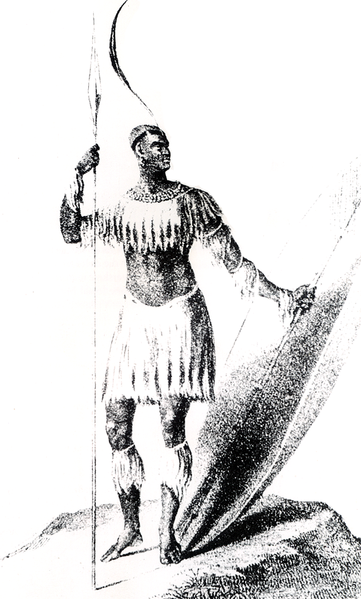
Freeman’s Journal, Saturday 16 August 1879, page 6/ 7
(abridged)
The manner in which Irish men are turning up among the Zulu people is much noticed. John Dunne, Cetewayo’s Prime Minister, is ascertained to be from Ballymena in Ulster. Renter’s telegrams to-day brings news of a chief called M’Carthy (sic.), captured in a battle by the English is an Irish emigrant to the South African diamond fields. He arrived in the year of the Fenian rising.
The formidable chief, Moirosi, who is reported to be besieged by the British forces, is really one Morrissy.
1935 – A Toast – 2014
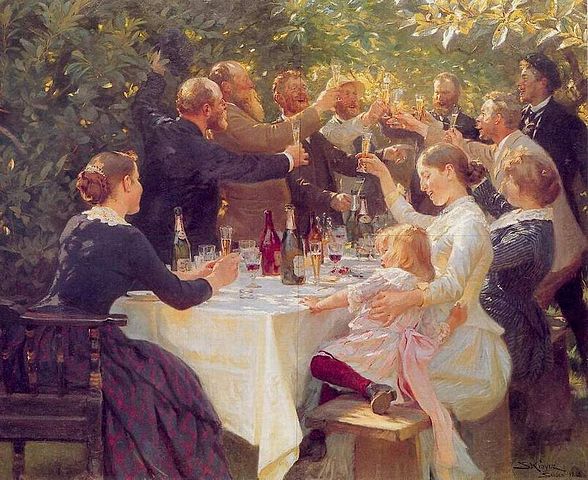
Peder Severin Krøyer (1851–1909)
Gothenburg Museum of Art
In Galway, a Gaelic toast used to go round embodying all the ingredients of human felicity –
“May you have health and a long life with the good wife of your own choice;
your land without rent and death in Ireland.”
 The Burren and Beyond