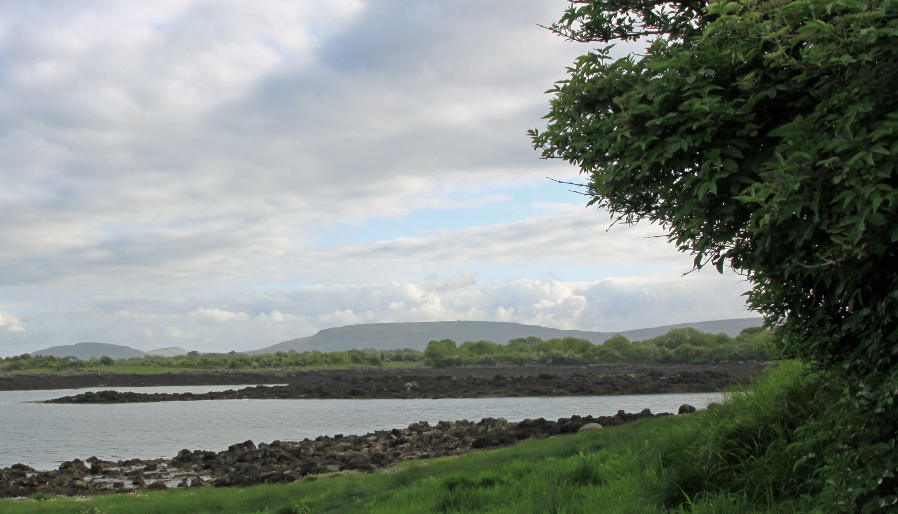
Kinvara was, and probably is yet, an Irish-speaking district, for, although the national school has been an institution there ever since the planting of that intellectual exotic in Irish soil, the old ways and the old ideals have, nevertheless, held their own. The Celtic spirit breathes in “ould Kinvara” still, and why should it not? Within sight of what have been aptly called “The Last Fortress of the Celt” – the Islands of Arran – and almost within sound of the league long breakers that encircle them with a belt of foam, it is not to be wondered at that the principles that made those islands saintly and storied should linger in the vicinity of Kinvara. Therefore, it is safe to assume that it is as Celtic and Catholic today as it ever was.
There are two fairs held there yearly, and there is the weekly market. At these the business used to be conducted principally in the old tongue. This is possibly the case to this day. The religion of the community being what it is, “God save you, kindly sir” of the ballad is the well-known and universal salutation, turned into English for the purpose of the rhythm.
The braedheen cloak and the plaid shawl, former for matrons and the latter for young women, are yet characteristic articles of female attire, and a picturesque garb they make in that quaint town and neighbourhood.
Note; The ballad is “The Auld Plaid Shawl” by Francis A. Fahy (1854-1935)
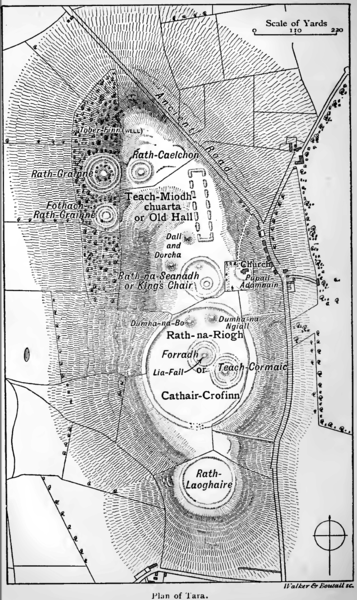
Plan of Tara Wakeman’s handbook of Irish antiquities (1903). p. 166
Freemans journal 23rd February 1922
Who shall Possess Tara?
THE HILL FOR SALE.
Tara Hill is in the market. Major Moore Brabazon, a member of the Meath family, is about to submit his Meath estate to the hazard of the auctioneer’s mallet. To the modern Greek, Thermopylae is immortalised ground; and so is Tara’s hill. The vital question is whether this precious heritage is to pass from one owner to another, or whether it is to become the permanent property of the Irish nation.
Tara has been strangely neglected; but specially secured as the property of the nation it would be more readily visited and more highly appreciated. Other ancient races, especially the Greeks, have revived their old games and sports. The ancient festivals of Beltaine and Samhain might be revived again in all their past glories on Tara’s Hill.
The Hill has no territorial beauty or distinction, only a low ridge of moderate dimensions; but these 330 acres of Royal Meath are very precious when we consider their historic value. Tara of ancient Druids and early kings, still haunted with the glory and glamor of ancient Ireland, hallowed by the hosts of pagan and Christian associations! The green grass of this holy and historic hill still sparkles with the’ dewy gems of legend, myth and romance during the fourteen centuries of its history.
Some outstanding features and events may be briefly noted. In the traditional period, away back in the twilight of the past, appears Ollamh Fodla, who founded the first Feis of Tara; here was- attempted the first tentative effort to found a primitive Parliament, and draw into concord and social intercourse the scattered element of Irish life. The meeting of Convocation took place every three years to preserve and improve the laws and customs, and also to verify history. It was a period of road-making; all roads led to Tara, and more than any other evidences indicate the influence and importance of Tara. The pagan epoch is demonstrated by the celebrated idol, Crum Cruach, and twelve minor idols.
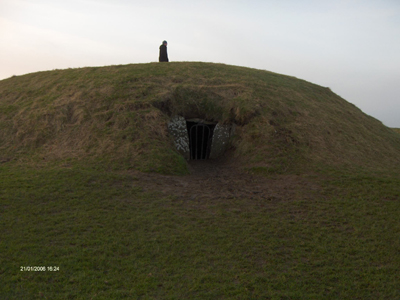
Mound of the Hostages, Tara. Photo: biekje Wikipedia.org
On Tara Hill, on Easter Day in the year 433, St. Patrick silenced the Druids of King Laoghaire in the presence of the king. It was a notable event in the history of the Christian Church of Ireland, when the heroic missionary set ablaze the Paschal fire on the Hill of Slane. It marked the doom of paganism. St. Patrick’s first move was to utterly destroy and overthrow the shrines and temples of the national idol at Mo Slecht.
In 890 Malachy the Great reigned in Tara, and in the year before his accession defeated the Norsemen in a great battle at Tara, where vast numbers were slain. Many of the revolutionaries of 1798 were buried in the sacred soil of Tara. In 1843 Daniel O’Connell addressed a monster meeting, on Tara Hill in support of the Repeal agitation. The glamor of a famous love story adds romance to the glories of battles and the splendid hospitalities of royal kings. On the northwest, in a grove of trees, stands Rath Grania. Here at Tober Finn (the crystal spring) , the lovers, Diarmuid and Grania, the daughter of Cormac Mac Art planned their elopement. When the Irish Literary Theatre was founded in 1899 the Tara romance of Diarmuid and Grania was dramatised by George Moore and W. B. Yeats. The play was produced on October 21, 1901. The scenes were the Banqueting Hall of Tara and the house of Diarmuid.
There is another charming episode. Where the road leads up the hill there is a well, and here sat Carned, the beautiful grinder of corn, grinding at her quern all day long. King Cormac, as he passed up and down the slope, gazed up on the beautiful grinder, and finally he carried her off. There was no other grinder, and the people were threatened with starvation. Ua Cuind a noble prince, had compassion upon them, and he brought a millwright over the great wave, and in this way the first mill in Erin was erected.
The stone named Lia Fail, known as the Coronation Stone or the Stone of Destiny, was through centuries one of the greatest treasures of Tara. It is said that it was carried away on the pretence to crown a king in Scotland.
The stone is generally believed to lie under the Coronation chair in Westminster Abbey. In the seventeenth, century Isaac Butler visited Tara and noted some details. He comments on the glorious views over twelve counties.
‘On the north side of the hill at the bottoms’ he says, ‘the Earl of Meath has a large modern seat arid a fine avenue.’
The residence is now known as Tara’s Hall.
The ancient Church of Tara dedicated to St. Patrick, is the most precious of all its monuments. It was built on an ancient pagan fort known as Adamnan’s Tent or Pavilion. The church is unroofed, but its grey tower is a conspicuous object over many miles. The ancient cross of St. Adamnan still exists. When Isaac Butler visited Tara there were two tolerable inns at Tara. Now there are none. Let us hope that fairy music of the past will enchant some patriot to a generous and noble deed.
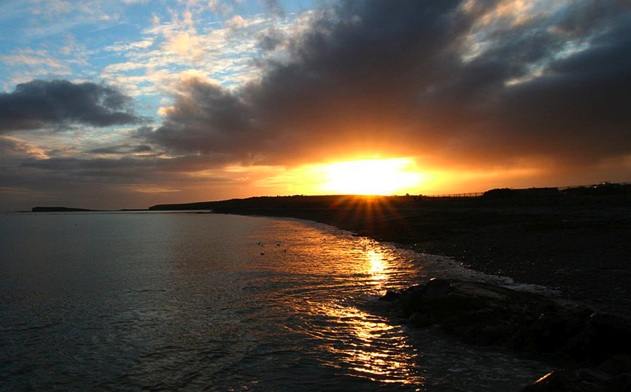
Sunset, Galway Bay wallpapers.varjati.com https://widgetworld3.wordpress.com/podcasts/
PETTICOAT PAPERS. OTAGO WITNESS, 23RD APRIL, 1891 P35
THE IRISH GIRL.
(abridged)
Irish women are the most passionate partisans in the world. Get an Irish girl into the corner of any drawing room, and tickle her with a remark about Balfour. or Parnell, or rents or evictions, or any of the burning questions which rend the “distressful country asunder”, and she will go for you with all the headstrong volubility of her race, and if she doesn’t convince you with her logic, she will do it with her eyes.
Have you never heard an Irish girl sing “The wearing o’ the green” with that passionate abandon which no English girl can approach, until you were ready to curse – Tory though you be – the scoundrels who were “hanging men and women for the wearing o’ the green”? For she has that keen sensibility, that quick sympathy which is so distinctive of the French woman. In fact, she is by nature and temperament a French girl, with a somewhat deeper reserve of passion and a freer system of education and social life than her Gallic Sisters.
That is why the Irish woman succeeds so well in Paris. When she finds herself in a congenial soil she takes root and flourishes with the luxuriance of an indigenous plant. She has all a French woman’s aptitude for intrigue, with more than a French woman’s fire and vigour. Politics, personal politics form her native element, and nowhere are politics so personal as in Paris. And so, when, in obedience to the French maxim, you have looked for the woman, you need not be surprised if she speaks with an Irish accent.
The Irish girl in England often creates an impression of fastness. It is quite a false impression, but springs naturally from her character. She is, as I have said, keenerwitted than home-grown girls “alive all o’er to smart and agonise at every pore.” This is mirrored in her talk, which is fervid and fluent hot from the heart which she bares to you in her speech. She presents herself to you au naturel. She is natural, unconventional, straightforward.
But the Irish girl must be studied at home on her native soil before she can be fully appreciated, and not in Dublin, or Cork, much less in Belfast or Ulster. Generally all big cities approximate to London, as all roads once led to Rome.
I should select Galway as the district where the purest and most unadulterated Irish maidenhood is to be discovered. Often and often, as one drives across the rainswept hills, one comes suddenly upon a cabin and as the clatter of wheels draws near, a figure steps out of the cabin which makes you feel instinctively for your sketch-book, ‘so wonderful are its suggestions of grace and beauty. Only suggestions, alas! For the dress is ragged, and the whole aspect unkempt. But there is a dignity in the carriage, a shimmer in the raven hair, and a purity of complexion.
The features of the girl are reproduced in a score of Galway country houses, only in a prettier frame. The eyes deep grey for choice with all sorts of half lights lurking in the corners, ready to blaze up in passion or melt in pity; eyes that rivet your own till you catch yourself blushing at your own temerity – were there ever such eyes?
All other features are blurred and indistinct if the real Irish eyes are there and as the Cheshire cat lives by its smile alone, so the Irish girl, in spite of a snub nose and a wide mouth, has only to look and conquer. And the voice! I You have no idea of the magic of the human voice if you have never heard an Irish girl tell Irish stories in an Irish house.
Oliver Wendell Holmes says somewhere that he has only heard two perfect speaking voices. One belonged to a German chambermaid, the other I forget to whom. But neither to an Irish girl.
He had never been in Ireland.
At home we often hear soft melodious voices—” voices low with fashion, not -with feeling” – but never in the world have I heard anything like the linked sweetness of an Irish girl’s voice. If it were but a page of Bradshaw that she were reading, the effect would be the same; as the long-drawn notes of a Stradivarias in the simplest melody bring tears from the heart. I cannot explain it, but everyone feels it. There is a note in the human voice which finds its complement in our inmost being. And the Irishwoman has put her finger on that note.
Every Irishman has a touch of Bohemianism in his nature. Thackeray said that we lose our way to Bohemia when we turn the corner of 40. The genuine Irishman never forgets his way there. The Irish girl has it, too, Only a soupcon— like garlic in French cookery; but it gives a flavour to her character. It comes out sometimes in a reckless disregard of expense and consequent financial disaster, sometimes in a wild rush to go nursing in Egypt or missioning in China. I have seen a Galway girl sit up all night while her brothers played billiards, and ride 30 miles after the hounds the next day without turning a hair. And I have seen the same girl sit by a sick bed for a week without taking off her clothes. It is this touch of Bohemianism which sometimes throws the Englishman off his balance. This reckless audacity, this outspoken frankness, which springs from warmth of heart he mistakes for something warmer. And then he notices that the tender grey of the Irish eye can harden into a steely blue, and finds the Irish girl bulwarked by the impregnable rock of maidenhood. She is without fear. Because she is without reproach.
Maedoc Book Cover, Ireland 1000AD Wikimedia commonshttps://widgetworld3.wordpress.com/podcasts/ DOMINION 6TH JULY 1812 P 11
IRISH FOLK SONGS.
Everybody that Ireland has a music of its own, and it is very sweet and beautiful music, too. Many people, however, imagine that the Tom Moore ballads comprise the great musical literature of that country. This is not the case, as the Countess de Cisneros will show in the music she is to sing at her concerts.
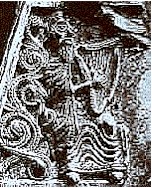
As soon as her present tour of Australasia was decided upon, Madame de Cisneros commenced her search for Irish music. She know that Ireland once possessed a race of troubadours—wandering birds who in Gaelic sang the legends of the country to tho music of the harp, Ireland’s national emblem.
“In America,” said the great mezzo-contralto, describing her search, “one can get the most-up-to-date information about everything. I set to work to hunt New York for some of those old harpers’ melodies. I approached several big music publishers. But they all gazed at me sadly, and told me they had never heard of anything of the kind. I was not discouraged. I kept on seeking, and in the end I found a publisher who said that he had somewhere in his library a book of songs just the sort I described. It was Dr. G. Petrie’s, collected early Irish music. I found that Dr. Petrie had taken many of his songs from the work of Mr. Edward Bunting, another enthusiast in Irish folk music. After much disappointment I obtained a copy of Edward Bunting’s work, and I found the two veritable storehouses of the exquisite music of old Ireland. I have been through them all. All are beautiful, but I have selected those which I consider to be the gems of the collections for inclusion in my Australasian programmes.”
In each of her concert programmes Madame do Cisneros will include a series of these delightful old melodies. the first of these is “Farewell, My Gentle Harp.” This song was first put into written form in I650. A well-known harper-Rory’ Dall M’Cahon-sang it in Dublin that year. A note was taken of it by a musician present, who recognised its value, and this note afterwards came into the possession of Mr. Edward Bunting in the course of his researches.
The date of the second number, “The Foggy Dew,” is unknown. Some harper composed it in the dim past. He taught it to others, and it was handed down, a traditional- folk song, from harper to harper, until Harper M’Garvay sang it in Dublin, and it was taken down about tho year 1700. “My Thousand Times Beloved” found its way into written form in similar fashion about the year 1798.
The last of, the four Irish songs of the first programme is called “A Golden Cradle Holds Thee.” Who composed it, and when, nobody knows. Mr. Bunting heard an old Irishwoman sing it away, in the wilds of Galway. He took down the music and tho Gaelic words. It relates a pretty, legend about the fairy fort of Farsoe. A young girl, whose infant brother had died a week before, was said to have wandered into the fort, there to find her brother in a rich cradle; placed; there by fairy hands. The song, with its exquisite music, is the lullaby she sings as she rocks tho golden cradle.
Creative Commonshttps://widgetworld3.wordpress.com/podcasts/ THE BRISBANE COURIER 21ST OCTOBER, 1889
Many of our readers will learn with regret, from the following extract from the Galway Express of 24th August, that an alarming accident has happened to Mrs. De Burgh Persse, though happily no serious results were apprehended :
” On Tuesday evening last, while Mrs. De Burgh Persse and her two sons were driving home from Galway in a light-running pony trap they carne in contact with a goods-van at Salthill, whioh struck against the vehicle with great force causing it to upset, throwing Mrs. Perse and the oldest boy out on the roadway,
“while the youngest boy was caught underneath the car. The driver of the van, it appears, instead of rendering any assistance, whipped on his horse and dashed at full speed into town, and up to the present has not been identified.
Mrs. Persse was very much shaken by the accident, but the younger boy remained unconscious for several hours, and great anxiety prevailed amongst the members of Mrs, Persse’s family. However, on Wednesday morning the poor little sufferer, who is only about 7 years old, showed much improvement, and is now beyond all cause for uneasiness.


 The Burren and Beyond