Supplement to the Cork Examiner 19th November, 1893
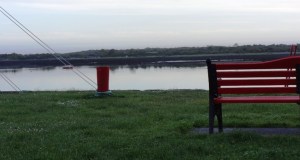
Kinvara Harbour Photo: EO’D
I was a child but the sea was old,
Gay and old was the roaring sea,
When first his mighty waters rolled
At my restless feet and sang to me;
I was a child, but the washing waves
In their wailing grief or their fitful play,
Called my name in the hollow caves,
And told me stories of yesterday.
Of a strange old time, I know not when,
Of a distant land, I knew not where!
Of a Home beyond the reach of my fondest pray’r,
I was a child, but the grey old sea
Told of a time that was long of yore
Told of a past Eternity
Like the great infinity before
Long have I trodden his beaches bare,
Gathered his sea-weeds brown and wild,
Scattered his spray from my waving hair
As though I were still a little child,
But now no more does the ocean tell
His mystic tales of the Past to me,
For I hear in his ceaseless surge and swell
The call of a far Futurity.
Lahinch is doomed unless £16,000 can be expended on defences to cheek the ravages of the sea. Slowly but surely it is giving way before the battering of the Atlantic, writes an ‘Irish Independent’ special representative in mid-February.
Permanent defences must, be erected, because patchwork is only a waste of time and money. This is the opinion of experts and of residents who are watching with growing apprehension the estimated yearly inroads of four yards along the beach.
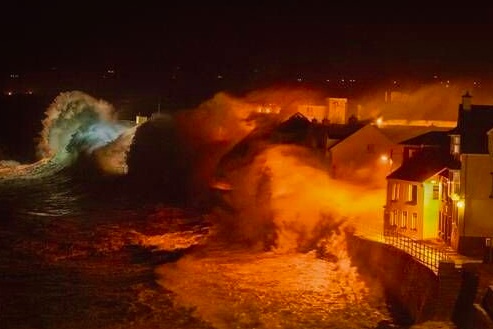
Only one who has visited the place can appreciate the terrific force of the waves here. Giant breakers are pounding relentlessly against the promenade wall, and heavy stones dislodged from a high cliff about 310 yards away are being hurled against it with a force that only the most massive defences could withstand.
The past winter. has been one of the worst experienced in Lahinch within living memory.
The long, high ridge of stones and shingle at the western end of the promenade has been, I was told, pushed back about 15 or 20 yards by the sea during the past few months. During high tides or storms waves break on top of it and are carried inland in clouds, of spray. Soon, it is feared, the sea will claim the low-lying land at the back and cut off the famous golf course from the town. In places at the back of the links the sea has eaten in up to 50 yards, I was told, during the past 25 years.
Mountainous Seas.
So mountainous has the sea been here since Christmas that not only have the waves come over the promenade, 27 feet high, on several occasions, but the spray has fallen in showers on the roofs and chimneys of houses — some of them three storeys high. The sea has even coursed along one of tho principal streets, and 25 yards away from the promenade edge has torn, up the tarred surface of the road, compelling householders to build temporary defences outside their floors.
In one untenanted house facing the Atlantic steel shutters are used outside the timber shutters to keep out the waves, but they offer poor resistance, being dislodged almost every night. Only by constant vigilance during the past month has the town been saved.
On one occasion about a fortnight ago the sea was prevented from breaking through by workers throwing dozens of bags of sand into a break suddenly created. Had the sea got through, residents are convinced that half the town would have been swept away.
Because the ground is much lower to the back, and as many houses are built on a sandy foundation, they would fall an easy prey to the sea.
Constant Repair Work
‘They talk about Greystones and other places,’ said Mr, Considine, a County Council clerk of works, ‘but here you have the full force of the Atlantic.’ He was in charge of a gang of men carrying out a slow and most laborious work. In the hope of preventing the sea from eating under the promenade, they arc putting down concrete protections. To prevent the tide from carrying away the day’s work during the night, it has to be covered with timber, and two feet of shingle and stones, all of which has to be removed every morning before work can be begun. Were it not for the constant attention of Mr. Considine and his workers, one can conjecture what the fate of Lahinch would be.
The. people have now centred all their hopes on tho Coast Erosion Committee, because the financial resources of the County Council are -unable to cope with this most difficult problem.
This famous beauty spot is almost solely dependent on visitors. Over 2000 persons are often present during golf tournaments. So much do the people fear the headway tho sea has made in recent years that all new houses, are now being built a considerable distance inland.
County Surveyor’s Opinion
‘There is no doubt about it, Lahinch must go if the Government do not build sea defences there,’ said Mr. F. Dowling, County Surveyor, to me. ‘And even if they ‘ do build them the place will be still in danger; but I would like to see the defences tested.
Every year, since the winter of 1923 when two houses had to be vacated, the County Council has spent £300 on repair work, he explained. The sand and clay on which some of the town, is built make no fight against the sea, and he did not believe that there were such seas and wind in any other part of Ireland as in Lahinch.
It was unfair, he said, to expect the rate payers to expend money here year after year. If the sea got in at the promenade it would sweep away the whole town. His estimate for the defences, which would consist of reinforced concrete, with a stone, facing, was about £16,000.
At Cappa, on the outskirts of Kilrush, the occupants of two homes are in danger of being washed out during a storm or high tide. For about a mile between Kilaysart and Labasheeda, the road along which the mail car deliveries are made is being attacked by the Shannon to such an extent that in some places there is scarcely room for one cart. Mr. Dowling ‘s proposal was to divert the road at an estimated cost of £2000, but the County Council turned that down owing to lack of funds.
At Kilkee in recent years tho sea has made tremendous caverns through the rock,and these cut clean under the road. People were living in houses over caverns and were not even aware of it. As most of Kilkee, however, is built on rock there is no immediate danger.

 The Burren and Beyond