The W. A. Record (Perth W.A) 5th August, 1905 p. 12 Accompanying a recent contribution to the “Irish World’s” Gaelic Language Fund from a subscriber to that paper was the following terse poetic sentiment of the donor : I’m just a plain hard-working man. I was born in the village of Ardrahan, And I like to do the best I can To help dear Mother Erin. For I spent many a happy day In Galway, Tuam and Monivea, Kinvarra, Gort and sweet Loughrea, Athenry and old Kilclairin. My hands are just as tough as leather, My face is bronzed with wind and weather, My heart is just as light as a feather, As I mingle with the throng. When times are bad I never holler, Thank the Lord I can spare, a dollar To help the cause along.
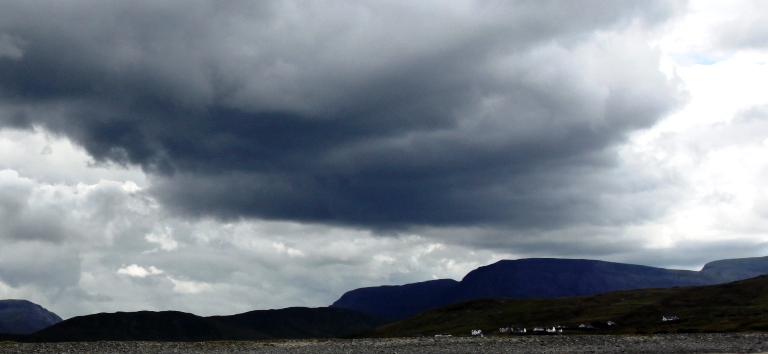
A thunder-storm of very peculiar character broke over this town yesterday morning about half past ten o’clock. The sky all round the horizon was clear, and there were no clouds anywhere to indicate what was about to take place, when we were startled by a loud peal, almost directly over us. On looking up, a dark gathering was now perceived about the zenith, but the general brightness of the atmosphere, so unlike anything that we had ever before observed during a thunder-storm, reminded us of the phenomenon considered by the ancients as a proof of the existence of Jupiter, when thunder claps were heard in a cloudless sky. The darkness above, however, quickly increased, and clouds – coming no one knew whence, but seeming to grow suddenly out of the disturbed air – began to settle over the town in dense masses interlaced with continual streams of vivid lightning.
A grey veil of rain soon appeared to hang down along the entire of the bay, dimming the brightness of the Burren hills, which were evidently at the time in full sunshine. The thunder roll was now almost incessant, and the display of lightning was, perhaps, the finest we ever witnessed. The immense length of the jagged shafts from the zenith to the horizon, and from the horizon back again to the zenith, crossing the sky several other directions, was among the most striking features of the display. The height of the storm was from four to five miles, and it continued stationary for almost an hour, when it slowly moved towards the north-east, leaving us again in bright sunlight.
But all was not yet over, for about two o’clock the sky began to darken toward the south-west, and the thunder recommenced. At half past two a white stream of lightning, accompanied by an explosion of a most terrific character, with a metallic ring in the sound, seemed to fall in the neighbourhood of the square, and we were soon after informed that the Bank of Ireland had, in fact, been struck by the electric fluid. After this the electric discharges continued with little intermission on every side, and shortly before three o’clock there was a shower of immense hailstones, accompanied by rain of such character as might almost suggest the outpouring of a celestial lake, and the streets became flooded almost instantaneously. This shower, fortunately for the hay and other crops about Galway, continued only for a few minutes, while it probably embraced but a narrow tract of country on its route; and it is to be hoped that but little harm was done anywhere by the storm in proportion to its apparently formidable character.
Distant thunder was heard for the remainder of the day. On inquiry at the bank we were kindly shown over the place by the manager, Mr. McDowell, when we found that the lightning first struck one of the chimneys, displacing several stones at the top and throwing one large one bodily into the yard at a distance of several feet from the house. Descending the chimney it penetrated the ceiling of one of the rooms making a very small hole and scattering the plaster in various directions. It then ran along a bell-wire under the ceiling on which it left several deposits that suggested a metallic character by their various iridescent colors of pink, yellow, blue &c. Reaching another apartment, strange to say, it forsook the wire and entered between the stucco plastering and the wall by rather a large breach, and there all further trace of its course was lost.
Several of the inmates of the house were severely affected by the concussion, either violently shaken or thrown down, and one of the servants was rendered insensible for some moments. One of the gentlemen in the bank office saw the lightning, as it appeared to him, playing among the iron railing outside which may, possibly have acted partially as a conductor, attracting a great portion of the electric fluid, and thus saving a great catastrophe.
Happily we enjoy a comparative immunity from thunder storms in Galway. Anything approaching the phenomenon of yesterday has not occurred with the memory of the oldest inhabitant. Galway Vindicator.
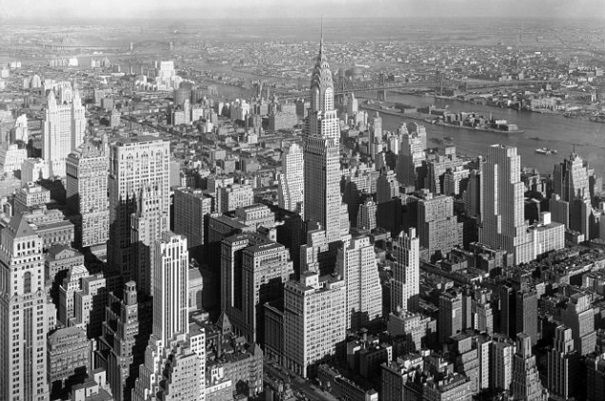
New York City 1932 Photo: Samuel Gottscho Library of Congress Wikimedia CommonsDances at New York
The New West of Ireland Ballroom at 884 Columbus Avenue, New York, recently taken over by the two Galway partners, Mike Tierney and Bob Connolly, is enjoying a wonderful patronage. A successful Galway dance was held there on Sunday night which brought patrons hailing from Kinvara, Gort, Loughrea, Tuam and Ballinasloe.
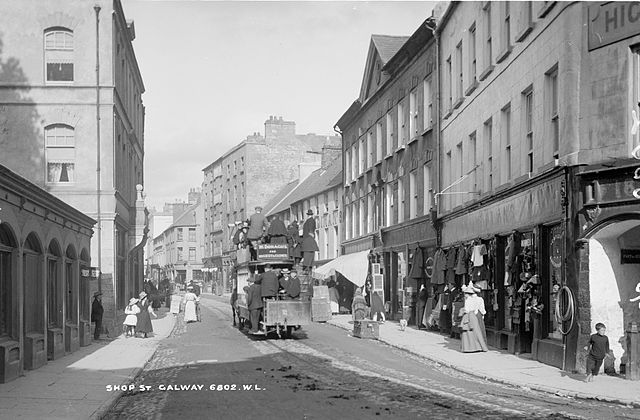
Horse drawn Tram, Shop Street, Galway. National Library of Ireland on The Commons Wikimedia Commons
(excerpt of letter from Mr T. Bermingham to “To the Guardians of the unions of Loughres, Gort, Ballinasloe and Tuam, especially – and to the inhabitants of the County Galway in General.”)
I have lately examined the southern coast of the Bay of Galway, and from the trade at present existing at Kinvarra and the New Quay, I have no hesitation in recommending the building there of two good piers, to protect the boats engaged in the fishery and seaweed trade, and as asylums for vessels of moderate burden, to encourage still further their spirited trade in corn, with a view of being a proper point of communication with the town of Galway by means of a steam tug – a plan which has been long agitated by the inhabitants of Galway. Tram roads for horse power are perhaps more adapted to the present trade of this county than more expensive railways for locomotive power.
With the experience that I have had in constructing a short line of railroad on cut bog, the property of Lord Clonbrock in this county, I can almost confidently state that a double line of rails of dimensions adapted to the present trade, can be constructed for three thousand pounds per statute mile – upon which one horse can draw a load weighing ten tons upon the level. Of course it would be necessary to have relays of horses to assist at some of the elevations – which upon the route that I propose to take, would be but few.
More on Kinvara in the news archives at theburrenandbeyond.com
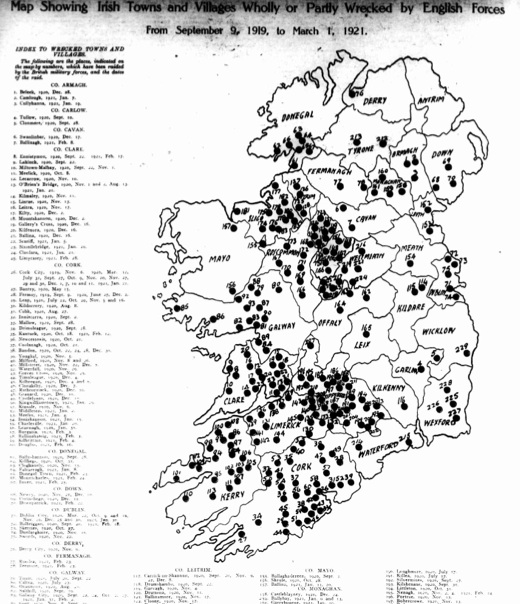
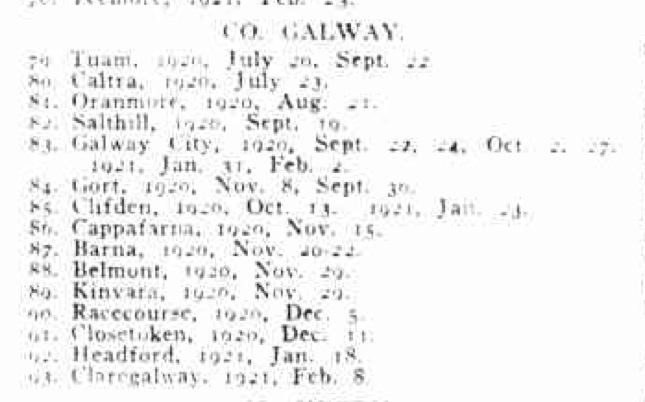
Map Showing Irish Towns and Villages Wholly or Partly Wrecked by English Forces From September 9, 1919, to March 1, 1921. INDEX TO WRECKED TOWNS AND VILLAGES.
The Catholic Press (Sydney, NSW : 1895 – 1942) 8 September 1921

 The Burren and Beyond