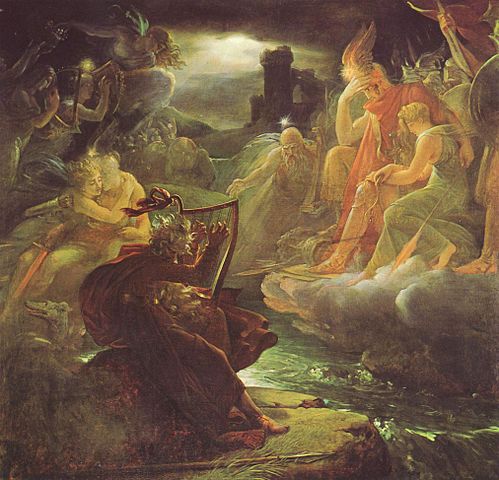
Ossian François Pascal Simon Gérard 1770-1837 Wikimedia Commons
It is said that two miles out to sea and due west of Lahinch there is a great span of submerged rock, where breaking waves constantly spread in the white stretch of foam. The tale goes on to relate that on the very sport there once stood a great city of magnificent palaces and lofty castles. One morning it disappeared and the waves rolled over the place where it once stood. On calm days when the sea is placid it is claimed that glimpses of the towers can be seen beneath the waves. Whether the story can be taken with the proverbial grain of salt or not, is not what I am concerned with. Neither am I anxious to prove that it is a deliberate fable invented by some ancient seanachie. I am concerned though with the insistence of the tale’s oldness and wish to emphasise that it has been associated with West Clare fireside gatherings since time immemorial.
The tale mentions the city’s size;
“It was as wide as Liscannor Bay and built as high as the cliffs of Moher.” There too, is mention of “towers and battlements that guarded wonderful palaces where happy people lived.” I have, as a youngster, often listened to the story and any doubt as to its authenticity I was wont to harbour, used to be dispelled by the narrator’s (who was an old fisherman) air of seriousness. The narrator insisted that every seven years and on a certain day, indicated by the phases of the moon, the towers of the buried city appeared over the surface of the sea. Anyone that beheld the sight died within the year and many instances used to be related to bear out this fact. In time I became convinced that such a place did exist, and often when seeking periwinkles on the rocks my eyes would wander westward towards the reef.
DPT
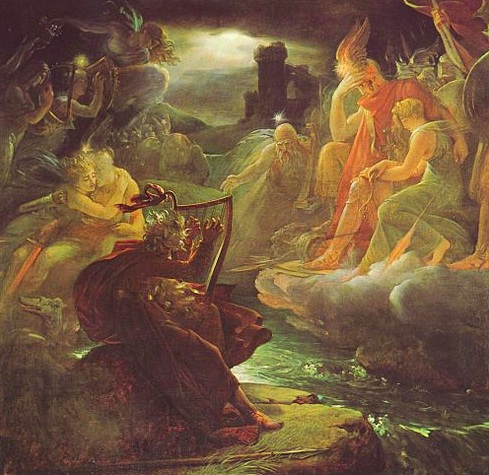
A Reading Book in Irish History P.W.Joyce LLD – One of the Commissioners for the Publication of the Ancient Laws of IrelandOssian François Pascal Simon Gérard Wikimedia Commons
Longmans, Green and Co. London, New York and Bombay. Dubln: M.H. Gill and Son 1900
THE CHANT OF THE FAIRY TO CONNLA OF THE GOLDEN HAIR.abridged
A land of youth, a land of rest, a land from sorrow free;
It lies far off in the golden west, on the verge of the azure sea.
A swift canoe of crystal bright, that never met mortal view
We shall reach the land ere fall of night, in that strong and swift canoe:
We shall reach the strand of that sunny land From druids and demons free;
The land of rest, in the golden west, on the verge of the azure sea!
A pleasant land of winding vales, bright streams, and verdurous plains,
Where summer, all the live-long year, in changeless splendour reigns;
A peaceful land of calm delight, of everlasting bloom;
Old age and death we never know, no sickness, care, or gloom;
The land of youth, of love and truth,From pain and sorrow free;
The land of rest, in the golden west, on the verge of the azure sea!
There are strange delights for mortal men in that island of the west;
The sun comes down each evening in its lovely vales to rest:
And though far and dim on the ocean’s rim, it seems to mortal view,
We shall reach its halls ere the evening falls, in my strong and swift canoe;
And ever more that verdant shore our happy home shall be;
The land of rest, in the golden west, on the verge of the azure sea!
It will guard thee, gentle Connla of the flowing golden hair,
It will guard thee from the druids, from the demons of the air;
My crystal boat will guard thee, till we reach that western shore,
Where thou and I in joy and love shall live for evermore:
From the druid’s incantation, from his black and deadly snare,
From the withering imprecation of the demon of the air,
It will guard thee, gentle Connla of the flowing golden hair;
My crystal boat will guard thee, till we reach that silver strand,
Where thou shalt reign in endless joy, the king of the Fairy-land!
She heard her name calledTHE HIGH DEEDS OF FINN AND OTHER BARDIC ROMANCES OF ANCIENT IRELAND
T. W. ROLLESTON, Crowell and Company, New York –
How Ethne Quitted Tir na nÓg (abridged)
By the banks of the River Boyne, where rises the great Fairy Mound of Newgrange, there once the shining Palace of a prince of the Danaan, named Angus. Of him it is that the lines are written—
“By the dark rolling waters of the Boyne Where Angus Óg magnificently dwells.”
When the Milesians invaded Ireland, and subdued the Danaans, the Danaans wrought magic by which rendered all their possessions invisible to mortals. Under their enchantments their palaces, dancing-places and folk-motes looked like green mounds or raths, lonely hillsides, or ruined shrines with nettles and foxgloves growing up among its broken masonry. In this way they were safe from humans.
After Angus, King of the Dananns and his folk had retreated behind this veil of invisibility, his steward’s wife had a daughter. She was named Ethne. On the same day Fand, the wife of Mananan the Sea God, also bore a daughter. Since Angus and Mananan were friends, Mananan sent his child to Brugh na Boyna, the noble dwelling-place of Angus, to be fostered and brought up. In turn Ethne, was fostered to Mananan.
In time Ethne grew into a fair and stately maiden at Mananan’s residence. As she was not of the mortal world there was always a store of food of the faery at her foster home. It was charged with magical spells, by eating of which one could never grow old or die. Curiously, after Ethne had grown up she rarely ate or drank of the fairy food, or of any other, yet she continued to seem healthy and well-nourished. Nonetheless a concerned Mananan reported this to Angus, and Angus visited to meet with Ethne.
A lord of the Danaans, who accompanied him was bewitched by Ethne’s beauty. He became quickly obsessed until he laid hands upon her and strove to carry her away to his own dwelling. Ethne escaped from him. However, the blaze of resentment at his behaviour towards her lit up Ethne’s soul. It burned to a point where it consumed her fairy nature. The nature of the children of Adam – the mortal – took its place. From then on she ate none of the fairy food, which is prohibited to man. Sensing Ethne’s transformation and her anger, Mananan and his Fand sought to protect her. They gave her a charm to wear around her neck, to keep her safe within the faery realm.
One very hot day not long after Ethne and her maidens went to bathe in the River Boyne. After they had refreshed themselves in the cool, amber-coloured water, they arrayed themselves in their silken robes and trooped back to the Brugh again; but ere they entered it, the maidens discovered that Ethne was not among them. So they went back, scattering themselves along the bank and searching in every quiet pool of the river and in every dark recess among the great trees that bordered it, for Ethne was dearly loved by all of them; but neither trace nor tidings of her could they find. Eventually they went sorrowfully home without her, to tell the tale to Angus and to her father.
What had befallen Ethne was this. In taking off her garments by the riverside she had mislaid her fairy charm, and finally became a mortal maid. Because of this she could no longer see her companions. Everything became immediately strange to her. The fairy track that had led to the riverside was overgrown with briars, the palace of Angus was gone, replaced by a wooded hill. Ethne did not know where she was, and pierced with sudden terror she fled wildly away, seeking for the familiar places that she had known in the fairy life, but which were now behind the Veil.
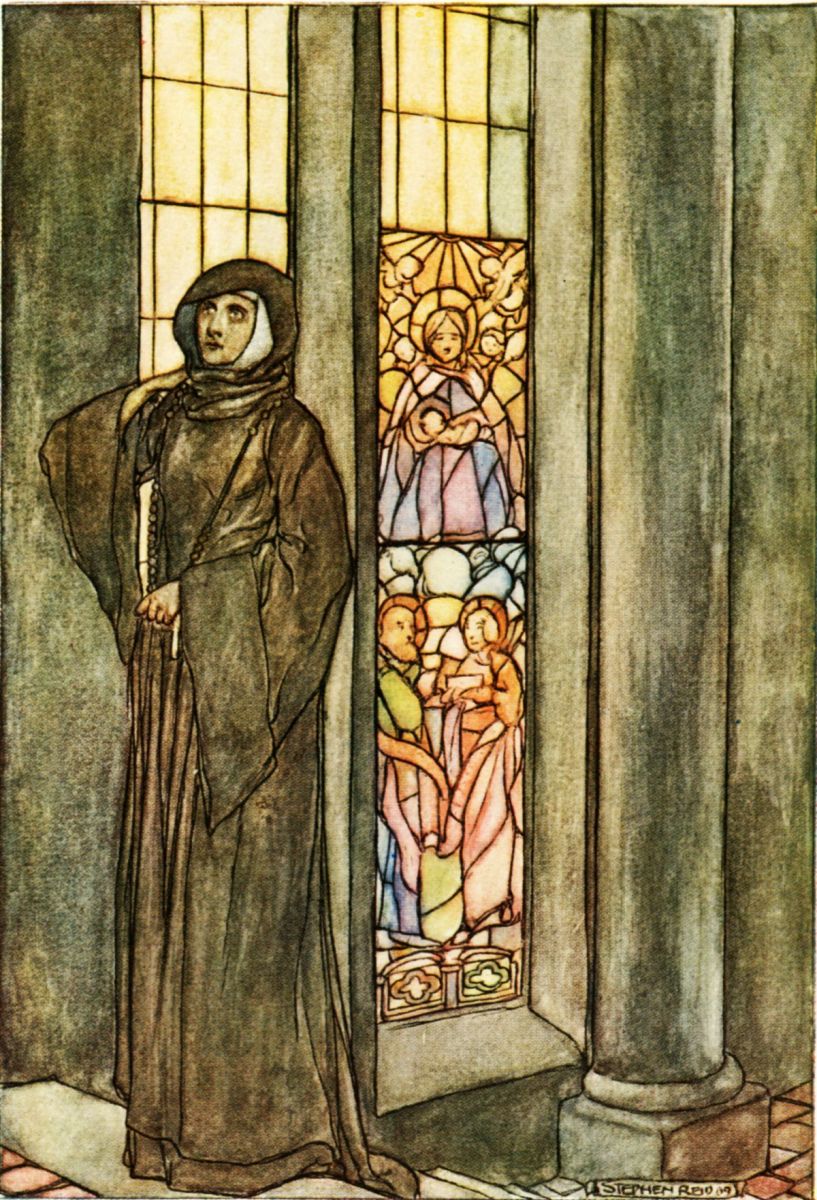
At length she came to a high wall wherein was a wicket gate, and through it she saw a garden full of sweet herbs and flowers, which surrounded a steep-roofed building of stone. In the garden she saw a man in a long brown robe tied about his waist with a cord. He smiled at her and beckoned her to come in without fear. He was a monk of Patrick, and the house was a convent church. When the monk had heard her tale, he marvelled greatly and brought her to St Patrick, who baptised her.
The following day Ethne went for a walk within the garden of herbs. She was lonely, thinking of her home. As she did, the sky darkened and she heard a sound like the rushing of a great wind. Mingled in it were cries and lamentations. She heard her name called again and again in a multitude of voices, thin and faint as the crying of curlews upon the moor. Ethne sprang up and gazed around, calling in return, but nothing could she see. Eventually the storm of cries died away, and everything was still again except the singing voice of Boyne and the humming of the garden bees.
Ethne sank down swooning. In that hour she fell into a sickness from which she never recovered. She was buried in the church where she had first been received by the monk; and the church was called Killethne, or the Church of Ethne, from that day forward until now.

 The Burren and Beyond